

What do you think?

Three Famous Short Novels: Spotted Horses / Old Man / The Bear
Three different ways to approach Faulkner, each of them representative of his work as a whole. Includes "Spotted Horses," "Old Man," and his famous "The Bear."
320 pages, Mass Market Paperback
First published January 1, 1958
About the author
William Faulkner
1,572 books11.4k followersWilliam Cuthbert Faulkner was an American writer. He is best known for his novels and short stories set in the fictional Yoknapatawpha County, Mississippi, a stand-in for Lafayette County where he spent most of his life. A Nobel laureate, Faulkner is one of the most celebrated writers of American literature and often is considered the greatest writer of Southern literature.
Faulkner was born in New Albany, Mississippi, and raised in Oxford, Mississippi. During World War I, he joined the Royal Canadian Air Force, but did not serve in combat. Returning to Oxford, he attended the University of Mississippi for three semesters before dropping out. He moved to New Orleans, where he wrote his first novel Soldiers' Pay (1925). He went back to Oxford and wrote Sartoris (1927), his first work set in the fictional Yoknapatawpha County. In 1929, he published The Sound and the Fury. The following year, he wrote As I Lay Dying. Later that decade, he wrote Light in August, Absalom, Absalom! and The Wild Palms. He also worked as a screenwriter, contributing to Howard Hawks's To Have and Have Not and The Big Sleep, adapted from Raymond Chandler's novel. The former film, adapted from Ernest Hemingway's novel, is the only film with contributions by two Nobel laureates.
Faulkner's reputation grew following publication of Malcolm Cowley's The Portable Faulkner, and he was awarded the 1949 Nobel Prize in Literature for "his powerful and unique contribution to the modern American novel." He is the only Mississippi-born Nobel laureate. Two of his works, A Fable (1954) and The Reivers (1962), won the Pulitzer Prize for Fiction. Faulkner died from a heart attack on July 6, 1962, following a fall from his horse the month before. Ralph Ellison called him "the greatest artist the South has produced".
Faulkner was born in New Albany, Mississippi, and raised in Oxford, Mississippi. During World War I, he joined the Royal Canadian Air Force, but did not serve in combat. Returning to Oxford, he attended the University of Mississippi for three semesters before dropping out. He moved to New Orleans, where he wrote his first novel Soldiers' Pay (1925). He went back to Oxford and wrote Sartoris (1927), his first work set in the fictional Yoknapatawpha County. In 1929, he published The Sound and the Fury. The following year, he wrote As I Lay Dying. Later that decade, he wrote Light in August, Absalom, Absalom! and The Wild Palms. He also worked as a screenwriter, contributing to Howard Hawks's To Have and Have Not and The Big Sleep, adapted from Raymond Chandler's novel. The former film, adapted from Ernest Hemingway's novel, is the only film with contributions by two Nobel laureates.
Faulkner's reputation grew following publication of Malcolm Cowley's The Portable Faulkner, and he was awarded the 1949 Nobel Prize in Literature for "his powerful and unique contribution to the modern American novel." He is the only Mississippi-born Nobel laureate. Two of his works, A Fable (1954) and The Reivers (1962), won the Pulitzer Prize for Fiction. Faulkner died from a heart attack on July 6, 1962, following a fall from his horse the month before. Ralph Ellison called him "the greatest artist the South has produced".
Ratings & Reviews
Friends & Following
Create a free account to discover what your friends think of this book!
Community Reviews
Displaying 1 - 30 of 202 reviews

July 9, 2023
Disastrous!
A collection of stories by renowned William Faulkner with three of his most iconic novellas, or so I read somewhere. Another of those little books found in the dusty family’s bookcase.
Man I HATED this with all my heart! Faulkner may be one of the most acclaimed and accomplished classical authors of all time but dang, he’s insufferable as hell! His style of writing is one of the hardest I’ve ever sampled; absurdly florid, impossibly contrived and most of it highly inconsequential at best; with an astounding amount of indiscernible characters as well. The dude apparently hates using full stop, since his sentences can sometimes take as long as a full page with dozens of commas, semicolons, parenthesis and whatever punctuation is out there except a f*cking dot! I really tried to concentrate hard at the beginning of each story but after a few pages I just couldn’t take it anymore and started skimming like a bandit. He also uses the N word way too often, which may be very pertaining to the era it was written but still more than enough to be considerably grating after a while, and easily noticeable even skimming like crazy.
Go for the Best, consider the Good, whatever the Meh.
The Meh :
★★☆☆☆ “The Bear.”
★★☆☆☆ “Old Man.” [1.5]
★☆☆☆☆ “Spotted Horses.”
If you already know and enjoy Faulkner “The Bear” and “Old Man” should be good I guess. The general plot of these stories was decent enough, I just couldn’t stomach the guy. There’s even a movie for “Old Man” (1997) which I may watch someday; once I can forget this god awful aftertaste.
After this outstandingly horrible experience I’d normally say I’d never EVER read Faulkner again in my life, but I would be lying since I already have his “As I Lay Dying” book which I also “borrowed” from my parent’s bookcase. And of course it would be far simpler to just surreptitiously return the book unread; but dang it I can’t help it,I’m too curious. I’m too dedicated. I’m too STUPID.
-----------------------------------------------
PERSONAL NOTE :
[1958] [320p] [Collection] [1.5] [HIGHLY Not Recommendable]
-----------------------------------------------
★★★☆☆ A Rose for Emily [2.5]
★☆☆☆☆ Three Famous Short Novels: Spotted Horses / Old Man / The Bear [1.5]
-----------------------------------------------
¡Desastroso!
Una colección de historias por el renombrado William Faulkner con tres de sus más icónicas novelas cortas, o eso leí en algún lado. Otro de esos pequeños libros hallados en la polvorienta estantería familiar.
¡Dios cómo ODIE esto con todo mi corazón! Faulkner puede ser uno de los más aclamados y laureados autores clásicos de todos los tiempos pero diablos, ¡es condenadamente insufrible! Su estilo de escritura es uno de los más complejos que alguna vez probé; absurdamente florido, imposiblemente artificial y la mayor parte de altamente inconsecuente cuando mucho; con una perturbadora cantidad de personajes indiscernibles también. El tipo aparentemente odia usar el punto y aparte, ya que sus oraciones a veces pueden tomar tanto como una página entera con docenas de comas, punto y comas, paréntesis y cualquier tipo de puntuación excepto un m*ldito punto. Realmente traté de concentrarme mucho al principio de cada historia pero después de unas pocas páginas simplemente no podía aguantarlo más y terminé salteando como un bandido. También usa la palabra N con demasiada frecuencia, que tal vez sea muy acorde a la época en que fue escrito pero aun así más que suficiente para ser considerablemente molesto después de pasado un rato, y fácilmente de notar incluso salteando como loco.
Ir por lo Mejor, considerar lo Bueno, loquesea lo Meh.
Lo Meh :
★★☆☆☆ “El Oso.”
★★☆☆☆ “El Viejo.” [1.5]
★☆☆☆☆ “Caballos Manchados.”
Si ya conocés y disfrutás de Faulkner “El Oso” y “El Viejo” deberían ser buenos supongo. La trama general de estas historias fue suficientemente decente, yo simplemente no pude soportar al flaco. Incluso hay una película para “El Oso” (1997) que puede que vea algún día; cuando llegue a olvidar de este asqueroso sabor de boca.
Después de esta horrorosamente sobresaliente experiencia normalmente diría que nunca JAMAS volvería a leer a Faulkner de nuevo en mi vida, pero estaría mintiendo ya que tengo su libro “Mientras Agonizo” que también tomé “prestado” de la biblioteca de mis viejos. Y por supuesto sería mucho más fácil simplemente subrepticiamente devolver el libro sin leer; pero demonios no puedo evitarlo,soy demasiado curioso. soy demasiado dedicado. soy demasiado ESTUPIDO.
-----------------------------------------------
NOTA PERSONAL :
[1958] [320p] [Colección] [1.5] [ALTAMENTE No Recomendable]
-----------------------------------------------
A collection of stories by renowned William Faulkner with three of his most iconic novellas, or so I read somewhere. Another of those little books found in the dusty family’s bookcase.
Man I HATED this with all my heart! Faulkner may be one of the most acclaimed and accomplished classical authors of all time but dang, he’s insufferable as hell! His style of writing is one of the hardest I’ve ever sampled; absurdly florid, impossibly contrived and most of it highly inconsequential at best; with an astounding amount of indiscernible characters as well. The dude apparently hates using full stop, since his sentences can sometimes take as long as a full page with dozens of commas, semicolons, parenthesis and whatever punctuation is out there except a f*cking dot! I really tried to concentrate hard at the beginning of each story but after a few pages I just couldn’t take it anymore and started skimming like a bandit. He also uses the N word way too often, which may be very pertaining to the era it was written but still more than enough to be considerably grating after a while, and easily noticeable even skimming like crazy.
Go for the Best, consider the Good, whatever the Meh.
The Meh :
★★☆☆☆ “The Bear.”
★★☆☆☆ “Old Man.” [1.5]
★☆☆☆☆ “Spotted Horses.”
If you already know and enjoy Faulkner “The Bear” and “Old Man” should be good I guess. The general plot of these stories was decent enough, I just couldn’t stomach the guy. There’s even a movie for “Old Man” (1997) which I may watch someday; once I can forget this god awful aftertaste.
After this outstandingly horrible experience I’d normally say I’d never EVER read Faulkner again in my life, but I would be lying since I already have his “As I Lay Dying” book which I also “borrowed” from my parent’s bookcase. And of course it would be far simpler to just surreptitiously return the book unread; but dang it I can’t help it,
-----------------------------------------------
PERSONAL NOTE :
[1958] [320p] [Collection] [1.5] [HIGHLY Not Recommendable]
-----------------------------------------------
★★★☆☆ A Rose for Emily [2.5]
★☆☆☆☆ Three Famous Short Novels: Spotted Horses / Old Man / The Bear [1.5]
-----------------------------------------------
¡Desastroso!
Una colección de historias por el renombrado William Faulkner con tres de sus más icónicas novelas cortas, o eso leí en algún lado. Otro de esos pequeños libros hallados en la polvorienta estantería familiar.
¡Dios cómo ODIE esto con todo mi corazón! Faulkner puede ser uno de los más aclamados y laureados autores clásicos de todos los tiempos pero diablos, ¡es condenadamente insufrible! Su estilo de escritura es uno de los más complejos que alguna vez probé; absurdamente florido, imposiblemente artificial y la mayor parte de altamente inconsecuente cuando mucho; con una perturbadora cantidad de personajes indiscernibles también. El tipo aparentemente odia usar el punto y aparte, ya que sus oraciones a veces pueden tomar tanto como una página entera con docenas de comas, punto y comas, paréntesis y cualquier tipo de puntuación excepto un m*ldito punto. Realmente traté de concentrarme mucho al principio de cada historia pero después de unas pocas páginas simplemente no podía aguantarlo más y terminé salteando como un bandido. También usa la palabra N con demasiada frecuencia, que tal vez sea muy acorde a la época en que fue escrito pero aun así más que suficiente para ser considerablemente molesto después de pasado un rato, y fácilmente de notar incluso salteando como loco.
Ir por lo Mejor, considerar lo Bueno, loquesea lo Meh.
Lo Meh :
★★☆☆☆ “El Oso.”
★★☆☆☆ “El Viejo.” [1.5]
★☆☆☆☆ “Caballos Manchados.”
Si ya conocés y disfrutás de Faulkner “El Oso” y “El Viejo” deberían ser buenos supongo. La trama general de estas historias fue suficientemente decente, yo simplemente no pude soportar al flaco. Incluso hay una película para “El Oso” (1997) que puede que vea algún día; cuando llegue a olvidar de este asqueroso sabor de boca.
Después de esta horrorosamente sobresaliente experiencia normalmente diría que nunca JAMAS volvería a leer a Faulkner de nuevo en mi vida, pero estaría mintiendo ya que tengo su libro “Mientras Agonizo” que también tomé “prestado” de la biblioteca de mis viejos. Y por supuesto sería mucho más fácil simplemente subrepticiamente devolver el libro sin leer; pero demonios no puedo evitarlo,
-----------------------------------------------
NOTA PERSONAL :
[1958] [320p] [Colección] [1.5] [ALTAMENTE No Recomendable]
-----------------------------------------------

May 28, 2012
Spotted Horses felt a little padded and boring, but had some amusing parts. Old Man was much more interesting, although admittedly a little rambling.
The Bear, however, is a goddam masterpiece, rightfully praised. It surely belongs in an elevated position along with the rest of Faulkner's great works. For the most part, Faulkner is working in familiar territory, evoking the death of his beloved South. However, I'm not sure if he ever hit this issue in such a direct or emotionally engaging manner. Over the course of 140 pages or so we get a detailed history of an entire countryside, from untainted paradise to primitive borderland to burgeoning civilization, with emphasis placed on the folly and impermanence of this so-called progress. Remarkably, Faulkner doesn't paint in broad strokes despite his subject matter, using local detail and social history to flesh out the specifics of this particular demise. As with the best Faulkner, parallels abound between the local and the universal. Our protagonist may be Isaac McCaslin, heir to a long line of patrician land- and slave-owners, but Faulkner almost exclusively refers to him simply as "he", a universal representative of mankind's inheritance, for better or for worse.
The Bear, however, is a goddam masterpiece, rightfully praised. It surely belongs in an elevated position along with the rest of Faulkner's great works. For the most part, Faulkner is working in familiar territory, evoking the death of his beloved South. However, I'm not sure if he ever hit this issue in such a direct or emotionally engaging manner. Over the course of 140 pages or so we get a detailed history of an entire countryside, from untainted paradise to primitive borderland to burgeoning civilization, with emphasis placed on the folly and impermanence of this so-called progress. Remarkably, Faulkner doesn't paint in broad strokes despite his subject matter, using local detail and social history to flesh out the specifics of this particular demise. As with the best Faulkner, parallels abound between the local and the universal. Our protagonist may be Isaac McCaslin, heir to a long line of patrician land- and slave-owners, but Faulkner almost exclusively refers to him simply as "he", a universal representative of mankind's inheritance, for better or for worse.

March 19, 2013
THE BEAR
"Courage and honor and pride, and pity and love of justice and of liberty. They all touch the heart, and what the heart holds to become truth, as far as we know truth."
The story of a boy, Isaac, who joins a hunting party for several summers, trying to kill Old Ben, an almost immortal and huge bear, a kind of a legend and a symbol of the power and the balance of nature. Seven times Isaac sees it, and once he forgives its life, forming a kind of unspoken tie with each other. Sam Fathers, a Negro who accompanies the party, becomes Isaac' greatest teacher and only friend.
The beast is eventually killed in a rather violent scene in which a huge, half-mad dog called Lion is badly hurt, and Boon, a half-mad, obsessed man kills the bear with his own hands. Sam Fathers dies shortly after.
When Isaac turns 21 he remembers that scene of some years ago, merging his own reflections on freedom and property; and Sam Fathers, Boon and the bear become living metaphors for slavery, the endless ambition of human beings to submit nature and his own beliefs on liberty and of justice.
For me, maybe the most complex of Faulkner's tales so far, but at the same time, an unbelievably beautiful utopia in which it's possible to believe that human beings can coexist in harmony with the natural world, even if our most inner desire is to rule and to finally annihilate it.
THE OLD MAN
"its folly and pain, which seems to be its only immortality: All in the world I want is just to surrender"
Old Man is a devastatingly poetic account of a convict who is taken out of jail to help in a huge flooding in Mississippi. After a month and 3 weeks of endless rowing along the overflowing river, the convict will taste freedom again, he will help give birth to a child, he'll save several people and in the end he'll return again to the deputy to be arrested again and charged ten additional years for "attempted escape" to his previous sentence.
The unfairness of the situation is presented in such an absurd but logical way that I couldn't help but wonder how could it be possible to make some sense out of these unpredictable and rambling waves of words and sentences which stream along with perfect melody, almost like a soft lullaby.
Indescribably wonderful, don't ask me why.
SPOTTED HORSES
My first encounter with the much acclaimed W.Faulkner. I had been expecting something deeply poetic, some eloquent rambling prose full of feeling and hidden meanings.
Something dense and intense like Woolf or Kafka.
Well, I couldn't find anything of this in Spotted Horses. Set in the middle of nowhere in the Far West, a group of men are gathered to buy horses in some sort of auction. That's it. The atmosphere is rustic and austere and Faulkner doesn't bother to introduce his characters, they seem to appear out from smoke and they leave as silently as they arrived, like some imagined spectres.
After this brief experience with Faulkner I feel frustrated because it's like I missed something important in here, I feel like if I was nearly graving it and somehow it finally slipped through my fingers. As I said, frustrated.
I'll have to read more to have a proper opinion, but for the moment I can't say I enjoyed my first plunge into Faulkner's world.
"Courage and honor and pride, and pity and love of justice and of liberty. They all touch the heart, and what the heart holds to become truth, as far as we know truth."
The story of a boy, Isaac, who joins a hunting party for several summers, trying to kill Old Ben, an almost immortal and huge bear, a kind of a legend and a symbol of the power and the balance of nature. Seven times Isaac sees it, and once he forgives its life, forming a kind of unspoken tie with each other. Sam Fathers, a Negro who accompanies the party, becomes Isaac' greatest teacher and only friend.
The beast is eventually killed in a rather violent scene in which a huge, half-mad dog called Lion is badly hurt, and Boon, a half-mad, obsessed man kills the bear with his own hands. Sam Fathers dies shortly after.
When Isaac turns 21 he remembers that scene of some years ago, merging his own reflections on freedom and property; and Sam Fathers, Boon and the bear become living metaphors for slavery, the endless ambition of human beings to submit nature and his own beliefs on liberty and of justice.
For me, maybe the most complex of Faulkner's tales so far, but at the same time, an unbelievably beautiful utopia in which it's possible to believe that human beings can coexist in harmony with the natural world, even if our most inner desire is to rule and to finally annihilate it.
THE OLD MAN
"its folly and pain, which seems to be its only immortality: All in the world I want is just to surrender"
Old Man is a devastatingly poetic account of a convict who is taken out of jail to help in a huge flooding in Mississippi. After a month and 3 weeks of endless rowing along the overflowing river, the convict will taste freedom again, he will help give birth to a child, he'll save several people and in the end he'll return again to the deputy to be arrested again and charged ten additional years for "attempted escape" to his previous sentence.
The unfairness of the situation is presented in such an absurd but logical way that I couldn't help but wonder how could it be possible to make some sense out of these unpredictable and rambling waves of words and sentences which stream along with perfect melody, almost like a soft lullaby.
Indescribably wonderful, don't ask me why.
SPOTTED HORSES
My first encounter with the much acclaimed W.Faulkner. I had been expecting something deeply poetic, some eloquent rambling prose full of feeling and hidden meanings.
Something dense and intense like Woolf or Kafka.
Well, I couldn't find anything of this in Spotted Horses. Set in the middle of nowhere in the Far West, a group of men are gathered to buy horses in some sort of auction. That's it. The atmosphere is rustic and austere and Faulkner doesn't bother to introduce his characters, they seem to appear out from smoke and they leave as silently as they arrived, like some imagined spectres.
After this brief experience with Faulkner I feel frustrated because it's like I missed something important in here, I feel like if I was nearly graving it and somehow it finally slipped through my fingers. As I said, frustrated.
I'll have to read more to have a proper opinion, but for the moment I can't say I enjoyed my first plunge into Faulkner's world.

May 17, 2022
This was the third book I’ve read by Faulkner and the first one I really liked (maybe because I am older? :), although I still found it difficult, partly because of the English, which is not straightforward for a non-native, and partly because of Faulkner’s sometimes convoluted prose.
I liked all the novels, but I was somewhat frustrated with the way Spotted Horses and Old Man ended, not because the endings are not happy, but rather because they seem to happen too suddenly, leaving me feeling as if I have missed something important.
The Bear was by far my favourite, mainly because the theme, the relation between humans and nature, is particularly close to my heart. It reminded me of Jack London, although it is obviously very different in the way it is written. It is a hunting story set in the 19th century told from the perspective of Isaac McCaslin, a boy from an old family in fictional Yoknapatawpha County, based on the region of Mississippi where Faulkner lived. One can see he knows what he is writing about, because his descriptions are so vivid and well done:
Then he saw the bear. It did not emerge, appear; it was just there, immobile, solid, fixed in the hot dappling of the green and windless noon, not as big as he had dreamed it, but as big as he had expected it, bigger, dimensionless, against the dappled obscurity, looking at him where he sat quietly on the log and looked back at it.
Then it moved. It made no sound. It did not hurry. It crossed the glade, walking for an instant into the full glare of the sun; when it reached the other side, it stopped again and looked back at him across one shoulder while his quiet breathing inhaled and exhaled three times.
Then it was gone. It didn’t walk into the woods, the undergrowth. It faded, sank back into the wilderness as he had watched a fish, a huge old bass, sink and vanish into the dark depths of its pool without even any movement of its fins.
I loved the story, the ending and most of the prose, except chapter 4, a long rambling / flashback of Isaac covering the period when he learned about his grandfather’s misdeeds and refused to accept his inheritance. This was long, confusing and almost drove me crazy. Fortunately, all the rest was so good, that the whole impression when I finished reading this novel was of deep empathy with Isaac in his communion with nature / the bear and his distress for its relentless destruction.
(…) the wilderness, the big woods, bigger and older than any recorded document of white man fatuous enough to believe he had bought any fragment of it or Indian ruthless enough to pretend that any fragment of it had been his to convey.
I liked all the novels, but I was somewhat frustrated with the way Spotted Horses and Old Man ended, not because the endings are not happy, but rather because they seem to happen too suddenly, leaving me feeling as if I have missed something important.
The Bear was by far my favourite, mainly because the theme, the relation between humans and nature, is particularly close to my heart. It reminded me of Jack London, although it is obviously very different in the way it is written. It is a hunting story set in the 19th century told from the perspective of Isaac McCaslin, a boy from an old family in fictional Yoknapatawpha County, based on the region of Mississippi where Faulkner lived. One can see he knows what he is writing about, because his descriptions are so vivid and well done:
Then he saw the bear. It did not emerge, appear; it was just there, immobile, solid, fixed in the hot dappling of the green and windless noon, not as big as he had dreamed it, but as big as he had expected it, bigger, dimensionless, against the dappled obscurity, looking at him where he sat quietly on the log and looked back at it.
Then it moved. It made no sound. It did not hurry. It crossed the glade, walking for an instant into the full glare of the sun; when it reached the other side, it stopped again and looked back at him across one shoulder while his quiet breathing inhaled and exhaled three times.
Then it was gone. It didn’t walk into the woods, the undergrowth. It faded, sank back into the wilderness as he had watched a fish, a huge old bass, sink and vanish into the dark depths of its pool without even any movement of its fins.
I loved the story, the ending and most of the prose, except chapter 4, a long rambling / flashback of Isaac covering the period when he learned about his grandfather’s misdeeds and refused to accept his inheritance. This was long, confusing and almost drove me crazy. Fortunately, all the rest was so good, that the whole impression when I finished reading this novel was of deep empathy with Isaac in his communion with nature / the bear and his distress for its relentless destruction.
(…) the wilderness, the big woods, bigger and older than any recorded document of white man fatuous enough to believe he had bought any fragment of it or Indian ruthless enough to pretend that any fragment of it had been his to convey.

May 12, 2020
I don't know where you start with Faulkner. His English is idiosyncratic; his characters appear in multiple novels, have long genealogies, are rarely indicated directly when they are speaking; and his setting is always the same fictional county in Mississippi (map below drawn by Faulkner himself)
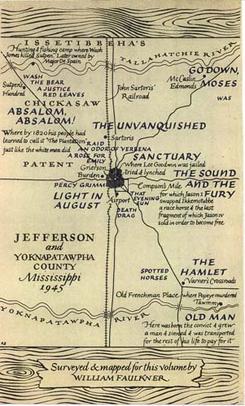
Well, this small collection is where I started.
I had never read anything by him before picking up this book. And I admit that I came to it with the excitement of approaching an author of high reputation.
Reputation - 4/5
William Faulkner is on every list of Great American Authors. He seems to be of particular interest to academics who love to overanalyze. Faulkner gives them a lot to work with. And if James Joyce was right when he said that his immortality would be guaranteed by all the riddles and enigmas he put in Ulysses that would "keep the professors arguing for centuries over what I meant," then Faulkner's posterity is likewise guaranteed by the same strategy.
Point - 3/5
So what does Faulkner mean?
The highest ambition of a writer is to write the epic of his people. Faulkner tries to do this for the American South. In the Modern tradition of Joyce, he does it in a cryptic, maximalist way, eschewing simple explanation and even conventional English grammar and punctuation.
Does it work?
“The Bear” is the most ambitious of the three stories in this collection. It later became one of the parts in Faulkner’s book Go Down, Moses, and probably makes much more sense within the context of that larger book. But it was also published as a stand-alone story, and that is how it appears in here.
It is a coming-of-age story of a boy who, through yearly hunting trips focused on a legendary bear named Old Ben, comes to intimately know the grandeur of Nature. Faulkner's style is very well-suited to this narration. His style is imposing. His long sentences, paused by commas but not stopped, raise the anticipation and heart-pounding energy of a hunt. I was enthralled by the first three chapters. They easily outran the other two stories in this collection.
But then, in chapter four of "The Bear," all the Modernity of Faulkner arrives in full force. The action becomes difficult to follow, the dialogues become philosophical, and the narrative is split up by interjections from ledger books written by other characters (whose English is usually poor and misspelled to show their lack of education). It's clear that Faulkner is trying something big at this point. And, rather than spoil it (or worse, analyze it!), I will leave you to read it.
The fifth and final chapter ends on a hunt in the same woods where the story began. The woods are now being torn apart by logging companies. The boy has grown into a man. He has come to major decision about his own future, and the metaphor of it can be extended to his whole family and culture (the Southern US).
This is what Modernism is supposed to do, right?
Yes. The only trouble is that this metaphor is presented so cryptically (in the fourth chapter), that it's almost impossible to follow. I found myself googling the book to find out what was going on, then reading academic crap about the "symbolic exploration of the relationship of man and nature" and "the search for redemption from Original Sin."
No one should have to do that unless he likes to do it. I don't like to do it.
To be fair, I do believe some academics have correctly interpreted what Faulkner is trying to do. But I have a great aversion to having my reading experience spoiled by having to look up what is happening in the story.
There is clearly something big going on there, it's just not very accessible to a common reader.
Recommendation - 4/5
So who should read this?
If you like Modernist fiction, if you like deciphering the author's meaning and drawing sweeping literary generalizations, then you'll really enjoy "The Bear."
Faulkner is also a First Tier American Author. And if, like me, you have never read any of him, then I think this is a good book to start with. The other two stories, "Spotted Horses" and "Old Man" are quite different in style - so you get a nice variety.
Enjoyment - 3/5
I found "Spotted Horses" too drawn out and pretty pointless. Not much happens in it. There was some nice characterization that reminded me of Chekhov, just a lot less terse.
"Old Man" is a good, straight-forward story with plenty of humour and some very memorable scenes. Though Faulkner's style can become a bit tiresome, the story rows on in a strong narrative voice and there are outbursts of superb writing that make you want to go back and re-read the whole paragraph.
Maybe I can best sum it up like this:
You'll often find yourself re-reading whole paragraphs of Faulkner's prose. Sometimes it'll be because you don't know what's going on. And sometimes it'll be because he says something so perfectly that you can't help but go back to the beginning and hear the whole thing again.
Well, this small collection is where I started.
I had never read anything by him before picking up this book. And I admit that I came to it with the excitement of approaching an author of high reputation.
Reputation - 4/5
William Faulkner is on every list of Great American Authors. He seems to be of particular interest to academics who love to overanalyze. Faulkner gives them a lot to work with. And if James Joyce was right when he said that his immortality would be guaranteed by all the riddles and enigmas he put in Ulysses that would "keep the professors arguing for centuries over what I meant," then Faulkner's posterity is likewise guaranteed by the same strategy.
Point - 3/5
So what does Faulkner mean?
The highest ambition of a writer is to write the epic of his people. Faulkner tries to do this for the American South. In the Modern tradition of Joyce, he does it in a cryptic, maximalist way, eschewing simple explanation and even conventional English grammar and punctuation.
Does it work?
“The Bear” is the most ambitious of the three stories in this collection. It later became one of the parts in Faulkner’s book Go Down, Moses, and probably makes much more sense within the context of that larger book. But it was also published as a stand-alone story, and that is how it appears in here.
It is a coming-of-age story of a boy who, through yearly hunting trips focused on a legendary bear named Old Ben, comes to intimately know the grandeur of Nature. Faulkner's style is very well-suited to this narration. His style is imposing. His long sentences, paused by commas but not stopped, raise the anticipation and heart-pounding energy of a hunt. I was enthralled by the first three chapters. They easily outran the other two stories in this collection.
But then, in chapter four of "The Bear," all the Modernity of Faulkner arrives in full force. The action becomes difficult to follow, the dialogues become philosophical, and the narrative is split up by interjections from ledger books written by other characters (whose English is usually poor and misspelled to show their lack of education). It's clear that Faulkner is trying something big at this point. And, rather than spoil it (or worse, analyze it!), I will leave you to read it.
The fifth and final chapter ends on a hunt in the same woods where the story began. The woods are now being torn apart by logging companies. The boy has grown into a man. He has come to major decision about his own future, and the metaphor of it can be extended to his whole family and culture (the Southern US).
This is what Modernism is supposed to do, right?
Yes. The only trouble is that this metaphor is presented so cryptically (in the fourth chapter), that it's almost impossible to follow. I found myself googling the book to find out what was going on, then reading academic crap about the "symbolic exploration of the relationship of man and nature" and "the search for redemption from Original Sin."
No one should have to do that unless he likes to do it. I don't like to do it.
To be fair, I do believe some academics have correctly interpreted what Faulkner is trying to do. But I have a great aversion to having my reading experience spoiled by having to look up what is happening in the story.
There is clearly something big going on there, it's just not very accessible to a common reader.
Recommendation - 4/5
So who should read this?
If you like Modernist fiction, if you like deciphering the author's meaning and drawing sweeping literary generalizations, then you'll really enjoy "The Bear."
Faulkner is also a First Tier American Author. And if, like me, you have never read any of him, then I think this is a good book to start with. The other two stories, "Spotted Horses" and "Old Man" are quite different in style - so you get a nice variety.
Enjoyment - 3/5
I found "Spotted Horses" too drawn out and pretty pointless. Not much happens in it. There was some nice characterization that reminded me of Chekhov, just a lot less terse.
"Old Man" is a good, straight-forward story with plenty of humour and some very memorable scenes. Though Faulkner's style can become a bit tiresome, the story rows on in a strong narrative voice and there are outbursts of superb writing that make you want to go back and re-read the whole paragraph.
Maybe I can best sum it up like this:
You'll often find yourself re-reading whole paragraphs of Faulkner's prose. Sometimes it'll be because you don't know what's going on. And sometimes it'll be because he says something so perfectly that you can't help but go back to the beginning and hear the whole thing again.

January 7, 2011
Does the man understand the use of periods and paragraphs?

August 16, 2023
Absurdly eloquent country bumpkin core.

March 6, 2017
'The Bear' was my fourth Faulkner novel in eight weeks! It contains many passages that highlight Faulkner's sheer brilliance as a prose writer. The story starts with a simplistic plot of a boy (Ike McCaslin) participating in a ritual to reach manhood; but then divulges into many other critical American themes such as race, slavery, investigating the past, exploring the wilderness, etc.
The novella's five sections were formerly published separately in different journals and were finally combined into one book in 1955. Sections 1-3 are about Ike's participation in the annual hunting of the bear (old Ben) with his comrades: Sam Fathers (Ike's mentor who is half Indian and Black), Boon Hogganbeck (who is half Indian and White), Major De Spain (who owns the hunting expedition), Ike's Cousin and a few others. Ike is a boy when he joins this group and comes to understand the life of these men and becomes very adept at navigating the wilderness. Section three ends with finally these hunters killing Old Ben.
We meet Ike again in Section 4, now a 21-year-old, relinquishing his property. He is repulsed by his grandfather's past of possessing slaves and his relations with the enslaved women. Section 4 mostly consists of dialogues between Ike and his cousin about the nature of ownership and his reasons for renouncing inheritance.
In Section 5 the world changes, as now the sacred woods have been occupied by the tractors from the lumber company. But Ike still goes out in the wilderness, whatever is remained of it, gets reminded of his time hunting in his youth, and proclaims that the wilderness is his wife and his mistress.
There is so much more to this novel that I do not want to giveaway. The writing style is experimental, so I would suggest reading slowly.
The novella's five sections were formerly published separately in different journals and were finally combined into one book in 1955. Sections 1-3 are about Ike's participation in the annual hunting of the bear (old Ben) with his comrades: Sam Fathers (Ike's mentor who is half Indian and Black), Boon Hogganbeck (who is half Indian and White), Major De Spain (who owns the hunting expedition), Ike's Cousin and a few others. Ike is a boy when he joins this group and comes to understand the life of these men and becomes very adept at navigating the wilderness. Section three ends with finally these hunters killing Old Ben.
We meet Ike again in Section 4, now a 21-year-old, relinquishing his property. He is repulsed by his grandfather's past of possessing slaves and his relations with the enslaved women. Section 4 mostly consists of dialogues between Ike and his cousin about the nature of ownership and his reasons for renouncing inheritance.
In Section 5 the world changes, as now the sacred woods have been occupied by the tractors from the lumber company. But Ike still goes out in the wilderness, whatever is remained of it, gets reminded of his time hunting in his youth, and proclaims that the wilderness is his wife and his mistress.
There is so much more to this novel that I do not want to giveaway. The writing style is experimental, so I would suggest reading slowly.

October 9, 2013
🐻 The Bear is a short story you ought to think about reading. It’s good writing and Hemingway thought the same. For every Southern boy it’s still three PM on July 3rd 1863 at Gettysburg and Pickett’s Charge is about to go through a hail of lead and fire. That’s part of it, that specific insight into the American South. An old man and his dog hunting the bear, a bear that takes on mythological proportions, is another part of it.
In its tragic reach and pathos the story becomes transcendent and epic. It’s about the American South, but it goes far beyond that. It’s not simply a regional or cultural piece of fiction though I suppose some critics or teachers would restrict it to those parameters.
Some have had trouble reading Faulkner for one reason or another. There have been issues with a book or story, say, As I Lay Dying.
The Bear is straightforward. It’s like someone is telling a story while everyone sits around a fire. Or around a table, relaxed, but listening closely because the tale fascinates.
It’s storytelling. Hemingway said, “This is how good Faulkner used to be.” Take that however you like it.
It’s one of my favorites.
In its tragic reach and pathos the story becomes transcendent and epic. It’s about the American South, but it goes far beyond that. It’s not simply a regional or cultural piece of fiction though I suppose some critics or teachers would restrict it to those parameters.
Some have had trouble reading Faulkner for one reason or another. There have been issues with a book or story, say, As I Lay Dying.
The Bear is straightforward. It’s like someone is telling a story while everyone sits around a fire. Or around a table, relaxed, but listening closely because the tale fascinates.
It’s storytelling. Hemingway said, “This is how good Faulkner used to be.” Take that however you like it.
It’s one of my favorites.

July 8, 2009
I only read "The Bear"(and only half of that) but goodreads doesn't have just "The Bear" alone, without "Spotted Horses" and "Old Man" and neither did the library so what can I do?
I adored the first half of "The Bear", which gave me a whole new perspective on hunting, but then it got all philosophical about the environment and I lost interest. Ironic since I picked this up based on it's inclusion on Newsweek's list of 50 books for our time and it made that list because of it's importance as an environmental novel. Sometimes I mystify myself.
A few things confused me so if anyone has read this and knows the answers please pm me.
******SPOILERS********** (as if)
1) how did Sam die? did someone kill him? Was it Boone?
2) what was Boone pounding on at the very end with the butt of his gun? were those really squirrels or was Faulkner being metaphorical? was he bleeding?
I adored the first half of "The Bear", which gave me a whole new perspective on hunting, but then it got all philosophical about the environment and I lost interest. Ironic since I picked this up based on it's inclusion on Newsweek's list of 50 books for our time and it made that list because of it's importance as an environmental novel. Sometimes I mystify myself.
A few things confused me so if anyone has read this and knows the answers please pm me.
******SPOILERS********** (as if)
1) how did Sam die? did someone kill him? Was it Boone?
2) what was Boone pounding on at the very end with the butt of his gun? were those really squirrels or was Faulkner being metaphorical? was he bleeding?

August 18, 2022
The Bear would have 4 stars. Good story with a lot of stimulating ideas.

September 17, 2017
Three Famous Short Novels by William Faulkner did not let me down. Old Man made my eyes water but, The Bear turned the faucet on (if that makes sense?). Faulkner has not let me down yet.

May 1, 2023
I did not read all three stories in this book. I only read The Bear because, when looking for information on my paternal grandfather and uncle, both named Isaac McCaslin, I was surprised when Google came up with a link to this story. Unfortunately, this story was by William Faulkner. That didn’t stop me from reading it, though, because I thought it was very strange that this particular, and not all that common, name was a character in a story by anyone. It starts out with Isaac as a boy who is allowed to go to a hunting camp with his elders. He learns to hunt and track and shoot (which both my grandfathers were also fond of doing). Everyone in the hunting party wants to find Old Ben, a huge bear who kills dogs, calves, pigs and any other animal he can get to eat. Old Ben is a legend in the area. Over the years, Isaac learns about the woods through wandering it. The story then quickly goes on to when Isaac finds out about his inheritance from his grandfather and also that his grandfather had a daughter by a slave and then got that daughter pregnant (yuck!). Then, twenty or so years later, the story goes back to Isaac being in the woods again. The land the hunting camp was on has been sold, a railroad is running through it, and it’s being built up. The best thing I can say about this story is that it wasn't that long. I can’t recommend it, well, not unless you also know an Isaac McCaslin or two. It was really a trial to get through and very disjointed, changing without explanation. I’m just really NOT a Faulkner fan and I sure hope he doesn’t have any characters named Lewis Nile (maternal grandfather).

September 7, 2023
I don't know that any of these novels are famous, at least not anymore, but Faulkner certainly is, and for good reason.
He's difficult to read, sure, all stream-of-consciousness and post-modern, with sentences interrupting each other, a novel that's really two novels (short stories?) "The Bear" and a lot of other craziness. But it's always worth it, and you'll always miss it when you are done.
Here Faulkner ties in several of his long-connected characters and families (Sartorises, Beauchamps, and more) and takes them on the usual Southern gothic messy racist paterfamilial romps often without the usual accepted grammar and narrative flow (repeat much?).
Faulkner has some great quotes and thoughts about the south, how the white people of the region (northern Mississippi in particular) doomed themselves with slavery and other stupidities, though nothing quite measures up to slavery in that regard, except the racism that came with it and after it and still today, it seems.
You know, rather than write them all out here, just go to pages 247, 250, 267, 277, and 282. It's worth it.
He's one of those writers that just had to write, maybe loved it, maybe hated it, but had to do it, and the more words and sentences the better, and maybe you could tell what was going on in the actual "story" such as it is/was, but that's not really what he cares about, its the words, the words the words an avalanche of words and the South and fathers and racism too, but mostly all those words. (This is kinda sorta how he writes.)
Anyway, this should not be the first Faulkner you read; that should be "As I Lay Dying."
He's difficult to read, sure, all stream-of-consciousness and post-modern, with sentences interrupting each other, a novel that's really two novels (short stories?) "The Bear" and a lot of other craziness. But it's always worth it, and you'll always miss it when you are done.
Here Faulkner ties in several of his long-connected characters and families (Sartorises, Beauchamps, and more) and takes them on the usual Southern gothic messy racist paterfamilial romps often without the usual accepted grammar and narrative flow (repeat much?).
Faulkner has some great quotes and thoughts about the south, how the white people of the region (northern Mississippi in particular) doomed themselves with slavery and other stupidities, though nothing quite measures up to slavery in that regard, except the racism that came with it and after it and still today, it seems.
You know, rather than write them all out here, just go to pages 247, 250, 267, 277, and 282. It's worth it.
He's one of those writers that just had to write, maybe loved it, maybe hated it, but had to do it, and the more words and sentences the better, and maybe you could tell what was going on in the actual "story" such as it is/was, but that's not really what he cares about, its the words, the words the words an avalanche of words and the South and fathers and racism too, but mostly all those words. (This is kinda sorta how he writes.)
Anyway, this should not be the first Faulkner you read; that should be "As I Lay Dying."

March 26, 2026
Really interesting stuff. Such a different style of writing and a completely different subject matter from many of his contemporaries like Hemingway and Fitzgerald. The first story, “Spotted Horses,” is a fun, quick read, but it’s nothing like the next two. “Old Man” is the standout in my opinion. It’s dense, convoluted, and full of really unique description. “The Bear” is great too, but I have to admit I only half understood the fourth chapter. Faulkner has an interesting take on the legacy of slavery in the south, and this is when he puts it on full display, breaking from the line of narrative. I’m not quite sure why he does this, and it’s a little jarring at first, and confusing to read as well.
All three stories and their focus on working class Americans blows ANYTHING Steinbeck has ever written out of the water.
All three stories and their focus on working class Americans blows ANYTHING Steinbeck has ever written out of the water.

Read
August 19, 2019"The Bear" immediately introduces readers to numerous time periods simultaneously. "There was a man and a dog too this time," Faulkner writes, and readers are alerted that at least two time periods are being described in the narrative. The story follows sixteen-year-old Ike McCaslin as he embarks upon his sixth year of an annual hunting trip and the experiences he undergoes during his two weeks in the hunting camp. The narrative weaves between a number of years in Dee's life, from his first hunting trip at age ten to the current year. As Ike ages, the elements of the trip that remain constant are the men he travels with—Major de Spain (owner of the land on which they hunt), General Compson, McCaslin Edmonds, Uncle Ash, Sam Fathers, Boon Hogganbeck, and Walter Ewell—and Old Ben, the "big old bear with one trap-ruined foot" whom the hunters track. After this initial setting of scene, the narration returns to Dee's first hunting trip, where Sam Fathers teaches Ike the code of die wilderness. In one exercise, Sam forces Ike to watch game animals pass in front of him without shooting. Ike gradually learns more about the wilderness in the rest of the first section. One day when he ranges through the woods without a gun, a watch, or a compass, he finally catches a glimpse of Old Ben.
The second section of this story begins three years later. Ike is thirteen and has now killed his first buck and his first bear. "By now, he was a better woodsman than most grown men," according to the narrative. During the hunting trip described in this section, the hunters lose one of their colts to a wild animal. General Compson is sure that the predator is a panther, but Sam Fathers—acknowledged as the most skilled woodsman of the group—is unsure of this. The party traps the animal only to find that it is a "fyce," a wild mongrel dog. Sam decides to keep the dog, whom he names "Lion," in order to help the party corner and kill Old Ben. In November of the next year, Lion tracks the bear down. General Compson shoots the bear and draws blood, but Ben escapes.
The third section of the story takes place the following year, in December of 1883. The weather is too unforgiving to hunt, so the men spend their time in the cabin drinking and gambling. When the whisky runs low, the men send Boon and Ike to Memphis to get more. While in Memphis, Boon and Ike stand out among the city folk because of their dirty hunting clothes. Boon, especially, looks like a wild man, and in the space of fourteen hours he gets drunk twice. The next morning, General Compson decides that Ike will ride the mule the next day because of Ike's superior skill—the mule, unlike the horses, will not bolt at the sight of the bear. Lion tracks the bear and comers him; the bear fights back, and Boon leaps upon its back and stabs it to death. As the hunting party surveys the aftermath of the battle, they find that not only Lion, but Sam as well, are in grave condition, and both soon die. As the chapter closes, Edmonds confronts Boon about Sam, wondering if Boon has had some part in Sam's death.
The fourth section recounts Ike's learning about his family's history. He and Edmonds, who has raised Ike since his father died, discuss their common ancestor Carothers McCaslin. Studying the family's business documents in their commissary, Ike discovers that Carothers not only was his own grandfather, but also fathered a daughter, Tomasina, with his slave Eunice. Unacknowledged in the documents but obvious by context is the fact that Carothers also fathered another son, Terrell, by his own daughter Tomasina. Moving backwards and forwards in lime, the narrative describes Ike's efforts to track down Terrell's children—his own second cousins, as closely related to him as Edmonds—and give them the thousand-dollar legacy left to them by Carothers' will. He fails to find one of them (Tennie's Jim) in Tennessee, but does find another, Fonsiba, in Midnight, Arkansas, where she has settled with her black Union Army veteran husband. Ike sets up a three-dollar-a-month pension for Fonsiba out of the legacy and returns to Mississippi. Thinking about the history bequeathed to him by his plantation-owner grandfather, and disgusted by what he sees as his grandfather's crimes, Ike finally, at age twenty-one, declines to inherit the land left to him in his father's will. He thinks about the degraded life of the plantation owner and the pure life of the hunter and chooses the latter. As the section ends, Ike finds out that he does not even have the silver cup full of gold pieces that had been promised him; his uncle Hubert Beauchamp borrowed all of the pieces from the cup and then substituted the cup itself for a coffee-pot, leaving Ike with nothing but I.O.U.'s. His wife, introduced at the very close of the chapter, hopes for Ike to reclaim his inheritance. When Ike refuses to do so, she turns her back to him, symbolic of the chaste marriage which they will then have.
In the final section, Ike returns to Major de Spain's land one more time. The Major has leased a section of the land to a lumber company, and the primeval wilderness that gave Ike his most important education will soon be gone. As the story ends, Ike meets Boon, the killer of Old Ben and the symbol of man's disrupted relationship with nature, under a gum tree. Boon is "hammering furiously at something in his lap" that turns out to be the disassembled components of his gun.
The second section of this story begins three years later. Ike is thirteen and has now killed his first buck and his first bear. "By now, he was a better woodsman than most grown men," according to the narrative. During the hunting trip described in this section, the hunters lose one of their colts to a wild animal. General Compson is sure that the predator is a panther, but Sam Fathers—acknowledged as the most skilled woodsman of the group—is unsure of this. The party traps the animal only to find that it is a "fyce," a wild mongrel dog. Sam decides to keep the dog, whom he names "Lion," in order to help the party corner and kill Old Ben. In November of the next year, Lion tracks the bear down. General Compson shoots the bear and draws blood, but Ben escapes.
The third section of the story takes place the following year, in December of 1883. The weather is too unforgiving to hunt, so the men spend their time in the cabin drinking and gambling. When the whisky runs low, the men send Boon and Ike to Memphis to get more. While in Memphis, Boon and Ike stand out among the city folk because of their dirty hunting clothes. Boon, especially, looks like a wild man, and in the space of fourteen hours he gets drunk twice. The next morning, General Compson decides that Ike will ride the mule the next day because of Ike's superior skill—the mule, unlike the horses, will not bolt at the sight of the bear. Lion tracks the bear and comers him; the bear fights back, and Boon leaps upon its back and stabs it to death. As the hunting party surveys the aftermath of the battle, they find that not only Lion, but Sam as well, are in grave condition, and both soon die. As the chapter closes, Edmonds confronts Boon about Sam, wondering if Boon has had some part in Sam's death.
The fourth section recounts Ike's learning about his family's history. He and Edmonds, who has raised Ike since his father died, discuss their common ancestor Carothers McCaslin. Studying the family's business documents in their commissary, Ike discovers that Carothers not only was his own grandfather, but also fathered a daughter, Tomasina, with his slave Eunice. Unacknowledged in the documents but obvious by context is the fact that Carothers also fathered another son, Terrell, by his own daughter Tomasina. Moving backwards and forwards in lime, the narrative describes Ike's efforts to track down Terrell's children—his own second cousins, as closely related to him as Edmonds—and give them the thousand-dollar legacy left to them by Carothers' will. He fails to find one of them (Tennie's Jim) in Tennessee, but does find another, Fonsiba, in Midnight, Arkansas, where she has settled with her black Union Army veteran husband. Ike sets up a three-dollar-a-month pension for Fonsiba out of the legacy and returns to Mississippi. Thinking about the history bequeathed to him by his plantation-owner grandfather, and disgusted by what he sees as his grandfather's crimes, Ike finally, at age twenty-one, declines to inherit the land left to him in his father's will. He thinks about the degraded life of the plantation owner and the pure life of the hunter and chooses the latter. As the section ends, Ike finds out that he does not even have the silver cup full of gold pieces that had been promised him; his uncle Hubert Beauchamp borrowed all of the pieces from the cup and then substituted the cup itself for a coffee-pot, leaving Ike with nothing but I.O.U.'s. His wife, introduced at the very close of the chapter, hopes for Ike to reclaim his inheritance. When Ike refuses to do so, she turns her back to him, symbolic of the chaste marriage which they will then have.
In the final section, Ike returns to Major de Spain's land one more time. The Major has leased a section of the land to a lumber company, and the primeval wilderness that gave Ike his most important education will soon be gone. As the story ends, Ike meets Boon, the killer of Old Ben and the symbol of man's disrupted relationship with nature, under a gum tree. Boon is "hammering furiously at something in his lap" that turns out to be the disassembled components of his gun.
November 12, 2025
I kind of liked all 3 - spotted horses as it describes rural people so well.
Old Man for the description of the power of the river
The Bear for the explanation of the power of being out in the wild
Old Man for the description of the power of the river
The Bear for the explanation of the power of being out in the wild
September 9, 2026
I debated giving in a 4, because it is beautiful prose, but when a book can't be enjoyed due to structural problems, I can't justify it.
Spotted Horses-3.25: There was an ominous feeling throughout, but the story felt unfinished.
Old Man-2.5: None of the characters have name and the author jumps forward and back in time without any clear indication.
The Bear-3.75: Beautifully written words but it's almost always impossible to tell who is narrating, who is talking, when things are happening because it jumps without prior warning. You can read several pages and just find out at the end who said it and when it was said.
Spotted Horses-3.25: There was an ominous feeling throughout, but the story felt unfinished.
Old Man-2.5: None of the characters have name and the author jumps forward and back in time without any clear indication.
The Bear-3.75: Beautifully written words but it's almost always impossible to tell who is narrating, who is talking, when things are happening because it jumps without prior warning. You can read several pages and just find out at the end who said it and when it was said.

June 19, 2020
Faulkner is definitely hygienic for the writer's soul (and the reader's). Gutsy, original, precise. Spotted Horses was hilarious, I didn't know Faulkner did slapstick. Old Man was super exciting and profoundly real. The Bear you need to be deep in the southern consciousness to read it correctly. As a Californian beach bum I was a little in the weeds for the famous second half until I got the hang of it. First half was as exciting as Old Man. My copy is banged up but I'm taping and keeping it!

October 19, 2015
19 October | I've just finished The Bear. I liked it-- I was reminded of Gary Paulsen and Godforbid-- Why Are We In Vietnam. And then part 4 happened and I was lost and there were no periods and no capitalization and I'm sorry but I like format and I just didn't get it that was not simple-- why do people say Faulkner is simple?
This was my first introduction to Faulkner and I can't say it was very good-- I'm planning on finishing this little anthology-- but I doubt I'll like those better.
28 October | I finished Spotted Horses days ago-- I wasn't impressed and don't remember the date.
I just finished Old Man and that's definitely my favorite or these-- though I must admit I'm not a big fan. I honestly didn't "get" it. The sentences were long and hard to decipher! Old Man, I liked the best as I think I actually "got" it. But, then again, I could be wrong.
I definitely will look into a Faulkner novel-- he is a classic author, though, I'm not expecting much.
This was my first introduction to Faulkner and I can't say it was very good-- I'm planning on finishing this little anthology-- but I doubt I'll like those better.
28 October | I finished Spotted Horses days ago-- I wasn't impressed and don't remember the date.
I just finished Old Man and that's definitely my favorite or these-- though I must admit I'm not a big fan. I honestly didn't "get" it. The sentences were long and hard to decipher! Old Man, I liked the best as I think I actually "got" it. But, then again, I could be wrong.
I definitely will look into a Faulkner novel-- he is a classic author, though, I'm not expecting much.

June 18, 2025
Read Spotted Horses, got half way from The Bear (~70 pages). Pretty boring, the grammar is horrible and makes reading comprehension very difficult. Definitely an author where you have to read in between the lines. Best part of the 1.5 stories is probably the realism in the characters, but none of them seem very fleshed out.
Fav Character: Ratliff
Overall Rating 2/5
Fav Character: Ratliff
Overall Rating 2/5

May 29, 2012
So, clearly this is actually three separate novellas in one volume. So to break it down:
Spotted Horses is a comedic tale. Honestly, it fell a little flat for me. It dragged quite a bit, but as "slice of life" it wasn't entirely bad. 2/5
Old Man is at heart an adventure tale and a tale of struggling to survive when everything has been provided for you. There's a cautionary tale of how the prison system from time immemorial has only prepared prisoners to be prisoners. 3/5
The Bear is the real gem in this collection. On one level it's about a boy becoming a man and on another level it's about man's struggle for control over nature. It combines the dynamics of a culture and landscape forever changed by the ending of slavery. It seems ambitious to encompass so much in a little over one hundred pages, but it works well. 5/5
Spotted Horses is a comedic tale. Honestly, it fell a little flat for me. It dragged quite a bit, but as "slice of life" it wasn't entirely bad. 2/5
Old Man is at heart an adventure tale and a tale of struggling to survive when everything has been provided for you. There's a cautionary tale of how the prison system from time immemorial has only prepared prisoners to be prisoners. 3/5
The Bear is the real gem in this collection. On one level it's about a boy becoming a man and on another level it's about man's struggle for control over nature. It combines the dynamics of a culture and landscape forever changed by the ending of slavery. It seems ambitious to encompass so much in a little over one hundred pages, but it works well. 5/5

August 22, 2014
Blimey! That was an adult's portion. I loved it but boy are you made to work for it? The first story had me chuckling in a way I can't remember doing to Faulkner. "Hey!" I thought, "I've got used to his style". The second story made me do a little more work. It also made me laugh from time to time on this odyssey. I got a sense that both Cormac McCarthy and the Coen Brothers had read this one. So much humanity. So much feeling. Such magnificent use of prose. The Bear is a monster. The rules of grammar and syntax are re-written. At times I felt I was in a maze of understanding and confusion in equal measure. At the end I'd probably taken more from it than I would had he chosen to follow a more conventional route.
An adult's portion indeed. Rich and strong. But very satisfying. A writer who most definitely had something to say and his own way of saying it.
An adult's portion indeed. Rich and strong. But very satisfying. A writer who most definitely had something to say and his own way of saying it.
February 6, 2009
Reading these three novels was an interesting experience; there were times when I felt compelled to throw the book against the wall, and other times when I felt close to appreciating what it was that granted Faulkner the status his name enjoys. This was the first book of his I have read, and it took discipline to read the entire thing. He bends the rules of punctuation and seems to enjoy writing paragraphs that last 2-3 pages without break. At times it's beautiful; at other times it's infuriating. But, I must admit, in the end I was interesting in reading more. I have a copy of As I Lay Dying at home, and chances are I will give him another try.
June 24, 2015
I will try to be nice in this review. This could possibly be the worst book I've ever read (either taken as a whole or each story individually). I got this from the library because "The Bear" was on a recommended reading list I read online. That was actually the worst of the three stories for me. Let me put it this way: if my life depended on me articulating a simple plot summary about The Bear, I would die. With every turn of a page, my comprehension dropped. I often had no idea what was going on throughout the stories. I had never read William Faulkner before. Are they all like this? I thought Shakespeare was difficult to understand with language, style, etc. But this....this...
My biggest regret is the hours of my life spent reading this book that I will never get back.
My biggest regret is the hours of my life spent reading this book that I will never get back.

October 20, 2018
I wish I'd known going in that these short novels are also parts of longer works: "Spotted Horses" is from "The Hamlet"; "Old Man" became half of "Wild Palms"; and "The Bear" shows up in "Go Down, Moses." On their own merits, they're each spotty with only sections that enthrall. The first tale builds to a tense horse-auction then deteriorates in a subsequent trial; the last one awkwardly jumps from hunting tale to a rambling examination of slavery's legacy. Only the middle novella -- about a convict battling a flood -- feels complete (though less so now that I know this lengthy story has been excised from a bigger book).

November 30, 2020
I had intended to heap cautious praise on "Spotted Horses," a clever and subtly eerie small-town tale, and "Old Man," which gathers together an apocalyptic flood, gator wrasslin, and home-spun and froth-mouthed Existenzphilosophie -- but then, without knowing what was coming, I hit the second half of "The Bear" and just sank into a penitent, stupefied transport. Then I realized, too, that whoever at Vintage thought to collect together these three novellas had a big and right idea.
Read
April 25, 2009It was interesting yet confusing, the way it jumped from past to middle to present. I did not know if or when he talking at age 10yrs or 16yrs or 80yrs old. I liked it very much and would mostly read it again.
August 12, 2011
My god, what an interminable prolix — even for the North American (high) standards of literary MELODRAMA — unbearably, frightfully, monstrously over the top. Goodness, William. go for a walk! go trout fishing! anything! just get off that goddam typewriter! ; )

December 31, 2012
I still read this guy for pleasure, how could you not. Not many people write the way this man did, and though it is not easy writing to get through, the rewards are more than worth it... The Bear is my new favorite work of his
Displaying 1 - 30 of 202 reviews