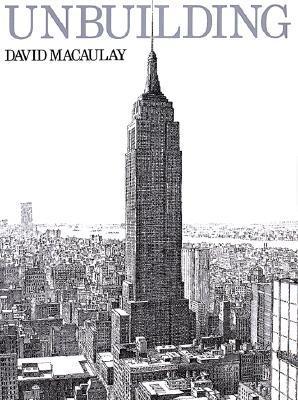
This fictional account of the dismantling and removal of the Empire State Building describes the structure of a skyscraper and explains how such an edifice would be demolished.
David Macaulay, born in 1946, was eleven when his parents moved from England to Bloomfield, New Jersey. He found himself having to adjust from an idyllic English childhood to life in a fast paced American city. During this time he began to draw seriously, and after graduating from high school he enrolled in the Rhode Island School of Design (RISD). After spending his fifth year at RISD in Rome on the European Honors Program, he received a bachelor’s degree in architecture and vowed never to practice. After working as an interior designer, a junior high school teacher, and a teacher at RISD, Macaulay began to experiment with creating books. He published his first book, Cathedral, in 1973. Following in this tradition, Macaulay created other books—including City, Castle, Pyramid, Mill, Underground, Unbuilding, and Mosque—that have provided the explanations of the how and the why in a way that is both accessible and entertaining. From the pyramids of Egypt to the skyscrapers of New York City, the human race’s great architectural and engineering accomplishments have been demystified through Macaulay's elaborate show-and-tells. Five of these titles have been made into popular PBS television programs.
As a kid with aspirations to be an architect, this book (along with Macaulay's others) was just fun to read over and over again. I'm sorely tempted to buy it, hide under my cover with a flashlight and go through it again.
Someday all of the great edifices must come down, and the author delivers on a plausible way that it could be achieved. The rationale for taking down the Empire State Building is inane, and makes me wonder why he chose it as a framing story.
Learning architecture and drawing by a master who teaches by taking things apart so you can learn to put it together. I bought this for my kids and feel it should be a textbook to anyone interested in drafting.
Extremely fascinating book about how it’s possible to deconstruct the Empire State Building to move it to another location. Really well done and the illustrations are superb. Macaulay does an excellent job as usual at describing an intricate architectural project.
What would happen if a crazy multibillionare in the Middle East decided to buy the Empire State Building and transport it across the ocean? Macaulay presents this scenario with a meticulously researched deconstruction with detailed illustrations of the building's internal structural features, showing over the course of two years what it would take to dismantle this monument of American architecture. In so doing, he helps the reader appreciate how significant an architectural achievement it is while also helping the reader understand how great buildings like this are made.
The concept of taking the building apart to show off its construction is a novel one, and Macaulay not only makes the reading worthwhile through his careful research, but also with humor. Tongue-in-cheek, he describes the local protests at the building's sale, and the appeasement of New York's residents by transforming the site into a park with the spire installed at its center. Ironically, after years of deconstruction, he chooses to have the building lost at sea en route to its destination. This plot twist is undoubtedly an acknowledgement of the Empire State Building's place in the American consciousness as a cultural icon, whose ownership cannot change hands.
This book, like all of Macaulay's architecture books, focuses primarily on the physical details of the building, so it will appeal best to readers who experience life through the details. This is an outstanding choice to prepare for a trip to New York, as part of an architecture or history study, or just for entertaining reading. Because most of the information comes through the exquisitely detailed drawings, it's a better read-alone than read-aloud.
The idea of deconstructing and "unbuilding" a skyscraper like the iconic Empire State Building is pretty compelling. Alas Macaulay does himself a disservice by couching the explanations in a dated satire about OPEC (here called the Greater Riyadh Institute of Petroleum, "GRIP" for sure) and the absurdly named Saudi Prince Ali Smith. (The satire is dated in the sense that it makes implicit reference to the gas crises of the 1970s. In the sense that it discusses dismantling skyscrapers in response to tighter energetic and economic realities, it doesn't seem so dated; I think of the writings of James Howard Kunstler and wonder if it might even be prescient. Speaking of prescience, I found it very eerie to read on p. 13 the Prince suggesting that he would be willing to pull down the twin towers of the World Trade Center—as a goodwill gesture!)
I was thinking this might be good for my skyscraper-fascinated 5 yr old. Because it's written so realistically, I thought of the War of the Worlds radio broadcast that made people worry that it was actually happening! The renderings were wonderful, at least from an architect's point of view and the fact that they were detailed and labeled made it a very interesting read. I have to agree with the review on the back cover that it is a perfect call to preservation to imagine what it would be to lose something precious like that. Although, I've never been to NYC to see the Empire State Building, it is too iconic to imagine it gone. One sad part was the short discussion of the World Trade Center towers being demolished as an appeasement to the city given it's tragic demise. Unfortunate in an otherwise wonderful book.
The most whimsical yet in David MacAulay's body of works - this time he tackles the Empire State Building, and instead of straightforwardly showing how it was built, he imagines a situation in which an oil-rich sheikh has bought the great building and is having it dismantled, reversing the building process, so it can be shipped to the Middle East. A great fun read, with the usual combination of fascinating tidbits of information, little bits of fun, and portrait of the culture and people that created the structure. A fitting companion piece to go with Castle, Cathedral, Mill, Mosque, Pyramid, and City. A good Christmas gift for kids or young-at-heart adults.
It's fiction, but it's wonderfully educational. It would never have occurred to me to ask how one would de-construct the Empire State building, assuming one wanted to. But I marvel at the engineering necessary to un-build. Plus, more cool stuff about the building of the Empire State than I knew before.
2013 May 5
It's spring and a woman's fancy returns to the Empire State Building. I love this book.
The inventive author/illustrator imagines the great undertaking of dismantling the Empire State Building. Black and white and highly detailed illustrations accompany detailed text that is understandable but introduces new architectural terms. To teach students aspects of construction and demolition or when working on measurements of height, length, and width at earlier levels this book could be utilized to verbally and visually teach new concepts. Macaulay brilliantly illustrates this fictional architectural journey and shows the massive Empire State Building reaching into the night sky.
This book is about now constructors would lie to take down the Empire State building. It is very detailed with what kind of things the builders would need to take down the building like falling rubble. I liked this book.
Unfortunately, it's a bit dated. I'm sure technology has changed somewhat in 30 years, and the idea of selling an American landmark to a middle eastern national would be laughable at best today--an his offer, in the story, to demolish the Twin Towers, gratis, is a bit jarring now.
If David Macaulay books didn't give me the super creeps, I'd probably give this a better rating. Just weird and creepy. Sorry I can't be more descriptive, I am just freaked out by these books!