Jump to ratings and reviews
Rate this book

Agenda #1

A Feast in the Garden

Rate this book
As the Jews of his town are transported to concentration camps, David Kobra escapes to Budapest and grows up amid death and violence, which he later uses in his writing. By the author of The Loser. 10,000 first printing.

394 pages, Hardcover

First published January 1, 1986

Loading...
Loading...

About the author

George Konrád

61 books46 followers
aka György Konrád

George Konrád was a Hungarian novelist and essayist. Konrád was born in Berettyóújfalu, near Debrecen into an affluent Jewish family. He graduated in 1951 from the Madách Secondary School in Budapest, entered the Lenin Institute and eventually studied literature, sociology and psychology at Eötvös Loránd University. In 1956 he participated in the Hungarian Uprising against the Soviet occupation.

Ratings & Reviews

What do you think?
Rate this book

Friends & Following

Create a free account to discover what your friends think of this book!

Community Reviews

5 stars
41 (22%)
4 stars
76 (41%)
3 stars
39 (21%)
2 stars
17 (9%)
1 star
8 (4%)
Displaying 1 - 20 of 20 reviews
Profile Image for Jim Fonseca.
1,193 reviews8,841 followers
February 19, 2019
I'm surprised that I am writing only the sixth review of this book on GR, especially since it is such a good book, and second, it was well-publicized when it first appeared in English in 1992. Excerpts were published in the New Yorker, Paris Review and Harper’s.

I came across it looking for more Hungarian authors, having very much liked books by Sandor Marai, Miklos Vamos and Peter Gardos.

description

It’s a dense book with almost no dialogue. Stories of families, love, relationships, faithfulness, unfaithfulness. It’s one to be savored, for a slow read, and it that sense it reminds me of Stone Upon Stone by Wieslaw Mysliwski. It also has a unique style. The author tells us in the beginning it’s partly autobiographical (even though he doesn’t use his name as the main character), and it’s also partly written as if someone were writing his biography. But then he lets other people speak in their own chapters as well, especially Melinda, a woman with a life-long husband and a life-long lover.

It’s also a story of the Holocaust. The author is Jewish and he tells us the stories of his family, extended family and neighbors during Nazi domination of his country. He spares us the horrendous details for the most part although we learn first hand of his personal horrors in the war. Often he tells a delightful story, for example one of two women, an aunt and a cousin of his, and ends the tale with a single line. “Both were gassed at Auschwitz.”

You get a strong sense of the randomness --- I’d say serendipity but that seems too pretty a word to use in this context -- with which some Jews survived while others succumbed to the horrors. The author and his family (two parents and a younger sister) are an example. His father owned a hardware store in small town in eastern Hungary. A day or two before a major round-up of all the Jews in town, his father was arrested for speaking out. A day later his mother went to the police to protest her husband’s arrest and she too was arrested. They were sent to labor camps rather than the death camps and survived the war.

The main character, the author, took the family money and with the help of a lawyer ‘bought’ permissions and travel passes to take his sister to relatives in Budapest, where they ended up in a communal setting that, initially at least, was under the protection of the Swiss embassy. But, for whatever reason, the protection did not last. Eighty people ended up living in a single apartment and only 30 survived.

Every so often there would be a kick at the door and soldiers or police would force a dozen or so Jews down to the docks on the Danube and shoot them. Once it was a 14-year old soldier who rounded up and shot several people. Jews who went into the street were often shot or jailed and sent off to camps. One of the author’s female cousins was rounded up in a group, taken to the docks, and waved away by a soldier because she was “too pretty.” She survived. Another young man was shot, but only in the arm, and he came back from the dead, crawled out of the river, went back to the apartment and survived the war.

Another relative survived because she became a kapo - a Jewish guard over others in the camps. Another survived the camp ordeal and was liberated but then immediately died of typhoid before he could be released. Of the author’s 200 schoolmates, only 5 beside he and his sister survived. After the war the family went back to their village where 100 males Jews had returned from a labor camp. All those men had lost their wives and children. The author and his sister, the only Jewish children in the village, felt like they were a constant reminder to those men of what they had lost.

I’ll be brief with the rest of the story and just give two examples of the numerous tales. The author had two male best friends who survived the war and they remained friends for life. But both of the men were infatuated with the same woman (Melinda above) and she kept one as a husband and one as a lover all her life – on into their late years. Of course the husband knew of the lover. And then there was the great-grandfather. He took his last wife when he was 80; she was 38. He still had affairs.

description

As a geographer, I appreciated that a lot of the book is about place and sense of place and contrasts. The contrasts between a rural small town and Budapest; between New York and European cities; between communist and non-communist cities in Europe and, in general between East and West. In particular we hear a lot about how manners, customs, outlooks differed between Eastern and Western European where Russia still dominated the East. And the despair of an entire nation being rid of Nazi domination only to have it replaced by Russian domination. The author and his two best friends – the only three Jews in the class in high school -- refuse to participate in the asinine singing of ‘worker songs’ in class. They once again feel as if they are wearing yellow stars.

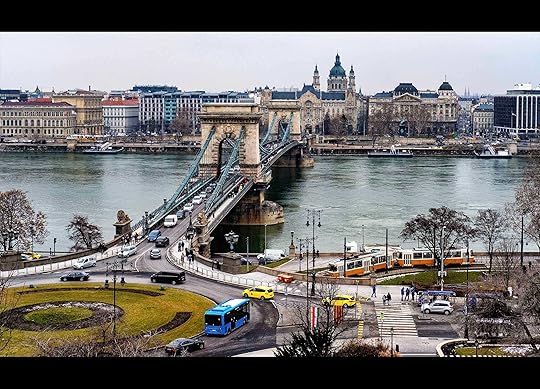
We are told that the famous old Chain Bridge across the Danube between Buda and Pest is the meeting place of East and West and the center of Central Europe. (Any two geographers have their own definitions of what countries make up ‘Central Europe.’ The term disappeared during the Cold War because of the boundary between East and West, but now the term is being reused, still with no broad agreement about its meaning.)

There are many Big Thoughts and excellent writing. Some examples:

“Nationalistic rhetoric everywhere undermines civil liberties.”

“The Lord, like a child, undertakes many things simultaneously and loses interest in all of them.”

“He who wants what is outside is an insider; he who wants what is inside is an outsider.”

“Zoltan hated to part with a single word that was unnecessary; you could see on his face that small talk caused him physical pain.”

“I can imagine that by the time one reaches ninety, one becomes quite sick of one’s family.”

“People like to exchange bad news. In company, a really bad piece of news is a delicacy. Anyone predicting a catastrophe is sure to be listened to.”

“…the only problems worth thinking about were the ones that were insoluble. For the solution of soluble problems you had the professional experts.”

“If most people are poor, why shouldn’t I be poor?”

“Every child … is a book that the parents try to decipher. Until they get tired of trying.”

description

An excellent read, but not an easy one. I gave it a 5 and added it to my favorites.

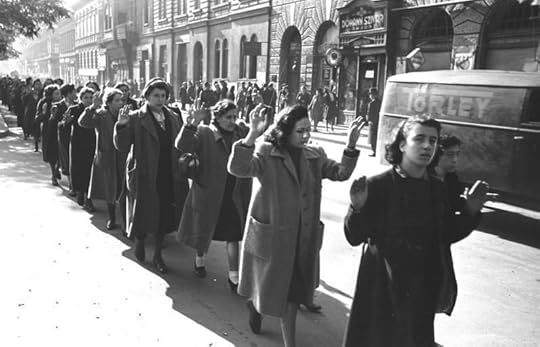
Photo of Jewish women being rounded up in Budapest from https://www.smithsonianmag.com/smart-...

Photo of the Chain Bridge in Budapest from darrellsteele.wordpress.com

Photo of the author from hungarianspectrum.org


Profile Image for Bettie.
9,973 reviews9 followers
April 13, 2015
Description: David Kobra's enchanted childhood in a small town in the heart of Central Europe comes to an abrupt end when the Jews there are put on trains to concentration camps. Young David escapes to Budapest, where he grows up with death and violence, observes Soviet liberators--and ends up under Soviet oppression. (Source: Google Books)

Opening: The house on the side of the hill, the cemetery to the right, the mental hospital to the left.


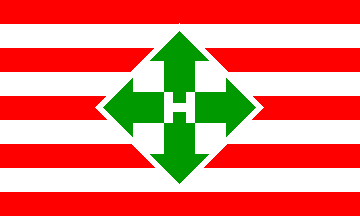
From a wiki article on the subject of 'Arrow Cross Party': 'The atrocities committed during the Arrow Cross rule, especially the mass murders of Jewish citizens, are depicted at length in György Konrad's largely autobiographical novel Feast in the Garden (1989).

The Arrow Cross government effectively fell at the end of January 1945, when the Soviet Army took Pest and the fascist forces retreated across the Danube to Buda. Szálasi had escaped from Budapest on December 11, 1944, taking with him the Hungarian royal crown, while Arrow Cross members and German forces continued to fight a rear-guard action in the far west of Hungary until the end of the war in April 1945.'


Somewhere very recently I came across the Arrow Cross, and would love to know where, because it was that engagement with a new-to-me subject that precipitated ordering this book.
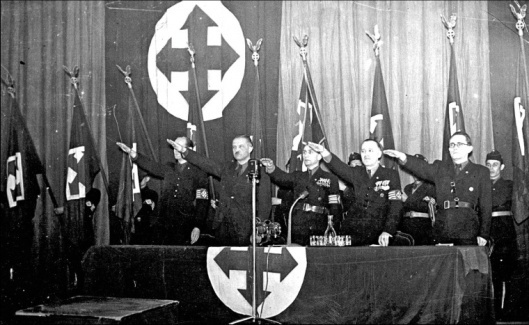
In researching this organisation for a review I came upon what is perceived as a more fascist group than Hitler's Nazi party. Can that be believed? Well yes, because this group had religious fervour as a topping.

This is an unstructured semi-autobiographical novel about a writer penning a novel about a certain David Kobra, who may or may not be Konrád. The prose is in turns beautiful, harsh, and disjointed. You may remember the likewise fracturing in Esterházy's 'Celestial Harmonies', so if that was a struggle then this will be too. I find it wondrous one minute, exasperating the next so have taken to skimming through to the interesting bits.

ETA HUZZAH - the main man remembers just where I came across this group - it was under Wallenberg, and this was the film


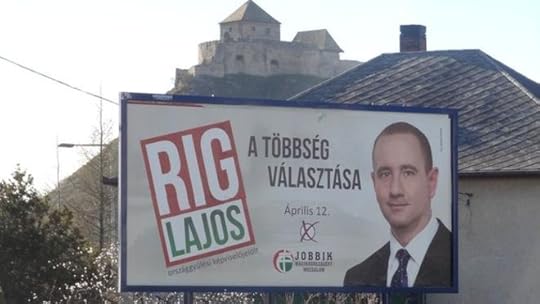
NEWS 11:04:2015: Hungary goes to the polls tomorrow, and the Jobbik Party hopes to score a win: Jobbik describes itself as "a principled, conservative and radically patriotic Christian party" on its website. Source


NEWS 13:04:2015: Far-right Jobbik party takes first seat in Hungary: The far-right Jobbik party in Hungary has won its first ever individual constituency in parliament, taking the Tapolca seat with a majority of just under 300 votes.It is now the most successful nationalist party in Europe and will challenge the governing Fidesz party in parliamentary elections due in three years' time.

Profile Image for Charlotte.
430 reviews131 followers
October 30, 2024
Ik ga zelfs geen poging doen om een recensie te schrijven of om citaten samen te harken, niets doet het genoeg eer aan. Wonderlijk boek. De Medeplichtige nog liggen, soon!
22 reviews2 followers
February 18, 2026
Ik ben hier enige tijd aan bezig geweest, het is een boek dat je in kleine happen dient te consumeren naar mijn mening. Ik had geregeld geen idee wat ik eigenlijk aan het lezen was maar ik heb er ten volle van genoten, ik liet het graag over me heenkomen en het was enorm intrigerend.
Er zit eigenlijk geen verhaal in dit boek, hoofdstukken kan je in gelijk welke volgorde lezen, maar het is zo prachtig geschreven en een schatkamer aan oneliners.
Bespiegelingen over het leven, literatuur, leven in een communistische staat, oorlog, jodenvervolging en ontmenselijking,… Aanrader voor mensen die graag traag een boek consumeren.
Profile Image for Jan.
8 reviews
February 2, 2015
Dit boek heeft een aparte voorgeschiedenis: om één of andere reden is het een van de weinige boeken van mijn vader die ik me duidelijk herinner. Na jarenlang te hebben rondgeslingerd in mijn onderbewuste, was het tijd om het lijvige werk zelf ter hand te nemen en te lezen.
Tuinfeest is het eerste boek van Konrad dat ik heb gelezen en ik moet toegeven dat ik het een geweldige schrijver vind. Hij slaagt erin om autobiografie, fictie en historische roman naadloos samen te smeden tot een ijzersterk geheel.

Kern van de roman vormt het lot van joodse families tijdens en na de oorlog. Het verhaal wordt gelardeerd met bespiegelingen over godsdienst, vrijheid, politiek en erotiek. De non-conformistische joodse auteur stelt in zijn lijvige roman bovendien de positie van de dissidente intellectueel in Hongarije aan de orde. Het boek heeft een autobiografisch karakter en is geschreven in een fragmentarische, zakelijke en ironische stijl, kenmerkend voor een generatie in het Oostblok zonder illusies.

Tegen het decor van de geschiedenis van zijn vaderland Hongarije en de lotgevallen van de Hongaarse joden, trekt een stroom aan herinneringen en gedachten aan de ik-figuur voorbij. Nu eens in het heden, dan weer in een (soms gefantaseerd) verleden wordt de schrijver geconfronteerd met zichzelf, de wereld en trekt daarin ook de lezer mee. Zowel het innerlijke als het uiterlijke worden in deze roman zeer gedetailleerd beschreven maar tegelijk slaagt Konrad er ook in elke vorm van kunstmatigheid te vermijden.

Konrads’ woorden zijn simpel maar stevig en getuigen van een rijke, spirituele kijk op het leven. Omdat hij zijn gedachten en herinneringen vasthaakt aan allerlei fictieve locaties, waarbij soms de grens tussen fictie en realiteit vervaagt, voelt men zich als lezer zeer snel thuis in deze vreemde maar daarom niet minder herkenbare wereld.

Het boek telt ruim 400 pagina’s en is uitgesmeerd over 31 hoofdstukken. Elk hoofdstuk is apart op zich te lezen maar in verband met andere hoofdstukken ontstaat er een prachtige caleidoscoop van ervaringen, emoties en gedachten. Het is geen gemakkelijk boek en enige achtergrond in filosofie en spiritualiteit zijn mooi meegenomen voor de lezer die hieraan begint. Toch zou ik het boek aan iedereen aanraden want het is prachtig.

Dan zou ik nu nog heelder essays kunnen schrijven over hoe en waarom dit boek prachtig is maar dat ga ik niet doen. Laat ik besluiten met volgende opdracht: zoek het boek, lees het, proef elk woord, contempleer en geniet.
Profile Image for Marc Lamot.
3,570 reviews2,140 followers
December 21, 2019
I remember how this book was glorified, back in 1988, when the Dutch translation was published. The next year the Iron Curtain fell and Konrad was the fame of the day. Earlier I read 'the Visitor' and was very charmed by it. But this book was a disappointment. This novel is centered around the Hungarian capital Budapest and its surrounding, under communist regime. Konrad presents a number of "voices", including his own as a writer, looking back on his life. These are the interesting parts. But the other voices (including a sarcastic old man and a woman obsessed by suicide) are really awful. I think, in the end, it was the disengaged writing style, very descriptive (you can find it with a lot of Central European writers) that put me of and made me close the book about halfway. I noticed Konrad's glory has totally faded; it says enough that I'm even the first one to write a review on Goodreads.
1 review
July 7, 2020
This Book was a fortunate mistake bought on a book sale. It’s so boring that I fell asleep just after the first few lines. The only star is given because it’s a fantastic sleep drug. Highly recommend for nights where you can’t sleep.
Profile Image for Stephen Varcoe.
63 reviews7 followers
Read
January 31, 2023
I'm back on vaguely familiar Hungarian territory with A Feast In The Garden.

Whilst this isn't an easy book to read, it's no Ulysses. So I'm at a bit of a loss to explain why more people haven't read it. I can't find the Hungarian language version on Goodreads and no Hungarian appears to have read it. Which for a renowned writer like Konrád György is a bit odd.

It's not a secret that this is part fiction and part autobiography but which part is which? Some places and people are recognisably real. Berettyóújfalú a town close to Hungary's modern border with Romania and the place of Konrád's birth features prominently. As do for example the Lukács thermal baths in Budapest.

However to me at least, the village of Ófalú isn't immediately recognisable, perhaps it was created as a foil to Újfalu, Ó and Új being old and new respectively.

Konrád uses the first person throughout but switches, sometimes almost in mid sentence, from one protagonist to another, in particular when writing about characters in a relationship with one another. Given that one of these relationships involves a woman and two men this can be challenging to follow. But if you're paying attention it's not that challenging and in any case as a device for demonstrating two differing realities, it works very well.

David Kobra is self evidently Konrád's alter ego and the part that recounts his and his family's lucky escape from the holocaust and the siege of Budapest, is indeed harrowing. And whilst we know that Konrád's family did indeed survive, it isn't clear how much of the story as he tells it here is factual.

But there's so much more to this book than a description of the fate of Berettyóújfalú's Jewish citizens in 1944/5 and it would be a mistake to read it for this alone.

What I liked most about the book, other than the parts that deal with storks, frogs, markets and recognisable places was the characters. Characters that Konrád portrays warts n'all.

Uncle Pista for example who lives somewhere near Nagyvárad. An argumentative and irascible old Jew who hates capitalism and religion (especially his own) in equal measure. He deliberately eats pork chops on Yom Kippur and believes that if everyone killed a couple of pigs every year, then there'd be much less conflict and unnecessary bloodshed in the world. Living a few hundred yards from the wartime Romanian border, when the Nazis come for him and his wife he makes no effort to escape across it but goes meekly to his death.

-------------------

I scribbled a few pencil notes in the margin as I read this. Now going back to them armed with an eraser, I’m reminded of how personal this novel felt to me.

I'm not sure that any of this will mean anything to anyone else but then that's why it's personal. Many of these are culinary, others are places or just ideas but they all mean something to me. It seems a shame to just erase all these notes without indulging in them one last time, so here goes..

Konrád begins by commenting upon where he's writing.

‘There are sour-cherry and walnut trees here, just as in the garden of the house in which I was born.’ and soon after he reveals that ‘It is because of this duo that I fell in love, at the age of forty, with the sexton’s house in Csobánka.’

I had a sour-cherry tree in my garden once, it was always the first thing to bear fruit in early summer. Indeed the arrival in May of cold sour-cherry fruit on the menu coincides with tables and chairs being brought out of winter storage and set up outside on the pavements of Budapest. Summer has come.

The walnut tree by comparison doesn’t crop until the autumn but it does produce deep shade. Nothing grows under a walnut tree, so there’s plenty of space for a table and chairs.

In a village home I once frequented there was a large spreading walnut tree between the Kádár era cube-house and the “nyári konyha”, literally the summer kitchen. The kitchen in these old houses is separated a few yards from the house and just like this one, it often has the pig-sty and the poultry yard tacked onto it at the back. Here we would sit and peel potatoes, wash the dishes and eat, drink and talk. Guests would be welcomed under the walnut tree and stories told. Under that tree we'd sort the corn before storing it in the góré to feed the pigs in winter. And in due course under the same tree, we'd kill the pig in winter. From the outer layer of the walnut they make a stain called diópác that can be used as ink to draw or write with.

Csobánka is a village in the Pilis hills north of Buda close to the bend in the Danube. I’ve been there quite a few times. It’s an area with a rich multi-cultural past - Serb, Slovak and Swabian as well as Magyar - but it's now more or less ethnically homogenous. Patrick Leigh Fermor walked through The Pilis on his way to Budapest in the 1930’s, spending a night under the stars in a gipsy encampment.

Konrád was born in Berettyóújfalu in eastern Hungary. From the window of his home he'd watch the storks that nested on the synagogue over the road.

With his hands clasped behind his back, the observer sees the male stork settling on the back of the female, his wings fluttering, his beak clapping.

It's a feature of my limited Hungarian that I know a lot of utterly useless words and expressions but that unfortunately I struggle to remember the more prosaic vocabulary that one might use in everyday conversation. This phenomena extends to the noise that storks make when they clap their beaks together. I can even decline the verb to clap your beak like a stork. The stork observer continues:

Then the female hatches the eggs while the male brings lunch. The mother distributes pieces of frog into the gaping beaks of the little ones, and the father flies back into the azure, circles high above the river basin, looking for a snack.

Many years ago I went to a wedding in Berettyóújfalu. My abiding memory of the reception was that the building we were in was surrounded by a plague of frogs of biblical proportions!

Today, in the cinema, spitting out the shells of pumpkin and sunflower seeds on the floor is strictly forbidden

But at football matches it's still acceptable. Tökmag and szotyi sold from large paper sacks, inebriated and violent looking skinheads (most of whom are entirely harmless) nibbling on seeds and spitting out the shells like so many budgerigars in their green or purple club colours.

A market scene that might be a description of a painting by Vilmos Aba-Novák.

You still have the babble of women, the noise of the geese and ducks, the drawn-out bellowing of oxen, the smell of fresh horse manure and strawberries and spring potatoes, and, in the rear, you still have the ever-new merry-go-round surrounded by vendors of cotton candy and penknives. You can also buy a small wooden rooster with a clapping tail,

No mention of Törökméz a kind of toffee like substance that pulls your fillings out if not your whole tooth. But it's there somewhere if you look for it.

The tavern was on the outskirts of town and had a large vineyard. The red Othello grapes stung my father's mouth.

I'll end here at summer's end with Othello grapes. Why red? The translator Imre Goldstein did a fabulous job on this book in my opinion. I appreciated his choice of English because more often than not I could retranslate the miscellanea of my acquired vocabulary back into Hungarian. Button football or 'gombfoci' for example. But in this instance I must protest. Othello grapes are one of my abiding passions but they aren't red! Why would they be named after a moor if they were red?

No! Othello grapes are a deep purple colour, almost black. Small and full of large and very hard pips. But it's the flesh that makes them so appealing and memorable, it's almost like jelly. And they are perhaps the last fruit of summer. In fact they reach the shops in late autumn along with the naspolya. Which seems like an appropriate moment to end this personal trip down memory lane.

It would be a shame not to read this in the original Hungarian if you're able to do so. I can only imagine that it's better. But Mr Goldstein's translation is pretty good.
Profile Image for Suze Geuke.
372 reviews11 followers
December 24, 2019
Bizarre collectie van zowel coherente als incoherente passages over familiebanden, verstikkende liefde en uiteraard fusilleren van de joden in Hongarije. Ook bijgevoegd: vele opmerkingen over hoe bevrijdend het wel niet is om te schrijven en dat het niet uitmaakt dat niemand het van waarde schat.
het is me nou niet helemaal duidelijk of het autobiografisch bedoeld is, zo niet dan heeft Konrád een onwaarschijnlijk volledig personage neergezet.
oh en een fenomenale eindzin over dat de auteur het verhaal ook zelf niet helemaal meer volgt. wat een man.
Profile Image for Robert Poortinga.
137 reviews13 followers
March 30, 2021
What an incredible book to read. It rises questions. The story swims but it doesn't swim in nothingness, it swims in incredible ideas. Konrad himself claims that he enjoys books where sentences stand on their own. There is such an overabundance of ideas that unfortunately I did have to give it 4 instead of 5 stars. Though the couple lines that flow throughout the book are clear and become clearer while the story progresses it would have been easier to read for the lesser intelligent than Konrad himself.

What a writer, in the league of Wiesel, who's books is was constantly reminded while reading this autobiographical inspired masterpiece.

It's a must-read that triggers ideas, but don't try to understand everything, as the author claimes he didn't understand the whole story himself either.
Profile Image for Leen.
763 reviews42 followers
June 6, 2015
Een vreselijk boek. Ik begon er vroeger al enkele keren in, maar heb me nu pas er doorheen weten te worstelen. Konrád vertelt het verhaal van zijn leven, of stukken ervan, tijdens en vlak na de oorlogsjaren in communistisch Hongarije en de incestueuze relatie met zijn dochter. Ik las werkelijk van stuk tot stuk, want tussenin sprong hij van de hak op de tak, ik zou niet kunnen zeggen waarover het ging, over Hongarije, veel te filosofisch of net te politiek getint naar mijn goesting. Dit is zogezegd één van zijn grootste werken (en daarom op de lijst der Blufboeken), dus dan wil ik de rest niet eens lezen. Ik ben wél blij dat ik het gelezen heb, want ik wil een boek niet afkraken zonder het gelezen te hebben.
Profile Image for Maarten.
Author 1 book3 followers
March 22, 2019
Een bevrijding om dit boek uit te hebben. Er zitten mooie, interessante verhalen en personages in verborgen, maar het is te vaak te vaag filosoferend, onduidelijk welk personage op welk moment in de tijd aan het woord is om mij erbij te houden. Een ander zal mogelijk zeggen dat het boek een meer aandachtige lezing vereist. Ik heb het geprobeerd, maar niet willen volhouden. Het boek eindigt met de zinnen. ‘Het verhaal hoeft u niet te begrijpen, ik begrijp het zelf ook niet.’ Had dat eerder gezegd.
Profile Image for Imre Bertelsen.
148 reviews11 followers
December 21, 2025
De auteur gaf veel blijk van zelfinzicht toen hij het boek afsloot met de woorden "Het verhaal hoeft u niet te begrijpen, ik begrijp het zelf ook niet".

Dit boek in de context plaatsend van de geschiedenis en de levensloop van de auteur zelf geeft al meer houvast en maakt ook dat je niet alles in dit boek direct hoef te begrijpen. Konrad schrijft heel associatief, knoopt de hoofdstukken en personages nauwelijks aan elkaar, maar geeft wel een indringend beeld van een getraumatiseerde, van de wereld vervreemde intellectueel.

De verschrikkingen van de Holocaust worden afgewisseld met de staatsrepressie die in de decennia daarop volgde in Hongarije. Met meer verbazing dan verdriet beschouwt de schrijver hoe hij de grootste verschrikkingen heeft moeten doorstaan ("Een mens kan niets het zijne noemen, alleen zijn leven en zelfs dat willen sommige lieden je graag ontnemen.") om vervolgens in een zwart gat van onderdrukking te vallen.

Qua politieke boodschap is het boek meer noodzakelijk dan baanbrekend. Het is een immer relevant pleidooi voor individuele vrijheden, afkomstig van iemand die weet wat het is om die niet te hebben. Net als dat het benadrukken van de kracht van literatuur en de rede dat is, Konrad schrijft er indringend over omdat hij het zelf allemaal aan den lijve ondervonden heeft. Ik houd wel van hoe onverholen de boodschap wordt gebracht, met de nodige opsmuk ook. Af en toe is de schrijver wat aan het schmieren, maar ik vergeef het hem, want het boek wordt er zo beter door en is, ondanks de zware thematiek, ook een uiting van levenslust.

"Ik vond excentrieke denkbeelden veel belangrijker dan consistentie. Buitensporigheid en toch voorzichtigheid, morgen zal ik mijn denkbeelden wel herroepen, uit de gistende massa van paradoxen zal de waarheid voortkomen."
Profile Image for Kaj Roihio.
694 reviews2 followers
Read
May 2, 2021
Unkarin merkittävin kirjailija, ne sanoivat. Värikäs kuvaus älymystön elämästä sodanjälkeisenä aikana, ne sanoivat. Pahaa-aavistamattomana eksyin 664-sivuiseen yksinpuheluun, jossa vanha mies naputtaa sormellaan pöytää ja kertoo miten asiat ovat. Parhaimmillaan Pidot puutarhassa on toki oikein hienoa romaanikirjoitusta, Unkarin juutalaisten historia, natsihallinto ja Budapestin taistelu tuovat kirjaan sisältöä. Mutta sitten vaivihkaa György Konrad hylkää lyyrisen proosan ja alkaa tiputella loputtomasti suurenmoisia ajatuksiaan kaikesta mikä ikinä mieleen juolahtaakaan, kertomus kuolee ja sen sijalle nousee esseistinen helvetti, melkein 300 sivua itsetarkoituksellista jaarittelua. Kirjallinen onanismi jatkuu loppuun saakka ja sen viimeisenkin sivun luettuaan voi vain todeta, kirjoittajan kieltämättömistä kyvyistä huolimatta, että olipas huono.
202 reviews
November 2, 2025
Soms bevatten boeken citaten die je wilt bewaren. Vroeger schreef je die over. Tegenwoordig maak je een foto met je smartphone. Van diverse citaten uit Tuinfeest maakte ik foto's. Konrád schrijft in Tuinfeest veel over de Tweede Wereldoorlog. Als kind van joodse ouders heeft hij veel meegemaakt en is veel mensen in zijn omgeving verloren. Konrád schrijft prachtig. Tijden lopen doorelkaar, mensen leven of zijn al overleden wanneer ze worden opgevoerd. In Hongarije verliep de oorlog weer net anders dan in West-Europa. Wat erg indringend beschreven staat is de wijze waarop veel Hongaren de dood vonden. Ze werden op een steen aan de Donau geplaatst om vervolgens met kogel en al in de rivier te vallen.
32 reviews
May 7, 2026
Ik denk dat dit een van de moeilijkste romans is, die ik gelezen heb. Het hoofdstuk Vogelverschrikker heb ik 4 keer moeten lezen en nog is het mij slechts gedeeltelijk helder wat Konrád precies wilde duidelijk maken.
Andere stukken zijn eenvoudiger, maar daarom niet minder gruwelijk. Geniaal boek. Ik mis alleen een boek met een gedetailleerde uitleg met glossen.
Profile Image for Danny.
245 reviews4 followers
February 10, 2020
peszgö ! voor deze blend van autobiografie, historie en fictie.
21 reviews
August 16, 2022
Irodalomnak vélt firkálmányok mérhetetlen mennyiségben elérhetők ezen az oldalon, de Konrád György műveit nem sikerült rendesen feltölteni... Miért spanyolul látom a Kerti mulatságot? Angolul is megtalálható, de annak főképp nincs köze a valósághoz. Egyrészt az Agenda-trilógia második része a Kőóra. Másrészt hiányzik a harmadik rész, mely a Hagyaték címet viseli. 2015-ben kezdték el kiadni a sorozatot az Európánál. Érdemes lenne pótolni! Magáról a könyvről a narrátort idézem: "A mesét nem szükséges megérteni. Én sem értem".
Displaying 1 - 20 of 20 reviews