Jump to ratings and reviews
Rate this book

The Confessions Of A Young Man

Rate this book
This scarce antiquarian book is a facsimile reprint of the original. Due to its age, it may contain imperfections such as marks, notations, marginalia and flawed pages. Because we believe this work is culturally important, we have made it available as part of our commitment for protecting, preserving, and promoting the world's literature in affordable, high quality, modern editions that are true to the original work.

136 pages, Paperback

First published January 1, 1886

Loading...
Loading...

About the author

George Moore

610 books91 followers
George Augustus Moore was an Irish novelist, short-story writer, poet, art critic, memoirist and dramatist. Moore came from a Roman Catholic landed family who lived at Moore Hall in Carra, County Mayo. He originally wanted to be a painter, and studied art in Paris during the 1870s. There, he befriended many of the leading French artists and writers of the day.

As a naturalistic writer, he was amongst the first English-language authors to absorb the lessons of the French realists, and was particularly influenced by the works of Émile Zola. His writings influenced James Joyce, according to the literary critic and biographer Richard Ellmann, and, although Moore's work is sometimes seen as outside the mainstream of both Irish and British literature, he is as often regarded as the first great modern Irish novelist.

Ratings & Reviews

What do you think?
Rate this book

Friends & Following

Create a free account to discover what your friends think of this book!

Community Reviews

5 stars
12 (10%)
4 stars
34 (30%)
3 stars
39 (34%)
2 stars
17 (15%)
1 star
10 (8%)
Displaying 1 - 19 of 19 reviews
Profile Image for Fionnuala.
915 reviews
Read
October 30, 2025
We are all readers here, and I'm guessing many of us were early readers, already searching our parents bookshelves at age eight or nine so addicted were we to reading by then.
Back in the 1850s and 1860s when George Moore was growing up, books were not his thing at all. He much preferred climbing trees, making rafts, and hunting and fishing on his family's large estate in Ireland. But when he was eleven, he overheard his parents talking about a book they'd just read. He was so seduced by the sound of the main character's name and the sensational mystery surrounding it that although his parents forbade him to read it, he did anyway. Lady Audley's Secret transformed him into a reader, and he gobbled up all of the Mary Elizabeth Braddon books he could find after that. One of those mentioned Shelley's poems, and soon he was a Shelley fan too, carrying a pocket-sized edition everywhere he went.

But for George Moore, the path to becoming a man of letters was not as straightforward as that promising beginning might sound. As he says himself:
"I came into the world apparently with a nature like a smooth sheet of wax, bearing no impress, but capable of receiving any; of being moulded into all shapes. Nor am I exaggerating when I say I think that I might equally have been a Pharaoh, an ostler, a pimp, an archbishop, and that in the fulfillment of the duties of each a certain measure of success would have been mine. I have felt the goad of many impulses, I have hunted many a trail; when one scent failed another was taken up, and pursued with the pertinacity of instinct, rather than the fervour of a reasoned conviction. Sometimes, it is true, there came moments of weariness, of despondency, but they were not enduring: a word spoken, a book read, or yielding to the attraction of environment, I was soon off in another direction, forgetful of past failures. Intricate, indeed, was the labyrinth of my desires; all lights were followed with the same ardour, all cries were eagerly responded to: they came from the right, they came from the left, from every side."

Those many 'lights' varied from riding in steeplechases and betting on horses, to studying art and painting, to composing poetry and writing articles about art for the press, to eventually writing novels, plays, and memoirs—as well as being a key figure in the Celtic Revival movement in Ireland.
But from the beginning he must have been an acute observer of people, as this recollection of the London bookies he frequented reveals:
Well do I remember that shop, the oily-faced, sandy-whiskered proprietor, his betting-book, the cheap cigars along the counter, the one-eyed nondescript who leaned his evening away against the counter, and was supposed to know some one who knew Lord——'s footman, and the great man often spoken of, but rarely seen—he who made "a two-'undred pound book on the Derby"; and the constant coming and going of the cabmen—"Half an ounce of shag, sir."

Confessions of a Young Man was published in 1884 when Moore was thirty-two, and mostly focuses on his time in Paris during the 1870s. He'd gone there aged twenty-one after his father's death when he was finally free to try his hand at painting—his father had wanted him to have a military career in the British Army.
Some of the chapters in Confessions read like autobiography while others are more like articles on specific themes ranging from Realism in literature, with many mentions of Emile Zola whom he knew, to Impressionism in art. Incidentally, he gives an amusing account of the first impressionist exhibition he attended with a fellow art student, and how they ridiculed the paintings. That's one of the things I like about George Moore: his ability to laugh at himself.
In any case, it was difficult for young artists attending painting classes in Paris in the early 1870s to comprehend that there might be art that departed from the strict principles of classical and neoclassical art taught at the École des Beaux Arts at the time. George Moore didn't attend the Beaux Arts itself however; instead he attended a studio which was very popular among foreign students who couldn't enter the Beaux Arts because of the language test, and among women who couldn't enter the Beaux Arts regardless of proficiency in French. That studio was called the Académie Julian, and although George Moore didn't make much progress in painting there, he did learn to speak French, and made friends not only with Julian himself but with other artists who frequented the studio and the nearby cafés where they all hung out at the end of the day.
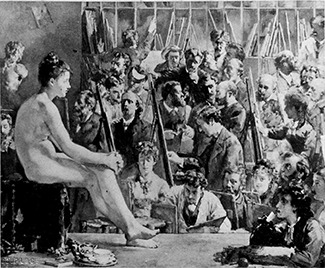
There's a painting from 1876 by Julian himself that shows a life class in his studio with George Moore in profile, sitting at his easel a little left of centre. This is a black and white photo of that painting:

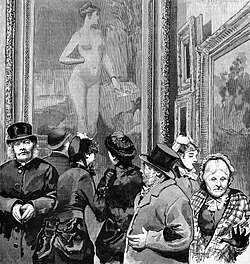
The model for that life class may well be a woman called Marie whom George Moore mentions more than once in the Confessions. At one point, she was the mistress of one his classmates, Lewis Marshall, and perhaps of Moore himself, though he's discrete about the models and actresses he frequented. He mentions calling on Marshall one evening and finding Marie there, and insisting they both go out with him that evening:
We dined in a gargote, and afterwards we went to a students' ball; and it seems like yesterday. I can see the moon sailing through a clear sky, and on the pavement's edge Marshall's beautiful, slim, manly figure, and Marie's exquisite gracefulness. She was Lefèbvre's Chloe; so every one sees her now. Her end was a tragic one. She invited her friends to dinner, and with the few pence that remained she bought some boxes of matches, boiled them, and drank the water. No one knew why; some said it was love.

The 'Chloe' referred to was a painting by Jules Lefèbvre that was exhibited in the Salon of 1875. It caused a stir and was considered an offense against propriety—as shown in this newspaper engraving from the time:

Marie's destiny, and the casual recounting of it, reminds me of how short a career an artist's model or a theatre actress had at the time, and that many must have ended up as despairing and destitute as Marie. And her story reminds me too of Puccini's tragic opera 'La Bohème' which was based on Henry Murger's 1850s account of life in Paris among struggling artists and their companions: Scènes de la vie de bohème

Speaking of struggling artists, by 1876, Moore had decided he didn't want to add to their numbers. He knew he'd never be an artist of any quality, and gave up attending Julian's studio. He turned his attention to poetry instead, and self-published a poetry collection inspired by Baudelaire, called 'The Flowers of Passion'. That little book didn't do very well and, as with painting, he decided he didn't want to be a mediocre poet either. So he started writing novels as well as articles about art for newspapers.

He continued to mix with a wide circle of artists, poets, writers, and musiciens. He gives such a fine account of the sad life of the musicien, Ernest Cabaner, that when I found an image of Cabaner, I felt I'd seen him already. Here's a little of Moore's description of the musician :
"I remember thy face, Cabaner; I can see it now—that long sallow face ending in a brown beard, and the hollow eyes, the meagre arms covered with a silk shirt, contrasting strangely with the rest of the dress. In all thy privation and poverty, thou didst never forego thy silk shirt.."

And here is Manet's portrait of Cabaner.

The 'Confessions', like his later memoir, Hail and Farewell!, are full of such pen pictures, and they make Moore's account of his life very readable. Without them, I might not have continued reading because sometimes he comes across as downright heartless:
As I picked up books, so I picked up my friends. I read friends and books with the same passion, with the same avidity; and as I discarded my books when I had assimilated as much of them as my system required, so I discarded my friends when they ceased to be of use to me.

The preface to my edition, written by Moore in 1904 when the 'Confessions' were being reprinted, contains a little reverie by the fifty-two year-old author on his younger self:
I would have wished for more care, for 'un peu plus de toilette'. There is something pathetic in the loving regard of the middle-aged man for the young man's coat. I would set his coat collar straighter, I would sweep some specks from it. But can I do aught for this youth, does he need my supervision? He was himself, that was his genius…
I have been accused of changing my likes and dislikes—no one has changed less than I, and this book is proof of my fidelity to my first ideas; the ideas I have followed all my life are in this book.

It is true that he had already decided by the end of 'Confessions', ie, 1884, that Manet was the greatest artist of the time, Balzac the greatest writer, and Wagner the greatest musician, and in his later memoirs, Hail and Farewell, he didn't waver from those opinions.
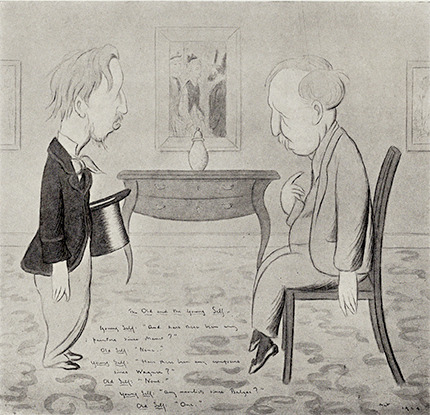
The caricaturist Max Beerbohm, who included George Moore in many of his illustrations, sketched a scene for us in which the young George Moore asks the old Moore to confirm those opinions:

So even though George Moore seemed to have lived many lives in the course of his one life, even though he moved frequently between Ireland, England, and France, even though he discarded passions and friends like old coats when new ones seemed more suitable, yet he remained faithful to those early judgements. And Manet, Balzac, and Wagner have all stood the test of time.

George Moore may not have stood the test of time quite so well, but I'd like to think that if he popped into Goodreads today, he wouldn't be too unhappy. He may not be as popular as some of his contemporaries but there's a bunch of reviews of his books and memoirs all the same. I'm glad I've been able to add to that number.
Profile Image for Sketchbook.
698 reviews274 followers
August 21, 2023
Moore's 'confessions' are aesthetic. If there's more, you'll find a soul struggling to rid itself of Victorian morality. Of landed gentry, Moore moved fr Ireland to Paris in his 20s hoping to be a painter. He immersed himself in Degas, Manet and discussed Gautier, Baudelaire at his Montmartre haunt until dawn. This memoir was finished in his early 30s after he decided to become a writer. He first tried journalism which he found stifling: "I longed to give a personal shape to something and this could not be achieved in an article." His memoir is youthfully all over the place, at times, but it's stuffed with alluring ideas.

He prefers Marlowe to Shakespeare, his literary ideal is Balzac, and why, he asks, must Henry James avoid decisive 'action'-- why is everything suppressed? Respectability is a "killing octopus," he avers; education destroys humanity, the masses only appreciate conventionality, "home" is the antithesis of freedom, books attract us like people (often for the same reasons) and art reflects the "the spirit of an age."

When it comes to the flesh, he grabs us by the collar: "Hypocritical reader," he zaps, "if you had the courage and money to lead a fast life, wouldn't you do so?"

Best remembered of youth in Paris: "The smells of every hour. Eggs frizzling in butter, the pungent cigarette, coffee and cognac, the fragrant odour of absinthe; and the steaming soup."

A worldling whose work was admired by Joyce-Stein, he became friends with the American culture maven Carl Van Vechten whose extravagant novel "Peter Whiffle" he somehow inspired. Whiffle even has an orange cat named George Moore. Says Peter Whiffle: "I've come to the conclusion that the only thing to do was live, just as fully as possible." The sentiment belongs to George Moore and I don't mean the cat.
Profile Image for Richard Epstein.
380 reviews21 followers
February 28, 2014
There are those who claim to have finished books by George Moore, but I don't believe them.
137 reviews
June 6, 2011
George Moore writes of a man [himself] in his twenties, searching for his passion. First, its art, then realizing it wouldn't work for him, he switches to reading and writing. Its a very honest book, from the insight of a privileged young man in a different time. I enjoyed his opinions and critiques of the authors he's read and how they changed throughout his twenties. I gave it three stars only because he was so arrogant and unlikeable.
Profile Image for Muaz Jalil.
385 reviews10 followers
April 12, 2022
I had the Amazon print. It was horrible, full of self importance. Chapter 8 was slightly interesting.
Profile Image for Samuel Parker.
4 reviews
May 28, 2015
Moore's false modesty disintegrates as the narrative progresses, leaving the reader with an insightful, if somewhat egoistic, read about art and life in Paris circa the late 19th century.

Some writerly trivia: In his day George Moore regarded Joyce, his younger compatriot, with distaste: : "Take this Irishman Joyce, a sort of Zola gone to seed. Someone recently sent me a copy of Ulysses. I was told I must read it, how can one plow through such stuff?... Joyce, Joyce, why he's nobody - from the Dublin docks: no family no breeding." (Taken from Moore's unpublished letters)
Profile Image for Peer.
324 reviews1 follower
February 27, 2018
First 40 or 50 pages are promising, then arrogance enters to spoil the rest of the book.
Profile Image for Rawley.
6 reviews
June 28, 2024
My sensibility appears to be in decided, decibelic disharmony with Goodreads, for I must confess that I simperingly, perversely adored this maligned book. Even the objectionable portions—and there is much, to contemporary mores, that is objectionable—are resolutely mesmerising. Such insouciant, robust cheerfulness; such cheeky, ecstatic braggartism—all so vivacious, so frivolously stiff-necked, and so dissolutely vital.
Furthermore, a detailed, fluent evocation of those bellicosely aesthetical times; times that I would be too modernly pusillanimous to habituate, but enjoy abstractedly holidaying in through forceful, verisimilar prose. Lamentably, much of what Moore scintillatingly imperates does resonate with me.
Alas, I'm incapable of consenting unequivocally to his literary criticism—tho' likely this is primarily because I am tearfully vacant of a critical mind, and the dire, pitiful dearth of literary critique I have (itchily, reluctantly) imbibed has felt always quite curiously unreal to me, like selfhood in the initial stirrings of morning's awakening—he coldly, politely vituperates against my own idolised Henry James! (perhaps a flimsily petty rationale for four stars, but one must occasionally boon one's self with the gift of graceless vindictiveness.)
Profile Image for F.J. Akkerman.
Author 1 book19 followers
Read
November 13, 2023
Reeks of idleness, arrogance and mindless, petty aristocratic sentiments which, by about four chapters in, closed the lid on it for me.

From the first sentence, it didn't bode well:
"My soul, so far as I understand it, has very kindly taken colour and form from the many various modes of life that self-will and an impetuous temperament have forced me to indulge in." And money. Yes, lots of money. Being "forced to indulge " in whatever took your fancy would be a trying malady indeed, if father hadn't died early and left you the means to indulge every whim.

"Therefore I may say that I am free from original qualities, defects, tastes, etc." Well congratulations, you've managed to do what nobody else has succeeded in doing: being born without defects - ha!

I suspected that the 19th century Paris arts/literary scene wouldn't offer much of interest to me anyways, which was confirmed after a further skim-read to the end. A relieved DNF.
Profile Image for Andrew Noselli.
738 reviews87 followers
August 20, 2023
This is the kind of self-enamored writing you get when a failed artist magnifies the literary context of his intellectual breakdown into an enlightened political act. It's no surprise that this work was an early recommendation to Thomas Wolfe by one of his idolized college upperclassmen at Harvard, seeing that the writer he became demonstrated a distracting "unevenness" in his craft, to quote William Styron. Using Moore as an artistic model for his intellectual ambitions instead of the superior Theodore Dreiser would, I think, tend to do that. Two stars.
Profile Image for Mike.
455 reviews38 followers
July 16, 2013
Lively report from early 20th c Paris & London.

hilites:
39..why could i not live without an ever-present and acute consciousness of life? why could i not love, forgetful of the ticking of the clock in the perfumed silence of the chamber?
49..Degas' innovations
75..miniature of a beauty of 30. He dreams of Pleasure and he is offered Duty.
94..Manet & Degas in a cafe
105..Whistler the least Impressionistic
106..reproach of Millet...always the same thing, the same peasant, the same sabot, the same sentiment.
109..Oh, for excess, for crime. I would give many lives to save one sonnet by Baudelaire....
England's greatest son (Cromwell) was the personification of injustice
131..Emma the maid ****I have spoken angrily to you, but never did that sweet face of yours lose its expression of perfect and unfailing kindness...doglike
Life in your case meant this: to be born in a slum, and to leave it to work 17 hours a day in a lodging-house; to be a Londoner, but to know only the slum in which you were born and the few shops in the Strand at which the landlady dealt.
133..sublime stupidity!
134..a mule...a drudge too horrible for anything but work
136..a young man in a house full of women
138..a club is dull
142..artistic decadence of London
143..artistic atrophy is benumbing us, we are losing our finer feeling for beauty.
179..the devil with literature
182..the real genius for love lies not in getting into, but getting out of love.
183..twitter-like exchange
212..Mummer worship...celebrity of actors ...very TMZ!
239..Balzac...the elegance of life exists mainly in the waist.
Profile Image for Nate.
639 reviews
July 31, 2015
roundup from 3.5 stars, kind of half memoir and half musings on art, culture etc. never read any of moore's other stuff so i really can't comment on his body of work here aside from this. jumps around to subjects rather frequently, the most interesting are his thoughts on literature, which includes the highest praise of balzac. his personal life is less interesting as he comes across as a rich, arrogant dick, but i guess almost any artist from 19c and before had to have that persona
Profile Image for L. O'Neil.
Author 5 books5 followers
June 10, 2012
For its era -- 1900s turn of the century -- this narrative offers insight to lifestyles of gay dandies and man about town a century ago, told through the POV of a character who believes himself a literary phenomenon. Snoozed through some passages about protagonist's hero worship of close friend.
Displaying 1 - 19 of 19 reviews