Jump to ratings and reviews
Rate this book

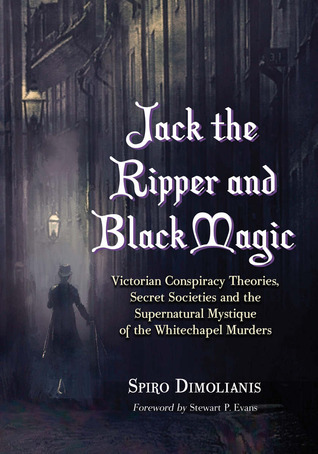
Jack the Ripper and Black Magic: Victorian Conspiracy Theories, Secret Societies and the Supernatural Mystique of the Whitechapel Murders

Rate this book

Jack the Ripper is a legendary gothic tale of Victorian conspiracies, the supernatural, secret societies and the police. Scotland Yard hunted a serial killer shrouded in politics as the mutilator of East End prostitutes infused pop culture with demonic horror. This book uses historic sources and rare official reports to reveal dark and supernatural aspects of the Ripper case.

236 pages, Paperback

First published July 25, 2011

16 people are currently reading
2358 people want to read

About the author

Spiro Dimolianis

1 book23 followers

Ratings & Reviews

What do you think?
Rate this book

Friends & Following

Create a free account to discover what your friends think of this book!

Community Reviews

5 stars
29 (31%)
4 stars
27 (29%)
3 stars
21 (22%)
2 stars
12 (12%)
1 star
4 (4%)
Displaying 1 - 5 of 5 reviews
Profile Image for Mel.
3,523 reviews214 followers
July 5, 2012
I bought this book for the collection at work, as despite the title it seemed like quite an interesting and scholarly book. I must admit that the only book I've read about Jack the Ripper is From Hell (which given the copious pages of footnotes to historical sources and modern ripperoligists means that I probably know more than you'd think having only read a comic book on the subject) and as such I did find it quite easy to follow the book.

The first three chapters were my favourite. The first looked at fortune telling and ghosts. It was wonderful to see all these examples, all of which came from Tower Hamlets. Cases of ordinary people who were arrested or charged over fortune telling. The book went on to look at the way the different types of people accussed of being Jack the Ripper represented different fears and prejudices within the community, Jews, Irish, Gypsies, even Americans. He also addressed the ways that the muders were incoporated into the spiritual and occult beliefs of the time, by the mainstream press, as well as by the different occult groups of the period. Most noticably the theosophists. He spent several chapters addressing the claims that D Onston was Jack the Ripper, the different ways the story the grew, who was responsible for them and how he hurt his own case. It was a very interesting look at the occult societies of the time and to see the way the story grew and gained more intrigue as it went on.

The last chapter was the only one that I didn't find very interesting. It tried looking at the secret service and it's relation to the urban myths that have grown up around the Ripper case. Here there was a lot of talks of spies and the official secrets act and I'm afraid I just found my attention starting to wane. The other criticism of the book was a lack of conclusion. Having presented lots of interesting information about the way the case and it's representation portrayed ideas about prejudice and the occult. Not only for the original period of 1888 but how these theories grew and changed with time and different current historians presenting their theories based on the evidence as it grew and changed. It would have been nice to have some form of conclusion or summing up rather than quite an abrupt end. Still overall I really enjoyed this book and would definitely recommend it to people with either an interest in the murders, late Victorian beliefs, and occult organisations.

I would also like to add that if you're reading a book called Jack the Ripper and Black Magic with a picture of a young Crowley on it, people do give you a lot more room on a crowded train. Particularly when going through Whitechapel.
Profile Image for Rob.
10 reviews
November 23, 2012
To be honest, this is quite possibly actually a 4-Star rating work, a 5-Star rating if you are interested in the history and culture of the period, are a lover of conspiracy theories, or are a 'Ripperologist.' In a somewhat odd moment, I found myself rating it lower than I believe that the work may actually deserve, not because of the writing style, or the author's personal agenda, but because the book is simply so densely packed with information and detail that it feels like the author has gotten lost in his material. (I said it was an odd moment)

Dimolianis' research is nothing less than exhaustive, and his presentation of it is, while of necessity a bit dry, nevertheless readable. I now know more about the way hospital schedules in Victorian London charity hospitals worked than I ever believed I would, as well as more about the freewheeling personal lifestyles of some of Helen Blavatsky's theosophist followers, and the publicity-seeking 'occult' volunteers seeking to make sense of the Ripper murders by offering their ideas to the Metropolitan Police and the press.

Most Ripperology works that I've read are focused on putting forth the author's specific candidate for committing the crimes and defending their hypothesis, frequently by attacking other potential candidates. Dimolianis doesn't go that route; instead he works his way through a list of individuals relating to the Ripper murders in great detail discussing how they intersect the crimes. Some are potential suspects, but others are simply publicity-seekers, or honest believers in the occult. His weakness (if you want to call it a weakness) is that in examining his array of historic individuals in the level of detail presented, he seems to have delved into each of their lives to such an extent that the idea of 'black magic' hinted at in the title (for me at least) falls away.

Not being a dedicated member of that field of study, I don't know that this work will change the landscape of Ripperology, but if all of the people studying the subject were this thorough and dedicated in their research, I can't see how the field would be anything less than well-respected in academic circles. I don't regret reading it by any means, but I can't recommend this work for a casual reader. To someone with an interest in period history, and especially the Ripper crimes, it might be a gold mine, though.

Profile Image for M.D. Meyer.
Author 1 book2 followers
November 20, 2014
I had a hard time reading this book. It was not due to the description of the murders, which was only briefly addressed, but rather due to the authors convoluted writing style and the use of a very small type font for the extensive quotes from Victorian newspaper articles, court transcripts, and correspondence. The quoted material often contained much information only tangentially related to the point being made. For example, there was a detailed discussion of one suspect, Roylyn D'Onston, that included a lengthy quote of 1880s hospital nursing procedures taken from court transcripts. Talk about lost in the details. On a positive note the author clearly did a great deal of research into original source material and did convey the cultural, political, and mystical/magical mind set of Victorian England. At the beginning of the book the author states that he expects the reader to be reasonably knowledgeable of the murders and so would not be reviewing all the suspects and theories that have evolved over time. He does review a few though and points out how they reflect the nature of that time period. As someone who was looking for an introduction to the Ripper murders, I was disappointed in the book. I did enjoy the historical material provided on the Theosophical Society which was established in London during this period. Overall, it just appears to me that the book seems in serious need of an editor.

I checked this book out form the library.
Displaying 1 - 5 of 5 reviews

Can't find what you're looking for?

Get help and learn more about the design.