

What do you think?
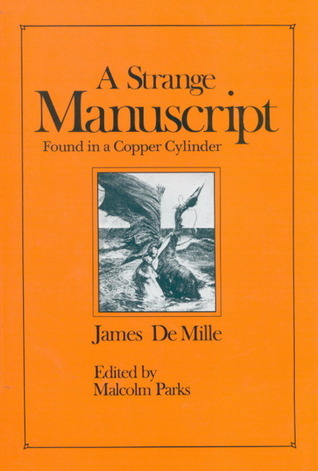
A Strange Manuscript found in a Copper Cylinder
With its curious mixture of adventure, natural history and satire this early Canadian novel has become a landmark work of fantasy and science fiction.
389 pages, Paperback
First published January 1, 1888
About the author
James De Mille
83 books12 followersJames De Mille was a professor at Dalhousie University, Nova Scotia, and an early Canadian popular writer who published numerous works of popular fiction from the late 1860s through the 1870s.
http://www.biographi.ca/en/bio.php?id...
http://www.biographi.ca/en/bio.php?id...
Ratings & Reviews
Friends & Following
Create a free account to discover what your friends think of this book!
Community Reviews
Displaying 1 - 30 of 150 reviews

February 8, 2014
Perusing the Library shelves for Fernando del Paso and landing at DEM with the words A STRANGE MANUSCRIPT FOUND leaping at the eye. Blurb on the back mentioning four readers of a manuscript (shades of metalepsis?), satire, pioneering, Canadian academic (1833 - 1880) mostly known for (t)his posthumous novel. Baited, hooked, book borrowed.
Later comment from an occasional online chat aQuaint Ants: "yawn", after describing the blurb. Undeterred, flicking open to the last page to find first publication by Chatto & Windus (point in book's favour) and notes (!?) mentioning Van Dieman's Land, Gorgons, Semiramis, more Paradise Lost quotes, and Thomas Moore (that Moore). More points.
***
You are sitting or standing somewhere reading these pixels on a screen, your now will not be the now of writing, but to all intents and purposes collapses to the same instant (this isn't a Calvino rip-off) and as you read, you might think you are alone, but somewhere someone else is reading and somehow, the comment thread of this review functions much like a comfortable room, somewhere you enjoy conversation and discussion, the where is up to you, and so you are joined by other readers standing sitting somewhere but to all intents and purposes sharing this congenial space. Of course, you discuss what you are reading, perhaps even orate from the text aloud, to snigger or snark, depending on your perception of what is de texte and what is ho(a)rse text.
Flashbackforward to a scene of four travellers in a ship discovering a text and discussing its merits, shortfalls, content, design, philosophy, language, reference to other texts, veracity, authenticity, comment on society, even (gasp), the intent of the author.
***
de Mille wrote this piece in 1878 or thereabouts.
***
Missing is the intrusive author. The opening text is closer to a nouveau roman in tone, in the use of camera (ignoring the past tense construction), and in the speakerless narration. Unless the dialogue of the characters is carrying the text, events are related simply, without loaded language - the reader is left, according to the whims of the reader, to infer how to assess these four characters who will find the strange manuscript and discuss it. It is not until the reading of that has begun, and the narrative returns to these four, that a Narrator, masquerading as author or simply an additional voice in the text (according to reader predilection), describes briefly (two paragraphs) each of the sea-going travellers, before they take up the tale again and continue their reading and discussion. And quite heated it becomes, a display of de Mille's research in current scientific discoveries, theories, notions and phax from the era, as each of the characters argues a specific point. Enter satire, but not just on the text being discussed, but on the various positions held by each of the four.
The manuscript itself, narrative-wise, is deliberately flawed, preceding Sorrentino's Stew, and borrows unashamedly from Swift's Gulliver's Travels and Rider Haggard's King Solomon's Mines, providing the characters grist for their respective mills, but is no less innovative (in a content sense) for that. It even degenerates to the level of either satirical or scientific romance, according to an argument between the London litterateur and the aristocrat dilettante, but that's left, as is much else, to the reader to decide, hence the borrowing from Swift is not in content alone, but in intent as well.
***
Interesting how the trend of late is towards non-phiction (phaction) - nobody reads fiction these days, and why should they, devoid as is it is anything unusual, unknown, outside the reader's ken, anything which might prompt an interest in discovering the new, the daring, the outrageous, the contrary - that is after all the province of phaxion, written in narrative styles reminiscent of texts dating from a few centuries ago, when the norm was demonstrating the accomplishment of the writing craft apprenticeship by referring to the study of what had gone before....
Later comment from an occasional online chat aQuaint Ants: "yawn", after describing the blurb. Undeterred, flicking open to the last page to find first publication by Chatto & Windus (point in book's favour) and notes (!?) mentioning Van Dieman's Land, Gorgons, Semiramis, more Paradise Lost quotes, and Thomas Moore (that Moore). More points.
***
You are sitting or standing somewhere reading these pixels on a screen, your now will not be the now of writing, but to all intents and purposes collapses to the same instant (this isn't a Calvino rip-off) and as you read, you might think you are alone, but somewhere someone else is reading and somehow, the comment thread of this review functions much like a comfortable room, somewhere you enjoy conversation and discussion, the where is up to you, and so you are joined by other readers standing sitting somewhere but to all intents and purposes sharing this congenial space. Of course, you discuss what you are reading, perhaps even orate from the text aloud, to snigger or snark, depending on your perception of what is de texte and what is ho(a)rse text.
Flashbackforward to a scene of four travellers in a ship discovering a text and discussing its merits, shortfalls, content, design, philosophy, language, reference to other texts, veracity, authenticity, comment on society, even (gasp), the intent of the author.
***
de Mille wrote this piece in 1878 or thereabouts.
***
Missing is the intrusive author. The opening text is closer to a nouveau roman in tone, in the use of camera (ignoring the past tense construction), and in the speakerless narration. Unless the dialogue of the characters is carrying the text, events are related simply, without loaded language - the reader is left, according to the whims of the reader, to infer how to assess these four characters who will find the strange manuscript and discuss it. It is not until the reading of that has begun, and the narrative returns to these four, that a Narrator, masquerading as author or simply an additional voice in the text (according to reader predilection), describes briefly (two paragraphs) each of the sea-going travellers, before they take up the tale again and continue their reading and discussion. And quite heated it becomes, a display of de Mille's research in current scientific discoveries, theories, notions and phax from the era, as each of the characters argues a specific point. Enter satire, but not just on the text being discussed, but on the various positions held by each of the four.
The manuscript itself, narrative-wise, is deliberately flawed, preceding Sorrentino's Stew, and borrows unashamedly from Swift's Gulliver's Travels and Rider Haggard's King Solomon's Mines, providing the characters grist for their respective mills, but is no less innovative (in a content sense) for that. It even degenerates to the level of either satirical or scientific romance, according to an argument between the London litterateur and the aristocrat dilettante, but that's left, as is much else, to the reader to decide, hence the borrowing from Swift is not in content alone, but in intent as well.
***
Interesting how the trend of late is towards non-phiction (phaction) - nobody reads fiction these days, and why should they, devoid as is it is anything unusual, unknown, outside the reader's ken, anything which might prompt an interest in discovering the new, the daring, the outrageous, the contrary - that is after all the province of phaxion, written in narrative styles reminiscent of texts dating from a few centuries ago, when the norm was demonstrating the accomplishment of the writing craft apprenticeship by referring to the study of what had gone before....

May 6, 2013
The problem with most Utopianists, as game designer Ken Levine points out, is that they don’t take into account the nature of humanity. Instead, they lay an ideal on top of humanity, and because it is a nice idea, just assume that it will just automatically smooth everything out. But, of course, the world has always been full of nice ideas, and despite that fact, greed, ignorance, brutality, and lust always end up getting in the way.
But then, the Utopianists were some of the first fantasists, authors who created and explored strange, false world of representational ideas, the world of Plato’s Republic, More’s Utopia, and Morris’ News From Nowhere --but alongside these were the satirists, those who created fantastical realms because of how effective such creations are when we want to mock the arbitrary traditions of our own world: Lucian’s Storia Vera, Swift’s Gulliver’s Travels, or Carroll’s Alice in Wonderland. In the end, De Mille’s fantastical world has too little to do with reality to make it really interesting.
The book starts off rather promisingly, giving us some amusing characters and then rushing full-bore into life-or-death adventure in a strange, new land--anyoine who has read Burrough's John Carter of Mars books or Haggard's Quatermain stuff will recognize it immediately: our hero must learn to survive amongst the unpredictable, alien culture. Of course, De Mille was the one who did it first, and there is something to be said for that.
Unfortunately, he can't keep up the pace, and by the midway point, we’re completely stagnated in goofy worldbuilding: the hero speaking at length to the natives about their world, then turning and speaking directly to the audience for a further chapter where he repeats everything. Then we break off to the frame story--a set of sailors reading this mysterious manuscript out loud--as they sit around theorizing what type of extinct creatures the narrator was describing, and whether the Antarctic race he encountered were the tenth tribe of the Jews or a race of Red Sea troglodytes, complete with a discussion of Hebrew phonemes.
Yet this culture isn’t particularly interesting, even though it sometimes gets close--the idea of a culture that idealizes the poor and downtrodden, that thinks fondly of death and sees wealth as an evil is not really all that odd. Eventually, De Mille has his narrators mention that it sounds like Buddhism or the Ascetic Christian tradition that sprung up from that Indian mystical influence. Unfortunately, De Mille doesn’t take cues form these cultures and add in details that make his little world unusual enough to be interesting, nor does the culture make much sense: the system which he describes seems to have no way of supporting itself as it is explained. Instead, like the Utopianists, he merely sets up a world that is the opposite of ours and never bothers to question how it might come about or why human beings would follow it, once it were established.
Of course, if it were just a bit of background info, lightly touched upon, the setting for an otherwise rip-snorting adventure, I might not mind so much, but since he spends chapter upon chapter trying to explain its nonsensical intricacies to us, its silliness and flaws cannot really be overlooked. Once again, I am reminded of my own person writing rule that it is better to imply than to explain, to show the world as it is through the action rather than sitting down and trying to explain it. The only thing that achieves is revealing to your audience all the holes in your ideas.
Then we head back to the frame story where the characters all talk about dumb and poorly-written the book is, and how it doesn't really make sense, though one gets the impression that De Mille is doing it in an attempt to be funny and clever. Then they start talking about the thematic meaning of the book, that even though the people in this culture have all the things we want, that we think will make us happy, they still aren't happy, and in fact they want all the stuff that we despise.
I suppose that would be a somewhat clever premise, but it isn't actually how the action or characters are set up. Since the culture is arbitrarily set up and (despite a lot of discussion on the subject) there's never any clear psychological reason for the characters to behave the way that they do, the satire falls rather flat. De Mille evokes Swift by name, talking about representational satires that reveal something about our world to us, but he simply isn't funny or clever enough to pull it off, and so it just becomes the same allegory over and over, occasionally interrupted by some very welcome action scenes. Indeed, the book described by the characters in the frame story sounds vastly more interesting than the one we actually get.
The lesson of Lucian, Swift, and Carroll is that the reader is less concerned with complex explanations about the author’s intentions than with story, character, action, wit, and insight. But then, their worlds were attempts to explore ideas through extended metaphors, whole nations and peoples that represented complex and unusual ideas--the truest definition of magic in literature being a metaphor, physically realized.
De Mille’s is just an example of contrarianism: he has taken the world as it is and turned it upon its head without much rhyme or reason to account for it, and as Quentin Crisp points out in his introduction to Mervyn Peake’s Gormenghast series, being original is not the result of looking at what everyone else is doing and performing the opposite, but of finding a purpose that drives you, a philosophy that gives meaning and direction to what you write. De Mille possesses neither that purpose nor an exciting tale to tell in lieu of it, so I suppose that really does make this book the prototype of the modern fantasy tale.
But then, the Utopianists were some of the first fantasists, authors who created and explored strange, false world of representational ideas, the world of Plato’s Republic, More’s Utopia, and Morris’ News From Nowhere --but alongside these were the satirists, those who created fantastical realms because of how effective such creations are when we want to mock the arbitrary traditions of our own world: Lucian’s Storia Vera, Swift’s Gulliver’s Travels, or Carroll’s Alice in Wonderland. In the end, De Mille’s fantastical world has too little to do with reality to make it really interesting.
The book starts off rather promisingly, giving us some amusing characters and then rushing full-bore into life-or-death adventure in a strange, new land--anyoine who has read Burrough's John Carter of Mars books or Haggard's Quatermain stuff will recognize it immediately: our hero must learn to survive amongst the unpredictable, alien culture. Of course, De Mille was the one who did it first, and there is something to be said for that.
Unfortunately, he can't keep up the pace, and by the midway point, we’re completely stagnated in goofy worldbuilding: the hero speaking at length to the natives about their world, then turning and speaking directly to the audience for a further chapter where he repeats everything. Then we break off to the frame story--a set of sailors reading this mysterious manuscript out loud--as they sit around theorizing what type of extinct creatures the narrator was describing, and whether the Antarctic race he encountered were the tenth tribe of the Jews or a race of Red Sea troglodytes, complete with a discussion of Hebrew phonemes.
Yet this culture isn’t particularly interesting, even though it sometimes gets close--the idea of a culture that idealizes the poor and downtrodden, that thinks fondly of death and sees wealth as an evil is not really all that odd. Eventually, De Mille has his narrators mention that it sounds like Buddhism or the Ascetic Christian tradition that sprung up from that Indian mystical influence. Unfortunately, De Mille doesn’t take cues form these cultures and add in details that make his little world unusual enough to be interesting, nor does the culture make much sense: the system which he describes seems to have no way of supporting itself as it is explained. Instead, like the Utopianists, he merely sets up a world that is the opposite of ours and never bothers to question how it might come about or why human beings would follow it, once it were established.
Of course, if it were just a bit of background info, lightly touched upon, the setting for an otherwise rip-snorting adventure, I might not mind so much, but since he spends chapter upon chapter trying to explain its nonsensical intricacies to us, its silliness and flaws cannot really be overlooked. Once again, I am reminded of my own person writing rule that it is better to imply than to explain, to show the world as it is through the action rather than sitting down and trying to explain it. The only thing that achieves is revealing to your audience all the holes in your ideas.
Then we head back to the frame story where the characters all talk about dumb and poorly-written the book is, and how it doesn't really make sense, though one gets the impression that De Mille is doing it in an attempt to be funny and clever. Then they start talking about the thematic meaning of the book, that even though the people in this culture have all the things we want, that we think will make us happy, they still aren't happy, and in fact they want all the stuff that we despise.
I suppose that would be a somewhat clever premise, but it isn't actually how the action or characters are set up. Since the culture is arbitrarily set up and (despite a lot of discussion on the subject) there's never any clear psychological reason for the characters to behave the way that they do, the satire falls rather flat. De Mille evokes Swift by name, talking about representational satires that reveal something about our world to us, but he simply isn't funny or clever enough to pull it off, and so it just becomes the same allegory over and over, occasionally interrupted by some very welcome action scenes. Indeed, the book described by the characters in the frame story sounds vastly more interesting than the one we actually get.
The lesson of Lucian, Swift, and Carroll is that the reader is less concerned with complex explanations about the author’s intentions than with story, character, action, wit, and insight. But then, their worlds were attempts to explore ideas through extended metaphors, whole nations and peoples that represented complex and unusual ideas--the truest definition of magic in literature being a metaphor, physically realized.
De Mille’s is just an example of contrarianism: he has taken the world as it is and turned it upon its head without much rhyme or reason to account for it, and as Quentin Crisp points out in his introduction to Mervyn Peake’s Gormenghast series, being original is not the result of looking at what everyone else is doing and performing the opposite, but of finding a purpose that drives you, a philosophy that gives meaning and direction to what you write. De Mille possesses neither that purpose nor an exciting tale to tell in lieu of it, so I suppose that really does make this book the prototype of the modern fantasy tale.

Want to Read
February 9, 2014Opening: It occurred as far back as February 15, 1850. It happened on that day that the yacht Falcon lay becalmed upon the ocean between the Canaries and the Madeira Islands. This yacht Falcon was the property of Lord Featherstone, who, being weary of life in England, had taken a few congenial friends for a winter's cruise in these southern latitudes. They had visited the Azores, the Canaries, and the Madeira Islands, and were now on their way to the Mediterranean.
The wind had failed, a deep calm had succeeded, and everywhere, as far as the eye could reach, the water was smooth and glassy. The yacht rose and fell at the impulse of the long ocean undulations, and the creaking of the spars sounded out a lazy accompaniment to the motion of the vessel. All around was a watery horizon, except in the one place only, toward the south, where far in the distance the Peak of Teneriffe rose into the air.
http://www.gutenberg.org/files/6709/6...
The wind had failed, a deep calm had succeeded, and everywhere, as far as the eye could reach, the water was smooth and glassy. The yacht rose and fell at the impulse of the long ocean undulations, and the creaking of the spars sounded out a lazy accompaniment to the motion of the vessel. All around was a watery horizon, except in the one place only, toward the south, where far in the distance the Peak of Teneriffe rose into the air.
http://www.gutenberg.org/files/6709/6...

July 21, 2014
Because this is believed to be the first work of Canadian speculative fiction, and because it has an oddly awesome title, I really wanted to love this. And there are moments of great imagination, but mostly it talks in circles, lectures, and never quite thinks through the implications of the society it sets up, taking the easy and obvious route every time. Plus, period-accurate but no less appalling for it racism and sexism. What I ended up liking best was the framing story, the boatload of what were essentially nineteenth-century trust fund brats portrayed as exactly that; I would have hated them in real life, but appreciated them in the context of the story.

July 15, 2024
As I believe I've mentioned elsewhere, British author H. Rider Haggard's back-to-back-to-back releases of "King Solomon's Mines," "She," and "Allan Quatermain" from 1885 - 1887 served as a sort of triple shock wave on the worldwide literary community. From that point and for the next half a century, scores of imitators would come out with hundreds of works that attempted to emulate the so-called "Father of the Lost-World Novel," and with varying degrees of success. But if Haggard deservedly remains the writer most identified with this type of story, he was hardly the first, as anyone who's read, oh, Edgar Allan Poe's "The Narrative of Arthur Gordon Pym of Nantucket" (1838) and Jules Verne's "Journey to the Center of the Earth" (1864) will readily tell you. In truth, many writers were toying with this type of wondrous tale before Haggard popularized it so sensationally, and I would now like to tell you of one such early example that I have recently experienced, namely James De Mille's "A Strange Manuscript Found in a Copper Cylinder."
De Mille's novel was apparently written sometime in the 1860s but not published until 1888...eight years after its author's passing. And since Haggard's earliest novel, "Dawn," was published in 1884, there is very little likelihood of De Mille ever having heard of H. Rider or being influenced by him, as so many dozens of later writers in this particular genre were. "A Strange Manuscript Found in a Copper Cylinder" was first released as a Harper & Brothers hardcover with interior illustrations by Gilbert Gaul, and, later in 1888, on the other side of the pond, as a hardcover from the British imprint Chatto & Windus. Over 80 years would pass before the novel was revived, this time as a paperback in 1969 by the publisher New Canadian Library. A good dozen more incarnations of the book would appear by the time the fine folks at Armchair Fiction released their own edition in 2015 (the one I was fortunate enough to acquire), with nicely faithful cover art by Lawrence Stevens and the same 11 wonderful interior illustrations by Gilbert Gaul that had graced the first edition. (The book is #5 in Armchair Fiction's Lost World - Lost Race Classics series, a series that currently stands at an impressive 58 volumes!) Wildside Press issued still another edition of the novel in 2016, and several ebook versions are currently available. The bottom line is that De Mille's fascinating lost-world story should pose no difficulty for any prospective reader to lay hands on today.
Oh...before I proceed, a quick word on the author himself. James De Mille was born James DeMill in St. John, New Brunswick in 1833. A professor of history at Dalhousie College in Halifax, Nova Scotia, De Mille (the name he preferred for his works of fiction) ultimately penned more than two dozen novels, including historical fiction, adventure tales, and stories for boys. "A Strange Manuscript...," which was serialized in "Harper's Weekly" magazine before its 1888 publications, remains his most well-known work. Sadly, De Mille passed away in 1880, at the age of 46.
As the book's title infers, the story here largely does take the form of a lost manuscript that is discovered, floating in its copper container, by four yachtsmen between the Canaries and Madeira Islands. The barnacle-encrusted, 18"-long cylinder had been fished out of the drink and axed open, and during the course of De Mille's book, the quartet of Englishmen take turns reading the many sheets of papyrus out loud, occasionally pausing to comment on, ridicule, or elucidate the remarkable document therein. Written six or seven years prior to its discovery by the four men in 1850, the document was the work of another Englishman, first mate Adam More, who, while sailing west from Tasmania, had decided to go with his ship's second mate, Agnew, to do a little ill-advised seal shooting on an ice-covered island. Unfortunately, while on that island, a sudden storm had arisen and the two mates had become separated from their mother ship; helplessly marooned on the high sea in their tiny rowboat, and in one of the most desolate areas of the planet! The two had sailed down a narrow strait and come across a hideous-looking but seemingly friendly people. Too late, the pair had learned that they were among cannibals! Agnew had been lost, while More had continued his hopeless journey, soon entering a long subterranean chamber, in which he'd battled a sea monster of some kind, passed out, and found himself...in a lost world!
As it turned out, More had made his way, inadvertently, to the south polar region...a zone almost tropical in nature (!), and surrounding a vast inland sea. The friendly people who had found More, called the Kosekins, had taken him in warmly and lavished him with luxuries. But slowly, Adam had become aware that there was more to the amiable Kosekin than at first met the eye. At the beginning of their six-month-long period of night, wholesale human sacrifices were made atop the city's truncated pyramid. The Kosekins, More soon learned, revered death, hated the burden that is life, and abhorred luxury and wealth and comfort and love. They despised the six-month-long daylight season, and their most highly esteemed societal class was the paupers, the actual rulers of the city. While among the Kosekins, More had fallen in love with a woman, Almah, who hailed from another south polar nation and did not share the Kosekins' topsy-turvy philosophies. More had attended a sacrifice, gone on several hunts, witnessed the prehistoric fauna that still survived in the area, and had been taken, with Almah, to the Kosekins' largest metropolis, across the inland sea. There, he'd met the Kohen Gadol, the wealthiest man among the Kosekins (and thus, the most despised and pitied), and had aroused the hot-blooded fancy of the Kohen Gadol's daughter, the beauteous Layelah. More and Almah had also learned that, on the coming of the new daytime season, they were to receive the blessing of being sacrificed upon the city's pyramid, followed by the even greater blessing of the Mista Kosek, during which their corpses would be eaten by the populace! After a failed attempt to escape via athaleb (an enormous, pterodactyllike creature), the two had been returned to the city and--far from being punished--were given even more "blessings": The lovers were to be separated, stripped of their possessions, and locked in dark caverns with other paupers, preparatory to the sacrifice and the cannibal ceremony. Talk about "killing with kindness"!
All told, "A Strange Manuscript..." is a smashing lost-world novel, and the Kosekin turn out to be a finely depicted lost race. Their culture and mores, strange as they are, are convincingly presented, and the reader is given no fewer than 27 Kosekin words and phrases to roll around on his or her tongue. (My favorite is their traditional salutation: "Atoesmzori alonla"!) Eventually, this people's contrary philosophy put me in mind of the Bizarro folks in the old "Superman" comics, and their outlook on life and death can be seen as a sort of inverted reflection on our own modern life. As the Chief Pauper tells Adam, "I have everything that heart can wish...I have poverty, squalor, cold, perpetual darkness, the privilege of killing others, the near prospect of death, and the certainty of the Mista Kosek...." As the old song goes, "Who could ask for anything more," right? Truly, this is quite an ingenious lost-world affair, made even more impressive by its having been written before the Haggardian influence swept the globe. And, anticipating many of the works of ol' H. Rider, this novel does feature two very different sorts of women for our hero to contend with.
De Mille's book, I should note, is very impressively written, in that distinctively classy mid-19th century manner, with finely rendered dialogue and some lovely descriptive passages (the subterranean transit, the central ocean whose horizon seems to rise upward, and the desolate volcanic isle of Magones are particularly well described). And More's account, written in a simpler style than are the interlarded sections with the four yachtsmen, is fascinating, exciting, gripping and suspenseful. Any number of wonderful sequences are given to the reader, among them: More and Agnew's desperate attempt to get back to their ship on a nighttime, storm-tossed sea; their nightmarish stay amongst that first group of cannibals; the subterranean passage and the encounter with the sea monster; More going on two "sacred hunts," the first to kill another sea beastie on the open waters (while the Kosekins with him charge into the fray, hoping for death), the second in the dense forest, seated on a giant, birdlike opmahera and going after some order of dinosaur; the grisly sacrifice atop the pyramid; a ship journey to the Kosekins' main city, with the crew again hoping for death on the storm-lashed waters; the thrilling escape via athaleb to the volcanic isle; and finally, Adam and Almah's separation and imprisonment, leading up to their sacrifice. Astute readers will notice the influence of Edgar Allan Poe here, not only in the book's title (a nod to the 1833 Poe story "Ms. Found in a Bottle"), but also in its Antarctic setting (Poe's only novel, the lost-world affair "The Narrative of Arthur Gordon Pym of Nantucket," was also set in the south polar area toward its conclusion). Throw in some homages to Jonathan Swift's "Gulliver's Travels" (1726) and you have here quite the unique entertainment, indeed.
Still, fun as it is, De Mille's book does come freighted with several problems. For one thing, the book concludes so abruptly that it's hard to know if More's story has come to an end or if Lord Featherstone, the yacht's owner, has simply tired of reading aloud. There is a slight instance of casual anti-Semitism (typical for the period) to be had, when one of the men on the yacht wonders whether the Kosekins might have been the remnants of the Biblical Ten Tribes, and Featherstone responds "Don't think they've got much of the Jew about them...They hate riches and all that, you know. Break a Jew's heart to hear of all that property wasted, and money going a-begging...." There are a few "oopsies" to be had in De Mille's book, as well. When More tells Agnew that (the English explorer) Sir James Ross had discovered his Antarctic volcanos "last year" (in other words, 1842)...well, that should be 1841...two years earlier. In another spot, Agnew cites some compass coordinates as he guesses where he and More might be on the ocean...coordinates that would place them right off the east coast of South America. So how does he expect to hit Africa's Cape of Good Hope by heading west? Shouldn't that be east?
There are other problems to be had. The book's entire central conceit of a tropical zone in the continent of Antarctica, with a central sea, is obviously the product of a fanciful imagination, but since this book was written a good half century before Norwegian Roald Amundsen became the first human to reach the South Pole, in 1911, I suppose we can let the matter slide. Adam's shocked reaction to Layelah's blatant come-ons will surely strike modern readers as hopelessly old-fashioned, but again, this novel was written during Victorian times. More problematic for this reader were several instances of fuzzy writing (the terrace-and-cave arrangement of the Kosekin cities was particularly difficult for me to visualize) and the fact that the scenes back on the yacht tend to bring Adam More's fascinating narrative to a grinding halt. During these interludes, Featherstone and the three others debate the manuscript's veracity, speculate on which dinosaurs More might be referring to, and argue about the Kosekins' origins and their language, in a somewhat off-putting yet surprisingly erudite manner. Still, these passages do add explanatory details and insight, I suppose, and even some welcome humor, especially when one of the men, Melick, calls the writer of the tale "tawdry; he has the worst vices of the sensational school--he shows everywhere marks of haste, gross carelessness, and universal feebleness...He is a gross plagiarist, and over and over again violates in the most glaring manner all the ordinary proprieties of style...." Ouch! Well, at least we can’t say that De Mille wasn't sporting enough to poke some fun at himself! And besides, I have a feeling that few readers will be in agreement with Melick's assessment. Most readers, indeed, will be more likely to concur with Lord Featherstone's early appraisal of Adam More's manuscript: "By Jove...this is really getting to be something tremendous"!
De Mille's novel was apparently written sometime in the 1860s but not published until 1888...eight years after its author's passing. And since Haggard's earliest novel, "Dawn," was published in 1884, there is very little likelihood of De Mille ever having heard of H. Rider or being influenced by him, as so many dozens of later writers in this particular genre were. "A Strange Manuscript Found in a Copper Cylinder" was first released as a Harper & Brothers hardcover with interior illustrations by Gilbert Gaul, and, later in 1888, on the other side of the pond, as a hardcover from the British imprint Chatto & Windus. Over 80 years would pass before the novel was revived, this time as a paperback in 1969 by the publisher New Canadian Library. A good dozen more incarnations of the book would appear by the time the fine folks at Armchair Fiction released their own edition in 2015 (the one I was fortunate enough to acquire), with nicely faithful cover art by Lawrence Stevens and the same 11 wonderful interior illustrations by Gilbert Gaul that had graced the first edition. (The book is #5 in Armchair Fiction's Lost World - Lost Race Classics series, a series that currently stands at an impressive 58 volumes!) Wildside Press issued still another edition of the novel in 2016, and several ebook versions are currently available. The bottom line is that De Mille's fascinating lost-world story should pose no difficulty for any prospective reader to lay hands on today.
Oh...before I proceed, a quick word on the author himself. James De Mille was born James DeMill in St. John, New Brunswick in 1833. A professor of history at Dalhousie College in Halifax, Nova Scotia, De Mille (the name he preferred for his works of fiction) ultimately penned more than two dozen novels, including historical fiction, adventure tales, and stories for boys. "A Strange Manuscript...," which was serialized in "Harper's Weekly" magazine before its 1888 publications, remains his most well-known work. Sadly, De Mille passed away in 1880, at the age of 46.
As the book's title infers, the story here largely does take the form of a lost manuscript that is discovered, floating in its copper container, by four yachtsmen between the Canaries and Madeira Islands. The barnacle-encrusted, 18"-long cylinder had been fished out of the drink and axed open, and during the course of De Mille's book, the quartet of Englishmen take turns reading the many sheets of papyrus out loud, occasionally pausing to comment on, ridicule, or elucidate the remarkable document therein. Written six or seven years prior to its discovery by the four men in 1850, the document was the work of another Englishman, first mate Adam More, who, while sailing west from Tasmania, had decided to go with his ship's second mate, Agnew, to do a little ill-advised seal shooting on an ice-covered island. Unfortunately, while on that island, a sudden storm had arisen and the two mates had become separated from their mother ship; helplessly marooned on the high sea in their tiny rowboat, and in one of the most desolate areas of the planet! The two had sailed down a narrow strait and come across a hideous-looking but seemingly friendly people. Too late, the pair had learned that they were among cannibals! Agnew had been lost, while More had continued his hopeless journey, soon entering a long subterranean chamber, in which he'd battled a sea monster of some kind, passed out, and found himself...in a lost world!
As it turned out, More had made his way, inadvertently, to the south polar region...a zone almost tropical in nature (!), and surrounding a vast inland sea. The friendly people who had found More, called the Kosekins, had taken him in warmly and lavished him with luxuries. But slowly, Adam had become aware that there was more to the amiable Kosekin than at first met the eye. At the beginning of their six-month-long period of night, wholesale human sacrifices were made atop the city's truncated pyramid. The Kosekins, More soon learned, revered death, hated the burden that is life, and abhorred luxury and wealth and comfort and love. They despised the six-month-long daylight season, and their most highly esteemed societal class was the paupers, the actual rulers of the city. While among the Kosekins, More had fallen in love with a woman, Almah, who hailed from another south polar nation and did not share the Kosekins' topsy-turvy philosophies. More had attended a sacrifice, gone on several hunts, witnessed the prehistoric fauna that still survived in the area, and had been taken, with Almah, to the Kosekins' largest metropolis, across the inland sea. There, he'd met the Kohen Gadol, the wealthiest man among the Kosekins (and thus, the most despised and pitied), and had aroused the hot-blooded fancy of the Kohen Gadol's daughter, the beauteous Layelah. More and Almah had also learned that, on the coming of the new daytime season, they were to receive the blessing of being sacrificed upon the city's pyramid, followed by the even greater blessing of the Mista Kosek, during which their corpses would be eaten by the populace! After a failed attempt to escape via athaleb (an enormous, pterodactyllike creature), the two had been returned to the city and--far from being punished--were given even more "blessings": The lovers were to be separated, stripped of their possessions, and locked in dark caverns with other paupers, preparatory to the sacrifice and the cannibal ceremony. Talk about "killing with kindness"!
All told, "A Strange Manuscript..." is a smashing lost-world novel, and the Kosekin turn out to be a finely depicted lost race. Their culture and mores, strange as they are, are convincingly presented, and the reader is given no fewer than 27 Kosekin words and phrases to roll around on his or her tongue. (My favorite is their traditional salutation: "Atoesmzori alonla"!) Eventually, this people's contrary philosophy put me in mind of the Bizarro folks in the old "Superman" comics, and their outlook on life and death can be seen as a sort of inverted reflection on our own modern life. As the Chief Pauper tells Adam, "I have everything that heart can wish...I have poverty, squalor, cold, perpetual darkness, the privilege of killing others, the near prospect of death, and the certainty of the Mista Kosek...." As the old song goes, "Who could ask for anything more," right? Truly, this is quite an ingenious lost-world affair, made even more impressive by its having been written before the Haggardian influence swept the globe. And, anticipating many of the works of ol' H. Rider, this novel does feature two very different sorts of women for our hero to contend with.
De Mille's book, I should note, is very impressively written, in that distinctively classy mid-19th century manner, with finely rendered dialogue and some lovely descriptive passages (the subterranean transit, the central ocean whose horizon seems to rise upward, and the desolate volcanic isle of Magones are particularly well described). And More's account, written in a simpler style than are the interlarded sections with the four yachtsmen, is fascinating, exciting, gripping and suspenseful. Any number of wonderful sequences are given to the reader, among them: More and Agnew's desperate attempt to get back to their ship on a nighttime, storm-tossed sea; their nightmarish stay amongst that first group of cannibals; the subterranean passage and the encounter with the sea monster; More going on two "sacred hunts," the first to kill another sea beastie on the open waters (while the Kosekins with him charge into the fray, hoping for death), the second in the dense forest, seated on a giant, birdlike opmahera and going after some order of dinosaur; the grisly sacrifice atop the pyramid; a ship journey to the Kosekins' main city, with the crew again hoping for death on the storm-lashed waters; the thrilling escape via athaleb to the volcanic isle; and finally, Adam and Almah's separation and imprisonment, leading up to their sacrifice. Astute readers will notice the influence of Edgar Allan Poe here, not only in the book's title (a nod to the 1833 Poe story "Ms. Found in a Bottle"), but also in its Antarctic setting (Poe's only novel, the lost-world affair "The Narrative of Arthur Gordon Pym of Nantucket," was also set in the south polar area toward its conclusion). Throw in some homages to Jonathan Swift's "Gulliver's Travels" (1726) and you have here quite the unique entertainment, indeed.
Still, fun as it is, De Mille's book does come freighted with several problems. For one thing, the book concludes so abruptly that it's hard to know if More's story has come to an end or if Lord Featherstone, the yacht's owner, has simply tired of reading aloud. There is a slight instance of casual anti-Semitism (typical for the period) to be had, when one of the men on the yacht wonders whether the Kosekins might have been the remnants of the Biblical Ten Tribes, and Featherstone responds "Don't think they've got much of the Jew about them...They hate riches and all that, you know. Break a Jew's heart to hear of all that property wasted, and money going a-begging...." There are a few "oopsies" to be had in De Mille's book, as well. When More tells Agnew that (the English explorer) Sir James Ross had discovered his Antarctic volcanos "last year" (in other words, 1842)...well, that should be 1841...two years earlier. In another spot, Agnew cites some compass coordinates as he guesses where he and More might be on the ocean...coordinates that would place them right off the east coast of South America. So how does he expect to hit Africa's Cape of Good Hope by heading west? Shouldn't that be east?
There are other problems to be had. The book's entire central conceit of a tropical zone in the continent of Antarctica, with a central sea, is obviously the product of a fanciful imagination, but since this book was written a good half century before Norwegian Roald Amundsen became the first human to reach the South Pole, in 1911, I suppose we can let the matter slide. Adam's shocked reaction to Layelah's blatant come-ons will surely strike modern readers as hopelessly old-fashioned, but again, this novel was written during Victorian times. More problematic for this reader were several instances of fuzzy writing (the terrace-and-cave arrangement of the Kosekin cities was particularly difficult for me to visualize) and the fact that the scenes back on the yacht tend to bring Adam More's fascinating narrative to a grinding halt. During these interludes, Featherstone and the three others debate the manuscript's veracity, speculate on which dinosaurs More might be referring to, and argue about the Kosekins' origins and their language, in a somewhat off-putting yet surprisingly erudite manner. Still, these passages do add explanatory details and insight, I suppose, and even some welcome humor, especially when one of the men, Melick, calls the writer of the tale "tawdry; he has the worst vices of the sensational school--he shows everywhere marks of haste, gross carelessness, and universal feebleness...He is a gross plagiarist, and over and over again violates in the most glaring manner all the ordinary proprieties of style...." Ouch! Well, at least we can’t say that De Mille wasn't sporting enough to poke some fun at himself! And besides, I have a feeling that few readers will be in agreement with Melick's assessment. Most readers, indeed, will be more likely to concur with Lord Featherstone's early appraisal of Adam More's manuscript: "By Jove...this is really getting to be something tremendous"!

May 17, 2012
This book's history is at least as interesting as its content. This dystopian novel was actually written before Butler's Erehwon, but it was published posthumously by his wife. De Mille wrote to his brother (I believe it was) that he was not satisfied with the book's denouement - that is why he never published it.
It has certainly received a varied reception, but enjoyed a renewed popularity when it was compared to more post-modern writers - the framing narrative is the least characteristic of its own era.
It has certainly received a varied reception, but enjoyed a renewed popularity when it was compared to more post-modern writers - the framing narrative is the least characteristic of its own era.

February 15, 2023
This is considered to be one of the earliest works of Canadian speculative fiction and a precursor to the Lost World genre. It was published posthumously because the author was supposedly unsatisfied with its ending, which is reasonable because it's rather abrupt. I didn't care at that it was because all that mattered was that it was over. Mercifully it wasn't that long though.
Even though this was one of the books voted for in in this second month of my ill-fated reading experiment, now ended, I strongly considered not finishing it early on several times. It's not that it's badly written, or even the racism, sexism, anti-Semitism, and other derogatory material. I simply find it to be terrible satire, in both the frame story and the the story itself. It's definitely worth an "AUUUGGGHHHHH" rating. Maybe it would be tolerable if I saw as it more than contrarianism for the sake of it.
Almost of all the novel explores the idea of "What if Western Traditions were inverted?" and also what if there were dinosaurs still around. Within the context of the story, it doesn't make any sense at all. It tries to present an entirely serious satire explained in detail about their customs and general way of life, but I couldn't get past how they hadn't entirely collapsed from attrition. It's possible that the speculative ideology is the entire point, but if it is, it's maddening and I didn't care about it at all. Unfortunately it falls into several different categories that I tend to dislike.
The frame story is somewhat better metacommentary on the work itself, which they're reading aloud. It alternates between academic lecturing and literary criticism. I don't know nearly enough about literary history to say whether this was an early example of postmodernism, or if it falls into some earlier tradition. The characters speculate what others would think about the book and provide arguements both for and against possible theories. This is mildly amusing, but is irrelevant compared to how atrocious I found the rest to be.
What this made me think about the most though what how even at this time it was difficult to locate a reasonably unknown place where some previously unknown civilization could exist. I wonder if this sort of concern was a primary driver of the secondary world fiction fantasy that was to come. The world was no longer mysterious, exotic, or had a sense of wonder, so elsewhere had to be created. The concept is still used today, but it almost always entirely abandons any and all sense of realism or plausibility.
That also relates in a way to the racism, where a people are described in an entirely monstrous and grotesque way, and while unpleasant, shows how alien the narrator thought them to be. That too lost appeal and fantastical races and other alien sorts had to be created to approximate the the disgust that was felt. That too seems be quickly losing appeal. Perhaps it's now beliefs rather than being. That's just idle speculation on my part though. I really ought to look more into literary history.
Even though this was one of the books voted for in in this second month of my ill-fated reading experiment, now ended, I strongly considered not finishing it early on several times. It's not that it's badly written, or even the racism, sexism, anti-Semitism, and other derogatory material. I simply find it to be terrible satire, in both the frame story and the the story itself. It's definitely worth an "AUUUGGGHHHHH" rating. Maybe it would be tolerable if I saw as it more than contrarianism for the sake of it.
Almost of all the novel explores the idea of "What if Western Traditions were inverted?" and also what if there were dinosaurs still around. Within the context of the story, it doesn't make any sense at all. It tries to present an entirely serious satire explained in detail about their customs and general way of life, but I couldn't get past how they hadn't entirely collapsed from attrition. It's possible that the speculative ideology is the entire point, but if it is, it's maddening and I didn't care about it at all. Unfortunately it falls into several different categories that I tend to dislike.
The frame story is somewhat better metacommentary on the work itself, which they're reading aloud. It alternates between academic lecturing and literary criticism. I don't know nearly enough about literary history to say whether this was an early example of postmodernism, or if it falls into some earlier tradition. The characters speculate what others would think about the book and provide arguements both for and against possible theories. This is mildly amusing, but is irrelevant compared to how atrocious I found the rest to be.
What this made me think about the most though what how even at this time it was difficult to locate a reasonably unknown place where some previously unknown civilization could exist. I wonder if this sort of concern was a primary driver of the secondary world fiction fantasy that was to come. The world was no longer mysterious, exotic, or had a sense of wonder, so elsewhere had to be created. The concept is still used today, but it almost always entirely abandons any and all sense of realism or plausibility.
That also relates in a way to the racism, where a people are described in an entirely monstrous and grotesque way, and while unpleasant, shows how alien the narrator thought them to be. That too lost appeal and fantastical races and other alien sorts had to be created to approximate the the disgust that was felt. That too seems be quickly losing appeal. Perhaps it's now beliefs rather than being. That's just idle speculation on my part though. I really ought to look more into literary history.

April 20, 2018
This 1888 tale appears to be the first novel to feature dinosaurs in a recognizable form. If it had mostly been about dinosaurs or had more scenes with dinosaurs, I might have liked it more. What we have here is essentially a "Lost World" story in which a group of yachtsmen find the title manuscript in a copper cylinder, read it aloud to themselves and comment upon it.
In the manuscript, sailor Adam More goes hunting in the Antarctic and gets separated from his ship. He has several adventures until he sails through a cavern into a lost, temperate world at the South Pole -- temperate because the cold is mitigated by geothermal heating -- not a bad idea for 1888. There he finds a world where the social structure is turned on its head. The paupers are the most revered and the leaders. The wealthiest are reviled. Lovers are separated rather than married. The loftiest goal is to be killed or sacrificed. All of this is repeated many times and all of this is told through racial and sexual viewpoints of the late nineteenth century. On top of that, none of the characters really rise above stereotypes.
In the manuscript, sailor Adam More goes hunting in the Antarctic and gets separated from his ship. He has several adventures until he sails through a cavern into a lost, temperate world at the South Pole -- temperate because the cold is mitigated by geothermal heating -- not a bad idea for 1888. There he finds a world where the social structure is turned on its head. The paupers are the most revered and the leaders. The wealthiest are reviled. Lovers are separated rather than married. The loftiest goal is to be killed or sacrificed. All of this is repeated many times and all of this is told through racial and sexual viewpoints of the late nineteenth century. On top of that, none of the characters really rise above stereotypes.

December 14, 2012
This is actually a book within a book. With this uninspiring and enigmatic title doesn't do justice to this story by the Canadian born writer James De Mille (1833-1880). An unsuspecting reader would soon think it an unknown or forgotten work of Jules Verne as it combines many of his intriguing subjects and ideas. A copper cylinder is found floating in the Caribbean Sea by vacationing Englishmen. In this cylinder a manuscript is found (from the title this story up to this point could be deducted but the magic of the tale has not yet been exposed). The story, written on papyrus, relates a tale of tribulations, horrors, murder and love. This is an amalgamation of Journey to the Center of the Earth and Jurassic Park with a bit of Love Story thrown in for spice. This story was posthumously published in serial form by Harper’s Weekly and in book form in 1888. The story, as a whole, is of a fantasy world turned upside down; what can’t be is and what is normal isn't. It is well worth an investment of time as you will finish it with your eyes wide open.

September 7, 2012
Just as the title says this tale is really strange. We begin with the story of four yatchsmen who, upon deciding to have a paper boat race come upon, as the books title says, a copper cylinder. Well they all take turns reading the manuscript therein which relates the apparent adventures of a sailor called Adam More who after being shipwrecked in Antarctica and upon entering some subterranean tunnel happens upon a world of prehistoric animals and plants coupled with a death worshipping cult...
The tale contains elements of Burroughs' The Land That Time Forgot, Poe's Narrative of Arthur Gordon Pym, and also a bit of Doyle's Lost World. Apart from these more popular tales it also reminds me of another lost world genre book I read earlier this year called 'The Lost World by Joseph E. Badger Jr."...
The tale contains elements of Burroughs' The Land That Time Forgot, Poe's Narrative of Arthur Gordon Pym, and also a bit of Doyle's Lost World. Apart from these more popular tales it also reminds me of another lost world genre book I read earlier this year called 'The Lost World by Joseph E. Badger Jr."...

August 14, 2026
Deduct two stars from my rating if you are not a CanLit enthusiast.
"A Strange Manuscript found in a Copper Cylinder" (1888) is a very good novel of the dystopian or "lost kingdom" genre. Various critics have noted that it has points in common with Edgar Allen Poe's "Narrative of Arthur Gordon Pym" (1838), Rider Haggard's "She" (1887), Jules Verne's "Sphinx des glaces" (1897), Thomas More's "Utopia" (1516) and Jonathon Swift's "Gulliver's Travels" (1726). To this list I would like to add Pierre Benoit's "L'atlantide" (1919) which like De Mille's "Copper Cylinder" is extremely macabre and has plot that is close to that of Rider Haggard's "She". In short, "A Strange Manuscript found in a Copper Cylinder" employs many devices that are familar to reader of "lost kingdom" books.
The problem for many of the GR reviewers is not De Mille's writing but that his theme is of no interest. The Kosekin (i.e. inhabitants of De Mille's kingdom are a very peculiar bunch. They prefer death to life, poverty to riches darkness to light. In their eyes unrequited love is superior to love that is fulfilled. Many readers are lost as to what point De Mille is trying to make. De Mille, however, explains himself through one of his characters. This characters observes that the Kosekin and the Europeans of the real world are similar in that both groups act in accordance with how they are perceived by their societies rather than by God. In order to appear well in public they fail to consider the needs of their souls.
De Mille also makes it very clear that the Kosekin belong to the European family of peoples. In the course of the novel it is learned that the Kosekin speak a language that is based on Hebrew and thus they have the same cultural roots as Europeans. In addition De Mille observes that self-denial is an important component not only of Chrisian but also of Buddhist culture.
"A Strange Manuscript found in a Copper Cylinder" certainly merits a place on the CanLit programmes taught in Canadian universities. Lovers of the "Lost Kingdom" genre from other countries will also enjoy it.
"A Strange Manuscript found in a Copper Cylinder" (1888) is a very good novel of the dystopian or "lost kingdom" genre. Various critics have noted that it has points in common with Edgar Allen Poe's "Narrative of Arthur Gordon Pym" (1838), Rider Haggard's "She" (1887), Jules Verne's "Sphinx des glaces" (1897), Thomas More's "Utopia" (1516) and Jonathon Swift's "Gulliver's Travels" (1726). To this list I would like to add Pierre Benoit's "L'atlantide" (1919) which like De Mille's "Copper Cylinder" is extremely macabre and has plot that is close to that of Rider Haggard's "She". In short, "A Strange Manuscript found in a Copper Cylinder" employs many devices that are familar to reader of "lost kingdom" books.
The problem for many of the GR reviewers is not De Mille's writing but that his theme is of no interest. The Kosekin (i.e. inhabitants of De Mille's kingdom are a very peculiar bunch. They prefer death to life, poverty to riches darkness to light. In their eyes unrequited love is superior to love that is fulfilled. Many readers are lost as to what point De Mille is trying to make. De Mille, however, explains himself through one of his characters. This characters observes that the Kosekin and the Europeans of the real world are similar in that both groups act in accordance with how they are perceived by their societies rather than by God. In order to appear well in public they fail to consider the needs of their souls.
De Mille also makes it very clear that the Kosekin belong to the European family of peoples. In the course of the novel it is learned that the Kosekin speak a language that is based on Hebrew and thus they have the same cultural roots as Europeans. In addition De Mille observes that self-denial is an important component not only of Chrisian but also of Buddhist culture.
"A Strange Manuscript found in a Copper Cylinder" certainly merits a place on the CanLit programmes taught in Canadian universities. Lovers of the "Lost Kingdom" genre from other countries will also enjoy it.

October 1, 2015
Review of A Strange Manuscript found in a Copper Cylinder, 1888, by James De Mille
Missed the mark.
The title was the hook. And I stand by it as being a great one. And the premise promised much, too. A story within a story as four friends combat the boredom of their privileged lives by setting sail around the Canary Islands and the Azores. While becalmed, they make paper boats for a race to combat yet more boredom, and so discover the mysterious floating cylinder.
So far so frame story.
The documents secreted within the cylinder tell the episodic and fantastic tale of Adam Moore, lost during his own sea-voyage six years previously. His trials and tribulations take him to the Antarctic, see him separated from his ship and facing starvation, madness and cannibalistic natives in a bizarre land of rock and fire. From here he escapes to a different, but equally bizarre land where the natives appear far friendlier and he is welcomed as a distinguished visitor. The problem is, the rules of this community subvert those of conventional societies and Adam Moore must now navigate his way through the increasingly perilous mire of upended values. Here, individuals aspire to the greatest poverty - the most unfortunate are the richest. Suffering is sought after and advancement and luxury are shunned.
Part satirical commentary on life in nineteenth century England, part adventure yarn à la H. Rider Haggard / Jules Verne / H.G. Wells.
Maybe I didn’t read it carefully enough; maybe I missed an entire level of sophistication; but I have to say that the repetition and the clunky descriptive vocabulary of the mysterious world made it hard-going for me. There are only so many fabulous creatures that can be made up of lion’s heads/legs, dragons’ tails/snouts, hippopotamus’ nostrils/fingernails, and what-have-you. It’s like one of those children’s flip-segmented books where you mix up the heads, bodies and legs of different animals. If the author’s intention was to make the point that Adam was a poor writer with very limited powers of expression, then maybe the story should have been about someone else!
Having said that, the love story was quite effective, Adam finding love in the form of fellow guest/prisoner Almah, and being tested by the charms of the native Layelah. The characterization of the frame story characters was fun, too, supplying commentary on Adam Moore’s tale in the form of scientific examination, literary criticism and amusing hypotheses as to the authenticity of the whole shebang (although these, too, went on a bit!).
My copy of Strange Manuscript is completely crinkled as I fell asleep reading it in the bath and dropped it! But I finished it; I suppose I’m glad I read it. It has made me want to revisit Haggard and the others. But I don’t see me racing to read it again.
Missed the mark.
The title was the hook. And I stand by it as being a great one. And the premise promised much, too. A story within a story as four friends combat the boredom of their privileged lives by setting sail around the Canary Islands and the Azores. While becalmed, they make paper boats for a race to combat yet more boredom, and so discover the mysterious floating cylinder.
So far so frame story.
The documents secreted within the cylinder tell the episodic and fantastic tale of Adam Moore, lost during his own sea-voyage six years previously. His trials and tribulations take him to the Antarctic, see him separated from his ship and facing starvation, madness and cannibalistic natives in a bizarre land of rock and fire. From here he escapes to a different, but equally bizarre land where the natives appear far friendlier and he is welcomed as a distinguished visitor. The problem is, the rules of this community subvert those of conventional societies and Adam Moore must now navigate his way through the increasingly perilous mire of upended values. Here, individuals aspire to the greatest poverty - the most unfortunate are the richest. Suffering is sought after and advancement and luxury are shunned.
Part satirical commentary on life in nineteenth century England, part adventure yarn à la H. Rider Haggard / Jules Verne / H.G. Wells.
Maybe I didn’t read it carefully enough; maybe I missed an entire level of sophistication; but I have to say that the repetition and the clunky descriptive vocabulary of the mysterious world made it hard-going for me. There are only so many fabulous creatures that can be made up of lion’s heads/legs, dragons’ tails/snouts, hippopotamus’ nostrils/fingernails, and what-have-you. It’s like one of those children’s flip-segmented books where you mix up the heads, bodies and legs of different animals. If the author’s intention was to make the point that Adam was a poor writer with very limited powers of expression, then maybe the story should have been about someone else!
Having said that, the love story was quite effective, Adam finding love in the form of fellow guest/prisoner Almah, and being tested by the charms of the native Layelah. The characterization of the frame story characters was fun, too, supplying commentary on Adam Moore’s tale in the form of scientific examination, literary criticism and amusing hypotheses as to the authenticity of the whole shebang (although these, too, went on a bit!).
My copy of Strange Manuscript is completely crinkled as I fell asleep reading it in the bath and dropped it! But I finished it; I suppose I’m glad I read it. It has made me want to revisit Haggard and the others. But I don’t see me racing to read it again.

November 4, 2015
Four yachtsmen sailing out of Madeira discover the titular manuscript which relates a strange tale of a lost world at the South Pole. The Lost World by Arthur Conan Doyle definitely owes a debt to this work, but A Strange Manuscript... is more allegorical and less entertaining than Conan Doyle's pulp classic.
Too much of the story is devoted to the cave-dwelling cannibalistic Antarctic inhabitants' nihilistic philosophy of life, which somehow manages to make a story of a secret world inhabited both by a lost civilisation and by dinosaurs downright dull.
The frame narrative, in which the discoverers of the manuscript discuss the story as it's in progression and speculate on its veracity, is more interesting than the story itself, although weighed down by large amounts of exposition about palaeontology and linguistics.
Too much of the story is devoted to the cave-dwelling cannibalistic Antarctic inhabitants' nihilistic philosophy of life, which somehow manages to make a story of a secret world inhabited both by a lost civilisation and by dinosaurs downright dull.
The frame narrative, in which the discoverers of the manuscript discuss the story as it's in progression and speculate on its veracity, is more interesting than the story itself, although weighed down by large amounts of exposition about palaeontology and linguistics.

February 2, 2014
Parts "Princess of Mars", "The Lost World", "Gulliver's Travels", and more, this was an interesting read.
That being said, holy crap people were open about their prejudices in the 1880s. The sexism and racism kept rearing up. It's probably best to take that as a product of the age it was written.
I'm of mixed opinion about the use of the framing device of the four indolent men becalmed on their yacht. I liked the half of their role that was as a sardonic, four-part Greek chorus. I wasn't as fond of the half acting as a dry Appendix of dinosaurs and language.
The ending was cute as well.
That being said, holy crap people were open about their prejudices in the 1880s. The sexism and racism kept rearing up. It's probably best to take that as a product of the age it was written.
I'm of mixed opinion about the use of the framing device of the four indolent men becalmed on their yacht. I liked the half of their role that was as a sardonic, four-part Greek chorus. I wasn't as fond of the half acting as a dry Appendix of dinosaurs and language.
The ending was cute as well.

October 15, 2024
Strange is an understatement.

September 20, 2025
P. 29: "All these notions," he said, "are dreams, or theories, or guesses. There is no evidence to prove them."—Modern science encapsulated.
P. 35: "It was like the horror that one feels towards rats, cockroaches, earwigs, or serpents. It was something that defied reason. These creatures seemed like human vermin."—It's just Denny's.
P. 128: "My life had been such that I never before had seen anyone whom I loved; and here Alma was the one congenial associate in a whole world of aliens: she was beautiful and gentle and sympathetic, and I loved her dearly, even before I understood what my feeling were."—A soul app could be big.
P. 35: "It was like the horror that one feels towards rats, cockroaches, earwigs, or serpents. It was something that defied reason. These creatures seemed like human vermin."—It's just Denny's.
P. 128: "My life had been such that I never before had seen anyone whom I loved; and here Alma was the one congenial associate in a whole world of aliens: she was beautiful and gentle and sympathetic, and I loved her dearly, even before I understood what my feeling were."—A soul app could be big.
June 11, 2018
This one took a couple of false starts before I got into it. I thought I knew just about every lost world novel, but hadn't come across James De Mille before, possibly because he is viewed as a Canadian writer. Published posthumously in 1888 as a series in Harper's Weekly, this apparently Canadian classic tale of an underground Antarctic civilization compares with Poe's Pym of 1838. The frame story is formed by bored friends who find the account written in papyrus in the cylinder of the title. One, Melick, believes it's a hoax and fictional, others believe it is factual and add comments about prehistoric creatures from their reading of Richard Owen. The discoverers argue among themselves on how to read the text, making references to several Victorian scientific writings. The found account tells of a civilization that worships death and darkness; their morals are reversals--death is best, as is poverty, and women rule. There are plesiosaurus and pterodactyls, references to John Symmes' Symzonia (1818) or hollow earth. The novel can be view as satire or science fiction and is great fun. The Broadview edition is heavily annotated. The year 1866 is given as a possible date of composition, thus predating Haggard's She.

March 18, 2017
A Strange Manuscript Found in a Copper Cylinder by James De Mille
Consisting of 203 pages across 31 well presented chapters in this edition. The story flows reasonably well, but perhaps it's reading might feel dated to some being a Victorian work.
The perspective of the work moves between a group of 'gentleman' enjoying a pleasure cruise on a yacht, and the characters in a collection of papers sealed in a copper cylinder these gentleman find at sea.
Dialogue is interesting and the author obviously understands the basis of language as is revealed in the work, although the narrative is a reflection of its period of writing.
I don't think the work is so much of a page-turner as a good yarn, full of well researched facts, possibly aimed at readers who might enjoy such works as Jules Verne's 'Mysterious Island'.
I enjoyed the read.
Consisting of 203 pages across 31 well presented chapters in this edition. The story flows reasonably well, but perhaps it's reading might feel dated to some being a Victorian work.
The perspective of the work moves between a group of 'gentleman' enjoying a pleasure cruise on a yacht, and the characters in a collection of papers sealed in a copper cylinder these gentleman find at sea.
Dialogue is interesting and the author obviously understands the basis of language as is revealed in the work, although the narrative is a reflection of its period of writing.
I don't think the work is so much of a page-turner as a good yarn, full of well researched facts, possibly aimed at readers who might enjoy such works as Jules Verne's 'Mysterious Island'.
I enjoyed the read.

July 12, 2014
More Swift than Conan Doyle, although far less savage than Swift - this is no Modest Proposal - this is well-crafted, although the ending is a bit abrupt. A clever examination of a society where virtue and piety are taken to such extremes that they become vices and perversions. The device of the aristocratic sailing party works reasonably well, although the characters in this aspect of the story are essentially just there to link the story together and speculate on the science. They are the learned man, Bullingdon Boy (complete with an inability to say his 'Rs'), the jolly good chap etc. interesting that the thing which frightens and baffles the protagonist the most is the concept of an assertive woman. Poor lamb, how dreadful for him!

December 28, 2020
After finding out that this was Canada’s first work of science fiction/fantasy I really wanted to read it.
It starts of a little slow but does pick up. I really wished that there was more analysis from the “present day” characters as I feel like so much was missed. The story of Adam More as he comes upon a group of people whose beliefs are completely opposite to Western culture (prefer death to life etc), offers great philosophical insights as well as social satire. However, I feel like the ending was super rushed and that many opportunities for actual discussion and critique of society were overlooked. That being said, I would still recommend this for those interested in philosophy and sociology as it does offer up some good talking points.
It starts of a little slow but does pick up. I really wished that there was more analysis from the “present day” characters as I feel like so much was missed. The story of Adam More as he comes upon a group of people whose beliefs are completely opposite to Western culture (prefer death to life etc), offers great philosophical insights as well as social satire. However, I feel like the ending was super rushed and that many opportunities for actual discussion and critique of society were overlooked. That being said, I would still recommend this for those interested in philosophy and sociology as it does offer up some good talking points.

August 11, 2019
***3.25 stars***
Keeping in mind how old this is I rather kind of enjoyed it though it does read a bit unevenly. There are some rather dark moments (cannibalism and worshippers of death) and of course some of the science seems dated but other then in the middle the pace was pretty good. The idea of a people who are polar opposites (you'll get the pun if you read the synopsis) is not new but it does raise some interesting moral questions.
Keeping in mind how old this is I rather kind of enjoyed it though it does read a bit unevenly. There are some rather dark moments (cannibalism and worshippers of death) and of course some of the science seems dated but other then in the middle the pace was pretty good. The idea of a people who are polar opposites (you'll get the pun if you read the synopsis) is not new but it does raise some interesting moral questions.

August 8, 2020
What a curiosity this one is, a posthumously released Lost World novel that predates both Doyle's The Lost World and Burroughs' The Land that Time Forgot (aka the book that begat the cheap puppet dinosaur flick that remains one of my favorite things ever.) Strange, seemingly without an ending, but with dinosaurs, so therefore automatically gets 3 stars.
March 31, 2016
The narrative of the castaway in the lands of the south pole was interesting on the whole, but nothing special. The interludes of the people on the boat become worse and worse each time they appear.
June 15, 2024
Utilitzant una societat totalment oposada a la seva, com les dues cares d'una mateixa moneda, l'escriptor posa en dubte els valors i costums de la seva societat insinuant, a través de l'absurditat de la imaginada, que potser no són tant coherents com sembla.

November 7, 2020
Despite the disappointed reviewers below, this work of early science fiction is amazing and definitely worth reading. Take a chance!
http://rlebling.blogspot.com/2012/02/...
http://rlebling.blogspot.com/2012/02/...

August 28, 2017
Quattro amici, fermi su una barca per via della bonaccia tra Madeira e la Canarie, ritrovano in mare un cilindro di metallo contenente un manoscritto.
A turno, Lord Featherston e i suoi tre compari leggeranno la storia di Adam More, un naufrago capitato in una terra ignota abitata da un popolo altrettanto sconosciuto, distantissimo dalla razza umana. Essi hanno il culto del buio e odiano la luce; l'amore deve essere solo non corrisposto e i poveri stanno ai gradini più alti della scala sociale; la morte è considerata l'obiettivo più ambito.
Il confronto con questa gente sconvolgerà i pensieri e la vita del protagonista, che però conoscerà Almah, una ragazza che come lui è capitata lì per errore; i due s'innamoreranno, facendo di tutto per riuscire a fuggire da questa società che ostacola il loro amore e che considera la vita solo un passaggio necessario per giungere alla sacralità della morte. Al tutto, fanno da cornice i giudizi, le domande e i dubbi, in materia antropologica, linguistica e zoologica, che stemperano in modo divertente e ironico l'intreccio narrativo.
Ecco, la finzione letteraria della trascrizione del manoscritto, a noi italiani, dovrebbe ricordare quantomeno il tanto amato e odiato Manzoni: non è un caso che anche questo testo sia un'opera risalente al diciannovesimo secolo, un vero e proprio ripescaggio negli abissi della letteratura.
Lo strano manoscritto trovato in un cilindro di rame del canadese James De Mille è stato da poco riscoperto in Inghilterra, mentre viene considerato alla stregua dei classici in Nord America; in Italia viene invece pubblicato quest'anno per la primissima volta. Come si suol dire: meglio tardi che mai.
È infatti un vero peccato esser stati digiuni d'un romanzo così brillante e fantasioso, che è al contempo racconto d'avventura e storia d'amore, nonché satira sull'uomo e sulle sue contraddizioni; una storia avvincente dalla prosa prosa limpida e scorrevole, che sconfigge il peso del tempo anche grazie a una traduzione all'altezza.
Consigliato.
A turno, Lord Featherston e i suoi tre compari leggeranno la storia di Adam More, un naufrago capitato in una terra ignota abitata da un popolo altrettanto sconosciuto, distantissimo dalla razza umana. Essi hanno il culto del buio e odiano la luce; l'amore deve essere solo non corrisposto e i poveri stanno ai gradini più alti della scala sociale; la morte è considerata l'obiettivo più ambito.
Il confronto con questa gente sconvolgerà i pensieri e la vita del protagonista, che però conoscerà Almah, una ragazza che come lui è capitata lì per errore; i due s'innamoreranno, facendo di tutto per riuscire a fuggire da questa società che ostacola il loro amore e che considera la vita solo un passaggio necessario per giungere alla sacralità della morte. Al tutto, fanno da cornice i giudizi, le domande e i dubbi, in materia antropologica, linguistica e zoologica, che stemperano in modo divertente e ironico l'intreccio narrativo.
Ecco, la finzione letteraria della trascrizione del manoscritto, a noi italiani, dovrebbe ricordare quantomeno il tanto amato e odiato Manzoni: non è un caso che anche questo testo sia un'opera risalente al diciannovesimo secolo, un vero e proprio ripescaggio negli abissi della letteratura.
Lo strano manoscritto trovato in un cilindro di rame del canadese James De Mille è stato da poco riscoperto in Inghilterra, mentre viene considerato alla stregua dei classici in Nord America; in Italia viene invece pubblicato quest'anno per la primissima volta. Come si suol dire: meglio tardi che mai.
È infatti un vero peccato esser stati digiuni d'un romanzo così brillante e fantasioso, che è al contempo racconto d'avventura e storia d'amore, nonché satira sull'uomo e sulle sue contraddizioni; una storia avvincente dalla prosa prosa limpida e scorrevole, che sconfigge il peso del tempo anche grazie a una traduzione all'altezza.
Consigliato.

April 28, 2022
Classic lost world adventure that I probably should have read years ago. Adam More ends up alone in the antarctic, ultimately landing in a tropical land at the south pole, where prehistoric flora and fauna still exist (pterodactyls are tamed and used for travel by flight!), and where the people have a value system that precisely inverts what More (and the reader) think of as normative: they prefer dark to light, death to life, wealth to poverty, etc. The satirical elements of this are largely left for the reader to infer, as the sort of dialogue between visitor and representative of the utopian country in which typically how the utopian values compare/contrast with those of the visitor are articulated barely happens. The satire is there, though. De Mille also plays interestingly with the standard love triangle. He also has some fun with metafictive textual elements: the eponymous object is found by four guys cruising in their yacht. They open it, take turns reading it to each other, and then critiquing it, with each adopting different perspectives on whether it is simply a scientific romance or a true account (the latter probably being the privileged option). The text does end rather abruptly, with these guys getting bored with reading the MS aloud and setting it aside, but the work does nevertheless seem to be complete. This edition (the Broadview) also includes a strong critical introduction and very useful excerpts from relevant contemporary texts, notably the literature of science and of exploration that De Mille evidently relied on as sources. Required reading for scholars of the Canadian fantastic. Casual readers may find its style a bit pedestrian, and its content dated.

January 29, 2019
L’effettiva valutazione sarebbe 2 stelle e mezzo.
Incuriosita dallo strano titolo ho deciso di prenderlo in biblioteca con la speranza di poter leggere un buon romanzo di avventura.
Nel corso della lettura ho invece trovato il racconto un po’ macchinoso, a volte pesante e non troppo scorrevole. Tutto ciò ad un certo punto mi ha quasi portato ad abbandonare il libro, ho però continuato spinta soprattutto da alcuni elementi presenti nel testo che ho trovato molto interessanti, primo tra tutti la scala di valori della civiltà kosekin che l’autore descrive (un’idea ottima, a mio parere). Un altro problema, che personalmente trovo sia il più difficile da superare in termini di valutazione complessiva del testo, è il mancato sviluppo di molti spunti, che sono rimasti solo abbozzati: questo è un peccato perché, come dicevo, l’autore aveva delle idee interessanti, che, secondo me, se approfondite, avrebbero potuto migliorare il racconto.
Ho quindi terminato la lettura non completamente convinta da quanto letto, quindi non sono sicura che lo consiglierei.
Incuriosita dallo strano titolo ho deciso di prenderlo in biblioteca con la speranza di poter leggere un buon romanzo di avventura.
Nel corso della lettura ho invece trovato il racconto un po’ macchinoso, a volte pesante e non troppo scorrevole. Tutto ciò ad un certo punto mi ha quasi portato ad abbandonare il libro, ho però continuato spinta soprattutto da alcuni elementi presenti nel testo che ho trovato molto interessanti, primo tra tutti la scala di valori della civiltà kosekin che l’autore descrive (un’idea ottima, a mio parere). Un altro problema, che personalmente trovo sia il più difficile da superare in termini di valutazione complessiva del testo, è il mancato sviluppo di molti spunti, che sono rimasti solo abbozzati: questo è un peccato perché, come dicevo, l’autore aveva delle idee interessanti, che, secondo me, se approfondite, avrebbero potuto migliorare il racconto.
Ho quindi terminato la lettura non completamente convinta da quanto letto, quindi non sono sicura che lo consiglierei.

December 6, 2023
Some really fun ideas in this book that were ruined by an enormous amount of repetition (even accounting for the fact that it was serialised), the fact that the logic of this world falls apart so quickly, and the most absurd piece of sexism I’ve seen in my life.

July 5, 2023
Not what I expected from “Canada’s first science fiction,” but once I realized that De Mille was writing speculative fiction about recent discoveries at the time (like Antarctica and dinosaurs), I got it.
I liked the device of having a secondary plot where people are reading the story and explaining/debating the “science”.
But historical significance aside, the story is just okay.
I liked the device of having a secondary plot where people are reading the story and explaining/debating the “science”.
But historical significance aside, the story is just okay.
Displaying 1 - 30 of 150 reviews