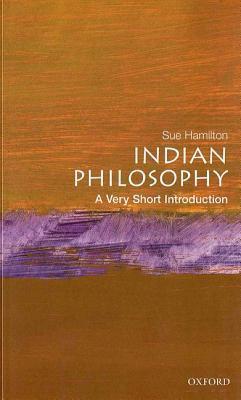
India has a long, rich, and diverse tradition of philosophical thought, spanning some two and a half millennia and encompassing several major religious traditions.
In this intriguing introduction to Indian philosophy, the diversity of Indian thought is emphasized. It is structured around six schools of thought that have received classic status. Sue Hamilton explores how the traditions have attempted to understand the nature of reality in terms of inner or spiritual quest and introduces distinctively Indian concepts, such as karma and rebirth. She also explains how Indian thinkers have understood issues of reality and knowledge--issues that are also an important part of the Western philosophical tradition.
About the Series: Combining authority with wit, accessibility, and style, Very Short Introductions offer an introduction to some of life's most interesting topics. Written by experts for the newcomer, they demonstrate the finest contemporary thinking about the central problems and issues in hundreds of key topics, from philosophy to Freud, quantum theory to Islam.
This is an especially dense Very Short Introduction, compressing its vast field into a 35,000-word neutron star of information. I found I had to take it slowly, despite the fact that the writing is clear and well-ordered.
Hamilton takes the decision to leave most key terminology untranslated, a decision I approve of, but it does leave the novice facing some pretty daunting discussions on things like svabhāva, or jñāna-kāṇḍa. Where other introductory books might write that ‘matter is seen as being less important than the underlying soul or consciousness’, Hamilton instead writes that ‘prakṛti is qualitatively inferior to puruṣa, and the sense of self imparted by the I-maker deluded’. This is ultimately better, but for a beginner like me it required some slow and careful reading.
I've shelved it under religion as well as philosophy; one of the things this books does especially well is make the point that the distinction between the two is a uniquely Western (and post-Kantian) one. Most of the thought systems here are, at least in some sense, soteriological, in that they have mokṣa or release from reincarnation as their more-or-less ultimate objective. To me with my feeble knowledge of Western philosophy a lot of it felt vaguely Pythagorean, or at any rate Pre-Socratic. Hamilton suggests near the end that those Indian philosophers who have become known in the West have done so by jettisoning the wider religious context of their arguments, and she looks forward to a time when a more authentically Indian milieu can be incorporated into these discussions. That seems to me to be a very fruitful and sensible position.
There is quite a lot here that I still don't understand (as you'd expect) – the intricacies of some of the Buddhist schools in particular are clearly far deeper than can be explored in this format – but what I am left with is a decent sense of the (impressively long) chronology and an idea of some of the key recurring themes. A focus on the power and meaning of language comes up a lot, as it does in Western thought, and that I found fascinating in the context of Sanskrit (except where it veers into epistemology, something I'm afraid I have always found totally uninteresting).
But most of the discussion, in this book at least, is metaphysical. The questions revolve around the nature of reality – whether or not there is some underlying nature separate from what we experience through our senses, and whether everything is ultimately the same one fundamental substance or rather made of a plurality of essences. You can see I've forgotten most of the proper terms already, but you get the idea.
Overall it's a very clear outline of what is obviously a big, complex field. It made me very aware of my ignorance in this area – but, as books like this need to, it also offers an excellent Further Reading section to help address the deficit.
Sankara's Advaita Vedanta is perhaps the best known of Indian ‘philosophies.’ It was the first to be exported to and propounded in the West, being presented by the Vedantin practitioner Vivekananda at the World Council of Religions in Chicago in 1893 as ‘Hinduism’, and subsequently established in various centres, such as ‘Ramakrishna Missions’, in many Western countries. It has since enjoyed such a high profile worldwide that not only do outsiders often not realize it is only one among many of India's schools of thought but it is also sometimes promoted as ‘the orthodox religio-philosophical tradition of India’ within the subcontinent itself.
This VSI gives a glimpse at the multifarious monster that Indian Philosophy really is. However, in the interest of making it comprehensible is such a short space, it tries to put an organic structure on indian philosophic ‘growth’ — it focuses on the most accessible aspects of the Indian tradition to extrapolate for consideration in the context of Western thought, debating its structure, relative methodological merits and inter-linkages in the process. It emphasizes the ‘context’ of each school so as to demonstrate the factors that led to its ‘branching out’. It also uses loaded terms from the western tradition such as ‘idealism’ and ‘transcendental logic’ to make the general thrust of the various schools intellectually available to the western reader.
As is often the complaint: In order to be taken seriously on the international stage of modern Western philosophy, Indian Philosophy has had to compete only on those terms that are of interest to modern Western philosophers. And, there has also been a tendency to separate philosophy in the sense of rational argument from any context that incorporated more religious issues.
Similarly, works on Indian philosophy adopts a western view on compartmentalization and wants to look at it as ‘philosophy’ — something alien to these schools, since all (well, most) of them would not have made a distinction of religion vs philosophy. It was not a case that Indian philosophy was more ‘mystical’; in fact, indian religious thought was more practical and incorporated the full range of speculations, not allowing theology to move away from philosophy. Whether that was a good thing is, of course, open to debate.
This VSI would not have been able to do an ‘introduction’ in 35,000 words without adopting the format and approach it eventually did. And as long as the reader is made aware that the whole book is an illusion of coherence, then it is fine by me. This is hinted at, but should have been made much clearer:
While the different logical arguments can be extrapolated and removed from the context of the tradition as a whole for intellectual interest and for the purposes of comparison with Western forms of logic, the classical Indian context was one in which there was no such formal separation.
All this is very fine and makes for interesting reading — but the thing is that indian philosophy does not always follow the outgrowth-model that is used to introduce the students of western histories of philosophy, it is more often ingrowths that guide its paths.
The philosophic traditions were quite often self-contained and hermetically sealed from one another, and hence grew almost independent of each other (not all, and not always… this is a gross simplification — a conceit by this reviewer, if you will). So minor differences are enhanced in this process just as small populations of the Galapagos finches develop such distinct beaks by inbreeding and mutual separation.
So to look at ‘Indian Philosophy’ as an organic whole and impose a structure of ‘growth’ and interrelation to the different schools is a retrospective western conceit — useful only for comprehending/seeing the whole picture, but at the cost of reducing the individual philosophies to non-entities, losing their real identity as rich self-contained traditions (inside each of these schools the dominant ideas that give it its identity might have wrestled with contending views before one triumphed temporarily — so to present another view as another 'school' makes no real sense when both schools are fighting the same battles...)
Such an introductory work which focuses on the distinct process of evolution available for study among the Indian traditions is what I would be really excited about. Such a work could go beyond presentation of ideas and attempt a glimpse at how they evolved in a medium that is not too distinct from the hyper-connected world of today (with collective enterprises taking precedence over individual investigations) where ideas bounce off each other, inbreed and mutate at the speed of thought, not waiting with patient discipline for neat out-branchings from previous ideas in any logical order. It is all a-tangle, and it is a lot of fun.
I am a big fan of the entire "Very Short Introduction' series, and have read several dozens of them. However, even in that field of mostly outstanding introductory books, this one stands out. I cannot give it enough praise. This is an eminently readable yet extremely intellectually stimulating book. It manages to convey the full richness and subtlety of Indian philosophical tradition, or at least as much of it as can fit in this format. Hamilton takes us through the historical development of the Indian philosophical thought, linking each new development to the previous ones, and emphasizes its significance. This is the first book that has convinced me that there are highly sophisticated philosophical traditions that have emerged outside of the Greco-Roman world. It would be of interest to anyone interested in philosophy, and not just for those interested in Indian thought. I highly recommend this book.
Very well done VSI; since it's a ridiculously broad topic to cover in such a short format, Hamilton has to be selective, but she is rationally selective, and tries to make everything fit together in a narrative and in comparisons. It's dense, and hard, because the philosophy is dense and hard, not because Hamilton does a bad job.
first of all, i bought this book unplanned at a book fair in hope that it would help me give an orderly perspective of ideas that i have encountered so far. it clearly does not do that to the extent that it could.
hamilton has had a 35k word limit and she did not use it at all. first of all, the book begins with many disclaimers, stating facts that really are already understood to any reader. secondly, we are given a lot of history with many names of authors and schools but the key ideas that separate them are not given clearly or at the proper place or actually at all. she could also make (better) use of diagrams to represent differences with less convoluted explaining. a lot of "space" is lost at the beginning with explaining the difference between religion and philosophy, which could actually be done in a shorter fashion later, when the need for this distinction arises. the chapter on language is too long and doesnt say much interesting. the book is repetitive in many places, for example every few pages the chronological timeline gets a new line (why?), or when she is first rephrasing the author and then offers a citation with the exact same point or the part about "sacrificies maintaining the order of the universe" that comes up time and time again. she also takes many opportunities to make excuses that indian philosophy is not mystical, as if this colonized abandonment of soteriology for the favour of the west is something that should be applauded- all this, while we are left wanting for content in more important places. the noble eightfold path, samadhi, lila, virtues, levels of consciousness are left out in favour of repeating and explaining pluralistic attributes and elements, twice. most of the book is representing conventional, pluralistic, ritualistic philosophies that resemble western ones instead of those that are radically different and interesting to a reader. the book really should be divided differently - this overarching chronology is meddling the waters - it would be way more clear to divide it into epistemology/linguistics, metaphysics, and ethics and then each of those should have a chronological listing of schools/positions with differences clearly stated along with new key concepts that they brought to the table. in short, much has been repeated and much has been left out.
i do have to admit that she does give justice to nagarjuna and shankara. those chapters are worth reading and there are some fine gems about indian epistemology in there!!! one would expect way more from an oxford scholar, but i will keep it as a list of literature to revisit. or as a templete about how not to do justice to your topic.
one more thing, i read the bosnian edition and it is abominable. the text is left-aligned, the margins will hurt your eyes, there are many double spacings and quite a few mistypes. at some point, after a framed text, we are given half of a sentence, and the first letter isnt capsed. not to mention that the translation is clearly not giving justice to the original text. the most half-*ssed job a publisher i have ever seen.
A concise guide to Indian Philosophy is a tall order. Over millennia, the discipline has had time to swell. This necessitated some careful pruning and selection on the part of the author. While the book does present key distinctions between all six of the orthodox schools of Indian Philosophy (i.e. Nyaya, Vaisheshika, Samkhya, Yoga, Mimamsa, and Vedanta,) the only one of the heterodox schools that it substantially addresses is that of Buddhism. (There are three major heterodox schools of Indian Philosophy by most accounts – Caravaka, Buddhist, and Jain, though some also include Ajivika and Ajnana to make five.)
This book focuses on the most novel ideas of each of philosophical schools under study, and it particularly focuses on points of debate where there is disagreement within or between schools. The book, therefore, moves metaphysics, ontology, and epistemology, but doesn’t explore all major philosophical questions for all the schools.
If you’re looking for a book that sums up the key points of debate between and within major schools of Indian philosophy, this is a great book. It does the job quite well and with a minimal page count. If you need a book that offers insight into more than the major points of contention, but extends into a given school’s stance on some of the less provocative questions, I’d recommend Chatterjee and Datta’s “An Introduction to Indian Philosophy” (it’s much longer and denser, but dives deeper and farms wider.)
I like how this book was organized and thought it did a good job of being both concise and clear (a duo that doesn’t play well together with regards complex philosophical subjects.)
الكتاب كان مدخلًا جيدًا في الفلسفة الهندية و طرقها و مدارسها و بداياتها و آرائها و تطوراتها في عدة مراحل من البراهمة و حتى البوذيين الكتاب موجز و قصير نسبيًا و فتح لي أفق جديد في الفلسفة ، ينقص الكتاب الكثير من المادة و التوسع و التوضيح و الشرح و قد قيمت الكتاب بثلاثة نجوم للمحتوى القيم و الموضوع الرائع الذي يتناوله .
this was the first time i thought a woman had written sometyhing badly, not all of it, just some of it. however i think they might have been user error as i really do struggle with indian philosophy. i will never forgive those mfs at kings for not forcing me to take an indian philosophy module in first year because its so different to western philosophy, once all youve learned is western philosophy, going intp eastern philosophy can be a struggle. however, i am eager to rectify the mistakes in my knowledge and eager to do a module on this, particularly because the best section in this book was buddhism, and my module is focuing on buddhism. shoutout to sue hamilton for being a reader at King's!
This entire review has been hidden because of spoilers.
The author wishes to demolish an old myth that the Indian tradition is 'mystical' and 'spiritual' in contrast to the Western 'logical' and 'rational' tradition. She is right to do so, as this is quite as patronizing to the Western religious traditions (whether Judaeo-Christian or pagan) as it is to the Indian philosophical ones, but come as no surprise to me (do not all people at all times ask questions about the strange and inexplicable phenomenon of existence?), so it was somewhat tedious. Indeed, it seems to me to be slightly patronizing to separate of 'Indian' philosophy anyway, as it implies that it is somehow only relevant to Indians, and not of common human interest, or even that it is inferior in quality - not 'mainstream'. But, alas, centuries of separation means that those classical philosophers (the author takes a historical approach, and abruptly stops at the end of - in European terms - classical antiquity) need to be considered on their home turf. But I cannot help but think that a more interesting endeavour would be to note the ways in which people, divided in time and space, end up saying the same thing, rather than different things.
Chapter 1: Reason and Belief: Richness and diversity in Indian thought Chapter 2: The Brahmanical Beginnings: Sacrifice, cosmic speculation, oneness Chapter 3: Renouncing the Household: The Buddha's Middle Way Chapter 4: Issues and Justifications: Language, grammar, and polemics Chapter 5: Categories and Method: Vaisčeṣika Nyāya Chapter 6: Things and No-things: Development in Buddhist thought Chapter 7: The Witness and the Watched: Yoga and Sāṃkhya Chapter 8: The Word and the Book: Bhartṛhari, Mīmāṃsā, and Vedānta
As a total neophyte, I found this book useful and easy to follow. It doesn't go into a lot of depth about any particular philosophical school, but it is good for understanding how different strains of Indian thought emerged from a common background and developed in relation to each other.
Kant marks the schism in Western thought, separating faith/religion from philosophy - latter being what can be known, limits of reason, and therefore the scope of philosophy.
Indian philosophy makes no distinction. Darshan - seeing, rshis - seers. What insight beyond cognitive perception (yogic perception) can be ganed by tuning and training the mind like a musical instrument?
2000BC Vedas. 800-500BC Upanishads. 500BC coexisting ritual+gnostic Brahminism. Householders vs renouncers. 400BC: Buddha. 300-100BC: exegetes. 200BC Vaisesika Sutra. 200AD Gotama Nyaya Sutra. 200BC to 300AD: Buddhist schools, Abhidharma, Mahayana, Prajnapramita (perfection of wisdom), Nagarjuna’s madhyamaka, mental processes of Cittamatra/Yogacara. 200AD: Yoga Sutras. 300-400AD: Samkhya. Bhartrhari connects language with knowledge of Brhman. 600AD Mimamsa (kumarila, prabhakara) of Vedic karma-kanda. 700AD Sankara’s Advaita Vedanta of Upanishadic jnana-kanda. 1000AD Ramanuja’s Visishtadvaita Vedanta (qualified non-dualism).
Vedic rituals and Dharma - performing action that creates set of conditions across the cosmos. Then Brahmanas/Aranyakas and Upanishads contemplating how this can be internalized within the self (no need for ritual) but coexisting along with ritual. Then Buddhism/Jainism questioning why we can’t just stick with the internalized versions.
Ritual-dependent world propagated by idea that during Brahmachari/Grihastha stage, should perform ritual, and then after child-bearing responsibilities done, then seek liberating knowledge.
Mimamsa (karma-kanda - action section) exegesis of Vedas, against Vedanta (jnana kanda - knowledge section) of Upanishads.
Sramanas (renouncers) rejected rigid Brahmanical prescriptions. Buddha rejected both - middle way.
Sramanas might have inherited Indus Valley tradition (did not arise from within Aryanism). Internalizing ritual in general might have come from indigenous influences.
Like all things, the self can only be understood from a frame of reference outside the self, so a complete understanding of reality will always tend towards the quest for moksha, not annihilation but transcendence in order to understand what this is. This is what makes heliocentrism so paradigmatic, not its factual accuracy but the idea for the first time that we can look on the earth from the outside to understand it better (transcendental deduction?)
Buddha’s enlightenment was 3 insights: 1. I see all my previous lives 2. I see how everyone else is a result of previous lives 3. I see a way out. While Upanishads say all is Permanence/Oneness and thus can be understood, Buddha - this is impermanent, characterized by unsatisfactoriness.
4 Noble Truths: 1. Existence/Unsatisfactoriness can be formulated 2. Its continuation are fueled by certain factors 3. Cessation is possible 4. There is a way leading to cessation. Specifically: 1. Existence is characterized by dukkha (unsatisfactoriness). 2. Dukkha from intentional state of mind (cravings + desires). 3. Cessation of dukkha is possible - nirvana 4. There is a path leading to Nirvana - 8 fold path.
Tetralemma: 1. Existence 2. Non-existence 3. Existence and non-existence 4. Neither existence nor non-existence. Buddha’s middle-way of impermanence: ‘dependent origination’ no independent existence.
Buddha’s object of investigation/understanding is not ontological (what is real) but the operation of cognitive faculty: link between how mind operates normally vs how cravings/desires affect it. Cravings atrophy when we identify falsity of independence/separateness (categorical imperative?)
All knowable things (dhamma) are not self (anatta): whatever you know is connected to the nature of knowing, not the nature of the thing being known (independent of knower), hence cannot know self (Kena U.?)
‘He saw the focus on remembering sacred formulae precisely, and guarding a sacred language from others, as diverting attention away from the need to understand teh structure of existential mechanics to the minutiae of sounds and utterances.’
How to take brahmin priests seriously, if ideas about internalized ritual had not been experienced by them, instead passed down through teachings. The idea perpetuates itself, seeking the perfect mind in which it can be born anew.
Vedas had to be defended in 2 ways: 1. Defend the point of ritual and 2. Establish connection with truth through 6 vedangas (limbs of Vedas) a. Phonetics b. Metrics c. Grammar d. Etymology e. Astronomy f. Ceremonial rules
Sanskrit’s role in the ‘creative process of the sacrifice’
Needed to argue that entire Vedas were coherent/meaningful: Jaimini’s start of mimamsa exegesis of Vedas. Everything in text in terms of being an instigator of action.
Dharma as 2 levels: macrocosm (cosmic order) and microcosm (what should be done). Adharma: breakdown of order, is when intervention is needed (Krishna in Gita)
Unlike Jaimini’s plurality, Badarayana’s Brahma-sutra or Vedanta-sutra’s oneness of Brahman - ritual injunctions don’t automatically indicate truth of their content, instead metaphors to know self. Mimamsa (Veda) = Purva (early) Mimamsa. Vedanta (Upan) = Uttara (later) Mimamsa.
Sutras are so cryptic, frequent branchings as different exegeses interpret differently. What to do now? Study all nodes and then abstract backwards is p=np hard? Or go back to the source and start studying branches in pairs?
If you rejected reliability of ‘testimony’ (sabda-pramana), then you had to establish primacy of at least one other epistemological criterion: perception , inference, reasoning.
Anvikshiki: logical reasoning, subject of enquiry, what is to be looked at.
Debate style: give proposition and then disprove it. Purvapakshin.
Jaimini: vedas are supreme. Kanada (Vaisesika): vedas have authority because they uphold dharma (nature of reality), which is supreme. Pluralistic realism: explore nature of things and their particularities (visesa).
Substance: 9 - earth, water, fire, air, ether, space, time, self, mind. Earth, water, fire, air combine to form objects. Ether, space, time and self are eternal/all-pervading. Mind is atomic in size, 1 mind atom is associated with 1 self-atom in a human being. Mind allows Self to be internally perceived.
24 Qualities, some that exist only in material substances (color, touch), some only in immaterial (consciousness, happiness, unhappiness, aversion, desire), and some that occur in combinations (conjunction, number).
A red rose encompasses 5 full categories: substance (rose), quality (redness), relation of inherence (substance + quality), particularity (red rose), universality (all redness, roseness).
Action - causality, all active parts of substance as opposed to passive/inactive Quality
Absences: 5 - absence (no rose here), difference (rose is not a cow), pre-existence (no rose yet on bush), post-existence (rose has come and gone), and non-existence (no rose will ever grow on a cow).
Gotama - nyaya-vaisesika. Valid means of knowledge. Inferential reasoning.
Nagarjuna’s Middle Way: between Nihilism (no-self, no-existence) and pluralistic realism of Vaisesikas - using dependent origin to say emptiness not as a substance (nihilism) but as a feature (all comes from something else, so no independent existence)
Vasubandhu’s 3 aspects of existence: constructed aspect (mental process mistakes superimposed construct for reality). Dependent aspect: raw data that is processed to become constructed aspect. Perfected aspect: reality as it is, without any construction.
True seer/self is Puru. Mental activity causes manifestation/seen Prakriti (done by Puru). Yoga separates these 2: reveals unconscious activity and makes everything conscious. Purus is only a witness. Yoga sutras as a practical map for internal journeys. Not a philosophical stance, but a description of states in which these stances can be gained. Teach a man to fish. In contrast: Samkhya (enumeration) Karika (isvarakrsna) has more clearly elaborated ontology/means of knowledge - enumerating, analyzing and discriminating categories of manifest world. Overcome suffering by discriminating between manifest, unmanifest, and knower.
Dualism: purushas (multiple knowers, distinct but identical) vs prakritis (singular: given, ie unmanifest, but also created, ie manifest in conjunction with purusha). Hence, nothing new is created (unmanifest becomes manifest) - effect pre-exists in the cause. Satkarya V.9 - things can only be produced by what is capable of producing them.
This attitude of causality is why inference is so important in Samkhya.
3 Qualities (sattva rajas tamas) as goodness, energy/passion, inertia - to manifest, activate, and limit. This is the best description of sattva I’ve read yet, reconciles the issue of an unnecessary sattva when an accereration/retardation is enough to explain all points of the wave (ascending, descending, equilibrium). Further - the qualities successively ‘dominate, support and interact with one another’. Superficially, I assume this means Rajas dominates the others and interacts with Rajas. Tamas interacts with Tamas and supports the other 2. Sattva dominates Tamas, supports Rajas, and interacts with Sattva? This is another way in which we can elevate Sattva over the other 2, in terms not of goodness but of flexibility.
Manifestation of Prakriti structured by categories: Buddhi (will, discriminating faculty - eventually discriminates purusha); Ahamkara (ignorant of purusha, thinks it is the conscious-self); Mind; 5 Sense organs; 5 action organs (voice, hands, feet, reproductive, excretive); 5 subtle elements (sound, touch, form, taste, smell), 5 gross elements (space, wind, fire, water, earth). Enumeration of these categories show how we unconscious prakriti thinks selves conscious (ahamkara: thinker of thoughts), how discrimination occurs within that state.
Buddhi drawn away from inactive purusha to active ahamkara (focus of experience).
Bhartrhari’s sabda-brahman (monistic sound). Language, and the sound of the universe, is continuous and indivisible. Can only be understood as a whole, not split into words/phrases.
Sankara’s main work is unifying the triple-foundation of revealed truth: Brahma Sutras, Upanishads, and Gita.
Vivarta-vada (manifestation by ‘appearance’). Effect pre-exists in cause, but change isn’t a transformation, but an illusion, all effect is just a manifestation of plurality. Hume’s causality? If everything coexists in 4D spacetime, including all possible states of plurality, then causality is simply the path we take to traverse space in time. Any alternate route gives alternate causality. Except of course that our view of causality is predictive, ie once that sequence is established, it always occurs in the future?
Misperception of coiled rope as snake, this ‘conventional reality’ of snake has real effect on us, but absolute reality of rope can be seen through to. Moving in a riverboat, we see trees moving backwards, in the same way do we see the soul being reborn.
Conventional reality is brhmn with qualities (saguna brahman). Absolute reality is brhmn without any qualities (nirguna brahman).
Sankaracharya’s advaita vedanta presented by Vivekananda as ‘Hinduism’. Even more representative is that of Ramanuja, part of devotional sect of sri-vaisnavas (bhagavata puranas) - he reconciled theology of bhagavatam with philosophy of sankara’s triple foundation. Not just an exegete but defender of a specific religious stance.
Unlike Sankara’s absolute monism, Ramanuja’s visistadvaita qualifies link between brahman and various selves (us), the way a rose is qualified by redness and other qualities, and cannot exist without these qualifiers. Unlike Sankara’s vivartavada, ramanuja’s parinama-vada has monistic brahman manifesting as plurality through ‘transformation’ not appearance.
Why Indian philosophy inseparable from ‘religious worldview’ - because despite being compiled over a millennium and containing enough variance to support multiple contradictory exegeses, these texts have a tag of epistemological certainty.
This is a dense read. Limited to only 35,000 words by the format of the Very Short Introduction series, Sue Hamilton does an admirable job in her attempt “to give a flavour, to lead the interested reader into a larger and more complex topic than the book can cover comprehensively, to make such a topic accessible to the beginner” (p. 20). Still, I certainly would not call this a fun read. I remain confused by the intricacies of Indian philosophy, but am also inspired to learn more. I was most interested in her account of Buddhist thought and am fascinated by the mystery of why it declined so much in India while flourishing in other countries. *
Quotes: “India has a long, rich, and diverse tradition of philosophical thought, spanning some two and a half millennia and encompassing several major religious traditions...philosophy is seen not in terms of a professional intellectual pursuit that can be set aside at the end of the working day, but as an attempt to understand the true nature of reality in terms of an inner or spiritual quest. One might say that what Westerners call religion and philosophy are combined in India in people’s attempts to understand the meaning and structure of life – in the broadest sense. This is comparable more with the approach of Socrates than with religion as faith in revelation and philosophy as an academic discipline.” (p. 26). * “Philosophy in India is about seeking to understand the nature of reality. Furthermore, the point of doing this is that it is believed that understanding reality has a profound effect on one’s destiny.” (p. 33). * "Though it is now regarded as a religious activity, the performance of the Vedic sacrificial rituals was largely for this-worldly ends. That is, the primary purpose of the sacrifice was the maintenance of the cosmos at its optimum level of status quo. The sacrifices were addressed to aspects of the natural order of the cosmos, such as sun, rain, lightning, wind, and so on, as well as abstract principles, such as contract and vow.” (p. 47). * “Dukkha has often been translated as ‘suffering’, ‘pain’, or ‘ill’, but it is now widely recognized that this wrongly attributes to the Buddha a deeply negative, and readily refutable, view of human existence. A better translation is ‘unsatisfactoriness’, which conceptually relates dukkha to the Buddha’s teaching that all of the factors of our phenomenal world of existence are impermanent.” (p. 75). * “The Buddha was denying not people’s selves, but that anything exists independently. This clearly is in contrast to the claims of others of the permanence of selfhood, but that it is stating that there is no self is questionable.” (p. 79). * “Textual sources suggest that during the 500 years following the lifetime of the Buddha, some 18 different schools of Buddhism were established.” (p. 120). * “In Brahmanical thought, dharma means both cosmic order and one’s personal duty” (p. 122). * “For about a millennium after the death of the Buddha, Buddhism flourished in India. During the reign of the Maurya king Aśoka, in the 3rd century BCE, Buddhism became the official state religion of India and its monastic communities were heavily endowed.... For centuries, Buddhist thought played a major role in the religio-philosophical life of India, contributing a variety of original and sophisticated ideas, critiques, and points of view…It is not known for certain how or why Buddhism virtually died out in India… Certainly when Muslims settled in India, from the 8th century CE onwards, they were able without difficulty to eradicate what remained of Buddhism in India: by then the monasteries were vulnerable to the wholesale destruction they suffered at the hands of the Muslim iconoclasts.” (p. 125) * “Sankara's Advaita Vedanta is perhaps the best known of Indian ‘philosophies’. It was the first to be exported to and propounded in the West, being presented by the Vedāntin practitioner Vivekānanda at the World Council of Religions in Chicago in 1893 as ‘Hinduism’, and subsequently established in various centres, such as ‘Rāmakrishna Missions’, in many Western countries. It has since enjoyed such a high profile worldwide that not only do outsiders often not realize it is only one among many of India’s schools of thought but it is also sometimes promoted as ‘the orthodox religio-philosophical tradition of India’ within the subcontinent itself.” (p. 170). * “…more representative of the daily beliefs of many ‘Hindus’ is the thought of the 11th-century CE Vedāntin, Rāmānuja. Rāmānuja was a fervent member of a highly devotional sect known as the Śrī Vaiṣṇavas, whose object of devotion was the personal Lord as represented in a sectarian text called the Bhāgavata Purāṇa.” (p. 170). * “While the different logical arguments can be extrapolated and removed from the context of the tradition as a whole for intellectual interest and for the purposes of comparison with Western forms of logic, the classical Indian context was one in which there was no such formal separation.” (p. 175).
Title:Indian Philosophy: A Very Short Introduction Author(s): Sue Hamilton Series: Oxford Very Short Introductions Year: 2001 Genre: Nonfiction - Eastern philosophy Page count: 202 pages Date(s) read: 1/27/24 - 1/27/24 Book #29 in 2024
The author has done a commendable job in summarising, sometimes lucidly, the key arguments surrounding core debates of the different schools of thought of Indian philosophy, which don't always make an attempt to be coherent. Someone not trained in the art of philosophy could also benefit from this book if they pay close attention to authors choice of words. Key ideas do get repeated in the text but that's due to the philosophy being discussed, not because the author is being redundant. However I like the fact that she has been able to maintain a flow within the text and the arguments.
I have taken a star out because I was expecting a bit more clarity from her on Buddhist philosophy. Additionally, the author puts forward the different schools of philosophy as interacting with each other, either directly or through the societal context. To which extent is this true is a question someone already well read in the Indian tradition can probably answer.
Overall, it is an extremely readable but dense book which gave me exactly what I was looking for - a very short introduction to Indian philosophy. :)
Finished this at work today on my breaks. It definitely lives up to its name "A very short Introduction".... which isn't necessarily a bad thing, and in this case, for the most part it isn't. It definitely breezes through a lot of topics, some of which obviously doesn't get enough time to allow for full grasping of it. Which in some ways is a good thing; it forces one to read the primary sources or other texts (either way it requires further reading) but on the other hand, its a bad thing because its not simplistic enough for a laymen or for someone hoping to get caught up on a topic (especially one as vague and large such as this).
This does make me interested in the other books/topics of this series (with albeit different authors, one of whom is Simon Critchley, who I've read some of his works before).
كتاب مهم عن تاريخ الفلسفة الهندية، يتكون من ثماني فصول، يوضح التطور التاريخي للفكر الفلسفي الهندي، ويشرح بدايات الفلسفة الهندية الكلاسيكية ومدارسها الفكرية الرئيسية عارضا الفلسفة البوذية بشكل مختصر، واللغات والقواعد المستخدمة، ركز على الفترة التي بدأ خلالها التراث الديني الفلسفي الهندي، والأفكار والممارسات السائدة في ذلك الوقت، وناقش بعض التقاليد والمدارس الفكرية القديمة مثل الفيدا القربانية لدين كهنة البراهما، كما تناول أنظمة الدراشانا الستة الكلاسيكية، وميز بين الفكر الديني والفكر الفلسفي، وقدمت هاميلتون من خلاله عدة مفاهيم هندية مميزة من خلال ست مدارس فلسفية مختلفة تتفاعل مع بعضها بشكل مباشر أو غير مباشر من خلال السياق الاجتماعي، كما قدمت لمحة موجزة عن وجهات النظر المتباينة بداية من الطقوس الفيدية القديمة مرورا بمنطق نيايا وصولا إلى اللاشخصية المؤهلة لرامانوجا. يؤخذ عليه حمله للعديد من المصطلحات والشخصيات التي كانت لابد أن تبسط.
As someone who is not philosophically inclined, I find it very hard going to understand the larger issues of the book, much less the concepts that were specific to India. That being said, if I had to know about the topic in greater depth, I'd reread the book since it is a concise ("short" having some negative connotations that the entire V.S.I. series belies) means of approaching the subject in a limited amount of time.
This book barely scratches the surface of Indian philosophy, then again, nothing really can. What this book successfully does is demonstrate the spread of topics, history and geography of a very intricate and expansive philosophical tradition. It is the case however that even though there can't be a full overview, this book is not without breath and for a short book as this, not without depth. Quite impressive and one of the better VSI books in my view.
A good book, overall. It goes through various Hindu and Buddhist schools, showing the differences between them. However, I think I would prefer less detail (less schools of Hinduism and Buddhism) for wider coverage (including Jainism). It would be better to go through a wider range of main philosophico-religious branches. Readers would then be able to pursue select main schools that interest them.
I’ve recently finished a book on Hinduism which is really pretty much about Indian Philosophy so I was interested to read this book which promised a more general overview of Indian thinking. Admittedly, both books were "Very short introductions" which limits what can be transmitted. Alas, it was pretty much the same and what I found missing from both books was some sort of critical analysis of both the history (as transmitted) and the actual ideas. It seems to me that there is less emphasis in the Indian Philosophy on divine revelation. That the sages were regarded as simply wise people (they all seem to be male). But they were not claiming (as in the Western tradition) that they were getting their message direct from God and therefore it had universal and irrevocable application. But I should mention here that I’ve only read this book in the Blinkist summary version, so, inevitably, have missed the detail and nuances that would be covered in the full book. Nevertheless, I’ve found these summaries to be pretty good and have no reason to doubt that, in the current case, that the Blinkist team have done a good job in extracting the essence. Anyway, I’ve extracted a few nuggets below which help capture what the book says. “Mapping the universe:....The sages of the Upanishads and later thinkers like Nagarjuna pursued knowledge with a clear goal in mind: to transform their destiny and achieve liberation from the endless cycle of rebirth......it's a sophisticated understanding of how actions create consequences. By the 5th century BCE, this understanding evolved to encompass all actions, with their effects potentially spanning multiple lifetimes.....The Buddha would later revolutionize this concept by teaching that intention, not just action, was the key to karmic consequences. They created an incredible system of knowledge written in sacred texts called the Vedas. Their world centred on sacrifice–detailed ceremonies they believed maintained the harmony of the cosmos. The brahmins maintained their position at the top of society because people believed their ritual purity kept these cosmic-maintaining ceremonies effective.....Some brahmins focused on performing ceremonies, others turned their attention inward......These inner-focused thinkers developed the teachings found in the Upanishads.....These texts introduced a revolutionary idea: your deepest self or atman shares its nature with the universal essence or Brahman.......Whether through precise ritual actions or deep insights into the nature of things, these thinkers aimed for practical results–breaking free from the cycle of rebirth and knowing the highest truth. Buddha's revolutionary path to awakening:...Around 485 BCE, Siddhartha Gotama was born to a wealthy family in what we now call Nepal.....This young prince would eventually become known as the Buddha, the Awakened One......He shared what he called the Four Noble Truths, but took a completely different path than the brahmin priests.....The Buddha's most striking teachings centred on two ideas: how everything connects, and how nothing stays the same......He created a balanced approach between extreme self-denial and complex rituals. This practical focus, would go on to influence not just Buddhist thought but the entire landscape of Indian philosophy.......These ideas spread rapidly across northern India, challenging the established order. The brahmins began their response by looking deeply at language itself......From this focus on language grew new ways of proving what we can truly know. [Almost the same as the linguistic schools that grew up in British Philosophy around Bertrand Russell and Witgenstein]. As these ideas about knowledge grew, another school called Taisheshika mapped out everything that exists. They found several basic building blocks of reality: substance, quality, action universality, particularity, inherence, and absence....From these intellectual foundations grew many branches of Indian thought. Some focused on understanding the nature of knowledge......Others turned toward exploring consciousness itself. As these ideas flowed through Indian society, they sparked something revolutionary-whole new ways of understanding the human mind and its potential. Two systems in particular-Yoga and Vedanta-created bridges between philosophical theory and spiritual practice that people still walk today......Yoga's origins stretch back to India's earliest spiritual seekers,....By the time these practices were systematized in Patanjali's Yoga Sutras around the 3rd century CE, they had evolved far beyond physical exercises. techniques to still what they called the modifications of the mind.....Yoga points to something deeper-a pure awareness that watches it all happen. This watching presence, called purusha, stands apart from everything it observes-the world of prakriti. Another tradition called Samkhya built a complete map of how this works. They saw reality as having two distinct sides-pure awareness on one hand, and everything else on the other. Then came Shankara, a brilliant thinker who turned everything upside down. His tradition, Advaita Vedanta, said reality isn't split in two-it's all one thing, pure consciousness-existence called Brahman.......Shankara said the whole world works like this. It's real, but not in the way we usually think. Other Vedantic philosophers like Ramanuja suggested a middle way........They saw reality as one fabric woven from many threads. Yes, everything connects in one great unity, but the distinctions we see still matter.......Each tradition offered a different map to freedom, a distinct way of seeing yourself and your place in the universe. Walk into any major university, and you'll find students studying ancient Indian texts right alongside Plato and Kant [Well that didn’t appear to be happening at the Australian National University when I studied Philosophy there. But there was certainly a strong school studying Sanscrit. I just didn’t see much or any overlap with the scholars studying Plato and Kant.] .........When Western scholars first began learning Sanskrit and reading India's ancient texts in the 1800s, something unexpected happened.....Indians themselves began looking at their philosophical heritage with fresh eyes.....Today, Indian philosophy travels two paths. In universities, scholars use modern tools to study these ancient ideas, showing they're every bit as rigorous as Western philosophy. [I’d really be interested in finding out about these studies but they don’t see to get much attention in the West....I must do a bit of research. My initial forays into critical analysis of ancient Indian teaching has not been very illuminating....there seems to be a lot of work in how they transmitted the message ...like pedogogy rather than analysis of the ideas]. Meanwhile, traditional schools in India keep teaching these ideas the old way, focusing on how they can transform your life. But here's the thing-this split between thinking and practice is new.....As we mentioned earlier, the original Indian philosophers saw no gap between careful reasoning and the search for spiritual freedom......These studies speak powerfully to modern questions. Their careful studies of meditation, how we perceive things, and the nature of awareness offer fresh angles on age-old mysteries: What watches your thoughts? How does your consciousness connect to the world?” So what’s my overall take on the book? Well, I think it’s generally pretty good except I would have liked a little more about modern Indian Philosophy. What are the scientists and scholars in the Maths departments and Engineering faculties and the Philosophy faculties thinking and teaching these days. My take-away from reading this book is that they are pretty much stuck with traditional Indian Philosophy but there is that throw-away line about Indian Philosophers using modern tools to analyse the ancient texts. So what is different? We are not given any clues. So three stars from me.
To explain the complexities of Indian Philosophy over two thousand years or so in one of the Very Short Introduction series from Oxford is asking for trouble but, within the series' constraints, Sue Hamilton does as good a job as might be possible under the circumstances.
On the positive side, she provides a framework for further study and helps us to understand both the developmental processes and sophistication of Indian thought. This was not burdened by the necessity to take into account an Abrahamanic variant of God.
It is difficult to separate philosophy from religion in the cases of Christian Europe, Judaism and Islam but these latter were able to construct a philosophical approach despite God. Indian philosophy can justly be regarded as a different and great thinking tradition, one that still allowed for 'God'.
Hamilton takes us from early Brahminical practice and thought through the multiplying and interweaving branches of Hindu and Buddhist investigations of reality and language. This leads us to the inevitable negative side of the book. There is just too much happening here over too long a period.
This is not Hamilton's fault. Her subject is complex. Over-simplification would mislead the serious reader. Her prose is clear but the need to cover so much ground means that this cannot be more than a framework. It is perhaps best to treat it as a useful way station than a terminus.
While treatment of 6 darshanas and Buddhist philosophy is ok, treating vedic philosophy as brahmanical is unwarranted. Also considering it as only ritualistic is grossly misleading. Few corrections: 1. Rich Krishna (a kshatriya) and poor Sudhama(brahmin) studied together. Same is the case with poor Drona and rich Drupada. This completely falsifies the argument Brahmins kept Veda to themselves and we're privileged.
2. Even Manusmruti, that distorts original vedic wisdom, advocates thread ceremony to all, not just Brahmins.
3. Vyasa was a fisherman, Vishwamitra a Kshatriya, Valmiki a hunter
Brahminical dominance may be true in pockets, but to impose it as general principle and interpret the whole philosophy in this light is completely misleading.
Secondly, the Gayatri mantra and purusha sukta found in rigveda samhita has spiritual value and also a model to determine ones dharma based on one's occupation and nature. It does not advocate varna based on birth. Repeatedly giving only ritual connotation to veda is again misleading.
It’s an enormously difficult task to translate and summarize over a thousand years of Indian thought and deliver to Western audiences and I think this book suffers from the weight of this task, oftentimes drowning in its own prose and terminology. I consider myself decently able to understand both technical and philosophical arguments but this book left me lost at many points. I think it would’ve helped significantly to simplify the terminology and even sentence structure, and would’ve been served by either a primer for each section or total reorganization of its content (the Short Introduction on Hegel does this well, as everything is contextualized and also cleverly arranged in such a way that reading one chapter improves the ability to understand the next).
It is, after all, a short introduction, yet I do not feel very “introduced”, only bewildered and hanging onto scraps of whatever I remembered.
A good basic introduction to the principal schools of thought in the classical Indian philosophical system. A book that I will definitely recommended to anyone who is looking for a starting point in this area.
I would have given it 5 stars but there is one aspect that left me a little disappointed. The author has completely skipped the Jain school of thought in this book and although she acknowledges that in the introductory chapter, the reasons are never made clear (apart from something along the lines of 'limited space and scope in an introductory book'). Personally, I would have preferred 10-15 more pages of discussion on Jainism than not having it at all. Perhaps it could be added in a later version.
🌕🌕🌗... Contains quite a few gems but would better be called a very short introduction to the *history* of Indian philosophy. Not much on contemporary thought - if at all. Tries to balance an Indian with a western philosophical approach to the matter - which must fail on a 35K threshold. Next edition should contain more graphs that conceptually compare the different schools. At the end, the reader is puzzled. What to make of all that history? Where are we now and how to proceed? I liked the concept summary boxes but the book would be much more powerful if it was structured differently. A chronological order is fine for background knowledge but it should not govern the overall narrative.
I like to have at least a decent graps of beliefs other than mine, if for no other reason than to represent them fairly. With Indian Philosophy, I knew next to nothing going in and came out with several key ideas and beliefs from this worldview. With that in mind, the introduction was successful. There was a lot of words left in their original language which was theoretically helpful because sometimes the most accurate rendering can be in the language it was formed (see homoousious), but this made it unnecessarily difficult in my case and may best have been left out of a general introduction.