A Scottish medieval adventure about the youngest in a war-band who must free her family from a castle prison after knights attack her home--with all the excitement of Ranger's Apprentice and perfect for fans of heroines like Alanna from The Song of the Lioness series.
One dark night, Drest's sheltered life on a remote Scottish headland is shattered when invading knights capture her family, but leave Drest behind. Her father, the Mad Wolf of the North, and her beloved brothers are a fearsome war-band, but now Drest is the only one who can save them. So she starts off on a wild rescue attempt, taking a wounded invader along as a hostage.
Hunted by a bandit with a dark link to her family's past, aided by a witch whom she rescues from the stake, Drest travels through unwelcoming villages, desolate forests, and haunted towns. Every time she faces a challenge, her five brothers speak to her in her mind about courage and her role in the war-band. But on her journey, Drest learns that the war-band is legendary for terrorizing the land. If she frees them, they'll not hesitate to hurt the gentle knight who's become her friend.
Drest thought that all she wanted was her family back; now she has to wonder what their freedom would really mean. Is she her father's daughter or is it time to become her own legend?
An unabashed fan of libraries (where she wrote her first novel as a teenager), history (especially from cultures or people who’ve rarely had their story told), and the perfect cup of tea, Diane lives in Maine with her husband and son. She uses the pronouns she/her.
Sometimes you just want to read a book that knows how to run.
There are many way to define the term “great writing” as it applies to children’s literature. Eloquent. Ennobling. Distinguished. These terms all work. Here’s another one. Booooooooring! Tell me you didn’t read at least one book as a child deemed a “great work of literature” only to find yourself snoring by page four. We’ve all been there. I do believe that there is a mistaken understanding out there that the slower a novel moves, whether it is for children, teens, or adults, the more worthy it must be in terms of literary achievement. Lest we forget, books with speed and velocity on their side can contain just as much emotional resonance as even the slowest of tomes. To back up this claim I present you with today’s book. It may be set in 13th century Scotland, the land of bogs, but nothing in Diane Magras’s high-spirited tale is ever (forgive me) bogged down. Fast on its feet, never slowing, never stopping to catch its breath, and yet filled to the brim with complex character development and personal growth, Magras pulls off one of the trickiest conjuring tricks I’ve seen. Behold! A book able to pull depth and meaning out of frenzy. Come one! Come all! You never saw the like.
12-year-old Drest is small and female, but underestimate her at your peril. She’s a canny lass, living as she does with her war-band brothers and her father, called The Mad Wolf. But even a canny child can be caught unawares. Without warning Drest’s father and brothers are captured by invading knights while she escapes unscathed. Left alone with one of the knights (wounded by one of his own) the girl cooks up a plan to exchange the man for her family. That means trekking off to Faintree Castle, a journey fraught with peril. Along the way Drest makes allies (the boy Tig with his crow Mordag and the accused witch/healer Merewen) and enemies (a ruthless bandit bent on pursuing Drest, a mob of villagers) alike. On her side Drest has stamina, cunning, and strength enough for all her companions. Yet she still has a lot to learn about the world, about her herself, and even about the family she believes to be so just. An Author’s Note at the back contains extensive information about the state of Scotland in 1210, Feudalism and Village Life, Women, Healing, Castles, Swords, The Landscape, and even the basis behind The Characters’ Names.
I wasn’t kidding before when I said that this book moves at a sharp clip. My six-year-old daughter has taken to watching me as I read middle grade novels for 9-12 year olds, asking every 30 seconds or so, “So what’s happening now?” (apparently actually reading the book to her is out of the question). With most stories that amount of time wouldn’t yield a lot of change. With this book, I honestly had new information to impart with every update. Then I read ahead 30 pages or so, so when she asked for a summary I had to tell her about the rescued boy with the crow and the witch who’s about to be burned and the bandit that almost catches them and more and more and more. All in 30 pages! Considering the fact that the book could potentially have come across as a long slog across the Scottish countryside, the fact that Magras is able to zip the reader from point to point effortlessly without sacrificing character development along the way is more than admirable.
There is another way in which the writer is able to keep the book moving. As an author, Magras utilizes a clever trick to keep the reader from dwelling too long in Drest’s head alone. To guide her choices (and her chances) Drest imagines the voices of her brothers and father in times of strife. What this means for the reader is a continually amusing, and very comforting (in its way) stream of advice and counter advice from men that won’t always agree with one another, even if they’re merely imaginary. And you’re certainly not bored.
Writers are often told that you should create characters with agency, and that reject passivity as part of their hero’s journey. Usually the hero will hear the call, reject the call, and then find something inside of themselves that makes them follow the call. Drest isn’t really like that. Pretty much from the get-go she is determined to use Emerick (the knight) to get to Faintree Castle to rescue her family. There are some moments later on when she feels a bit down, but at no point does there come a time when she thinks better of this plan. It’s interesting to be placed so squarely inside the head of someone with so few doubts. Of course, that’s Magras’s secret plan on the sly. Drest at first is steadfast in her vision of right and wrong. Then, through a series of events, she comes to doubt everything she took for granted.
One of the central themes of the book is the question of morality in the face of family loyalty. Separated for the first time in her life from her brothers and father, Drest encounters but the outward perception of her family by the masses. In some cases villagers are sympathetic towards her on behalf of what they owe her family. In other cases, quite the opposite is the case. As she collects stories about her family’s actions, some are true and some are not but it is often impossible to distinguish. This places Magras in a tricky situation. If Drest’s family really does consist of true brigands, then the only solution is to permanently separate her from them in some way by the story’s end. So the author must play it both ways. The family must be vindicated for the most part, but be guilty of some kind of horrid crime as well. Drest’s father, it turns out, admits to some innocent deaths, albeit unintentional ones. So Magras is able to maintain the theme of Drest learning that her family is fallible while also keeping her with them (for the time being).
I won’t say it’s flawless, of course. Few books for kids are, let alone debuts. So I was, admittedly, somewhat baffled by the fact that at no point Drest (or anyone else for that matter) raises any questions about of her mother, except for a very brief mention that she never knew her (or, it is implied, cared to). Yet for a story set in 1210, it is strange that no mention comes of Drest’s closest familial relation. Mind you, the ample Author’s Note at the back does a very good job of distinguishing the roles of different kinds of matrons and maidens in the medieval era. Readers can read into those what they will. Or just assume that Ms. Magras is saving the info for a future book in the series.
I was trying to think of books similar to this one and a title that sprang immediately to mind was Tamora Pierce’s Alanna: The First Adventure. When it comes to girl-with-sword tales, nobody tops the Pierce. Yet as I thought about it I came to slowly realize the pop culture character that sits even closer to Drest’s soul. Rey from the new Star Wars films wield a light saber and not a sword, but deep down she and Drest are mighty similar. So to the librarians of the world I say this: Know a Star Wars girl hungry for some strong female characters? Hand them this, hand them Alanna, hand them The True Confessions of Charlotte Doyle and then just keep on going. Girls with swords unite!
You know what’s hot this year? The 13th and 14th centuries in Europe. Boy, kids today that hunger for a little horse dung and serfdom are certainly in their element this year. Between this book and the also charming The Book of Boy by Catherine Gilbert Murdock, I don’t think I’ve seen Medieval life encapsulated so beautifully and so frequently. This book, being historical fiction, has a distinct disadvantage when held up alongside Murdock’s book or The Inquisitor’s Tale by Adam Gidwitz. I might be wrong but there’s not a single heavenly body in disguise on any of these pages. Kids sometimes get the impression that historical fiction is dull on some level. To those kids I hand Drest. Dirty. Filthy. Dead set. Warrior. Drest. A book for those kids that yearn for adventure, as well as children that would prefer their adventures to be played out by somebody else. By the end of this book Drest learns that “sometimes words alone can save your life.” The words on these pages may bear that out. A magnificent debut.
If you're looking for action, adventure, and lots of heart in a story helmed by a strong young warrior, this is an absolute must-read!!!
THIS is the book I longed for when I was younger, and was still longing for until an early copy landed in my hands. And it not only lived up to my long-held hopes; it smashed and surpassed them, delivering an unforgettable story of family, friendship, and bravery.
Thanks so much to my readers this year for your enthusiasm. I'm grateful for the many kids and teachers and librarians especially who read this, my debut book. It was a year full of wonderful surprises, including this one:
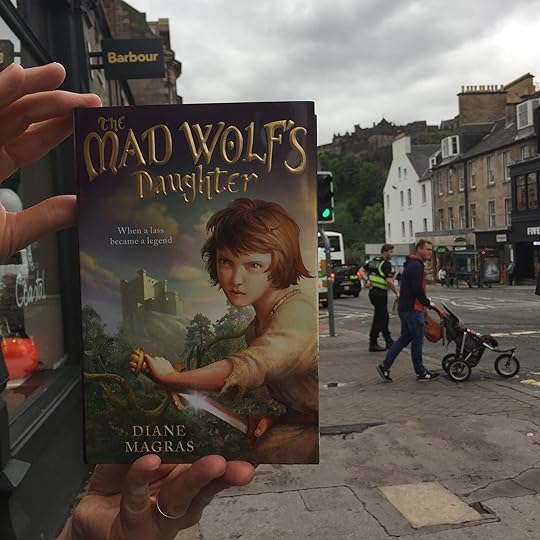
I also never expected to see my wee lass in Edinburgh, my favorite city (by the way, I was in Scotland in 2015 when I first heard that Kathy Dawson Books at Penguin Young Readers wanted to buy this book and other works of mine).
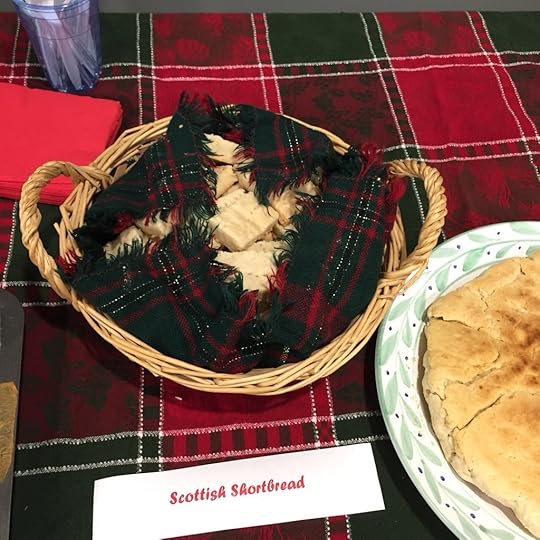
And I certainly didn't expect to find a huge Scottish dessert spread at a book talk I gave at a student reading club (the desserts included this quite scrummy shortbread:
It's been quite the year, indeed.
***
So here's a bit of news:
I got my first author copy!!!
Here it is, in all its glory, on a saltire, no less, with a claymore letter opener (I know, I know, it's a sword from the wrong era, but it's Scottish and it's what I have on hand):
And then there's also this lovely piece, a starred review from Publisher's Weekly, which states:
"Empathetic, bold, and entirely herself at a time when women were dismissed as weak, Drest shines in this fast-paced adventure."
The book will be in print in a bit more than a month, and I'm feeling quite honored and humbled by all this.
*** This was quite something to see on Publishers Weekly:
"If the promotional language on ARCs was universally accurate we should all need larger bookstores, that’s certain, but if any galley were to be held up as a model of truth in advertising it is The Mad Wolf's Daughter by Diane Magras. And yet the character of the book transcends the simple truth of its descriptors.
"Why? A rising tide lifts all boats, they say, and it is apropos to storytelling as well. A great story elevates all its constituent parts. Sure, it’s true that The Mad Wolf's Daughter is a middle grade fantasy with feminist elements, a strong young heroine, an informed exploration of relevant social issues, and the transposition of established gender roles, but it is the book’s great storytelling that makes all its components shine."
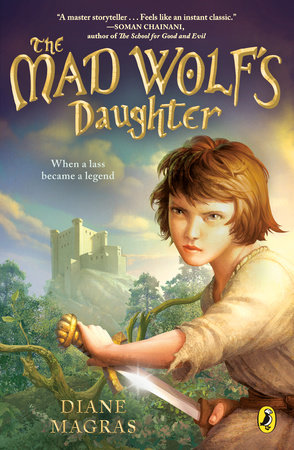
So I have a new cover. Isn't my wee lass absolutely…well…tough as steel? (She'd whack me with that sword if I called her anything else.)
Art by the incredible Antonio Javier Caparo.
A bit of the text is changing from the ARC too, with a tweaks to a couple of scenes. So, with the map (in progress; I'll share it when I can, but I saw the first draft today and it is BEAUTIFUL!) and those tweaks, there will be some new material for readers, even if you've snagged an ARC.
And that, the final version, will be in print four months from Monday!
Want to be up in the news of what's happening with the book, read my writing prompts for students, or take a glimpse of my beloved Scotland? I've a blog in in which I do all that and more, and for that you may sign up here!
***
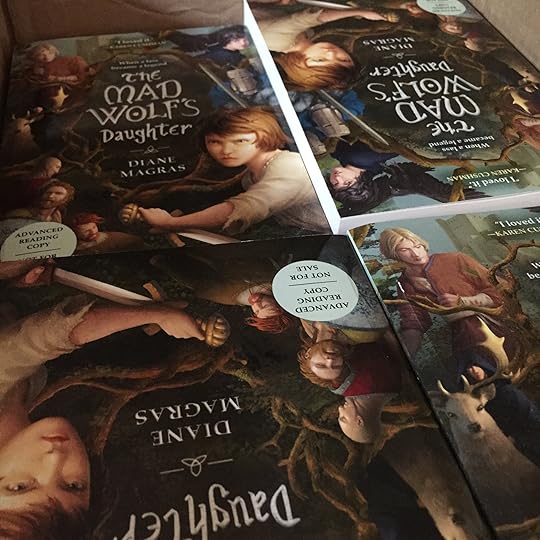
The ARCs are in!
And here's a wee pic of those lovelies…
It's truly an incredible feeling to holds my very first book (even in ARC form) in my hands. The feeling is pretty much a mix of awe, wonder, delight, and utter gratitude for the work of my incredible editor.
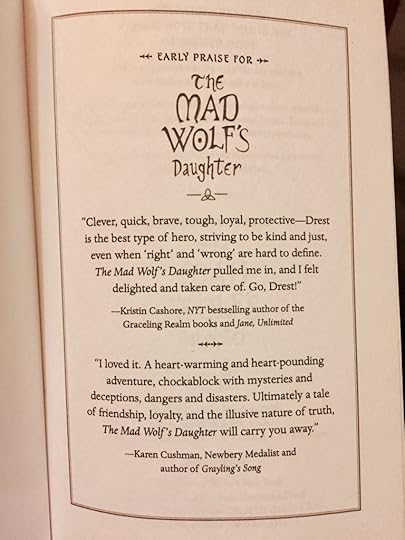
And for something else to send a shiver of delight down my spine: Said editor send me these lovely snippets of advanced praise not long before the ARCs were printed:
I hope other readers enjoy it as much as these two heroic authors did!
If you're looking for a strong MG female heroine, Drest, from The Mad Wolf's Daughter, is it! I loved this fast-paced Scottish Medieval adventure of sword and legend. Can't recommend it enough!!!
“Sometimes words alone can save your life.” I received an ARC from Penguin Young Readers Group for a fair review and a blog tour.
The Story What an exciting story about 12 year old Drest as she journeys to save her family after she is the sole survivor of a raid that has taken them captive. I think my favorite part about this book was that when she was processing a situation it wasn’t told in a way that she was thinking it out…even though she was. In multiple scenarios Drest imagined her various brothers giving her advice on how to handle the situation. Even though it was her own thoughts it reflected how much of her own training came from each of her brothers and dad, but also how she herself branched off as her own courageous person.
The story itself had consistent pacing that started off in a way that sets the vibe that Drest is the youngest and not the most experienced. By the end she has grown, learned, and experienced so much more that she has readily earned the appreciation from the whole war band. The book is an ode to little girls who can be just as brave as any boy.
The World Building Though the story itself isn’t an epic fantasy I felt that I could easily escape into the world. Through the language the characters used, to the subtle descriptions of the surrounding, weaponry, attire, and even the actions of the towns people, I was able to imagine the world that Drest was traveling through. There were only a few times that I thought the scenario a stretch, but for the most part I thought it all a story that is entirely plausible.
The end of the book included a glossary as well as an author’s note that included research that would help any young reader understand with background information about historical Scotland and even where inspiration from names came from.
The Characters I am only going to express my love for our hero Drest here. What a tough cookie! I love that though she may let some people assume she was a boy, she still was proud to be a girl and to not let it affect her concept of her abilities. Never once did she think that she couldn’t accomplish such an impossible task because of her sex or even her age. Even though she had never gone off to battle herself, she thought herself just as much a part of her fathers war band just as any other brother of hers, declaring herself to be a legend. She is such a brave and snarky character that you can’t help but cheer her on.
This debut historical fiction middle grade novel is a fast-paced, page turning adventure! Drest's strong 'voice' was refreshing & the plot line intricially woven with lots of twists and turns!
I received an ARC of this book, and was so happy because I've been looking forward to it ever since I first saw that cover. Here is my honest review:
What a page turner! An epic adventure through a vivid world, I enjoyed every minute of this book. Drest is a fantastic character, strong and fierce and full of determination, yet still vulnerable, still a girl left fully on her own for the first time. I loved watching her grow, from frightened and uncertain, trying to imagine what her family would do, to a legend in her own right. Can't wait for the sequel!
There are so many things I loved about this medieval middle grade novel; the historical Scottish setting, the fast paced action, the strong main character, Drest.
The attention to historical detail was quite fascinating to read and I learned a lot I didn't know about this particular time period, especially with the author's note at the end. Drest is a fiery lass and her dedication to her family and relationship with her brothers is what endeared me to her. This is a perfect book for middle grade readers looking for great fiction based in real history.
I cannot say enough about The Mad Wolf's Daughter. I read this in one sitting, and much later, I'm still vibrating with the excitement and perfection that is this book. I wish...ack, I wish I'd had this book as a kid! This is Alanna, but in a world and family where Alanna hadn't needed to disguise herself as a boy. Where Alanna could, unquestioningly, be herself from start to finish. And be taken *seriously* as a force from start to finish.
This is what angers me: that often in fiction, we must disguise boys as girls to allow them to *do* anything.
It is terrible how that trope erases so many children, how it trains them to think that they cannot do miraculous things, cannot *be themselves* unless they pretend to be something they're not. Yes, sure, some worlds (our world, I know) do not allow females to be empowered as they are. But too, there are ways to subvert this! THE MAD WOLF'S DAUGHTER does it brilliantly and cleverly, and oh how my whole heart is in love with Drest's family for this very reason.
Drest has teeth. Clever teeth. Brave teeth. Teeth she sinks into conflict that she should not win, and yet, she finds a way to do so! I cheered for her from start to finish, and was unreasonably thrilled to watch her take ownership of the shape of her heart at the end. And when I got to the end and found hints of a sequel layered in, I shouted from the couch, "YES, MORE DREST!" I am going to be shoving this book into the hands of every Middle Grade-reading kid I know.
5/5 for Mad Wolf's Daughter by @dianemagras; thanks to @PenguinKids for sending me this book to share with the @kidlitexchange network (#partner). All opinions are my own. _*_*_*_*_* Swipe for the back! _*_*_*_*_* Wow! I completely inhaled this historical fiction tale set in medieval Scotland. Magras is a master at character development; I was strongly attached to Drest, Emerick, the enemy knight she takes captive and eventually befriends, and Tig, the young lad who helps them on their quest. When I saw that both Karen Cushman and Kristin Cashore (Graeling! still one of my faves!) had blurbed for this one, I knew I had to read it despite that it's a genre outside my usual comfort zone. I AM SO GLAD. Drest is possibly the bravest, kindest, most daring heroine I've seen in a long time. Her feats are awesome, but also completely believable and the imagined inner narrative she has with her captured older brothers is just wonderful. I read this in less than a day and raced through the last two thirds. I even cried! Let's just say I often find that reading these middle grade books as a parent makes me especially sensitive to parent-child scenes. Does that happen to any of my fellow adult friends who read middle grade books? Do not miss this book! It is a must-buy for all elementary and middle school libraries. I can't wait to put it in my historical fiction section and I'm really glad I read it because I do think it's one that will need a bit of booktalking to start flying off the shelf. _*_*_*_*_* #kidlitexchange
There is just something about middle grade novels that makes me feel so happy and safe and I just can't get enough of them. The Mad Wolf's Daughter is no exception. I read the entirety of the novel in less than a day, so engrossed in the story that I just had to finish it then and there. It was a fun read, but that doesn't stop the story from being meaningful. It gave me nostalgia for Ranger's Apprentice, and makes me want to read more MG at the moment.
I really enjoyed the story. It was straight-forward, but Magras added enough twists and turns throughout the narrative so that it didn't seem that way. The count down had me at the edge of my seat, and Drest's adventures on the way to save her family were very heartwarming and entertaining. I love how Drest was so adamant to follow her father's code, despite her father not even being there. Each twist of the plot was because Drest chose to be a good person, putting others before herself and her needs. Even when it would have benefited her to walk away, Drest recognized that something was wrong and that it had to be remedied.
Each character was very entertaining and lovable. I probably loved Drest and her relationship with Emerick (the injured knight) the most, mainly because there was no forced romance between them. I was so thankful for that, because the friendship that develops between the two of them is beautiful. I especially enjoyed Tig as well, with Merewen coming in a close second.
The last thing I want to mention is that ending!!! I was honestly shocked, and hadn't been expecting it, so I was emotional for a little while? But I especially loved how it ended, and how Drest took things into her own hands.
Final Rating: ★★★★★ Overall? I really need to read more middle grade. The Mad Wolf's Daughter is an amazingly fun novel that was full of twists and turns. I love how it centered friendship and doing what's right, while also standing up for yourself. Magras focused on important lessons while also making the story fun and interesting.
Would I Recommend? Yes! Especially if you're looking for middle grade fantasies. I really hope Magras decides to write a sequel, because the ending was left very open for the possibility. If there is one, you can bet that I'll snatch it up with no hesitation.
*I received a copy of this book from the publisher in exchange for an honest review*
This turned out to be quite a charming and enjoyable read. The general concept of the novel is very traditional, but it is spiced up by many unique elements and plot twists that Magras employs throughout. I had such a fun time following the journey of this brave young warrior and her friends. The story mixes danger, mystery, and intrigue with warmth, love, and friendship to create a highly immersive read. With solid characters, a well-written narrative, and plenty of action and adventure, it is incredibly easy to fall in love with this tale.
In this novel, we follow a young Scottish girl named Drest, who’s life is turned upside-down when her father and brothers are captured and taken to the prison at the nearby Faintree Castle. After these knights invade her home, Drest barely escapes the hostility brought upon her family, be she is the only one to do so. Therefore, she is thrown into an unexpected adventure, and must find the courage deep within herself in order to save the ones she loves the most.
Trusting one of the wounded knights to lead her to the castle, she draws strength from the encouraging voices of her five brothers that she hears in her head. Joined early on by a young boy named Tig, the unlikely trio soon become comrades, as they fight through the many perils that lie ahead of them.
However, not everything is as it seems, and the indiscretions of the war-band—her family—are beginning to come to light. This leaves Drest questioning not only who she should put her trust in and whether her family should actually be freed, but also who she is. Despite the obstacles she fights through along the way, the most challenging part of her journey might in fact be at the very end.
I found this to be a very captivating and fast-paced story, and I fell into it very easily. It hooked me right from the start, as we are thrown directly into the action. And the characters were a very high point of the novel. Drest is an incredibly strong heroine and a fantastic model of bravery, both physically and mentally. She develops very realistically throughout the course of the narrative, starting off much more timid and unsure of her abilities and steadily blossoming into a true warrior. A multi-dimensional and dynamic character, Drest is truly the driving force in this novel.
I would have liked to have seen the relationships between the characters developed a bit more than they were, particularly the war-band. We get a fairly good idea of their personalities as the story unfolds, but I think that area could have been focused on slightly more. This was by no means a huge detriment to the story, but I feel as though that would connect the reader even more to the characters, their relationships, and how those elements are tested throughout the narrative.
As far as the writing itself goes, I thought this novel was beautifully written. Magras really has a way with words—everything flowed perfectly and carried me quickly and smoothly through the story. Her writing suits the target age range for this novel so well. She words things very intelligently and clearly. The text is not pared down so far that it comes across as too basic or simple, but it never feels as if it would be too difficult for young readers to understand. She expertly wrote in a style that challenges but would not confuse a middle grade audience.
Magras also does a fantastic job of accurately building the setting of this Scottish headland and beyond. Every detail is not only clearly depicted, everything is very realistic. The backdrop of this story is full of depth and history. In the same vein, the language used feels spot-on for both the time and location, and you can tell the effort and research she put into this aspect of the narrative. The slang used, the way all the characters address one another, it all feels authentic and immerses you deeply in the story. I had no trouble both transporting myself into the world and hearing every line of dialogue with the accompanying Scottish accent.
The Mad Wolf’s Daughter is a very well-crafted and enchanting story of the strength and courage one can find within oneself in the face of adversity. Though it is targeted at a younger audience, I believe that readers of any age will be able to take an interest in this novel. The messages that radiate from this story are very positive and enlightening. It is sure to teach a middle grade reader important lessons about the warrior we all have inside of us. This is full of heart, and is a wonderfully wholesome and exciting fantasy that young readers will surely eat up.
This is one of the rare books that lives up to the hype. It would have been a five-star book if the ending had been more of an ending and not felt like it was just a convenient stopping place. Drest, though, is an amazing character and her companions, Tig and Emerick, are worthy co-adventurers. The three face danger, betrayal and menace on their journey, but they also experience people at their best and most helpful. I'm always a fan of a girl-with-sword novel and this is a strong entry in that sub-genre and, I hope, the opening to an equally strong series.
A very special thanks to Diane Magras for providing our #bookexcursion group with an ARC of The Mad Wolf's Daughter. It publishes on March 6, 2018. All opinions are my own.
Wee lass Drest and her family are attacked by knights from Faintree Castle. Drest desperately wants to join her father, Mad Wolf of the North and her five brothers in this battle, but Mad Wolf orders her to hide. She witnesses her family bound, captured, and sailing away from her. Her only hope of finding her family is a young knight named Emerick who Drest witnessed being attacked by one of his own men. She strikes a deal with Emerick to take him to Faintree Castle and in return, he will release one of her brothers, although Drest plans to rescue her entire family.
Throughout their journey, Drest hears tales of her family's brutality from Emerick, which she does not believe to be true. In addition, a bandit by the name of Jupp shares his own story of her father's cruelty. Drest begins to realizes that words are strong weapons because not only is she beginning to doubt her family but also she is struggling to figure out her own identity. Can a warrior be brave and kind?
The Mad Wolf's Daughter is an adventure that has action and heart. With each chapter, Diane Magras kept me on the edge both excited and afraid to read on. I absolutely love Drest who learns that you can't always control our own legend, and sometimes words not swords can save lives.
This was a heck of a read! As a children's librarian, I try to read as many tween novels as I can. Generally I read the first half to get a good feel for it and then go on to the next. Not with this one. Solid from beginning to end with a great tale, lots of action (boys will dig that) and also very interesting characters and back stories (hi girls!). It's a rare treat to read a tween novel that I feel will appeal to a wide range of readers but this one fits the bill nicely. Also appears to be the first in a series so I can't wait to read the next installment. Thanks Ms. Magras!
Drest is an absolutely marvelous character who will stick with readers for a long time. An adventure story with family as a central theme, this book has a classic feel. Highly recommended!
This was great, good fun. The execution may have been a bit rocky, and I'd like to have felt more attachments, within the relationships. It is unclear that there might be more.
The Mad Wolf's Daughter reminds me a bit of Disney's Brave, maybe it's that they both take place in medieval Scotland, or that the main characters have a tomboyish quality that I would've identified with back in middle school. And I know I would've loved Drest's short hair and that she is a member of her families Warband rather than a princess like Merida. She's also so wonderfully smart, resourceful and very determined. There's a feistiness to her that I appreciate. Family is really important to Drest and why she doesn't hesitate to embark on their rescue when they're captured. Drest's family has a strong code that they live by, with the protection of matrons and maidens being one of their most important ones. Drest takes this to heart when she jumps into a battle to save a young boy being bullied by six boys or intervenes when a witch is about to be burned by a mob of villagers. At first, her actions may seem a bit rash and impulsive, but she leaps into action because it means her actions are living up to the responsibilities of the family code, and she believes it would make her family proud.
Later in the story, Drest faces a personal challenge of having to reconcile her father and brothers actions with what she learns from the villagers that she encounters along her adventure, and how their actions may have been contrary to what she's been taught. It's difficult to not feel welcomed into the village and hard to distinguish which side of the story is correct. She wants to believe in her family first, but when a bandit begins to stalk them and leads them to the town of Birrensgate, everything she thought she knew is shattered. A tough choice between believing in your family and looking at all of the facts. Over the course of the story, Drest grows and develops into this fearless heroine with responsibilities and duties that she doesn't shirk or run away from, she becomes a friend to Emerick and a legend around the countryside.
I adored Emerick and Tig, the two characters aiding Drest on her adventure. This was one of my favorite parts of the story, the transition of Emerick being Drest's prisoner to becoming her friend. They're such a fun pair. I particularly enjoyed this dialogue between them.
"He glanced at her face and stared "God's bones, you're a lass." "You say that as if I'm a three-headed goose. Have you never seen a lass before?" "I've seen many, but never one like you. What was your mother? A banshee?" Drest scowled. "I don't know who my mother was. But if you insult her again I'll drop you."
There is an author note at the back of the book which provides detailed information about medieval Scotland including Feudalism, Village Life, War-bands, Women, Healing, Castles, Swords, the Landscape, and even an explanation of the origins of the characters names. It was fascinating to read about the role of matrons and maidens in Scotland, and the way in which Magras tied all the information back to the story, like how Drest's using a sword wouldn't have been typical but that many other young girls might have used a longbow during this time period. The Mad Wolf's Daughter has it all, historical time period, action, fantasy adventure and lovely moments of reflection, family, and friendship.
Medieval historical fiction for kids is a very small genre, but is inhabited by some of the giants of kidlit like Avi and Karen Cushman. The Mad Wolf's Daughter is a worthy addition to this group, especially because of how it resists traditional gender norms while not sugarcoating the violence and danger of the time period.
Drest is the only daughter of the Mad Wolf, the fearsome leader of a family of fighters. When the Mad Wolf and his sons are captured, Drest is able to escape. The rest of the book follows her daring journey to rescue her family. Along the way, she is challenged in every single capacity. The plot is exciting, but the real star of the show is Drest. She's a very complicated character who mostly carries the book on her own. She's also one of the fiercest, strongert, most determined main characters I've ever seen. She is literally carrying one of the other characters for most of the book.
The extensive author notes at the end are a great wealth of information and the author is meticulous in her research. The only thing that disappointed me about this novel is that it's not based on a real character or real events. It doesn't diminish the story in any way, but I wish Drest were real because she feels so real to me!
Drest is awesome - strong, smart, fierce and determined. She hops right into action and does not flinch from doing what is right even if it is terrifying and difficult. She is tough, doesn't give up, and is supported by all of her brother's voices in her head throughout her journey. The pacing is frantic, full of peril, the adventure doesn't stop. It is refreshing to see such a strong heroine fighting tooth-and-nail for who she loves. She makes mistakes, but she always tries to do what she believes to be true and correct.
There were a few things that I did not love. In the beginning, when her family is taken, I thought it odd that none of her brothers would take her warning seriously, as she saw the knights coming to attack well in advance and repeatedly told them that danger was coming. Also, Drest's Father had told her to be strong, 'for she was not like the frail women and girls that his code had sworn them to protect...' It's not enough that so many books today have that lead heroine who is 'not like other women', do we have to have this in middle grade fiction as well?
Wow. I don’t have the words to review this book the way it deserves to be reviewed. I can tell you it’s one of my top favorites of the year. I can tell you Drest is a character I’ve needed to know, and #MGlit has needed as well. I can tell you I’ve never enjoyed a book set in a medieval time period, of any genre, until now. And I can tell you that this is a rare gem of a book that young readers interested in historical, adventurous stories will LOVE. I’m sad to see it end (I’ve been lingering over it for days), but I will eagerly anticipate more of Drest’s adventures.
I absolutely adored this book! Drest is such a fierce heroine and I loved all the action and adventure! I'm a huge fan of medieval Scottish literature, and this book was verra pleasing!! I highly recommend!
This Scottish medieval setting with castles, knights, and bandits is a bullseye for my tastes. A slow-paced story, even if it is good, can be like walking in deep sand for me. My natural pace is to clip along like a sail boat over white-capped water. Fantasy is my go-to, not realistic fiction. A strong female character who is impulsive, determined, and athletic as Drest is in this story grabs my attention. There are some fantastical parts, but most of "The Mad Wolf's Daughter" stays grounded as a knight tale with a monarchy under threat. The plot builds tension that rewards the reader with some twists that had me turning around and rereading the book. At 260 pages this was easy.
Twelve-year-old Drest is a strong "lass" and not your typical "maiden." Her five brothers and dad, legendary warriors, taught her to wield a sword and live by an honorable code. They also taught her to intimidate with name-calling such as "maggot-headed squid" or "grub-spotted barnacle". Name-calling doesn't work most of the time but does spice the story with humor. The men in Drest's family have a war-band and are captured by the Knights of Faintree in a battle that only she escapes. A wounded knight, Emerick, is left behind becoming her bargaining chip to free her family from a public hanging in five days. Drest sets off to save them and has adventures along the way discovering who she is and what she wants to be in life. She's tough. She's naïve. She's determined.
Drest's strengths and shortcomings show a girl that is afraid and impulsive but overcomes it with courage, loyalty, and a strong moral compass. Emerick counters her impulsivity with negotiation making her think about her actions. He stresses that words are a great weapon, if not greater than a sword. Initially, Drest uses her sword to do the talking almost killing another boy and rushing at a man who could have wounded her with a hidden dagger. In both cases she was defending someone who was being treated unjustly and while her strong sense of justice when someone is being wronged is admirable, Emerick tries to drop a pebble in her constantly moving body that she doesn't need to plunge blade-first into every melee she stumbles across. Words have power too, he stresses. She uses words with her enemies later and grows to understand that while her brothers and fathers are "bloodthirsty warriors" she cannot kill another person. As her friend Tig claims, she is a warrior with a "good heart." Drest's shortcomings create a sympathetic versus judgmental character that makes her more authentic for me.
Minor characters are well-crafted not drifting from the overall story arc. The brothers are developed with Drest talking to them in her imagination. She envisions what they would say in different situations that comforts and helps her make decisions while maintaining a swift pacing. Jupp is not a one-dimensional villain. Emerick turns from enemy to friend. Tig is a funny sidekick that worships Drest for her kindness as well as her fighting skills. He has a pet raven, a symbol of Celtic goddesses and witches in myths. He says he's a witch although no special powers appear. Both Drest and Tig are trying to find their identity as they move from adolescence into adulthood.
The witch, Merewin, says that Drest saving her is "extraordinary"; however, we never find out why. Merewin is mysterious, magical, and unpredictable like a goddess from a Celtic myth. The yellow dust she has as a trap in her hut is not explained but it hurts Drest. Does the dust show Merewin as a witch with magical powers? Does it allow her to follow Drest? GPS dust? Just kidding. Then a stag shows up which is a Celtic symbol representing freedom or the pursuit of wisdom, etc. Stags were hunted and a common motif in medieval Scotland. The stag appearance foreshadows Merewin who is currently being hunted and marginalized by society or in this case used as a scapegoat for a death in the village since she is a healer. The name Merewin is close to King Arthur's advisor, Merlin. I kept trying to connect it with King Arthur but it seemed to be presenting an opposite advisor than in that story. Is she Drest's relative? My guess is she knows something about Drest's mother who is absent and no explanation given as to what happened to her. Perhaps a sequel will address? Merewin tries to give Drest advice but realizes Drest doesn't need it. She does look after her basic needs on her quest and gives warnings (that Drest ignores).
Merewin is connected more with the history of witchcraft in cultures and how women healers were unfairly blamed for village deaths. This feminist focus gives the story its own shape keeping it from drifting into myths and focused on the oral tradition of legends. Drest's adventures expose her to what defines her family's legend throughout the region. Some is good, bad, and exaggerated. Drest is creating her own legend with the reader as well as the community. She inspires with her sense of justice and teaches what it means to be brave and kind in bad situations. Even in the worst of circumstances she doesn't give up or succumb to fears.
The overall story arc is well done. William Kenower writes in his book "Fearless Writing" about three narrative arcs: physical arc, emotional arc, and intentional arc. The physical arc can be a story that follows a formula of some sort. This story is the hero's journey: a girl embarks on a quest, has adventures and trials, is betrayed, fights for her life, and is changed by the journey. The emotional arc looks at characters motivations. Drest is motivated to rescue her family and then others as the journey proceeds. She thinks that she is a great warrior like her brothers but discovers she isn't "bloodthirsty". She realizes that she doesn't have to embrace her family's legend but can make her own. The intentional arc is the reason behind telling the story. This probably has many answers but the one that stuck with me was Drest as a representation that girls can be strong and true to themselves as they find their own way in the world.
The repetition and emphasis on storytelling as a way of orally preserving history presses throughout Drest's tale. Tig tells stories about Drest the warrior maiden who rescues people. He repeats certain phrases and the author attempts to mimic some oral traditions. Tig is creating his own story on his quest and develops in confidence on the journey. Drest's dad and brothers tell stories of their battles around the camp fire but leave out the negative parts of the story. When Drest hears alternative tales of her quest it makes her question her brother and father's choices. She questions their choices and forces them to think about some of their actions. Drest asks Jupp his story. At the end, her Dad says they trained her better than he thought. She says, "Maybe you did, or maybe it was just me." She's writing her own story.
By continually pointing out this rich tradition of storytelling the author implies that she is carrying on the craft by sharing a story from her own imagination. She also acknowledges through the characters that legends don't always reflect the truth. They might try to represent history but oftentimes are partial truths. A listener or reader needs to think critically of legends. The best part of storytelling for me is the sharing of a story where I can enter into a character and see some truth about my life or better understand the world while having fun in an imaginary setting. I can chew on that kind of story.
Young Drest hears a sound one night, but her father and brothers don’t believe her. When their camp is invaded, war breaks out, and Drest is forced into hiding to stay safe. Unfortunately, the Mad Wolf and his band of sons are taken as prisoners, leaving Drest to fend for herself. Still hidden, she witnesses a scene between two men and she can’t believe it when one of them double crosses the other and tries to kill him. The wounded man is left behind and Drest takes him as her captive. He is a knight from the invading group and knows the way to the castle where her brothers and father have been locked up. She hopes she can trade the man she rescued for her family, and the man is desperate to get to the castle for his own reasons. Drest has never left the area where her family has their camp. The path to the castle is not easy and they encounter bad weather, people who steal from them and danger at every turn. Plus, she hears terrible stories about her father and brothers which she knows can’t be true. Drest’s captive may be her enemy, but she does her best to keep him alive though his health continues to fail. Enemies to the core they must work together to get what they both want; although only one can be the victor. What will happen when Drest makes it to the castle? Will she be able to save her father and her band of brothers? Is she truly the Mad Wolf’s daughter or is she her own person? You’ll have to read this tail and decide for yourself.
When I heard about The Mad Wolf’s Daughter by Diane Magra I knew I had to read the book. I was not disappointed! I liked the confidence Drest has and how she stood for what she believed was right. All her life she heard the stories from her father and brothers about what they did to protect women and children. Even when her belief faltered she still held true to what she knew was right. The story of friendship, struggle and fight will appeal to those who like adventure. I recommend this book to kids and adults from fourth grade up who like taking a trip back in time when people often took the law into their own hands and were at the mercy of those in the court and castle. I am already looking forward to reading the second book, The Hunt for The Mad Wolf’s Daughter.
THE MAD WOLF’S DAUGHTER is a historical tale of bravery and family love, with trust issues mixed in too.
Drest approaches situations in ways that feel realistic for her age, and yet she is very skilled with a sword and clever with her plans, after being raised within a war-band made up of her father and brothers. On the journey to rescue her family, Drest must consider her father’s stories against other versions of the stories she’s hearing from new characters. Is he a ruthless beast or just an avenger? I really liked the lesson of not believing everything you hear, and to seek the truth.
It was almost a history lesson mixed in to the adventure of it all. As is expected during the middle ages, there is some anti-witch mania aimed at healers, and cruel lords, and a struggle for the lowly commoners.
Diane Magras is a wonderful writer, and I felt confident in her ability to lead us through Drest’s story. She obviously has exceptional knowledge about the time period and region of Scotland.
This book is INTENSE and SO GOOD! The adventures are fast paced and non stop, the characters are excellently crafted and engaging, the story is well thought out, the character growth is so well done that you are learning and growing alongside them as you read! I can’t wait for the next book! Highly recommend!
Drest has never been off of her homeland, but one night when she wakes to see that her and her family are being invaded, she has no choice but to leave in order to save her father and her brother's who've been taken back to Faintree Castle to be hanged. Accompanied by a left-behind knight, a boy named Tig and his pet raven, and her brother's voices in her head when she needs advice the most, they make their way towards the castle braving bandits and other great dangers along the way.
The medieval Scottish setting and language was what made the story for me. I loved hearing Drest and her brothers use slang that that area uses. Not only that, but I was really glad about how Drest's character was written. She went from a small scared child hiding out on a cliff, to chasing after her family's captors and braving things no child should have to endure in their lifetime. The character development in Drest was top-notch, and I really would like to read another book starring her. A girl can hope!
This book was full of great action and adventure and loads of heart. Drest is the best kind of middle grade character - braver than she thinks she is, clever and compassionate, out finding her place in the world while questioning what she always thought HER world was. I loved the relationships between her and her brothers. The voices of her brothers encouraging and teasing her along her journey were a great addition to the narrative. Drest's adventure is a satisfying one and leaves the reader with plenty of intriguing questions to be answered in the sequel!