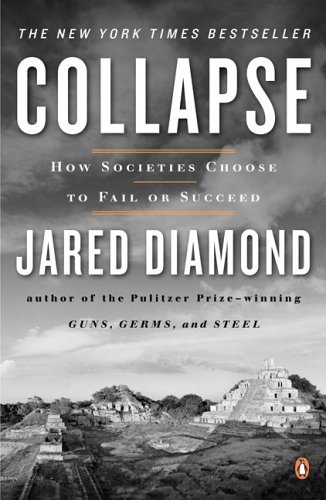
Brilliant, illuminating, and immensely absorbing, Collapse is destined to take its place as one of the essential books of our time, raising the urgent question: How can our world best avoid committing ecological suicide?
In his million-copy bestseller Guns, Germs, and Steel, Jared Diamond examined how and why Western civilizations developed the technologies and immunities that allowed them to dominate much of the world. Now in this brilliant companion volume, Diamond probes the other side of the equation: What caused some of the great civilizations of the past to collapse into ruin, and what can we learn from their fates?
As in Guns, Germs, and Steel, Diamond weaves an all-encompassing global thesis through a series of fascinating historical-cultural narratives. Moving from the Polynesian cultures on Easter Island to the flourishing American civilizations of the Anasazi and the Maya and finally to the doomed Viking colony on Greenland, Diamond traces the fundamental pattern of catastrophe. Environmental damage, climate change, rapid population growth, and unwise political choices were all factors in the demise of these societies, but other societies found solutions and persisted. Similar problems face us today and have already brought disaster to Rwanda and Haiti, even as China and Australia are trying to cope in innovative ways. Despite our own society's apparently inexhaustible wealth and unrivaled political power, ominous warning signs have begun to emerge even in ecologically robust areas like Montana.
Brilliant, illuminating, and immensely absorbing, Collapse is destined to take its place as one of the essential books of our time, raising the urgent question: How can our world best avoid committing ecological suicide?
Jared Mason Diamond is an American scientist, historian, and author best known for his popular science and history books and articles. Originally trained in biochemistry and physiology, Diamond is commonly referred to as a polymath, stemming from his knowledge in many fields including anthropology, ecology, geography, and evolutionary biology. He is a professor of geography at UCLA.
In 2005, Diamond was ranked ninth on a poll by Prospect and Foreign Policy of the world's top 100 public intellectuals.
Було дуже цікаво, дізналась про книги автора як джерела натхнення Харарі, тепер зрозуміло звідки ноги ростуть 🙃 4.5 насправді, але рука тягнулась до п'ятірки
Команда Cowo.guru запрошує вас до спільного читання книги американського біолога, публічного інтелектуала, автора науково-популярних бестселерів Джареда Даймонда “Колапс: Чому одні суспільства занепадають, а інші успішно розвиваються” з експертом Андрієм Баумейстером. Ця книга є другою після праці “Зброя, мікроби, сталь”, яка принесла автору Пулітцерівську премію. Зовсім нещодавно була опублікована третя книга “Upheaval: How Nations Cope with Crisis and Change”, фрагменти з якої ми також розглянемо протягом нашого курсу.
Обговорення книги Даймонда завершиться публічним виступом учасників на тему “Вихід України з національної кризи”, мета якого – застосувати концепцію автора в сучасних реаліях та запропонувати власні рішення.
Чому ця книга важлива? ● У книзі “Колапс” автор пропонує масштабне дослідження цивілізацій минулого, залучаючи антропологію, біологію, палеонтологію, археологію, географію та демонструючи міждисциплінарний підхід. ● Даймонд робить висновок про те, що цивілізації зазнавали краху за схожим сценарієм, і пропонує схему з 5-ти пунктів, яка допоможе проаналізувати причини як занепаду, так і успіху досліджуваних суспільств. ● Окреслюючи головні чинники занепаду цивілізацій, Джаред Даймонд закликає діагностувати стан сучасних суспільств та вчасно надати їм ефективну допомогу. ● Автор намагається сформулювати практичні уроки, які можуть винести сучасні покоління, вивчаючи історію як успішних суспільств минулого, так і цивілізацій, які зазнали занепаду. ● Ця книга – поєднання досвіду автора, як біолога-дослідника, так і керівника міжнародних екологічних організацій, тому його погляд спрямовано на практичну реалізацію висновків із проведених досліджень.