

What do you think?
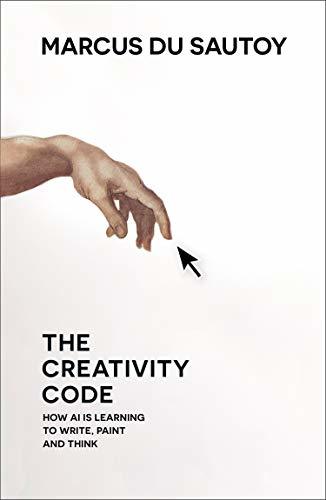
Creativity Code
The award-winning author of The Music of the Primes explores the future of creativity and how machine learning will disrupt, enrich, and transform our understanding of what it means to be human.
Can a well-programmed machine do anything a human can―only better? Complex algorithms are choosing our music, picking our partners, and driving our investments. They can navigate more data than a doctor or lawyer and act with greater precision. For many years we’ve taken solace in the notion that they can’t create. But now that algorithms can learn and adapt, does the future of creativity belong to machines, too?
It is hard to imagine a better guide to the bewildering world of artificial intelligence than Marcus du Sautoy, a celebrated Oxford mathematician whose work on symmetry in the ninth dimension has taken him to the vertiginous edge of mathematical understanding. In The Creativity Code he considers what machine learning means for the future of creativity. The Pollockizer can produce drip paintings in the style of Jackson Pollock, Botnik spins off fanciful (if improbable) scenes inspired by J. K. Rowling, and the music-composing algorithm Emmy managed to fool a panel of Bach experts. But do these programs just mimic, or do they have what it takes to create? Du Sautoy argues that to answer this question, we need to understand how the algorithms that drive them work―and this brings him back to his own subject of mathematics, with its puzzles, constraints, and enticing possibilities.
While most recent books on AI focus on the future of work, The Creativity Code moves us to the forefront of creative new technologies and offers a more positive and unexpected vision of our future cohabitation with machines. It challenges us to reconsider what it means to be human―and to crack the creativity code.
Can a well-programmed machine do anything a human can―only better? Complex algorithms are choosing our music, picking our partners, and driving our investments. They can navigate more data than a doctor or lawyer and act with greater precision. For many years we’ve taken solace in the notion that they can’t create. But now that algorithms can learn and adapt, does the future of creativity belong to machines, too?
It is hard to imagine a better guide to the bewildering world of artificial intelligence than Marcus du Sautoy, a celebrated Oxford mathematician whose work on symmetry in the ninth dimension has taken him to the vertiginous edge of mathematical understanding. In The Creativity Code he considers what machine learning means for the future of creativity. The Pollockizer can produce drip paintings in the style of Jackson Pollock, Botnik spins off fanciful (if improbable) scenes inspired by J. K. Rowling, and the music-composing algorithm Emmy managed to fool a panel of Bach experts. But do these programs just mimic, or do they have what it takes to create? Du Sautoy argues that to answer this question, we need to understand how the algorithms that drive them work―and this brings him back to his own subject of mathematics, with its puzzles, constraints, and enticing possibilities.
While most recent books on AI focus on the future of work, The Creativity Code moves us to the forefront of creative new technologies and offers a more positive and unexpected vision of our future cohabitation with machines. It challenges us to reconsider what it means to be human―and to crack the creativity code.
336 pages, Hardcover
First published February 18, 2019
About the author
Marcus du Sautoy
37 books512 followersMarcus Peter Francis du Sautoy, OBE is the Simonyi Professor for the Public Understanding of Science and a Professor of Mathematics at the University of Oxford.
Ratings & Reviews
Friends & Following
Create a free account to discover what your friends think of this book!
Community Reviews
Displaying 1 - 2 of 2 reviews

May 9, 2022
En bok som kan förklara hur hur nära sammanlänkad matematik är med utveckladet av AI. Mycket intressant att lära sig mer om hur matematiken bakom en musikalisk komposition ser ut och hur man kan lära AI att skapa musik efter dessa matematiska mönster. Mycket läsvärd, även för en inkompetent mattenolla som jag.
September 9, 2026
Intressant om kreativitet och hur innovation, nya upptäckter och konst påverkas av AI.
Boken är utgiven 2019, innan genomslaget för generativ AI och chatGPT, men ger en bra bild av förmågan hos de digitala verktygen såg ut precis innan.
Generellt underhållande och tydligt beskrivet - men ett par kapitel som fokuserar på matematik och dess utveckling var lite för nördigt och navelskådande.
Boken är utgiven 2019, innan genomslaget för generativ AI och chatGPT, men ger en bra bild av förmågan hos de digitala verktygen såg ut precis innan.
Generellt underhållande och tydligt beskrivet - men ett par kapitel som fokuserar på matematik och dess utveckling var lite för nördigt och navelskådande.
Displaying 1 - 2 of 2 reviews