

What do you think?
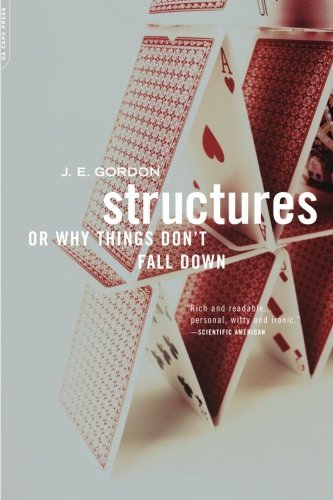
Structures: Or Why Things Don't Fall Down
In a book that Business Insider noted as one of the "14 Books that inspired Elon Musk," J.E. Gordon strips engineering of its confusing technical terms, communicating its founding principles in accessible, witty prose.
For anyone who has ever wondered why suspension bridges don't collapse under eight lanes of traffic, how dams hold back--or give way under--thousands of gallons of water, or what principles guide the design of a skyscraper, a bias-cut dress, or a kangaroo, this book will ease your anxiety and answer your questions.
Or Why Things Don't Fall Down is an informal explanation of the basic forces that hold together the ordinary and essential things of this world--from buildings and bodies to flying aircraft and eggshells. In a style that combines wit, a masterful command of his subject, and an encyclopedic range of reference, Gordon includes such chapters as "How to Design a Worm" and "The Advantage of Being a Beam," offering humorous insights in human and natural creation.
Architects and engineers will appreciate the clear and cogent explanations of the concepts of stress, shear, torsion, fracture, and compression. If you're building a house, a sailboat, or a catapult, here is a handy tool for understanding the mechanics of joinery, floors, ceilings, hulls, masts--or flying buttresses.
Without jargon or oversimplification, Structures opens up the marvels of technology to anyone interested in the foundations of our everyday lives.
For anyone who has ever wondered why suspension bridges don't collapse under eight lanes of traffic, how dams hold back--or give way under--thousands of gallons of water, or what principles guide the design of a skyscraper, a bias-cut dress, or a kangaroo, this book will ease your anxiety and answer your questions.
Or Why Things Don't Fall Down is an informal explanation of the basic forces that hold together the ordinary and essential things of this world--from buildings and bodies to flying aircraft and eggshells. In a style that combines wit, a masterful command of his subject, and an encyclopedic range of reference, Gordon includes such chapters as "How to Design a Worm" and "The Advantage of Being a Beam," offering humorous insights in human and natural creation.
Architects and engineers will appreciate the clear and cogent explanations of the concepts of stress, shear, torsion, fracture, and compression. If you're building a house, a sailboat, or a catapult, here is a handy tool for understanding the mechanics of joinery, floors, ceilings, hulls, masts--or flying buttresses.
Without jargon or oversimplification, Structures opens up the marvels of technology to anyone interested in the foundations of our everyday lives.
395 pages, Paperback
First published January 1, 1978
About the author
J.E. Gordon
10 books70 followersJames Edward Gordon (UK, 1913–1998) was one of the founders of materials science and biomechanics, and a well-known author of three books on structures and materials, which have been translated in many languages and are still widely used in schools and universities.
(wikipedia)
(wikipedia)
Ratings & Reviews
Friends & Following
Create a free account to discover what your friends think of this book!
Community Reviews
Displaying 1 - 3 of 3 reviews

October 2, 2020
Хорошая разминка для мозгов. Инженерия это все-таки отчасти наука, отчасти искусство. Поэтому книга получилась с поэзией. Читал из списка Илона Маска, поэтому настроен был с большим интересом, чем если бы сам нашел. Это помогло дочитать книгу, хоть и после нескольких месяцев медленного прогресса. По результату - обещание книги выполняется, намного лучше понимаю как обеспечивается прочность конструкций. Здания, мосты, корабли, самолеты - нашлось место всему
March 3, 2021
Ребята, это просто эмейзинг

April 20, 2020
После книги "Дизайн привычных вещей" - одна из самых интересных.
Рекомендую читать, если вы хотите узнать:
- почему длинные тисовые луки были только в северной Европе?
- как биомеханика связана с сопроматом?
- почему паровые котлы из чугуна это плохо?
Есть немного формул, но все они идут в комплекте с графиками, так что переживать не стоит (:
Рекомендую читать, если вы хотите узнать:
- почему длинные тисовые луки были только в северной Европе?
- как биомеханика связана с сопроматом?
- почему паровые котлы из чугуна это плохо?
Есть немного формул, но все они идут в комплекте с графиками, так что переживать не стоит (:
Displaying 1 - 3 of 3 reviews