

What do you think?
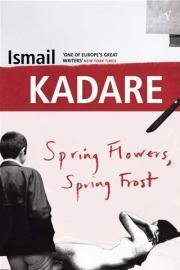
Spring Flowers, Spring Frost
From behind the closed door, the man shouts, 'Be on your way - you have no business here!'
'Open up, I am the messenger of Death'.
As spring arrives in the Albanian mountain town of B, some strange things are emerging in the thaw. Bank robbers strike the National Bank. Old terrors are dredged up from the shipwreck of history. And ultra-explosive state secrets are threatening to flood the entire nation. Mark, an artist, finds the peaceful rhythms of his life turned upside down by ancient love and modern barbarism and by the particular brutality of a country surprised and divided by its new freedom.
'Open up, I am the messenger of Death'.
As spring arrives in the Albanian mountain town of B, some strange things are emerging in the thaw. Bank robbers strike the National Bank. Old terrors are dredged up from the shipwreck of history. And ultra-explosive state secrets are threatening to flood the entire nation. Mark, an artist, finds the peaceful rhythms of his life turned upside down by ancient love and modern barbarism and by the particular brutality of a country surprised and divided by its new freedom.
192 pages, Paperback
First published January 1, 2000
About the author
Ismail Kadare
261 books1,832 followersIsmail Kadare (also spelled Kadaré) was an Albanian novelist and poet. He has been a leading literary figure in Albania since the 1960s. He focused on short stories until the publication of his first novel, The General of the Dead Army. In 1996 he became a lifetime member of the Academy of Moral and Political Sciences of France. In 1992, he was awarded the Prix mondial Cino Del Duca; in 2005, he won the inaugural Man Booker International Prize, in 2009 the Prince of Asturias Award of Arts, and in 2015 the Jerusalem Prize. He has divided his time between Albania and France since 1990. Kadare has been mentioned as a possible recipient for the Nobel Prize in Literature several times. His works have been published in about 30 languages.
Ismail Kadare was born in 1936 in Gjirokastër, in the south of Albania. His education included studies at the University of Tirana and then the Gorky Institute for World Literature in Moscow, a training school for writers and critics.
In 1960 Kadare returned to Albania after the country broke ties with the Soviet Union, and he became a journalist and published his first poems.
His first novel, The General of the Dead Army, sprang from a short story, and its success established his name in Albania and enabled Kadare to become a full-time writer.
Kadare's novels draw on Balkan history and legends. They are obliquely ironic as a result of trying to withstand political scrutiny. Among his best known books are Chronicle in Stone (1977), Broken April (1978), and The Concert (1988), considered the best novel of the year 1991 by the French literary magazine Lire.
In 1990, Kadare claimed political asylum in France, issuing statements in favour of democratisation. During the ordeal, he stated that "dictatorship and authentic literature are incompatible. The writer is the natural enemy of dictatorship."
Ismail Kadare was born in 1936 in Gjirokastër, in the south of Albania. His education included studies at the University of Tirana and then the Gorky Institute for World Literature in Moscow, a training school for writers and critics.
In 1960 Kadare returned to Albania after the country broke ties with the Soviet Union, and he became a journalist and published his first poems.
His first novel, The General of the Dead Army, sprang from a short story, and its success established his name in Albania and enabled Kadare to become a full-time writer.
Kadare's novels draw on Balkan history and legends. They are obliquely ironic as a result of trying to withstand political scrutiny. Among his best known books are Chronicle in Stone (1977), Broken April (1978), and The Concert (1988), considered the best novel of the year 1991 by the French literary magazine Lire.
In 1990, Kadare claimed political asylum in France, issuing statements in favour of democratisation. During the ordeal, he stated that "dictatorship and authentic literature are incompatible. The writer is the natural enemy of dictatorship."
Ratings & Reviews
Friends & Following
Create a free account to discover what your friends think of this book!
Community Reviews
Displaying 1 - 1 of 1 review
January 5, 2024
Хорошо, что я уже была готова к тому, что мне предстояло. Начало у книги довольно реалистичное: маленький албанский городок, наши дни. Герой - художник, но где-то там работает, впрочем, не особо напрягаясь: приходит на работу отметиться, а затем бредёт по своим делам. Судя по тому, как в кафе он встречает людей самых разных профессий, работать в Албании вообще не в почёте.
Затем сны, мифы, сказки и слухи начинают причудливо переплетаться с реальностью. Иногда герой говорит "а потом я проснулся", иногда - явно фантастический отрывок никак не комментируется, просто начинается следующая сцена.
Поскольку Албания - мусульманская страна, книга напоминает что-то такое восточное, типа "1001 ночи" или там "Слепой совы".
Кончается книга, конечно же, ничем конкретным. После ухода коммунистического режима в глубинке как будто бы поднимает голову старая традиция кровной мести - вроде бы подхватывается на том же месте, где остановились 50 лет назад перед советской оккупацией, но в конце выясняется, что это только часть некоего сна наяву. Интересно узнать, что за исторические события происходили в Албании после Югославии, пожалуй, ознакомлюсь. Ну и конечно продолжу знакомиться с Кадаре - ничего не понятно, но очень интересно.
Затем сны, мифы, сказки и слухи начинают причудливо переплетаться с реальностью. Иногда герой говорит "а потом я проснулся", иногда - явно фантастический отрывок никак не комментируется, просто начинается следующая сцена.
Поскольку Албания - мусульманская страна, книга напоминает что-то такое восточное, типа "1001 ночи" или там "Слепой совы".
Кончается книга, конечно же, ничем конкретным. После ухода коммунистического режима в глубинке как будто бы поднимает голову старая традиция кровной мести - вроде бы подхватывается на том же месте, где остановились 50 лет назад перед советской оккупацией, но в конце выясняется, что это только часть некоего сна наяву. Интересно узнать, что за исторические события происходили в Албании после Югославии, пожалуй, ознакомлюсь. Ну и конечно продолжу знакомиться с Кадаре - ничего не понятно, но очень интересно.
Displaying 1 - 1 of 1 review