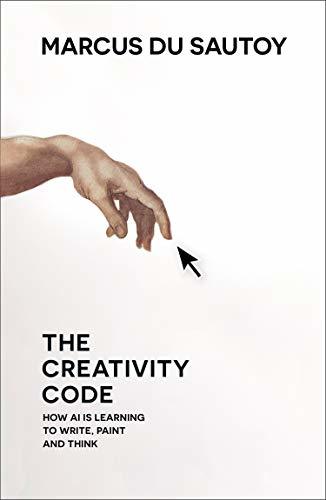
The award-winning author of The Music of the Primes explores the future of creativity and how machine learning will disrupt, enrich, and transform our understanding of what it means to be human.
Can a well-programmed machine do anything a human can―only better? Complex algorithms are choosing our music, picking our partners, and driving our investments. They can navigate more data than a doctor or lawyer and act with greater precision. For many years we’ve taken solace in the notion that they can’t create. But now that algorithms can learn and adapt, does the future of creativity belong to machines, too?
It is hard to imagine a better guide to the bewildering world of artificial intelligence than Marcus du Sautoy, a celebrated Oxford mathematician whose work on symmetry in the ninth dimension has taken him to the vertiginous edge of mathematical understanding. In The Creativity Code he considers what machine learning means for the future of creativity. The Pollockizer can produce drip paintings in the style of Jackson Pollock, Botnik spins off fanciful (if improbable) scenes inspired by J. K. Rowling, and the music-composing algorithm Emmy managed to fool a panel of Bach experts. But do these programs just mimic, or do they have what it takes to create? Du Sautoy argues that to answer this question, we need to understand how the algorithms that drive them work―and this brings him back to his own subject of mathematics, with its puzzles, constraints, and enticing possibilities.
While most recent books on AI focus on the future of work, The Creativity Code moves us to the forefront of creative new technologies and offers a more positive and unexpected vision of our future cohabitation with machines. It challenges us to reconsider what it means to be human―and to crack the creativity code.
Marcus Peter Francis du Sautoy, OBE is the Simonyi Professor for the Public Understanding of Science and a Professor of Mathematics at the University of Oxford.
Marcus Du Sautoy bespreekt in zijn kenmerkende vlotte schrijfstijl (prima vertaling) de vraag of AI aanleg heeft voor creativiteit. Hij onderscheidt daarbij drie soorten creativiteit: verkennende , getransplanteerde uit andere vakgebieden, en disruptieve (eigen omschrijving).
Als voorbeelden geeft hij de AI toepassingen bij schaak, go, schilderkunst, literatuur en zijn eigen vakgebied de wiskunde. Elk voorbeeld is op zichzelf al fascinerend, maar Du Sautoy maakt er een samenhangend verhaal van (en dit sluit aan bij een vorig boek dat ik las van Harari die stelt dat Homo sapiens zijn sprong naar bewustzijn maakte als verhalenverteller).
Marcus Du Sautoy werpt de mogelijkheid op dat AI code onze “biologische code” zal overtreffen. Het struikelblok voor AI code is een“bewustzijn”. In mijn eigen woorden vertaald: Heeft een AI entiteit een innerlijke stem die reflecteert op de door de AI entiteit geproduceerde output? Mijn persoonlijke interpretatie van het boek is dat Marcus Du Sautoy dit inderdaad voor mogelijk houdt maar dat het AI bewustzijn anders zal zijn dan ons biologisch bewustzijn. Voor wat het waard is, ik ben dezelfde mening toegedaan.
Het boek is een aanrader. Mijn betere helft zei dat ze mij zelden een boek zo snel zag uitlezen. Voor wie graag experimenteert met GPT 3 (en ondertussen 4) een aanrader (het boek dateert van 2019).
Hoe creatief is en wordt de computer. Toegankelijk geschreven. Laagdrempelige uitleg over wat nu al kan en gebeurt. Vragen over wat toekomstige ontwikkelingen kunnen zijn met niet-opdringerige antwoorden die ruimte laten voor eigen overwegingen. En een sterke conclusie die aanzet tot nadenken.
Interessante view op AI en creativiteit. Soms iets te zeer focus op wiskunde, en zeker op klassieke muziek. De herhaalde persoonlijke bezorgdheid van de auteur is storend.
Interessant wel. Maar wel van voor het ChatGPT tijdperk, dus er is weer een extra hoofdstuk nodig. Dat verhaal over AlphaGo vond ik leuk, ook de docu bekeken.