

What do you think?
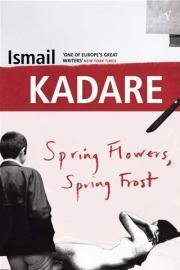
Spring Flowers, Spring Frost
From behind the closed door, the man shouts, 'Be on your way - you have no business here!'
'Open up, I am the messenger of Death'.
As spring arrives in the Albanian mountain town of B, some strange things are emerging in the thaw. Bank robbers strike the National Bank. Old terrors are dredged up from the shipwreck of history. And ultra-explosive state secrets are threatening to flood the entire nation. Mark, an artist, finds the peaceful rhythms of his life turned upside down by ancient love and modern barbarism and by the particular brutality of a country surprised and divided by its new freedom.
'Open up, I am the messenger of Death'.
As spring arrives in the Albanian mountain town of B, some strange things are emerging in the thaw. Bank robbers strike the National Bank. Old terrors are dredged up from the shipwreck of history. And ultra-explosive state secrets are threatening to flood the entire nation. Mark, an artist, finds the peaceful rhythms of his life turned upside down by ancient love and modern barbarism and by the particular brutality of a country surprised and divided by its new freedom.
192 pages, Paperback
First published January 1, 2000
About the author
Ismail Kadare
261 books1,832 followersIsmail Kadare (also spelled Kadaré) was an Albanian novelist and poet. He has been a leading literary figure in Albania since the 1960s. He focused on short stories until the publication of his first novel, The General of the Dead Army. In 1996 he became a lifetime member of the Academy of Moral and Political Sciences of France. In 1992, he was awarded the Prix mondial Cino Del Duca; in 2005, he won the inaugural Man Booker International Prize, in 2009 the Prince of Asturias Award of Arts, and in 2015 the Jerusalem Prize. He has divided his time between Albania and France since 1990. Kadare has been mentioned as a possible recipient for the Nobel Prize in Literature several times. His works have been published in about 30 languages.
Ismail Kadare was born in 1936 in Gjirokastër, in the south of Albania. His education included studies at the University of Tirana and then the Gorky Institute for World Literature in Moscow, a training school for writers and critics.
In 1960 Kadare returned to Albania after the country broke ties with the Soviet Union, and he became a journalist and published his first poems.
His first novel, The General of the Dead Army, sprang from a short story, and its success established his name in Albania and enabled Kadare to become a full-time writer.
Kadare's novels draw on Balkan history and legends. They are obliquely ironic as a result of trying to withstand political scrutiny. Among his best known books are Chronicle in Stone (1977), Broken April (1978), and The Concert (1988), considered the best novel of the year 1991 by the French literary magazine Lire.
In 1990, Kadare claimed political asylum in France, issuing statements in favour of democratisation. During the ordeal, he stated that "dictatorship and authentic literature are incompatible. The writer is the natural enemy of dictatorship."
Ismail Kadare was born in 1936 in Gjirokastër, in the south of Albania. His education included studies at the University of Tirana and then the Gorky Institute for World Literature in Moscow, a training school for writers and critics.
In 1960 Kadare returned to Albania after the country broke ties with the Soviet Union, and he became a journalist and published his first poems.
His first novel, The General of the Dead Army, sprang from a short story, and its success established his name in Albania and enabled Kadare to become a full-time writer.
Kadare's novels draw on Balkan history and legends. They are obliquely ironic as a result of trying to withstand political scrutiny. Among his best known books are Chronicle in Stone (1977), Broken April (1978), and The Concert (1988), considered the best novel of the year 1991 by the French literary magazine Lire.
In 1990, Kadare claimed political asylum in France, issuing statements in favour of democratisation. During the ordeal, he stated that "dictatorship and authentic literature are incompatible. The writer is the natural enemy of dictatorship."
Ratings & Reviews
Friends & Following
Create a free account to discover what your friends think of this book!
Community Reviews
Displaying 1 - 3 of 3 reviews
January 14, 2022
Vērtējumu gribētos likt virs viduvējā trijnieka, bet subjektīvi līdz 4 zvaigznēm neizvilka, jo neizpratu / nesajutu darba kopējo ideju vai, teiksim tā, autora vēstījumu.
Iespējams, ja es nebūtu burtiski pirms tam izlasījusi Kadares ''Mirušo armijas ģenerāli'' un uzbūrusi sev prātā un sajūtās Albānijas ainu (vizuālo, kultūras, tradīciju un vēstures ainu), tad no ''Ziedoņa puķes, ziedoņa sals'' saprastu vēl mazāk.
Kas saistīja manu interesi - Albānijas mazpilsētiņa pēc diktatūras beigām, pieskaršanās mitoloģijai un leģendām; kanuna / asinatriebības, khmm, atgriešanās, faktiski, atgriešanās pie senajām tradīcijām, un vai tas vispār ir iespējams pirmatnējā veidolā.
Tiešām nedaudz sirreāls darbs, kurā atsevišķas epizodes ir pat izbaudāmas, bet, diemžēl, kopā es to nemācēju salikt.
Un, iespējams, kaut kas ir pazudis tulkojumā, kas ir no franču nevis albāņu valodas.
Iespējams, ja es nebūtu burtiski pirms tam izlasījusi Kadares ''Mirušo armijas ģenerāli'' un uzbūrusi sev prātā un sajūtās Albānijas ainu (vizuālo, kultūras, tradīciju un vēstures ainu), tad no ''Ziedoņa puķes, ziedoņa sals'' saprastu vēl mazāk.
Kas saistīja manu interesi - Albānijas mazpilsētiņa pēc diktatūras beigām, pieskaršanās mitoloģijai un leģendām; kanuna / asinatriebības, khmm, atgriešanās, faktiski, atgriešanās pie senajām tradīcijām, un vai tas vispār ir iespējams pirmatnējā veidolā.
Tiešām nedaudz sirreāls darbs, kurā atsevišķas epizodes ir pat izbaudāmas, bet, diemžēl, kopā es to nemācēju salikt.
Un, iespējams, kaut kas ir pazudis tulkojumā, kas ir no franču nevis albāņu valodas.
October 12, 2023
kadare šeit nedaudz pieviļ

September 14, 2023
Darbā ir tāda vibrējoša atmosfēra, ka kuru katru brīdi kaut kas notiks. Bet kaut kā nenotika tā, lai man līdz galam patiktu. Iespējams, man arī neaizgāja visas rūpīgi vītās detaļas par Albāniju, kailo sievieti, Titāniku un aisbergu, asinsatriebību un mītiem. Šķiet, detaļu gluži vienkārši bija par daudz. Man ļoti patika šizīgums šajā stāstā, līdz kam nonāca galvenais varonis. Lasīt bija interesanti.
Displaying 1 - 3 of 3 reviews