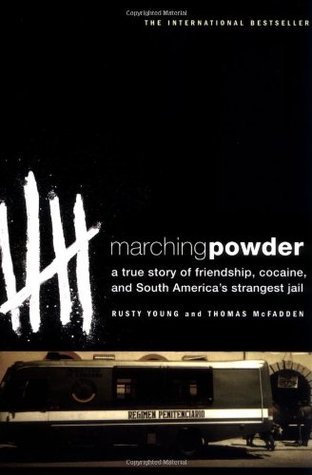
Rusty Young was backpacking in South America when he heard about Thomas McFadden, a convicted English drug trafficker who ran tours inside Bolivia's notorious San Pedro prison. Intrigued, the young Australian journalisted went to La Paz and joined one of Thomas's illegal tours. They formed an instant friendship and then became partners in an attempt to record Thomas's experiences in the jail. Rusty bribed the guards to allow him to stay and for the next three months he lived inside the prison, sharing a cell with Thomas and recording one of the strangest and most compelling prison stories of all time. The result is Marching Powder .
This book establishes that San Pedro is not your average prison. Inmates are expected to buy their cells from real estate agents. Others run shops and restaurants. Women and children live with imprisoned family members. It is a place where corrupt politicians and drug lords live in luxury apartments, while the poorest prisoners are subjected to squalor and deprivation. Violence is a constant threat, and sections of San Pedro that echo with the sound of children by day house some of Bolivia's busiest cocaine laboratories by night. In San Pedro, cocaine--"Bolivian marching powder"--makes life bearable. Even the prison cat is addicted.
Yet Marching Powder is also the tale of friendship, a place where horror is countered by humor and cruelty and compassion can inhabit the same cell. This is cutting-edge travel-writing and a fascinating account of infiltration into the South American drug culture.
Rusty Young (born 1975) is the Australian-born author of the international bestseller Marching Powder, the true story of an English drug smuggler in Bolivia’s notorious San Pedro Prison and the bestselling novel, Colombiano, a fact-meets-fiction revenge thriller about a Colombian boy who sets out to avenge his father’s death.
Rusty grew up in Sydney, and studied Finance and Law at the University of New South Wales. He was backpacking in South America when he heard about Thomas McFadden, a convicted English drug trafficker who ran tours inside Bolivia's famous San Pedro Prison. Curious about the reason behind McFadden's huge popularity, the law graduate went to La Paz and joined one of Thomas's illegal tours. They formed an instant friendship and then became partners in an attempt to record Thomas's experiences in the jail.
Rusty bribed the guards to allow him to stay and for the next three months he lived inside the prison, sharing a cell with Thomas. After securing Thomas's release, Rusty lived in Colombia where he taught the English language and wrote Thomas's story. The memoir, Marching Powder, was released in 2003 and was an international bestseller.
Following the success of Marching Powder, Rusty was recruited as a Program Director of the US government's Anti-Kidnapping Program in Colombia. He was part of a team that trained local police, military and SWAT teams in kidnapping response and hostage rescue. At the time, Colombia had an average of eight kidnappings a day. It was a role fraught with danger and Rusty lived part-time on a military base, drove a Level III armoured vehicle, communicated with colleagues via encrypted radio and changed houses in Bogotá a dozen times. He kept this work completely secret.
Through police and army contacts, Rusty was able to interview special forces soldiers, including snipers and undercover intelligence agents, about their work. He also interviewed captured child soldiers from the two main terrorist organisations – FARC and Autodefensas. The former soldiers, some as young at twelve when they joined, described in great detail their reasons for enlisting, their hatred of the enemy, their gruelling military training, their political indoctrination and their horrific experiences in battle. Once Rusty had earned their trust, they also opened up to him about gruesome tortures they were forced to witness or participate in.
These interviews, along with Rusty’s extensive in-the-field knowledge about cocaine trafficking, formed the factual setting and background for his novel Colombiano, a fact-meets-fiction revenge thriller.
Colombiano was published in Australia in August 2017 and was the highest-selling Australian fiction title that month. It will be released worldwide in 2018.
In 2011, Rusty co-founded the Colombian Children’s Foundation of Australia, which helps rehabilitate and resocialise former child soldiers. Currently, his house in Bogotá is the charity’s headquarters. Ten percent of his royalties of Colombiano will go to the foundation, which has almost 200 former child soldiers under care.
Rusty also fronts the documentary Wildlands (2017) in which he interviews notorious characters formerly involved in the cocaine trade, including George Jung – famously played by Johnny Depp in the movie Blow – and, more terrifyingly, John Velasquez or “Popeye”, Pablo Escobar’s right-hand man and one of the deadliest hitmen in cartel history.
Knyga daugelį metų buvo mano norimų perskaityti sąraše, tačiau perskaičiusi supratau, kad ji visiškai neatitiko susikurto lūkesčio.
Pirmiausia reikia pripažinti tai, kas kūrinyje pavyko geriausiai. Buvo nepaprastai įdomu pažinti Boliviją ir San Pedro kalėjimą - vietą, kuri šviesmečiais nutolusi nuo mums įprasto kalėjimo suvokimo. Čia kaliniai perka kameras, gyvena su šeimomis, valdo restoranus, gamina kokainą, rengia ekskursijas turistams, o visą sistemą persmelkia korupcija. Šie faktai ir kasdienybės detalės tapo didžiausia knygos stiprybe.
Tačiau kuo toliau skaičiau, tuo labiau atrodė, kad tikrasis knygos herojus nėra Tomas. Man juo tapo Rikardo - žmogus, kuris pirmasis jam padėjo, kai šis buvo ką tik atvykęs į kalėjimą, skolino maistą, mokė išgyventi, saugojo nuo kitų kalinių ir net po daugelio metų išliko ištikimas draugas. Rikardo turėjo vertybių, humoro jausmą, saiką ir savikontrolę. Jis gyveno toje pačioje aplinkoje kaip Tomas, tačiau neleido jai savęs sunaikinti.
Tuo tarpu pats Tomas mane vis labiau glumino. Knygoje nuolat pabrėžiama, koks jis apsukrus, sumanus ir patyręs, tačiau jo veiksmai dažnai rodė visai ką kita. Jis pasitikėdavo nepažįstamais žmonėmis, nuolat prarasdavo pinigus, kartodavo tas pačias klaidas ir beveik niekada iš jų nepasimokydavo. Kai kurie jo sprendimai atrodė ne kaip gudraus žmogaus planai, o kaip saviapgaulė.
Didžiausią nusivylimą sukėlė tai, kad neradau ryškesnės asmenybės augimo linijos. Tomas nuolat atsiduria situacijose, kurios galėjo tapti lūžio tašku - prarasta meilė, išdavystės, priklausomybė, grėsmė kalėti dar ilgiau. Tačiau net ir paskutiniuose puslapiuose jis iš esmės lieka toks pats žmogus. Skaitydama vis laukiau akimirkos, kai jis nuoširdžiai pažvelgs į savo gyvenimą iš šalies ir pripažins, kur jį atvedė jo pasirinkimai, bet tokio momento taip ir nesulaukiau.
Dar vienas dalykas, kuris kliuvo, buvo narkotikų vaizdavimas. Knygoje gausu vakarėlių, kokaino vartojimo ir istorijų apie tai, kaip linksmai buvo leidžiamas laikas. Nors kartais parodomos ir pasekmės, man pritrūko aiškesnės refleksijos. Vietomis net susidarydavo įspūdis, kad kokaino vartojimas romantizuojamas labiau, nei kritikuojamas.
Todėl užvertus knygą neatsikratau keisto jausmo. Įsiminė ne Tomas, o San Pedro. Ne jo kelias, o kalėjimo fenomenas. Ne jo charakteris, o Rikardo. Ši istorija man netapo nei įkvepiančia išlikimo istorija, nei stipriu žmogaus portretu. Veikiau tai buvo žvilgsnis į neįtikėtiną vietą ir žmogų, kuris joje atsidūrė, bet taip ir nesugebėjo iki galo savęs suprasti.
Iki šiol nesu tikra, kokią žinutę autorius norėjo perduoti skaitytojui. Ar tai pasakojimas apie pasirinkimų pasekmes? Apie priklausomybę? Apie korupciją? O gal tiesiog apie žmogų, kuris visą gyvenimą troško būti žinomas bei prisimintas? Ir, deja, linkstu prie paskutiniojo varianto.