

What do you think?
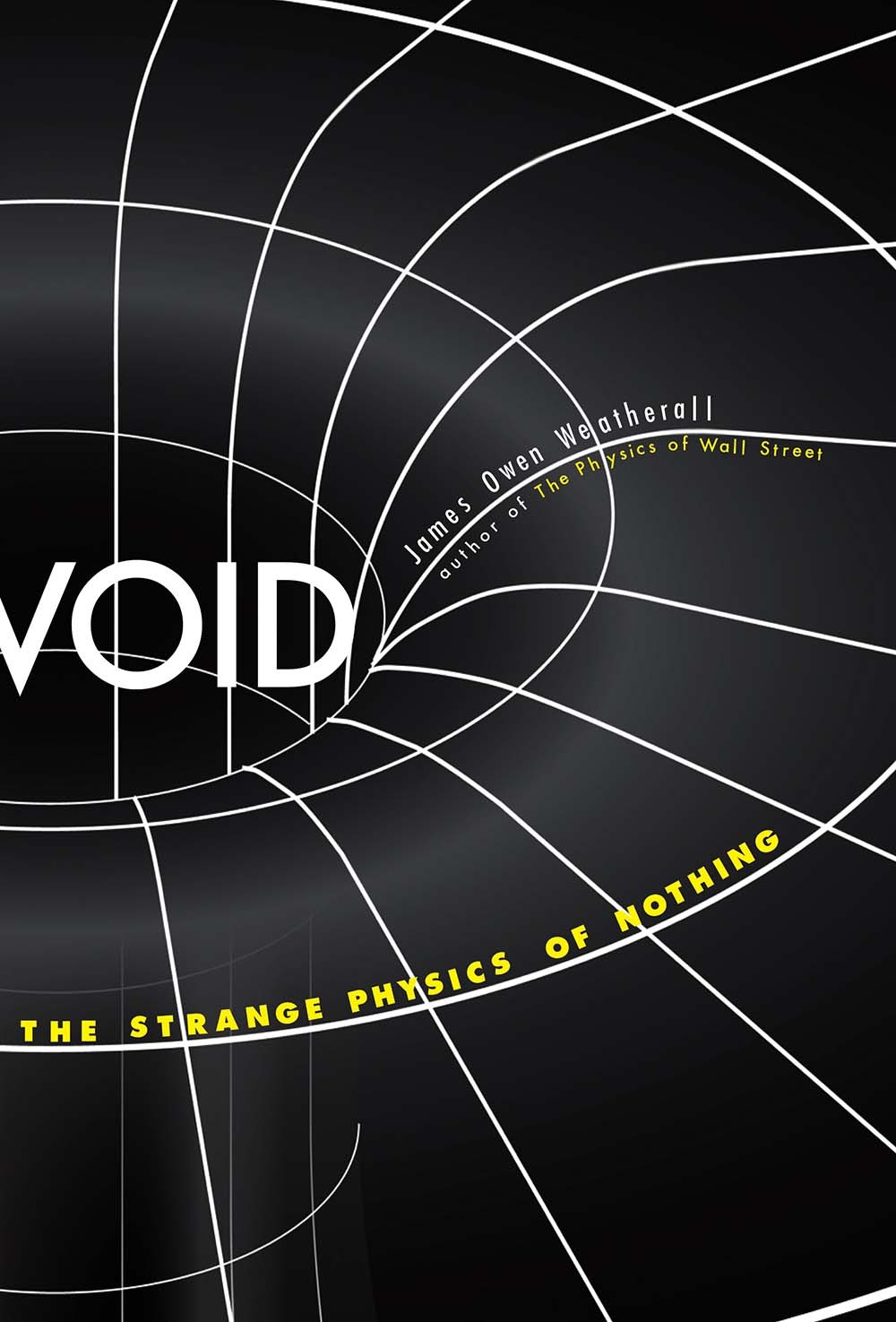
Void: The Strange Physics of Nothing
The rising star author of The Physics of Wall Street explores why “nothing” may hold the key to the next era of theoretical physics
James Owen Weatherall’s previous book, The Physics of Wall Street, was a New York Times best-seller and named one of Physics Today’s five most intriguing books of 2013. In his newest volume, he takes on a fundamental concept of modern nothing. The physics of stuff— protons, neutrons, electrons, and even quarks and gluons—is at least somewhat familiar to most of us. But what about the physics of nothing ? Isaac Newton thought of empty space as nothingness extended in all directions, a kind of theater in which physics could unfold. But both quantum theory and relativity tell us that Newton’s picture can’t be right. Nothing, it turns out, is an awful lot like something , with a structure and properties every bit as complex and mysterious as matter. In his signature lively prose, Weatherall explores the very nature of empty space—and solidifies his reputation as a science writer to watch.
James Owen Weatherall’s previous book, The Physics of Wall Street, was a New York Times best-seller and named one of Physics Today’s five most intriguing books of 2013. In his newest volume, he takes on a fundamental concept of modern nothing. The physics of stuff— protons, neutrons, electrons, and even quarks and gluons—is at least somewhat familiar to most of us. But what about the physics of nothing ? Isaac Newton thought of empty space as nothingness extended in all directions, a kind of theater in which physics could unfold. But both quantum theory and relativity tell us that Newton’s picture can’t be right. Nothing, it turns out, is an awful lot like something , with a structure and properties every bit as complex and mysterious as matter. In his signature lively prose, Weatherall explores the very nature of empty space—and solidifies his reputation as a science writer to watch.
224 pages, Hardcover
First published November 22, 2016
About the author
James Owen Weatherall
4 books43 followersJames Owen Weatherall is a physicist, philosopher, and mathematician. He holds graduate degrees from Harvard, the Stevens Institute of Technology, and the University of California, Irvine, where is presently an assistant professor of logic and philosophy of science. He has written for Slate and Scientific American.
Ratings & Reviews
Friends & Following
Create a free account to discover what your friends think of this book!
Community Reviews
Displaying 1 - 4 of 4 reviews

April 22, 2021
Il titolo è un poco fuorviante del vero contenuto di questo saggio: è una storia della fisica da Newton ai giorni nostri, o quasi, praticamente priva di formule matematiche. Tutto è estremamente discorsivo, e a tratti anche estremamente chiaro. Molti gli aneddoti citati delle vite dei protagonisti, e i contenuti delle loro lettere private, che sono sempre interessanti.
Io ritengo che qualche formula o qualche diagramma non avrebbe guastato, perché se uno vuole saperne qualcosa di più della teoria della Relatività Generale o della teoria Quantistica servono. Ma se uno vuole semplicemente averne una idea, ecco, questo è il testo che fa per lui.
sarebbero 3 stelle e mezzo, ma abbondo.
Io ritengo che qualche formula o qualche diagramma non avrebbe guastato, perché se uno vuole saperne qualcosa di più della teoria della Relatività Generale o della teoria Quantistica servono. Ma se uno vuole semplicemente averne una idea, ecco, questo è il testo che fa per lui.
sarebbero 3 stelle e mezzo, ma abbondo.

November 4, 2023
Buon saggio per l'approfondimento storico del contesto personale e intellettuale in cui sono nate le idee della fisica moderna, ma poco spazio per il tema centrale del Nulla, che finisce per essere relegato a considerazioni a margine sullo sfondo di movimenti teorici più significativi.
August 12, 2022
Poche pagine, di cui troppe dedicate alla storia della fisica, per introdurre il vuoto. Quelle specifiche dedicate al tema, però valgono tutta la lettura.

August 5, 2017
Una volta era facile parlare del nulla. Beh, no: una volta non si pensava che potesse esserci "il nulla", proprio come non aveva senso parlare del numero zero. Ancora Cartesio non ammetteva l'esistenza del vuoto, e se ci pensate l'etere serviva allo stesso scopo nella meccanica newtoniana, la prima delle teorie fisiche trattate in questo libro; le altre sono l'elettromagnetismo classico, la relatività generale e la meccanica quantistica. Più che al significato fisico del concetto di vuoto (o se preferite del nulla), però, a Weatherall interessa mostrare le sue implicazioni filosofiche; s interessante la lettura che lui fa della diatriba tra Leibniz - che sicuramente il calcolo infinitesimale lo vedeva anche filosoficamente - e Newton, che oggettivamente io credevo meno interessato a tali speculazioni; sicuramente peculiari sono poi le sue interpretazioni della fisica quantistica - ma anche lì possiamo dire che ogni fisico ha le sue idee. Quello che si scopre è che il vuoto è diventato man mano sempre più "pieno", nel senso di avere una certa struttura (o tante possibili strutture come nel caso delle equazioni della relatività, per non parlare della meccanica quantistica). Nel complesso un bel testo anche se non semplicissimo, aiutato dalla buona traduzione di Andrea Migliori.
Displaying 1 - 4 of 4 reviews