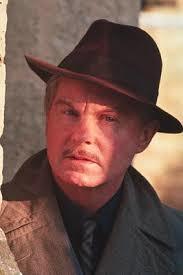
During World War II a group of men is held prisoner by the Germans, who determine that three of them must die. This is the story of how one of those men trades his wealth for his life—and lives to pay for his act in utterly unexpected ways.
Henry Graham Greene was an English writer and journalist regarded by many as one of the leading novelists of the 20th century. Combining literary acclaim with widespread popularity, Greene acquired a reputation early in his lifetime as a major writer, both of serious Catholic novels, and of thrillers (or "entertainments" as he termed them). He was shortlisted for the Nobel Prize in Literature several times. Through 67 years of writing, which included over 25 novels, he explored the conflicting moral and political issues of the modern world. The Power and the Glory won the 1941 Hawthornden Prize and The Heart of the Matter won the 1948 James Tait Black Memorial Prize and was shortlisted for the Best of the James Tait Black. Greene was awarded the 1968 Shakespeare Prize and the 1981 Jerusalem Prize. Several of his stories have been filmed, some more than once, and he collaborated with filmmaker Carol Reed on The Fallen Idol (1948) and The Third Man (1949). He converted to Catholicism in 1926 after meeting his future wife, Vivienne Dayrell-Browning. Later in life he took to calling himself a "Catholic agnostic". He died in 1991, aged 86, of leukemia, and was buried in Corseaux cemetery in Switzerland. William Golding called Greene "the ultimate chronicler of twentieth-century man's consciousness and anxiety".
Greene's 'lost' manuscript that turned up in an MGM sale; the purchaser returned the script to Greene, who went on to finalise and publish it in 1985. In a German prisoner of war camp in France there is a declaration that one in every ten men is to be shot. The 'Tenth Man' after the drawing of lots is the rich lawyer Chavel, who in turn offers his entire legacy to anyone that is willing to take his place, and amazingly a young man Janvier does! The book recounts the resultant outcomes after the War, as the now pauper Chavel feels compelled to return to his family home, now occupied by Janvier's sister and mother. Another interesting war-time thriller by Greene. 7 out of 12, a strong Three Star read. 2011 read
Chavel/Hopkins sta tornando al suo studio da avvocato dopo la pausa pranzo e finisce in una retata dei nazisti: portato in carcere, ci resterà per anni, fino alla fine della guerra.
Questo romanzo ha una storia curiosa alle spalle: Greene iniziò a scriverlo nel 1937, ma lo completò solo sette anni più tardi (che non credo proprio abbia passato lavorando solo a questo) quando era sotto contratto con la Metro Goldwyn Mayer. La storia non diventò un film. Il manoscritto fu abbandonato e dimenticato negli archivi della MGM, e riscoperto nel 1983: una sorpresa per lo stesso Greene che se ne era dimenticato. Greene pensava si trattasse di un paio di pagine di bozza di un romanzo, ma poi, quando lo ricevette per revisionarlo, scoprì invece che si trattava di un testo breve completo di 30 mila parole. Nel 1985 uscì il libro, pubblicato con l'aggiunta di due racconti dallo stile simile, e un’introduzione dello stesso Greene che raccontava la genesi del romanzo.
L’avvocato Chavel abita a circa un’ora da Parigi, ogni mattina deve prendere il treno per andare a studio.
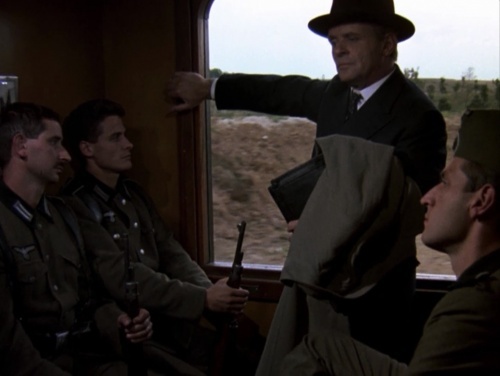
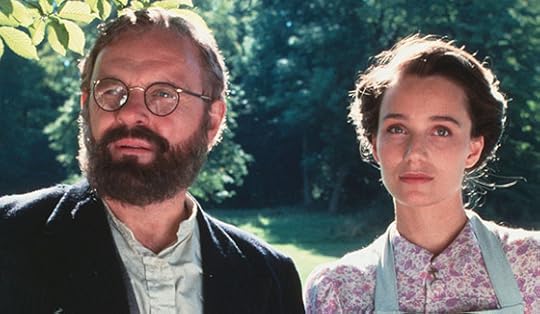
A questo punto il film è stato fatto (1988), dalla CBS, e quindi per la televisione. Pur se girato effettivamente in Francia, risente degli anni passati e del media al quale era destinato: tipica produzione televisiva a corto di mezzi, con regia scialba, salvata in più punti dalla qualità della recitazione (Anthony Hopkins, Kristin Scott-Thomas, Derek Jacobi).
I romanzi di Greene pubblicati dal 1939 al 1948 sono considerati il suo periodo ‘cattolico’, quindi ci rientra anche questo (vero!). Buffo però che la conversione di Greene dal protestantesimo alla chiesa romana avvenne ben prima, nel 1926: all’epoca era ventiduenne, e probabilmente non sapeva quello che faceva.
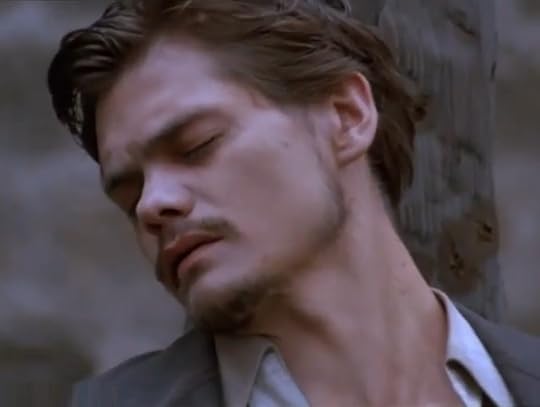
Questo è il prigioniero disposto a farsi fucilare al posto di Chavel, il fratello gemello di Thérèse. Lo scambio che innesta la storia. Il giovane era comunque ormai al capolinea, talmente malato che non ne avrebbe avuto più per molto.
Il titolo è riferito al fatto che nella Francia occupata i nazisti condannano a morte per rappresaglia un prigioniero ogni dieci (il decimo uomo): essendocene trenta, le vittime saranno tre. E saranno gli stessi carcerati a scegliere, decidere o offrirsi volontari. Ovviamente volontari non ci sono e quindi si procede tirando a sorte. Uno dei tre condannati, Chavel (Anthony Hopkins), è un avvocato abbastanza ricco per poter offrire tutti i suoi averi in cambio della vita, nel senso che li regalerà a chi si offre di andare a farsi fucilare al suo posto. Un prigioniero piuttosto giovane, Janvier, malato di tubercolosi, destinato comunque a morire di malattia, accetta lo scambio per garantire un futuro economicamente solido alla madre e alla sorella gemella Thérèse (Kristin Scott-Thomas). Anni dopo alla fine della guerra Chavel si presenta sotto falso nome alla sua villa, dove vivono madre e sorella di Janvier, il fucilato. Le due donne lo assumono come tuttofare. E l’avvocato si rivela bravo di mano, servizievole, e di fiducia. Nonché progressivamente innamorato di Thérèse, la quale sembrerebbe ricambiare. Se non che, qualche tempo dopo, si presenta alla villa un altro uomo che sostiene di essere proprio Chavel. La situazione precipita e ci scappa il morto.
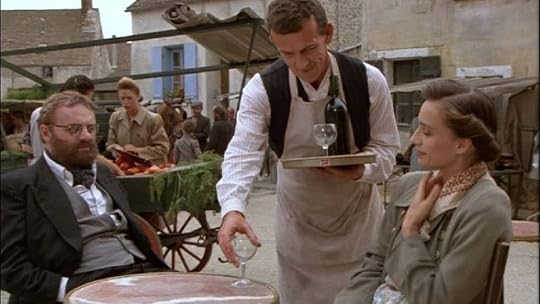
Chavel/Hopkins esce dal carcere e torna a casa: siccome si è fatto crescere un barbone, nessuno lo riconosce (camuffamento risibile, sigh).
Il tema vero/falso, verità/menzogna è centrale: ci sono due personaggi che si spacciano per quello che non sono. E addirittura, il più falso dei due (il secondo arrivato) finisce con l’essere creduto più del primo, la cui bugia era meno eclatante: la verità viene creduta menzogna, e viceversa. Direi che l’argomento viene intensificato dal tema del doppio, non solo quello dello scambio di identità, ma anche col fatto che Thérèse è la sorella gemella del fucilato. Questa ambiguità è accentuata nel romanzo (non nel film, che è più lineare, e così facendo perde parecchio) dal fatto che il racconto è portato avanti da più punti di vista: il classico narratore, un giudice che era nella cella e ha assistito allo scambio di destino, il truffatore (e assassino) che si presenta alla villa come secondo incomodo.
Kristin Scott-Thomas, sempre brava, qui però è mal diretta e si concede qualche ingenuità e leziosaggine di troppo.
Chavel è un altro protagonista à la Greene, anti-eroe per eccellenza: solitario, traditore, in principio pavido, si redime dalla sua colpa (la prima e più grossa, aver scambiato la sua vita con la morte di un altro – la seconda, e minore, aver mentito sulla sua vera identità) con il sacrificio della sua stessa vita.
PS Esiste un film del 1936 con lo stesso titolo che è tratto da un play di W. Somerset Maugham. Ma hanno in comune solo il titolo.
Derek Jacobi interpreta il maramaldo che si spaccia per Chavel e riempie la testa di Thérèse di bugie, ben più di quanto avesse fatto il vero Chavel. Per aumentare l’ambiguità, Greene adotta cognomi francesi così simili che nel film sono stati cambiati per non rischiare confusione dello spettatore.
While under a two-year contract with MGM in 1944, Graham Green wrote The Tenth Man. In 1983, it was rediscovered.
Ironically, F. Scott Fitzgerald worked for MGM in 1937-1939. In his notebook, he sketched a similar plot.
The premise of the book is extraordinarily fascinating—a group of prisoners are told that 3 of them must be executed. They can select which three. To be fair, they decide to draw lots. When a wealthy man gets a bad lot, he offers to buy his own life. Then, he discovers what kind of deal he made.
While I appreciate the readability of Greene’s prose, the execution should have been so much better. The female characters needed much more development; their backstory was completely insufficient.
Miracles can happen. Yes, even in the midst of our present-day times of despair and devastating tragedy, miracles can happen.
Like how my dearest friend and soul brother Matthew Appleton thought, oh God bless him, to surprise me with a special gift all the way from England, a nimble cord of our friendship thrown over the vast distances between our respective countries, and thus mailed me the beautiful, elegant first edition of this beautiful, elegant and even elegiac novella by my favourite storyteller, thus sending it off on its long and winding path across the seas and countries to find its destination here in far-flung Bombay. Nothing short of a miracle, the kind that warms the heart when one thinks of it.
Or like how this elegant gift sailed and forged its way across those same seas and shores and found its way to my doorstep one evening and thus diminished all the darkness of boredom and disillusionment that had set in at dusk that day. Again, nothing short of a miracle, indeed. Thank you from the bottom of my heart, Matthew.
Or like how rediscovering "The Tenth Man" - which had already earned very well-deserved five stars from me in my first reading, back in the Summer of 2019, already a world and a point of time that feels so blissfully distant and free from all peril and paranoia, could only prove to me further that anything written by Greene, no matter how many decades old, could still resonate powerfully and even as indelibly as the first time in the desperate times that we find ourselves in the midst of today.
Consider, for instance, the opening scene. Men incarcerated in an anonymous prison, held there by the desperate will of an alien power that has now held their land hostage, biding their time by the most mediocre and mundane of things. And that opening conundrum of the unreliability of time. Just whose time is to be trusted - the time of a wealthy man or the time of a humble peasant? And does it really matter? Can anybody really measure time in this strange, anonymous prison? How does it matter what hour of the day or night it is when all the possibilities of freedom and even life have been reduced to the bare minimum?
These thirty men are informed, one day, that every one man in ten will die. It could be anybody - married or unmarried, wealthy or poor, honest or crooked, brave or cowardly, respectable or guilty. But this much is sure - that every one man in ten will die. They draw lots, to pick the victims among them but even then it is up to chance and fortune to decide the three men who must face their fate the next morning at short notice. One man in these chosen three protests, revolts at the harsh fate dealt out to him and makes a bargain, literally a bargain with everything he has in stake...
Not a very different situation to our own dilemma, isn't it?
What happens after that? Oh, why do we have to even wonder about how masterfully does Greene lets this exquisitely sad, superbly rounded, brilliantly characterised story unfold organically, leisurely without ever writing a word too much or an expression too less? We know that we are in the hands of a master storyteller when we realise that "The Tenth Man" was not even originally a novel; it was an unused story treatment that had lain for decades in the archives of MGM, who were producing films with more inferior and emotionally underwhelming scripts at the same time as this was written and it is also something of a miracle that it was found, reworked by the author and then published so that we can finally see for ourselves what a mistake it was it to let it lie in those archives for so long.
For "The Tenth Man" is more profound, more effortlessly compelling, more vividly cinematic and more powerfully dramatic than any good film can dream of. Like "The Third Man", it deconstructs a lesser-known chapter of the final years of the Second World War and it dissects, with much deft skill and sharp irony, the nature of the moral duplicity of those desperate and dire times. And even beyond that, it is Greene at his customary best - a story of guilt and redemption, of cowardice and courage, of heroism and romance, of cunning and honesty and, yes, of a miracle of heartbreaking consequences.
Yes, a miracle. For identities change and distort, the liars are believed to be true and honesty pays its own terrible price. And yet, as the climax, the pitch-perfect, nearly flawlessly orchestrated ending of the story approaches, we witness another miracle, of guilt being redeemed, of an error being corrected, of cowardice transforming into a feat of courage.
As I said even before, miracles can happen. And Greene, as always, makes us believe in this very sentence with all our heart.
An unheard of (to me) yet utterly heartbreaking piece of work from Graham Greene. This novel was written in the 1940s and lay forgotten until the 1980s in MGM's archives. What a mistake that was. A poignant and sharply written masterpiece that puts Mr Greene on the map, capable of writing serious literature for anyone who believed his novels were just a bit of light entertainment.
Impressed by its reader-friendly fonts and conveniently manageable 158 pages, I decided to read this novel depicting a rich lawyer named Chavel, one of the thirty prisoners guarded by German soldiers in occupied France in World War II, whose life has been saved since, from drawing lots, he is the tenth man doomed to be executed but Janvier, an inmate sick of final-phase tuberculosis, hoping to die rich accepts his offer including his wealth. When the war is over, poor Chavel returns home in which Janvier's mother (Madame Mangeot) and sister (Therese) occupy so he works there as a servant called Charlot. Eventually, an imposter and murderer named Carosse arrives at the house claiming to be Chavel and trying to win Therese's favor but he is duly exposed by Charlot (Chavel in disguise). https://en.wikipedia.org/wiki/The_Ten...
While reading this thriller, we can realize that this is about common nature of human beings who live in greed, anger and ignorance; their differences are concerned with the degree controlling these negative traits by means of philosophy, religion, education, etc. since the ancient times.
Interestingly, what Greene has written some 30 years ago still rings a bell in recent social media, for example:
He said to the girl slowly, 'Of course. You are Mademoiselle Mangeot. ... You must forgive my want of tact, mademoiselle. I'll go at once.' (p. 112)
But the fear was under control: like a vicious horse beneath a good rider it showed only in the mouth and the eyeball. (p. 113)
'... Add to that you have been a long time in prison -- and knew her brother. It's just a chemical formula, my dear fellow.' He belched again. (p. 124)
Besides, once in a while, we may encounter some of his good sentences worth pondering in which, presumably, taken from his long span of literary career. Probably categorized as witty philosophy, this extract, I think, he has meant more or less to share with his readers as a sort of Stoicism:
When you reach a certain age you don't care about the future: it is success enough to be alive: every morning you wake with triumph. (p. 91)
Finally, we know the fate of Chavel, wounded from Carosse's shots, who has gradually been in the stage of critical coma since "The blood from his stomach was running down his leg. ... The touch of blood cooled his fever like water. ... He began to sign his name, but before he had quite finished he felt the water of his wound flowing immeasurably: a river: a torrent: a tide of peace." (p. 158) This narration of 'blood' and 'water' signifies his horrible illusion leading to his end.
-This novel was written in 1938 and was published only in 1983. The reason: It was lying in a shelf forgotten. - This was written for MGM (film studio) and supposed to be made into a film.
Remarks:
- Reading the novel was like watching a film. And this film focuses more on action and plot than on inner workings of the human action/heart. As a film that is to be justified. But in a novel more on the other part would have been better. - The themes dealt in it are many: Would you trade your life for the possessions that you cannot enjoy? What would your conscience say when you have gained life by sending someone else to death in your place? What would your reaction be especially when you meet the family of the person who took death for you? Can you, as a Christian, forgive the person on account of whom you have possessions but not the life of the family member? Are you courageous enough in your convictions when faced with death?
So one can see that there are many possibilities for exploration into human heart. But Greene touches upon all and leaves it hanging wanting the reader/film-goer to decide on the course. Anyway, a good novel to keep you engaged and to prod you into thinking on many subjects.
Interesting Trivia:
When Greene was intimated about the existence of the novel after 30 years, he imagined that he had just made the outline for a film and not an entire script. Later knowing the fact, he went in search among his own shelves and found two more 'outline sheets' for films. He gives them as part of introduction. The second of which he claims to have developed into Our Man in Havana. But the first one, which I loved even better than the novel itself remains unfinished still.
3 stars. Have meant to read this for a while. Interesting look at the question of what will we do when faced with certain life-or-death choices, as well as other questions.
From 2010 — I absolutely loved this little book of just under 120 pages. Originally written as a movie script for MGM in 1944 and then forgotten, the manuscript was found again in 1983 and published in its present form. The story takes place in France during and immediately following WWII. In the opening chapter, a German officer informs a group of thirty prisoners that they must choose three men among their ranks to be executed the following morning. The men decide to draw for it, and when Jean-Louis Chavel, a rich and unpopular lawyer finds he's picked a piece of paper marking him for execution, he offers to give away all his possessions, including his family's country house, to the person who'll accept to take his place. The bulk of the story centres around Chavel once he is released, penniless, unable to find work and irresistibly drawn to the home of his ancestors, now occupied by the dead man's remaining family. This story was both fascinating and profound, touching on issues of identity, morality, courage and redemption. It was my introduction to Graham Greene, an author whose work I’ve long wanted to read and which I'll be sure to seek out.
This book was short, but powerful. A group of French men are imprisoned by the Germans during WWII. The Germans have decreed that every tenth prisoner will be executed. One man, Chavel, is a rich lawyer and, in a moment of mindless panic, offers all his possessions to anyone who would take his place should he draw the tenth straw.
Nobody takes him seriously, as indeed, he was really just speaking wildly. Who would take up such an offer, when they wouldn't survive to enjoy the wealth?
But a man Janvier decides he will take up the offer. He plans to give the wealth to his mother and sister. This is what happens.
Later, Chavel leaves the prison alive, but destitute. He returns to his home where Janvier's mother and sister are now living, passes himself off as a man named Charlot and works as their servant.
What ensues is an interesting and suspenseful relationship between Chavel, now Charlot, and Therese, Janvier's sister. He listens how she expresses her hatred for Chavel, not realizing to whom she is talking.
Things become more suspenseful when another man shows up at the house claiming to be Chavel. The real Chavel recognizes him as an actor who was in the prison with him by the name of Carosse. Carosse is a very good actor and also a murderer.
The plot is quite thick and forcefully drives the story, but it is the subtle complexities of each person's relationship and especially the conflicting thoughts that Chavel suffers inside himself as he must decide to brazen out his deception or in his own way attempt redemption.
Graham Greene was a Roman Catholic and I find Man's complicated relationship with God and his struggle within his own corrupted nature is explored in every book and short story I've read by him.
The good thing about being a Greeney – a Graham Greene fan (or even stan) – is that he was so prolific that there’s always another novel(la). I had not heard of this book until recently, but I’m glad I found it lurking in a second-hand bookshop. Greene explores ideas in just over 100 pages that a lesser novelist would take 350 to say – that money doesn’t bring happiness, that you can’t cheat death, as well as his usual obsessions: doing the wrong thing for the right reasons (or indeed vice-versa), redemption, good vs evil, two men fighting over the same woman (an innocent) and that revolutions – in this case la Resistance against the Nazis – don’t always go well for the common man.
The book reminded me somewhat of The Scapegoat, a 1957 Daphne Du Maurier book about an English tourist taking on a French aristocrat’s life after the war, which is odd because the book was in a vault at MGM for 40 years so DdM couldn’t have been influenced by The Tenth Man, and her novel couldn't have shaped Greene's.
"He envied Jules: to have been able to remain ‘correct’: to have saved his self-respect by small doses of rudeness or inattention. But for him— to have remained correct would have meant death."
The Tenth Man is not just a story but a moral experiment: A group of prisoners of war are told that as punishment for the killing of occupying forces by the local resistance movement, one in ten prisoners would be executed. It is up to the prisoners to draw lots.
From this Greene develops a tale of moral conflict, perceptions of heroism and cowardice, of pretense and being true to character, and it all starts, not with the draw, but with one of the chosen offering to buy his life in exchange for all his possessions.
I really enjoyed the premise of the story and - needless to say - Greene's writing. However, the introduction of the love story and ending of the book left me wanting more of a development of the original dilemma - Chavel having to deal with his conscience - rather than focusing the story on the ensuing love triangle and resolving all the issues in a rather convenient manner. Not that Greene does not often chose to resolve his characters' conflicts in the same manner, but in this book in particular, I felt the story itself would have offered a less clean-cut conclusion.
However, this story was written around the same time as the The Third Man, and Greene intended it to work as a screenplay, in which case a more ambiguous ending would not have worked. At least not if he needed to sell the story to a film studio.
Having read Greene's novels there is a distinct difference between early works written for film and later works, many of which were eventually turned into films. The early works, The Tenth Man included, tend to be limited in developing characters and ideas, whereas the later ones thrive on both and allow Greene's writing to develop another dimension. "The paper lay on the floor beside him, scrawled over with almost illegible writing. He never knew that his signature read only Jean-Louis Ch … which stood of course as plainly for Charlot as for Chavel. A crowning justice saw to it that he was not troubled. Even a lawyer’s meticulous conscience was allowed to rest in peace."
"When you reach a certain age you dont care about the future--"
France, W2 is just over and "men were picking their way home, from prison camps, from hiding places, from foreign parts..." A young woman named Therese greets, at her new home, an older man who knew her brother who was shot as a German hostage. In the same jail, this stranger also knew the wealthy man who lived--survived--because he gave away his inheritance and property, in exchange for his life, to the youth who wanted his poor sister (and mother) to be comfortable forever. Yet, herein are necessary lies and deceits. Two things are true. The hostage brother was executed, the sister inherited a fine country home. ~ As always, there's a catch. This is Graham Greene, after all. Therese, despairing because her brother sacrificed his life for her, deeply hates the man who made the bargain.
This marvelous novella was written as a screen treatment in the mid1940s for Metro and then lost, forgotten...and, like a Greene story, discovered in 1983... Some readers scoff because it was merely a treatment, but it's pure Greeneland and admirers should not miss it. It can be read in a few hours...It's so damn good, I deliberately read it over a few days...I didnt want to reach the inevitable, and tragic, conclusion.
Compassion, redemption, the uselessness of worldly goods....a life for a life.
Je me souvenu de ce livre que j'avais lu il y a plus de 20 ans, en passant devant les studios Gaumont, l'autre jour. Ce livre a une histoire qui mérite d'être contée. Il faut un temps, après la guerre, où le romancier anglais n'était pas sûr de faire vivre sa famille en écrivant des romans. Donc il se mit à composer des scénarios de films, en particulier pour la Metro Goldwin Mayer. Dans les tiroirs de cette firme, il y a un texte de Greene qui l'avait tout simplement oublié. C'est " Le dixième homme ". L'ayant relu, l'auteur l'a trouvé encore tout à fait lisible. Cela se passe in France, pendant la guerre, dans un camp où les Allemands enferment des résistants. Sur trente otages, trois sont condamnés à être fusillés, ce sont les otages eux-mêmes qui doivent les désigner.. J'ai trouvé cette scène géniale. Ce n'est que dans " Sophie's Choice "que j'ai rencontré la tragédie du choix. Un de ces trois malheureux refuse de mourir et offre tous ses biens en échange de sa vie...le marché est accepté par un autre. Ce qui suit, découvrez-le vous-même, car Greene a vraiment le talent du suspense. Même si ce n'est pas un très grand roman, c'est du bon Greene. Camus a écrit " Le Premier Homme ". Les neuf autres se sont enfuis chez Greene, à la recherche du suspense perdu. Je n'peux pas les blâmer.
What at first sight seems a simple and straightforward story, untangles into a deep and moving tale about guilt, love and ultimately, the value of life. With a magnificent prose, Greene develops a Hollywoodesque gripping tale of a man who bought his life in prison and the unexpected consequences. This was my first Greene and I was not disappointed, looking forward for more books like this.
'It's not so easy to hate a face you know,' she said, 'as a face you just imagine.'
Another short, but powerful and enjoyable Greene novel. One of the ten prisoners are going to killed in a WWII prisoner-of-war camp and they are left to decide who the tenth man will be. What happens from here determines the rest of the novel, stretching past the camp, and into the future that lies beyond for the survivors. Above all, this is a story of guilt and courage.
If one had possessed a God's eye view of France, one would have detected a constant movement of tiny grains moving like dust across a floor shaped like a map.
The manuscript was lost for nearly forty years until someone found it and wrote to Greene about it. He claimed he couldn't remember writing it. The Tenth Man, a treatment to be developed into a film script, was written as part of Greene's contract with MGM in the late 40s. On rediscovery in the 1980s Greene re-edited it and allowed it to be published. It's a pity it never got made into a film by Carol Reed, who directed The Third Man, Our Man in Havana and The Fallen Idol. I haven't seen The Fallen Idol yet but the other two are excellent. Many times Greene's work got made in lousy movies. The Ministry of Fear is good and I liked the 21st century version of The Quiet American, but beyond these two, and the Carol Reed's flicks, there isn't much.
As a short novel of around 30,000 words I preferred this to The Third Man. It has a less complicated narrative structure and stronger characters. The Third Man's strength is its setting in the divided post-war Vienna. This one is set in France during WWII and after. Interestingly, all the characters are French, no Englishman to be seen; unusual for Greene.
Clever. Clear prose not without beauty. Psychologically sharp. A bit melodramatic and sentimental, perhaps, at the end, parochial, patriarchal, but nevertheless endearing.
'You good ones are so horrifying. You get rid of your hate like a man gets rid of his lust.'
Its very becoming is a work about memory and process - Greene recalls to have penned only an outline, 'two pages in typescript', instead of the some thirty thousand words, 'very readable', whose existence was forgotten for almost four decades in the archives of Metro-Goldwyn-Myers. Greene muses on his notes which recall other outlines, sometimes (then, in 1944) almost a decade old, which recall a dramatic figure much like Chavel. This is the eternal returning, the odyssey of recollection, the slow digestion behind the creative process.
(This edition at least) also includes, along with Greene's notes, sketches for two films: Jim Braddon and the War Criminal, in which the former, a lookalike to the latter (Nazi 'Inspector General of concentration camps' Schreiber, whose real-life Generalarzt counterpart got briefly Lublyanka'd, listed a, and eventually ran a general practice in Argentina until overdue death) suffers a plane crash in Mexico that leaves him an amnesiac with displaced identity documents. Shenanigans ensue. Somewhat interesting tarrying with memory (which obviously resonatres in metafictional context), but mostly dependant on odd essentialist notions of goodness. Nobody to Blame is a comedy of errors featuring a philatelist sewing machine salesman who gets recruited by the Secret Service for the secondary income, and passes off expenses for fictive agents and rare postage stamps as bribes, which balloons in his face as those things do. Altogether quite entertaining.
3,5 stele. Graham Greene nu a obținut Premiul Nobel pentru Literatură, însă, între 1950 și 1973, a fost nominalizat în - țineți-vă bine - optsprezece ani diferiți. Dat fiind faptul că numele scriitorilor nominalizați nu pot fi făcute publice decât la 50 de ani distanță, iar 1973 reprezintă ultimul an despre care există date certe, e posibil ca numărul nominalizărilor lui Greene să crească. Oricum ar fi, rămâne la distanță mare de deținătorul recordului de nominalizări (154 în 26 de ani diferiți între 1931 și 1968), istoricul literar spaniol Ramón Menéndez Pidal. Cu toate acestea, Pidal nu a câștigat Nobelul pentru Literatură. Bineînțeles, mai sunt și alți scriitori care au fost nominalizați într-un număr mai mare de ani decât Graham Greene și nu au primit Nobelul pentru Literatură (de exemplu, E. M. Forster, nominalizat în 20 de ani diferiți între 1945 și 1969, André Malraux, nominalizat în 23 de ani diferiți între 1947 și 1973 etc.). Un lucru este cert: numărul mare sau foarte mare de nominalizări nu este deloc o garanție a faptului că scriitorul în cauză va primi în cele din urmă premiul mult râvnit. Mai ales că există și cazuri, William Faulkner, Bertrand Russel etc. în care nominalizarea într-un singur an s-a dovedit a fi suficientă pentru a câștiga. Dincolo însă de faptul că nu a fost recompensat cu Premiul Nobel pentru Literatură, Graham Greene rămâne o voce relevantă în literatura secolului al XX-lea. Este imposibil să îți placă tot ceea ce a scris, însă este la fel de imposibil să nu-ți placă niciuna dintre cărțile sale. Al zecelea om nu este nici pe departe cel mai bun roman al lui Greene. Deși a fost publicat în 1985, totuși originea sa se află în anul 1937 și nu era vorba despre un roman, ci despre o povestire. Ce-i drept, o povestire cu o temă fascinantă. Ulterior, cadrul povestirii va fi schimbat, acțiunea având loc mai întâi într-o închisoare din Franța aflată sub ocupație nazistă. Într-o celulă sunt înghesuiți treizeci de deținuți, iar un ofițer german îi anunță că trei dintre ei vor fi executați drept represalii pentru uciderea unor soldaţi nemți de către localnici neidentificați. Pe el nu-l interesează "cine sunt cei trei". Prin urmare, deținuții trebuie să decidă cine va muri și cine nu. Louis Chavel face notă discordantă printre ceilalți deținuți deoarece este avocat și a moștenit o adevărată avere. Fără niciun folos, însă, deoarece, atunci când se trag la sorți persoanele care vor fi executate, el trage biletul necâștigător. Însă, poate că nu e totul pierdut: Chavel e dispus să cedeze întreaga sa avere colegului de celulă care este dispus să se sacrifice în locul său. Surprinzător, însă există cineva dornic să facă acest pact cu Chavel. Partea a doua a romanului se desfășoară după terminarea războiului. Chavel este acum un om liber, însă a devenit un biet vagabond. Se hotărăște să se întoarcă la casa natală, unde locuiesc acum sora și mama deținutului cu care el a făcut schimbul acela suprarealist. Această întâlnire este punctul forte al romanului. Lectură plăcută!
This story begins in a WW2 prisoner-of-war camp. Of the thirty prisoners, three must die and the prisoners draw lots to decide. Wealthy Chavel though, when his name is drawn, does not have the nerve to follow through and offers his lands and money to somebody who'll take his place. A man offers to die for him so that his sister and mother may live better lives.
Once out though, Chavel is challenged by the dead man's sister, ,who'd rather her brother alive than live in monetary prosperity.
It sounds intriguing, but this novella seems rushed. Greene certainly doesn't juice this rich story for all that its worth. Perhaps the fact that he wrote it with a screenplay in mind is part of the reason that the story doesn't make the most of the many potential insights the plot could offer. It's still 'good', just not 'great' - as Greene usually is.
Ωραίο στόρυ και καλή πλοκή! Μπορεί να φαίνεται λίγο παλιακό, αλλά τελικά μου άρεσε πολύ ο τρόπος που παρουσίαζε αυτό που τελικά ήθελε να μας μεταφέρει ο συγγραφέας. Ο δόλος, η δειλία, οι οικογενειακοί δεσμοί και η αγάπη, είναι τα βασικά θέματα που πραγματεύεται μέσα από τους ήρωες του. Νομίζω έχει γυριστεί και ταινία και αν ισχύει αυτό, σίγουρα θα ήθελα να τη δω.
Greene se lució con esta narración sobre un personaje que debería haber muerto pero que debe continuar con su vida y darle sentido. Está claro que sabía contar historias y aquí aprovecha bien sus puntos fuertes: Tanto el desarrollo de los personajes como los diálogos son impecables y con ellos levanta una de sus tramas de perdedores que ganan (¿O ganadores que pierden?) y dilemas morales irresolubles.
There is not a bad Graham Greene book. This one was an easy read, insighful, as always, but appeared rather rushed, although the idea itself, had ample depth potential. An imprisoned, in occupied France,man (the 10th man) draws the lot for execution but buys himself out by selling all his property to another prisoner who takes his place. After the war the 10th man returns to his family home where the other prisoner's family lodges and falls for the other prisoner's sister.
The usual pattern of guilt, remorse, twisted and belated ethics, all fall within their well-crafted places by Greene. The way he always paints the outer and inner picture is present throughout the novella.
Being myself a devoted resident of "Greeneland" this one is added to the "enternainment" books of this masterful story-teller.
Graham Greene wrote The Tenth Man in 1944 when he was under a two-year contract with MGM. The manuscript lay forgotten in their archives until 1983 . It was published two years later.
This story starts with 30 men in a German prison cell in occupied France. As a reprisal for three murders by the local resistance, three of these 30 will be shot the following morning. They draw lots. One of the unlucky three is a rich lawyer called Lewis Chavel who has a failure of nerve and offers his worldly belongings if someone will take his place.
Someone does so they can pass on the money and property to their family.
After the war and in disguise, Chavel goes back to the place he called home to see what became of his property.
I read this Greene novel after about a gap of fifteen years from the last one of his that I read. I have to say, Graham Greene has not lost his magic on me - the man's ability to twist and convolute his plot, mainly in the heads of his characters, is extraordinary. And to think that this novel was buried in the archives at a major film studio and nearly forgotten!
Passado na segunda guerra mundial, esta pequena narrativa expõe as consequências de um homem condenado á morrer mas que troca de lugar oferecendo os seus bens a um prisioneiro pobre. Anos mais tarde, ele regressa a sua casa sob outra identidade e convive com a irmã do falecido. Entre os dois criar-se-á uma grande proximidade, até que surge outro homem fazendo-se passar por ele. Irá Chavel deixar cair a máscara ou manterá sempre o seu disfarce com medo de perder o carinho daquela mulher?
Is a man born to be a coward? Is a man raised to be a coward? Or during a crisis does a man panic and act in a perceived cowardly way, and is from then on labeled a coward? In the case of Louis Chavel the reader will have to decide.
A short entertaining read, an easy recommendation.
This book is 150 pages long, and 30 of those are introduction (and have a whole different story in them - I love when writers do that), but it took me almost exactly a week to read and I loved it. I wanted to string out every chapter, savour every word, and just bask in the fact that Graham Greene's way with storytelling just blows me away.
It's not even the poetry of the words, although they feel like the sort of thing you want to read out loud. It's the deftness of description. It's the things he mentions, the way he points them out, and you can just see it all in your head and you know exactly what he wants you to take from it. I just... the man is a genius. I always knew this.
In The Tenth Man (I sadly did not get a chance to tell someone with a straight face that it's the seventh in the series after The Third Man - a missed opportunity though I say so myself), there is a decimation in a prison in 1944 occupied France. A lawyer draws the short straw, as it were, and trades everything he owns in order to save his own life. That alone is interesting enough - especially as a follow-up to the last book I read which also grappled with the ethics of capital punishment, and how it affects people. In the second half of The Tenth Man, the war ends, and the lawyer goes back to his old house, meets the family of the man who took his place, and tries to come to terms with what he has done.
The first half of the story - the half in the prison - I found interesting, but the second half is where the book really finds itself. Instead of finishing on a Cliffhanger Slash Uncertain Future, that future plays out. We see how it works, and it's fascinating, and clever, and I finished it twenty minutes ago and I'm still not completely sure what I ultimately take from it. The question, I suppose, is "Was the lawyer wrong, in the end, to sell everything he had for this man's life?" and while he immediately regrets it, and Greene sort of comes down on the side of "probably yes he was wrong," I'm not entirely sure. It's very interesting and I'm sure I'll be working out the twists in it for a while to come. I'd recommend it for that alone, frankly.
Oh, but the point is that it was gorgeous to read. Utterly gorgeous to read. This is actually the only book of Greene's that I've ever read - I know, I'm as surprised as you are, he's right up my avenue - and I foresee a lot more of his back catalogue in my life in the near future. I'm quite excited about the prospect.