

What do you think?
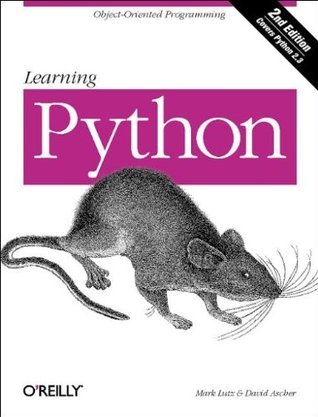
Learning Python
Portable, powerful, and a breeze to use, Python is the popular open source object-oriented programming language used for both standalone programs and scripting applications. Python is considered easy to learn, but there's no quicker way to mastery of the language than learning from an expert teacher. This edition of Learning Python puts you in the hands of two expert teachers, Mark Lutz and David Ascher, whose friendly, well-structured prose has guided many a programmer to proficiency with the language.
Learning Python , Second Edition, offers programmers a comprehensive learning tool for Python and object-oriented programming. Thoroughly updated for the numerous language and class presentation changes that have taken place since the release of the first edition in 1999, this guide introduces the basic elements of the latest release of Python 2.3 and covers new features, such as list comprehensions, nested scopes, and iterators/generators.
Beyond language features, this edition of Learning Python also includes new context for less-experienced programmers, including fresh overviews of object-oriented programming and dynamic typing, new discussions of program launch and configuration options, new coverage of documentation sources, and more. There are also new use cases throughout to make the application of language features more concrete.
The first part of Learning Python gives programmers all the information they'll need to understand and construct programs in the Python language, including types, operators, statements, classes, functions, modules and exceptions. The authors then present more advanced material, showing how Python performs common tasks by offering real applications and the libraries available for those applications. Each chapter ends with a series of exercises that will test your Python skills and measure your understanding.
Learning Python , Second Edition is a self-paced book that allows readers to focus on the core Python language in depth. As you work through the book, you'll gain a deep and complete understanding of the Python language that will help you to understand the larger application-level examples that you'll encounter on your own. If you're interested in learning Python--and want to do so quickly and efficiently--then Learning Python , Second Edition is your best choice.
Learning Python , Second Edition, offers programmers a comprehensive learning tool for Python and object-oriented programming. Thoroughly updated for the numerous language and class presentation changes that have taken place since the release of the first edition in 1999, this guide introduces the basic elements of the latest release of Python 2.3 and covers new features, such as list comprehensions, nested scopes, and iterators/generators.
Beyond language features, this edition of Learning Python also includes new context for less-experienced programmers, including fresh overviews of object-oriented programming and dynamic typing, new discussions of program launch and configuration options, new coverage of documentation sources, and more. There are also new use cases throughout to make the application of language features more concrete.
The first part of Learning Python gives programmers all the information they'll need to understand and construct programs in the Python language, including types, operators, statements, classes, functions, modules and exceptions. The authors then present more advanced material, showing how Python performs common tasks by offering real applications and the libraries available for those applications. Each chapter ends with a series of exercises that will test your Python skills and measure your understanding.
Learning Python , Second Edition is a self-paced book that allows readers to focus on the core Python language in depth. As you work through the book, you'll gain a deep and complete understanding of the Python language that will help you to understand the larger application-level examples that you'll encounter on your own. If you're interested in learning Python--and want to do so quickly and efficiently--then Learning Python , Second Edition is your best choice.
1214 pages, Paperback
First published July 24, 2013
About the author
Mark Lutz
21 books60 followersMark Lutz is the world leader in Python training, the author of Python's earliest and best-selling texts, and a pioneering figure in the Python community.
Mark is the author of the popular O'Reilly books Programming Python, Python Pocket Reference, and Learning Python, all currently in 4th Editions. He has been using and promoting Python since 1992, started writing Python books in 1995, and began teaching Python classes in 1997. As of mid 2010, Mark has instructed some 250 Python training sessions, taught some 4,000 students, and written Python books which have sold roughly a quarter of a million copies and been translated to over a dozen languages.
Together, his Python efforts since 1992 have helped to establish it as one of the most widely-used programming languages in the world today. In addition, Mark holds BS and MS degrees in computer science from the University of Wisconsin where he explored implementations of the Prolog language, and over the last 25 years has worked as a professional software developer on compilers, programming tools, scripting applications, and assorted client/server systems.
Mark maintains an additional book support site on the web at www.rmi.net/~lutz.
Mark is the author of the popular O'Reilly books Programming Python, Python Pocket Reference, and Learning Python, all currently in 4th Editions. He has been using and promoting Python since 1992, started writing Python books in 1995, and began teaching Python classes in 1997. As of mid 2010, Mark has instructed some 250 Python training sessions, taught some 4,000 students, and written Python books which have sold roughly a quarter of a million copies and been translated to over a dozen languages.
Together, his Python efforts since 1992 have helped to establish it as one of the most widely-used programming languages in the world today. In addition, Mark holds BS and MS degrees in computer science from the University of Wisconsin where he explored implementations of the Prolog language, and over the last 25 years has worked as a professional software developer on compilers, programming tools, scripting applications, and assorted client/server systems.
Mark maintains an additional book support site on the web at www.rmi.net/~lutz.
Ratings & Reviews
Friends & Following
Create a free account to discover what your friends think of this book!
Community Reviews
Displaying 1 - 1 of 1 review

April 28, 2018
Un buen libro sobre el muy popular y nuevamente dinámico lenguaje de programación Python.
Se complica un poco por el hecho de que el mundo python tiene 2 variantes 2.x y 3.x que evolucionan a diferentes velocidades y en ocasiones son incompatibles.
También el hecho de las letras chiquitas lo hacen menos didactivo, pero pueden ser muy útiles para muchos
Se complica un poco por el hecho de que el mundo python tiene 2 variantes 2.x y 3.x que evolucionan a diferentes velocidades y en ocasiones son incompatibles.
También el hecho de las letras chiquitas lo hacen menos didactivo, pero pueden ser muy útiles para muchos
Displaying 1 - 1 of 1 review