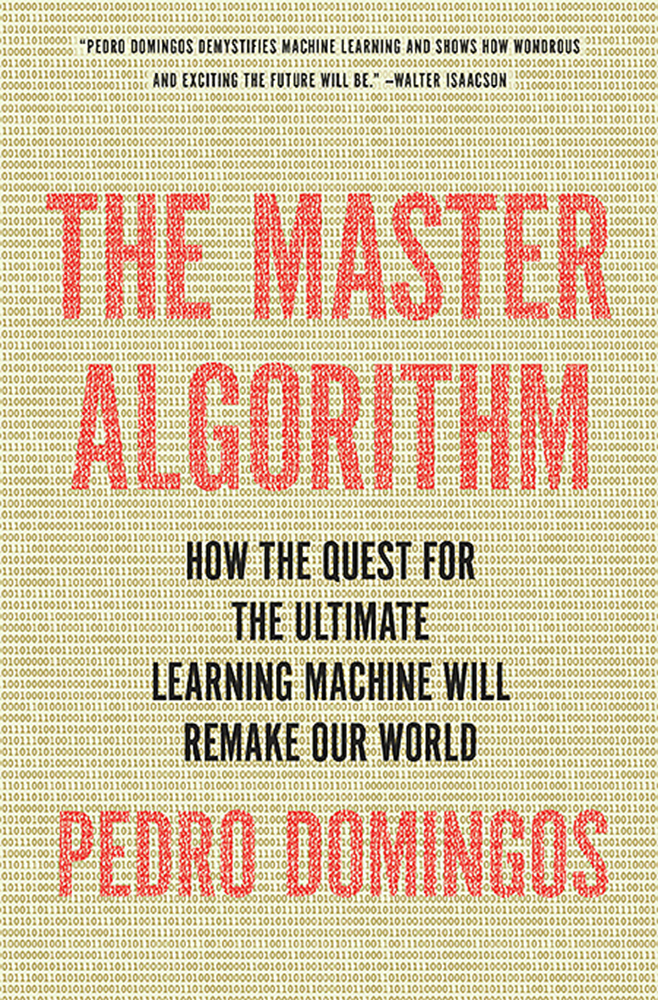
A thought-provoking and wide-ranging exploration of machine learning and the race to build computer intelligences as flexible as our own
In the world's top research labs and universities, the race is on to invent the ultimate learning one capable of discovering any knowledge from data, and doing anything we want, before we even ask. In The Master Algorithm, Pedro Domingos lifts the veil to give us a peek inside the learning machines that power Google, Amazon, and your smartphone. He assembles a blueprint for the future universal learner--the Master Algorithm--and discusses what it will mean for business, science, and society. If data-ism is today's philosophy, this book is its bible.
I'm a professor emeritus of computer science and engineering at the University of Washington and the author of 2040 and The Master Algorithm. I'm a winner of the SIGKDD Innovation Award and the IJCAI John McCarthy Award, two of the highest honors in data science and AI. I'm a Fellow of the AAAS and AAAI, and I've received an NSF CAREER Award, a Sloan Fellowship, a Fulbright Scholarship, an IBM Faculty Award, several best paper awards, and other distinctions. I received an undergraduate degree (1988) and M.S. in Electrical Engineering and Computer Science (1992) from IST, in Lisbon, and an M.S. (1994) and Ph.D. (1997) in Information and Computer Science from the University of California at Irvine. I'm the author or co-author of over 200 technical publications in machine learning, data science, and other areas. I'm a member of the editorial board of the Machine Learning journal, co-founder of the International Machine Learning Society, and past associate editor of JAIR. I was program co-chair of KDD-2003 and SRL-2009, and I've served on the program committees of AAAI, ICML, IJCAI, KDD, NIPS, SIGMOD, UAI, WWW, and others. I've written for the Wall Street Journal, Spectator, Scientific American, Wired, and others. I helped start the fields of statistical relational AI, data stream mining, adversarial learning, machine learning for information integration, and influence maximization in social networks.
Me ha costado horrores terminar este libro, y no es poque esté mal escrito o sea aburrido. Al contrario. Pienso que "The Master Algorithm" de Pedro Domingos es un libro imprescindible para aquell@s que quieran empezar a entender lo que significa "todo eso" del big data o el machine learning, términos muy novedosos sobre los que se habla mucho pero se comprende poco.
Entonces, ¿qué se me "atragantó" del libro? Lo densa que es la materia. Para empezar, hace falta refrescar los conocimientos estadísticos. De lo contrario habrá párrafos que no se entenderán. Lo siguiente es que este no es un libro "de informática". No aparece ni una sola línea de código. Casi que diría que es un libro filosófico, porque estudia las diferentes teorías de cómo aprendemos, ya que entender bien ese mecanismo es fundamental para poder diseñar el algoritmo definitivo (que va a llegar, de eso estoy seguro).
"The Master Algorithm" es un libro optimista. Pedro Domingos ve un futuro en el que las enfermedades se baten en retirada, el trabajo de fuerza bruta o repetitivo lo hacen las máquinas, y donde los recursos se aprovechan mucho más. Sí, es cierto que, hasta que lleguemos a esa situación seguirá el "caos" en el que estamos viviendo, en el que desaparecen profesiones y la desigualdad en cuanto a riqueza aumenta.
Excelente libro lo recomiendo a cualquiera que se este introduciendo en el mundo del aprendizaje automático., Que deberiamos ser todo o casi todos para no se absolutos
El libro es casi más una antología de inteligencia artificial que otra cosa. El autor hace un repaso de la historia y las diferentes ramas de IA que han ido surgiendo, los problemas que son buenas resolviendo y los que no. Todo explicado con palabras sencillas y muchas alegorías y referencias literarias, pero sin casi ni una sola fórmula o algoritmo real. Se nota que Pedro domingos es un ávido lector y disfruta dejando guiños por todo el libro. La parte realmente interesante para aquellos que quieran aprender a desarrollar estos algoritmos es capítulo de further readings, donde hace un repaso de todas los libros y papers que ha ido mencionando durante el libro.