

What do you think?
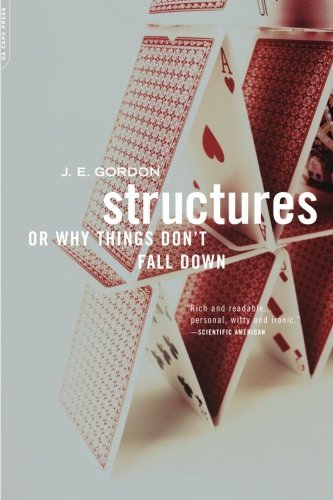
Structures: Or Why Things Don't Fall Down
In a book that Business Insider noted as one of the "14 Books that inspired Elon Musk," J.E. Gordon strips engineering of its confusing technical terms, communicating its founding principles in accessible, witty prose.
For anyone who has ever wondered why suspension bridges don't collapse under eight lanes of traffic, how dams hold back--or give way under--thousands of gallons of water, or what principles guide the design of a skyscraper, a bias-cut dress, or a kangaroo, this book will ease your anxiety and answer your questions.
Or Why Things Don't Fall Down is an informal explanation of the basic forces that hold together the ordinary and essential things of this world--from buildings and bodies to flying aircraft and eggshells. In a style that combines wit, a masterful command of his subject, and an encyclopedic range of reference, Gordon includes such chapters as "How to Design a Worm" and "The Advantage of Being a Beam," offering humorous insights in human and natural creation.
Architects and engineers will appreciate the clear and cogent explanations of the concepts of stress, shear, torsion, fracture, and compression. If you're building a house, a sailboat, or a catapult, here is a handy tool for understanding the mechanics of joinery, floors, ceilings, hulls, masts--or flying buttresses.
Without jargon or oversimplification, Structures opens up the marvels of technology to anyone interested in the foundations of our everyday lives.
For anyone who has ever wondered why suspension bridges don't collapse under eight lanes of traffic, how dams hold back--or give way under--thousands of gallons of water, or what principles guide the design of a skyscraper, a bias-cut dress, or a kangaroo, this book will ease your anxiety and answer your questions.
Or Why Things Don't Fall Down is an informal explanation of the basic forces that hold together the ordinary and essential things of this world--from buildings and bodies to flying aircraft and eggshells. In a style that combines wit, a masterful command of his subject, and an encyclopedic range of reference, Gordon includes such chapters as "How to Design a Worm" and "The Advantage of Being a Beam," offering humorous insights in human and natural creation.
Architects and engineers will appreciate the clear and cogent explanations of the concepts of stress, shear, torsion, fracture, and compression. If you're building a house, a sailboat, or a catapult, here is a handy tool for understanding the mechanics of joinery, floors, ceilings, hulls, masts--or flying buttresses.
Without jargon or oversimplification, Structures opens up the marvels of technology to anyone interested in the foundations of our everyday lives.
395 pages, Paperback
First published January 1, 1978
About the author
J.E. Gordon
10 books70 followersJames Edward Gordon (UK, 1913–1998) was one of the founders of materials science and biomechanics, and a well-known author of three books on structures and materials, which have been translated in many languages and are still widely used in schools and universities.
(wikipedia)
(wikipedia)
Ratings & Reviews
Friends & Following
Create a free account to discover what your friends think of this book!
Community Reviews
Displaying 1 - 2 of 2 reviews
June 23, 2017
3,5 estrellas. Bastante instructivo, aunque ocasionalmente tedioso.

August 22, 2013
Este libro me ha resultado muy interesante, habla de lo divino y lo humano, todo ello relacionado, de alguna manera, con las estructuras. Introduce con ejemplos sencillos y entendibles la elasticidad, la tensión y compresión.
Explica un montón de cosas, como por ejemplo porque algunos edificios tienen la forma que tienen, por qué las vigas tienen la característica forma de I a la que estamos acostumbrados o porque los modistos diseñan la ropa de la forma en que lo hacen.
Columnas, paredes, puentes y rascacielos son solo algunas de las cosas de las que habla pero también habla de la filosofía de construir cosas que en último término va a usar gente. Analiza accidentes que han ocurrido y finalmente habla de la estética de la construcción y como de alguna manera hemos destrozado la estética de las ciudades buscando optimizar las estructuras hasta el último milímetro.
Si solo hay tiempo para leer un libro sobre el tema, este libro es un claro candidato. E incluso si jamás os habíais planteado leer un libro sobre estructuras, resulta interesante comprender el cómo y el por qué de las cosas que nos rodean.
Explica un montón de cosas, como por ejemplo porque algunos edificios tienen la forma que tienen, por qué las vigas tienen la característica forma de I a la que estamos acostumbrados o porque los modistos diseñan la ropa de la forma en que lo hacen.
Columnas, paredes, puentes y rascacielos son solo algunas de las cosas de las que habla pero también habla de la filosofía de construir cosas que en último término va a usar gente. Analiza accidentes que han ocurrido y finalmente habla de la estética de la construcción y como de alguna manera hemos destrozado la estética de las ciudades buscando optimizar las estructuras hasta el último milímetro.
Si solo hay tiempo para leer un libro sobre el tema, este libro es un claro candidato. E incluso si jamás os habíais planteado leer un libro sobre estructuras, resulta interesante comprender el cómo y el por qué de las cosas que nos rodean.
Displaying 1 - 2 of 2 reviews