

What do you think?
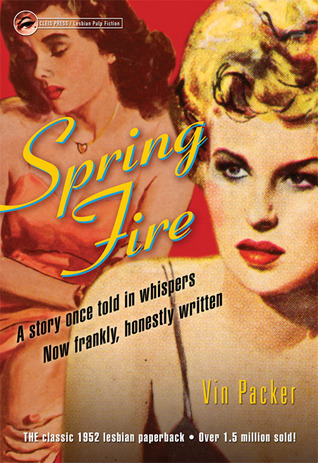
Spring Fire
Her silky black hair. Her low-cut gown. Her sparkling sorority pin. It's autumn rush in the Tri Epsilon house, and the new pledge, Susan Mitchell--"Mitch" to her friends--trembles as the fastest girl on campus, the lovely Leda Taylor, crosses the room toward her for a dance. Will Leda corrupt Mitch? Or will the strong and silent Mitch draw the queen of Tri Ep into the forbidden world of Lesbian Love? Spring Fire was the first lesbian paperback novel and sold an amazing 1.5 million copies when it first appeared in 1952. It launched an entire genre of lesbian novels, as well as the writing career of Vin Packer, one of the pseudonyms of prolific author Marijane Meaker, whose acclaimed memoir, A Romance of the 1950s , told the story of her own forbidden love. Now available after forty years out of print, Spring Fire is both a vital part of lesbian history and a steamy page-turner.
170 pages, Paperback
Published May 10, 2004
About the author
Vin Packer
39 books44 followersMarijane Meaker (born May 27, 1927) is an American novelist and short story writer in several genres using different pen names. From 1952 to 1969 she wrote twenty mystery and crime novels as Vin Packer, including Spring Fire which is credited with launching the genre of lesbian pulp fiction (although few of Packer's books address homosexuality or feature gay characters). Using her own observations of lesbians in the 1950s and 1960s, she wrote a series of nonfiction books as Ann Aldrich from 1955 to 1972. In 1972 she switched genres and pen names once more to begin writing for young adults, and became quite successful as M.E. Kerr, producing over 20 novels and winning multiple awards, including the American Library Association's lifetime award for young-adult literature (Edwards Award). She was described by The New York Times Book Review as "one of the grand masters of young adult fiction." As Mary James, she has written four books for younger children.
Regardless of genre or pen name, Meaker's books have in common complex characters that have difficult relationships and complicated problems, who rail against conformity. Meaker said of this approach, "I was a bookworm and a poetry lover. When I think of myself and what I would have liked to have found in books those many years ago, I remember being depressed by all the neatly tied-up, happy-ending stories, the abundance of winners, the themes of winning, solving, finding — when around me it didn't seem that easy. So I write with a different feeling when I write for young adults. I guess I write for myself at that age."
Regardless of genre or pen name, Meaker's books have in common complex characters that have difficult relationships and complicated problems, who rail against conformity. Meaker said of this approach, "I was a bookworm and a poetry lover. When I think of myself and what I would have liked to have found in books those many years ago, I remember being depressed by all the neatly tied-up, happy-ending stories, the abundance of winners, the themes of winning, solving, finding — when around me it didn't seem that easy. So I write with a different feeling when I write for young adults. I guess I write for myself at that age."
Ratings & Reviews
Friends & Following
Create a free account to discover what your friends think of this book!
Community Reviews
Displaying 1 - 3 of 3 reviews

January 27, 2023
Este libro se lee con un interés literario (un interés literario un tanto inmaduro, de adolescente picada con Crepúsculo) y, además, con un interés histórico. La historia es sencilla, y a veces predecible, pero me parece que está muy bien contada. Como lesbiana, me duele mucho el final y las implicaciones socioculturales detrás de este, pero, aun así, vale la pena. Hay partes un tanto sexys y fantasiosas, y otras muy crudas, lo cual lo vuelve un retrato muy realista de las sororidades universitarias estadounidenses.

October 4, 2021
tres estrellas por las risas vaya libro más caótico

October 4, 2021
Sin palabras
Displaying 1 - 3 of 3 reviews