

What do you think?
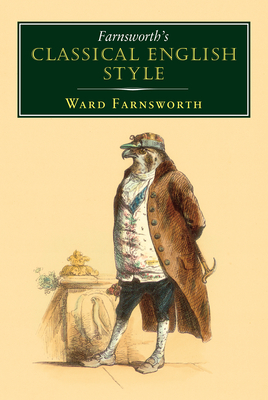
Farnsworth's Classical English Style
“An original and absorbing guide to English style. Get it if you can.”― Wall Street Journal
Say it with style―on paper or in person. This book explains why the best writing sounds that way, with hundreds of examples from Lincoln, Churchill, Douglass, and other masters of the language. As Farnsworth says, “Explaining a precept may take just a few words, but only examples can make it familiar to the ear. So we will consider examples from writers and orators who all have lessons to teach.”
Farnsworth shows how small choices about words, sentences, and paragraphs put force into writing and speech that have stood the test of time. What was the secret? Knowledge of choices in the selection of words, the arrangement of sentences, the creation of a cadence. Now that knowledge can be yours through hundreds of examples of the very best use of rhetorical devices, classical cadence patterns, hyperbole and much more.
This is must for anyone who wants to speak or write with clear, persuasive, enjoyable, unforgettable style. “A storehouse of effective writing, showing the techniques you may freely adapt to make music of your own.”― The Baltimore Sun
Say it with style―on paper or in person. This book explains why the best writing sounds that way, with hundreds of examples from Lincoln, Churchill, Douglass, and other masters of the language. As Farnsworth says, “Explaining a precept may take just a few words, but only examples can make it familiar to the ear. So we will consider examples from writers and orators who all have lessons to teach.”
Farnsworth shows how small choices about words, sentences, and paragraphs put force into writing and speech that have stood the test of time. What was the secret? Knowledge of choices in the selection of words, the arrangement of sentences, the creation of a cadence. Now that knowledge can be yours through hundreds of examples of the very best use of rhetorical devices, classical cadence patterns, hyperbole and much more.
This is must for anyone who wants to speak or write with clear, persuasive, enjoyable, unforgettable style. “A storehouse of effective writing, showing the techniques you may freely adapt to make music of your own.”― The Baltimore Sun
168 pages, Hardcover
Published April 21, 2020
About the author
Ward Farnsworth
32 books283 followersWard Farnsworth is Dean and John Jeffers Research Chair at the University of Texas School of Law. He formerly was Associate Dean for Academic Affairs and Professor of Law at the Boston University Law School. He has served as a law clerk to Anthony M. Kennedy of the United States Supreme Court and to Richard A. Posner of the United States Court of Appeals for the Seventh Circuit, and worked as a Legal Adviser to the Iran-United States Claims Tribunal in the Hague. He received his J.D. with high honors from the University of Chicago Law School, and his B.A. from Wesleyan University.
Farnsworth is the author of books on law, philosophy, rhetoric, and chess. He also has published scholarly articles on the economic analysis of law, constitutional law, statutory interpretation, jurisprudence, and cognitive psychology. He serves as Reporter for the American Law Institute’s Restatement Third, Torts: Liability for Economic Harm.
Farnsworth is the author of books on law, philosophy, rhetoric, and chess. He also has published scholarly articles on the economic analysis of law, constitutional law, statutory interpretation, jurisprudence, and cognitive psychology. He serves as Reporter for the American Law Institute’s Restatement Third, Torts: Liability for Economic Harm.
Ratings & Reviews
Friends & Following
Create a free account to discover what your friends think of this book!
Community Reviews
Displaying 1 - 26 of 26 reviews

March 22, 2024
Superb selection of sonorous sentences.
June 27, 2020
An excellent guide for all writers and speakers. When you read this book, you will notice the absence of quotations from anyone within the last 60 years. Rhetoric, writing, grammar, and many similarly out of fashion things used to be taught. Their absence is reflected in the quality of writing and oration that we see today.

September 3, 2020
Fantastic work on what excellent English style looks like. Farnsworth's sections on etymology were marvelous, and I loved the plethora of examples from great English-speaking orators throughout the work. Between the advice and examples, it's probably one of my favorite works on English style that I've read. Definitely a useful resource for teaching.
Rating: 4.5 Stars (Excellent).
Rating: 4.5 Stars (Excellent).
July 20, 2020
This book joins Farnsworth’s Classical English Rhetoric and Classical English Metaphor on my shelf of prized references. Together they make a strong trilogy. The pleasure of Farnsworth’s books is in the clarity of his distinctions and the quality of the texts he chooses for illustration, mostly drawn from the literature of the eighteenth and nineteenth centuries, with some Churchill thrown in for good measure. Strange to say, but in our present day and age reading Farnsworth is almost an escapist indulgence. Each book is for me a little island of sanity and peace.

Read
March 26, 2021I had never realized the full implication of English being (for the most part) the progeny of Germanic and Romance languages. Now the two families of words are hard to miss. As helpful as the concepts of this book are, Farnsworth's writing itself is just as useful. A book about writing well really ought to be well written itself and this book delivers there. Reading the prose, you know you are in good hands. I take as much from studying his own style as I do from studying the examples he gives.
January 25, 2022
Finally a book on style that doesn't just promote simplicity and economy. The use of examples feels overdone but are important in trying to develop the reader's ear and eye to the techniques.

December 28, 2020
The main argument made in Farnsworth’s Classical English Style is that good writing involves the balancing of contrasts. Many of these contrasts are rhythmic, and one good way to vary rhythmic flow, treated extensively in the first part of Farnsworth’s book, is to set off polysyllabic Latinate words from monosyllabic Saxon ones. Other contrasts that distinguish good writing are those between abstract and concrete imagery and front-loaded and back-loaded sentences. Farnsworth’s general watchword, however, is variation.
This stress on ebb and flow as a hallmark of good prose counts as a rebuke to the modern arbiters of style who have instilled in recent generations of writers the imperative always to compress and economize. While efficiency in writing is certainly an object, Farnsworth argues, it should not be pursued to monotonous extremes. Doing so, he laments, is like removing some of the instruments – long words, long sentences, and formal language – from the orchestra a writer conducts, altogether a “rhetorical misfortune.” (pp. xiv-xv) In another musical simile, Farnsworth asserts that “skilled writers, like musicians, don’t always play at the same speed.” (p. 12) Summing up the rule of variation, Farnsworth notes:
This is a good book.
This stress on ebb and flow as a hallmark of good prose counts as a rebuke to the modern arbiters of style who have instilled in recent generations of writers the imperative always to compress and economize. While efficiency in writing is certainly an object, Farnsworth argues, it should not be pursued to monotonous extremes. Doing so, he laments, is like removing some of the instruments – long words, long sentences, and formal language – from the orchestra a writer conducts, altogether a “rhetorical misfortune.” (pp. xiv-xv) In another musical simile, Farnsworth asserts that “skilled writers, like musicians, don’t always play at the same speed.” (p. 12) Summing up the rule of variation, Farnsworth notes:
Good writing has variety in the sounds that it makes, in whether it is more or less refined, in whether it is abstract or concrete, and in whether it appeals to the heart or mind. All those variations create rhetorical energy that can be put to various uses, as by enabling a writing or a speech to convince, inspire, or scathe. (p. 12)As easily as I’m convinced by Farnsworth’s argument, and as illuminating as I find his book, I am almost sorry I read it. To maintain the musical analogy: We should simply recall the words of Duke Ellington – “If it sounds good, it is good” – and be confident that the goodness of a piece of writing is self-evident. I would hate to lose my instinct for a pleasing cadence while self-consciously debating between the anapestic and the dactylic. I guess the important thing is to be clear about how the book is to be used (maybe “approached” would have been a better word). Farnsworth’s is a pleasure to read, and the examples of good writing it provides may establish themselves in the reader’s mind in such a way as to inform, subliminally, his choices as a writer; but its terminologies, while helpful for purposes of discussion, will be of no aid to creativity. “If I Fell” is a catchy Beatles song, in part because of the tritone substitution in its intro, but John Lennon didn’t necessarily know what a tritone substitution was, much less read about it in a reference book and decide to write a song with one. Such a notion is – how should I put it? – risible, nonsensical, horseshit. (I wanted a parenthetical interrupter with a strong Saxon finish.)
This is a good book.

July 24, 2020
If you write for a living, or if, like me, you edit, or even if you simply like to pop the hood of English to see how the language works, you ought to read Farnsworth’s Classical English Style. It identifies “principles of style that are powerful and enduring,” illustrating them with quotations from masters of English prose such as the King James Bible, Shakespeare, Abraham Lincoln, and Winston Churchill.
The book’s central insight is that “rhetorical power can be created by various sorts of oppositions—by the relationship, usually one of friction or contrast, between two things. The two things might be plain and fancy words, long and short sentences, hard and soft syllables, high or rich substance and low or simple style (or vice versa), the concrete and the abstract, the passive and the active, the dignified and the coarse, detachment from the audience and engagement with it.”
The book’s first three chapters focus on style questions that arise from the fact that contemporary English grows mostly from Anglo-Saxon and Latinate roots. Consequently, when choosing words, an author can harvest concrete, often one-beat Saxon words, or abstract, often polysyllabic Latinate words: for example, light (Saxon) or illumination (Latinate). One rule of thumb is to prefer the short, concrete Saxon words.
Ward Farnsworth argues, however, that the best English prose brings Saxon and Latinate words together fruitfully. (Sometimes, he points out, the issue isn’t etymology so much as it is word length, with Saxon standing in for short words and Latinate for long ones.) You can begin a sentence with Latinate words and end it with Saxon ones: “the Saxon finish.” Or You can do the opposite, “the Latinate finish.” For an example of the Saxon finish, consider this quote from Churchill: “You may take the most gallant sailor, the most intrepid airman, or the most audacious soldier, put them at a table together—what do you get? The sum of their fears.”
Successive chapters address metonymy, hyperbole, sentence length and structure, the passive voice, anacoluthon and related devices, and rhetorical announcements and instructions. The final two chapters address cadence, that is, “variation between stressed and unstressed syllables.” We typically think of cadence in terms of poetic meter: iambs, trochees, anapests, dactyls, and so on. Good prose has poetic moments, however, when the cadence of the words makes the sentence sharp and memorable. Consider this anapestic finish—an anapest consists of “three stressed syllables with two unstressed ones between each of them”—from 2 Corinthians 2:15 (KJV): “To the one we are the savour of death unto death; and to the other the savour of life unto life” (the bold letters are stressed syllables).
(Poetry friends: Both Farnsworth and I know that an anapest is two unstressed syllables followed by a stressed one, so just go with his novel definition of anapestic finish.)
Readers should take note that this is now a how-to book. It identifies stylistic traits and illustrates them copiously. Indeed, the illustrations of good English prose are a selling point for the book. However, Farnsworth does not offer a Step 1, Step 2, Step 3 approach to writing good prose. He simply identifies the principle, illustrates it, and leaves the would-be writer to his or her own devices. And that’s a good thing! Good writing comes from reading good writing and working hard on your own writing to make it good. That kind of writing can’t be prepackaged or bought. It must be earned.
Farnsworth’s Classical English Style is the third volume in a trilogy. After reading it, I look forward to savoring its predecessors: Farnsworth’s Classical English Rhetoric and Farnworth’s Classical English Metaphor.
Book Reviewed
Ward Farnsworth, Farnsworth’s Classical English Style (Boston: David R. Godine, 2020).
P.S. If you like my review, please click “Helpful” on my Amazon review page.
The book’s central insight is that “rhetorical power can be created by various sorts of oppositions—by the relationship, usually one of friction or contrast, between two things. The two things might be plain and fancy words, long and short sentences, hard and soft syllables, high or rich substance and low or simple style (or vice versa), the concrete and the abstract, the passive and the active, the dignified and the coarse, detachment from the audience and engagement with it.”
The book’s first three chapters focus on style questions that arise from the fact that contemporary English grows mostly from Anglo-Saxon and Latinate roots. Consequently, when choosing words, an author can harvest concrete, often one-beat Saxon words, or abstract, often polysyllabic Latinate words: for example, light (Saxon) or illumination (Latinate). One rule of thumb is to prefer the short, concrete Saxon words.
Ward Farnsworth argues, however, that the best English prose brings Saxon and Latinate words together fruitfully. (Sometimes, he points out, the issue isn’t etymology so much as it is word length, with Saxon standing in for short words and Latinate for long ones.) You can begin a sentence with Latinate words and end it with Saxon ones: “the Saxon finish.” Or You can do the opposite, “the Latinate finish.” For an example of the Saxon finish, consider this quote from Churchill: “You may take the most gallant sailor, the most intrepid airman, or the most audacious soldier, put them at a table together—what do you get? The sum of their fears.”
Successive chapters address metonymy, hyperbole, sentence length and structure, the passive voice, anacoluthon and related devices, and rhetorical announcements and instructions. The final two chapters address cadence, that is, “variation between stressed and unstressed syllables.” We typically think of cadence in terms of poetic meter: iambs, trochees, anapests, dactyls, and so on. Good prose has poetic moments, however, when the cadence of the words makes the sentence sharp and memorable. Consider this anapestic finish—an anapest consists of “three stressed syllables with two unstressed ones between each of them”—from 2 Corinthians 2:15 (KJV): “To the one we are the savour of death unto death; and to the other the savour of life unto life” (the bold letters are stressed syllables).
(Poetry friends: Both Farnsworth and I know that an anapest is two unstressed syllables followed by a stressed one, so just go with his novel definition of anapestic finish.)
Readers should take note that this is now a how-to book. It identifies stylistic traits and illustrates them copiously. Indeed, the illustrations of good English prose are a selling point for the book. However, Farnsworth does not offer a Step 1, Step 2, Step 3 approach to writing good prose. He simply identifies the principle, illustrates it, and leaves the would-be writer to his or her own devices. And that’s a good thing! Good writing comes from reading good writing and working hard on your own writing to make it good. That kind of writing can’t be prepackaged or bought. It must be earned.
Farnsworth’s Classical English Style is the third volume in a trilogy. After reading it, I look forward to savoring its predecessors: Farnsworth’s Classical English Rhetoric and Farnworth’s Classical English Metaphor.
Book Reviewed
Ward Farnsworth, Farnsworth’s Classical English Style (Boston: David R. Godine, 2020).
P.S. If you like my review, please click “Helpful” on my Amazon review page.

October 5, 2022
Farnsworth explains in detail, with examples, why at a mechanical level English prose of the 17th, 18th, and 19th centuries sounds so good. He demonstrates that ultimately it's about creating contrasts that connect to the substance of the sentence. Contrast can come in many forms, from cadence (iambic finishes versus dactylic finishes) to diction (Latinate vs Saxon) to grammar (grammatical vs anacoluthon).
This book will give you plenty of eurekas if you enjoy the style of classical English authors but you don't know why. And if you write, even just as a hobby, you'll find it useful - if intimidating - to learn how authors of the past used style to please the ear, create effects, and reinforce their message.
This book will give you plenty of eurekas if you enjoy the style of classical English authors but you don't know why. And if you write, even just as a hobby, you'll find it useful - if intimidating - to learn how authors of the past used style to please the ear, create effects, and reinforce their message.

May 22, 2023
Superb tour de force of the best Classical English offers.
Very much enjoyed reading and learning the multitude of styles and origins of English. Particularly, the distinction between Saxon and Latin words with their interplay in our language. I understood English robbed many languages to form its own, however; I had no idea it did it so well, to the eye & ear.
Ward Farnsworth explains in simple (yet classical) English the entire spectrum of prose laced with quotes from history's greatest orators and writers. Brilliantly chosen memorable examples.
Highly recommended for those interested in English style and usage by the greats.
Very much enjoyed reading and learning the multitude of styles and origins of English. Particularly, the distinction between Saxon and Latin words with their interplay in our language. I understood English robbed many languages to form its own, however; I had no idea it did it so well, to the eye & ear.
Ward Farnsworth explains in simple (yet classical) English the entire spectrum of prose laced with quotes from history's greatest orators and writers. Brilliantly chosen memorable examples.
Highly recommended for those interested in English style and usage by the greats.

December 29, 2020
Fascinating and almost clinically thorough, Farnsworth's Classical English Style examines what makes both spoken and written word powerful and engaging. Abraham Lincoln, Winston Churchill, and Oliver Wendell Holmes Jr. are the most heavily featured illustrations of what superb writing and oratory can achieve. In minute detail, Farnsworth explains how and why the choice of words, sentence structure, cadence, and other language devices either help or hinder conveying one's message. The plethora of quoted sources inspire further reading and study.
Those interested in language, writing, and oratory will find this book fascinating and immensely helpful.
Those interested in language, writing, and oratory will find this book fascinating and immensely helpful.
May 20, 2022
Sort of a niche book, for those who write for a living, either fiction or professional writing. This is a guide to structure of paragraphs and phrases based on 'classical' (read: old) writers and orators. Interesting in its own way and really does make you think about word choice and how you put a sentence together for entertainment or persuasive effect. People who are interested in that sort of thing will love this and keep it as a treasured reference, but for those that do not, there is not much here for you.

April 22, 2021
Well-illustrated by an impressive collection of quotations, Farnsworth’s Style book can improve both one’s written and one’s spoken English ... somewhat dated (his most recent quotes are from Sir Winston Churchill) ... Farnsworth dissects these English snippets to show how they achieve their resonance and beauty ...

May 17, 2023
Contrast is key. Latinate vs Anglo Saxon words for effect. Hard vs Soft endings. Figures of Speech, synecdoche, images, iambic patterns , dactylic patterns, repetition, combinations, fragments, etc.
Churchill
Shakespeare
Lincoln
The King James Bible
G.K. Chesterton
Samuel Johnson
Patrick Henry
Samuel Adams
Edmund Burke
Oliver Wendell Holmes
Churchill
Shakespeare
Lincoln
The King James Bible
G.K. Chesterton
Samuel Johnson
Patrick Henry
Samuel Adams
Edmund Burke
Oliver Wendell Holmes
Want to Read
June 27, 2020
September 9, 2020
Excellent.
March 29, 2021
Great!
Many great examples of how to write effectively. A good advertisement for the concept of not solely relying on news media for evidence of literacy or qualification.
Many great examples of how to write effectively. A good advertisement for the concept of not solely relying on news media for evidence of literacy or qualification.

October 26, 2021
Wonderful.

January 22, 2022
This is a great resource on rhetoric without reading like a textbook.

June 20, 2022
Exquisite

January 1, 2023
Thank you for another great book (and audio!) and another organized repository of great quotes, Ward Farnsworth!

November 20, 2023
great reference book

March 14, 2024
4.25 stars

November 16, 2024
You can't go wrong with Farnsworth! Definitely educational and the quotes were worth the price of the book!

July 9, 2020
Learn by example, and the best examples at that. Even if you already have a grip on good style, the excerpts from some of history's best writers and orators make it more than worth your time.

April 21, 2022
Interesting and useful information. I'm not nearly as enamored with the examples given, though. They are presented as shining examples that no modern writing can touch. Supposedly nothing of this level of greatness has been written since the 50s. Barf. Well then, thank God we've moved on from those shimmering, navel-gazing heights.
Displaying 1 - 26 of 26 reviews