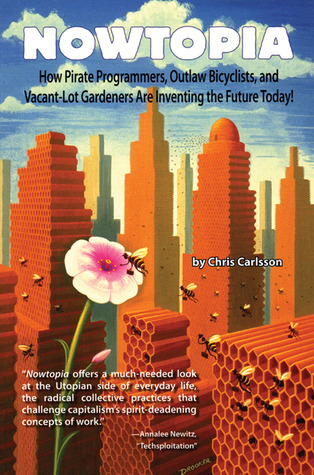
“As major agriculture and oil multinationals set their sights on emerging markets for agrifuels, Carlsson describes caravans of veggie oil powered vehicles, smelling of popcorn and French fries, taking to the streets to spread inspiration and know-how about sustainable, small-scale biodiesel production… [This book is] a timely and valuable contribution to understandings of the myriad ways in which creative resistance operates always and everywhere.”- The Journal of Labor and Society Outlaw bicycling, urban permaculture, biofuels, free software, and even the Burning Man festival are windows into a scarcely visible social transformation that is redefining politics as we know it. As capitalism continues to corral every square inch of the globe into its logic of money and markets, new practices are emerging through which people are taking back their time and technological know-how. In small, under-the-radar ways, they are making life better right now, simultaneously building the foundation—technically and socially—for a genuine movement of liberation from market life. Nowtopia uncovers the resistance of a slowly recomposing working class in America. Rarely defining themselves by what they do for a living, people from all walks of life are doing incredible amounts of labor in their “non-work” time, creating immediate practical improvements in daily life. The social networks they create, and the practical experience of cooperating outside of economic regulation, become a breeding ground for new strategies to confront the commodification to which capitalism reduces us all. The practices outlined in Nowtopia embody a deep challenge to the basic underpinnings of modern life, as a new ecologically driven politics emerges from below, reshaping our assumptions about science, technology, and human potential. Chris Carlsson , executive director of the multimedia history project “Shaping San Francisco,” is a writer, publisher, editor, and community organizer. He has edited four collections of political and historical essays. He helped launch the monthly bike-ins known as Critical Mass, and was the longtime editor of Processed World magazine.
Chris Carlsson, executive director of the multimedia history project "Shaping San Francisco" (foundsf.org), is a writer, publisher, editor and community organizer. He was a founder of the ground-breaking magazine Processed World, and helped launch the monthly bike-ins known as Critical Mass that have spread to five continents and over 300 cities. Carlsson has edited and authored numerous books, including Reclaiming San Francisco: History, Politics, Culture.
Book Review: "Nowtopia: How Pirate Programmers, Outlaw Bicyclists, and Vacant-lot Gardeners are Inventing the Future Today" by Chris Carlsson Review by James Generic "Nowtopia: How Pirate Programmers, Outlaw Bicyclists, and Vacant-Lot Gardeners Are Inventing the Future Today!" explores the subcultures of subtle and active resistance to the dominate US consumer culture. Author Chris Carlsson argues that today, the American working class is fragmented and not able to organize through traditional union politics, since people work in jobs where they are moved around a lot or are more individualized in smaller units, like retail jobs or smaller shops or service jobs, with many different locations, as opposed to the factory setting of the 20th century. He says that active resistance focuses on creating a "nowtopia" approach rather than a far off future utopia. He touches on a variety of people in the US engaged in building this new world today, instead of confronting the old existing capitalist world order. Examples he gives include the DIY ethic, urban gardeners, bicyclist, hackers and internet freaks, the Burning Man, left-wing scientists, and free fuel activists.
Urban gardeners reclaim otherwise decaying urban cities, where drugs and crime plague neighborhoods, and try to get food from the land. The gardens take back private property, long abandoned by slum lords, and turn it into public land or a commons for the neighbors and by the neighbors, growing and sharing food. More often than not, women lead in rebuilding a sense of community by everyone with an interest in the gardens putting caring for them. Green Philadelphia, a network promoting urban gardens in Philadelphia areas taken over by drugs, empowered residents to be in charge of their neighborhoods. In the 1990s, MayorGiuliani saw t he NYC vacant lot gardeners as a threat to private enterprise, even calling them communists, and basically declared war on the gardeners, forcing them to engage in active fights to preserve gardens and to prevent the land on which they sat from being sold to development schemes.
Carlsson also explores bike culture, like the Critical Mass protests that occur in cities throughout the world typically taking place the last Friday of the month. Bicyclists show that there is a viable, healthy, environmentally friendly and affordable alternative to car culture. Particularly in cities walking, biking or taking public transit provide valuable alternates to cars, lessening air, noise soil and water pollution. He interviews people who've opened up bike repair spaces to anyone who wants learn. In San Francisco, he focuses on programs that teach bike repair to children in low income neighborhoods. He also interviews people who rebel against mainstream bike culture, with its glossy magazines and spandex. The bike messenger culture, a highly individualistic, very punk subculture, has organized into messenger unions, but one in San Francisco fizzled out because the sponsoring union eventually pulled out and suffered backlash from the courier companies.
Carlsson looks into other revolts against mainstream consumer culture, like the veggie-fuel movement, telling the story of one group of people, who drove across the country, procuring used oil at fast food restaurants along the way in order to fuel their journey.They gave talks on their trip, telling others about biodiesel and about how to convert a car to run on veggie-oil. This group reduced their reliance on the oil economy and met their fuel needs by re-using oil that was otherwise destined for the dump. Their project was based on DIY ethics, on environmentally friendly motives, and on a reuse ethic, which in the current days where gas prices are through the roof might seem like a good alternative and a cheap way of fueling vehicles. (Though I worry about Carlsson promoting biodiesel in this day and age, since it will probably end up like ethanol and drive up corn prices, if it became widely popular.) Biodiesel is not sustainable on a mass scale. So consumers need to consider reducing their use of fuels though that's not always possible in places that are built around the automobile.
He looks at using open source software against corporate giants like microsoft. And he discusses the Burning Man festival. Although described by its organizers as an experiment in community, radical self-expression, and self-reliance, and promoting an idea of attenders who are all participants with its "no spectators" concept, not allowing monetary exchange so that attendees allegedly learn to think outside of the capitalist structure and re-evaluate "value" by bartering skills and things, Carlsson acknowledges that the festival has become another for-profit enterprise.
Throughout the book, Carlsson asks various people what they think their class background is. They usually respond that they aren't sure but thought they were some kind of middle class. He takes that to mean that the US working class is not something around which to organize. I think he might be forgetting that the US education system does not explicitly teach people about class. Even in the UK, where people often say they are working class even when they are not, interestingly similar to and yet different from the US where everyone thinks they're middle class from sanitation workers to US Senators. He berates unions over and over because they look at class from an outdated point of view. I agree: unions don't organize people anymore (I think that is the fault of US unions not of unionism). Though unions and the labor movement have been slow to adapt to the changing economy, I don't think that throws out a worker-driven movement.
A part I did like about this book is that it explained the concept of "Multitudes", developed and used by people like Negri, in language that was more on my level, so I finally figured out what it means (there are multiple classes of people instead of one working class).
All in all, the book is an interesting read, though it is a bit choppy and maybe the author jumps to conclusions too quickly. Still, it's cool to see what other people are doing to organize and agitate or self-organize as far as interests outside of my own. I've never been someone who's thought that you can only do one thing ("either, or"), and all else is damned. For any movement to thrive, there has to be a whole lot of stuff doing all kinds to resist and reject to the dominant cultures, as well as organizing within it and for a better future beyond it.
Chris has put his finger on some of the most encouraging movements in the USA today. Oh, wait, 2008 was quite a while ago. I'd love to see an update on this. (Maybe I should write it?) There are too few books like this written about the progressive grassroots with an affirmative slant and close observation.
Chris Carlsson's Nowtopia is an excellent exploration of DIY culture and organizing. Carlsson concentrates on several movements and presents them as proleptic visions of the types of social forms and networks that may become the basis for a post-capitalist society based on meaningful work, direct participation, and far more localized versions of production and self-governance. The central question this book focuses on is whether and how we can alter the social systems of power so that we can turn to an unalienated relationship to our labor, and to the social, cultural, and political world that we should be producing (rather than being produced by).
In order to discuss the potential of DIY culture Carlsson concentrates on several different DIY communities: urban gardeners; radical bicyclists; biofuel collectives (especially concentrating on biodiesel); open source programming; and the Burning Man festival (this is the least satisfying chapter, as far as I'm concerned). Not only do you get a lot of fantastic interview material in these sections, as well as a sharp analysis of the philosophical underpinnings of these community movements and the benefits and contradictions of each type of DIY action, but Carlsson gives fascinating histories of the rise of each of these groups. Some of this history is really interesting, and relatively buried when it comes to mainstream media accounts; for example, did you know that localized "victory gardens" provided up to 40% of the vegetables eaten in the U.S. by 1944? Or that there were 70,000 victory gardens in San Francisco alone?
Carlsson brings a host of theoretical tools to bear on his analysis of DIY culture, including a healthy engagement with Marxist analysis that uses Marx's general critique of the forces of capitalism, but also queries the usefulness of some of the classic Marxian categories (including the "working class"!!!!) as theoretical tools for dealing with contemporary conditions. Carlsson also usefully explores the concept of alienation, the notion of the "general public intellect," the idea of reclaiming the Commons for public use, the question of capitalist co-optation, questions of scarcity and abundance, and the importance of sustainability. This book is a must read for anyone who is currently thinking about new ways to organize and new modes of life, and for anyone who is seriously querying why it is that we seem so unable to make history for ourselves and how we might start living up to the promise of self-production (at all levels).
My only complaint about this book is that though there is a ton of useful information provided, I sometimes felt the book could have had more of a gustatory relationship with the DIY cultures that were written about. Although I know a lot more about outlaw bicyclists than I did before, I still would have loved to have read a concrete description of what it's like to ride along with a Critical Mass event. Similarly, DIY biodiesel is often described, but I would have liked to hear more about the actual process of transforming fry-cooker fats into diesel gold. I think this was, ultimately, why the Burning Man section was so disappointing to me. It did a fine job of discussing the philosophical, political, and communitarian issues that are a major part of the Burning Man experience, but I didn't actually get much of a sense of what it's like to be there. For a book that spends so much time discussing DIY movements in which people use their bodies to try to create a sense of direct participation in the world, this book feels a bit disembodied at times.
Finally, check out the excellent link to on-line resources that Carlsson provides with his Nowtopia website, which you can find at
Also, apparently I'm part of the "Lorax Generation," a term I hadn't encountered until reading this book. Certainly much better than that lame old "Generation X"!
community gardens, community bike shops, home veggie oil production, open source programming.
I really like the main thesis of this book. These projects have done a great deal to change the way people see the world and the US in general, and i'm sure glad that the projects and movements involved are now archived and discussed in print. I'm not just saying that because myself and many of my friends are pretty well entrenched in much of what he writes about. I suppose that if the internet is still around, it will be able to guide the historians of the future on ways the that north americans in the early 21st century resisted and lived within a capitalism out-of-control. but if it disappears, i can now rest assured knowing that they'll have something to go on to learn about us wingnuts.
However, I do think he tried to cover too much at once which makes the book feel like it's fragmented and jumping around. Each of the subjects could have been talked about more in depth, but instead he dedicated a hell of a lot of pages to putting the tinkerers in the historical context of late capitalism by inundating us with snippets of marxist theory and poorly written history.
Interesting book that discusses the topic of selecting work that is social responsible and also enjoyable to the worker. Although I think that the many examples given in this book are great forms of work, I think that it is somewhat naive in the fact that the great majority of workers do not get to choose the type of field they work in. Most people work out of necessity or desperation and do not have the opportunity to get an education and participate in jobs that require a higher education.
The discussion of Burning Man at the end was also terrible. Burning man is not even acceptable in theory and the application that it becomes is disgusting.
I'm glad that someone is shedding light on and encouraging more meaningful work but again it seems that this book was written for a privileged few.
I enjoyed this far more than I had thought I would.
Author Chris Carlsson looks at how computer programmers, community gardeners, Burning Man attendees, bike riders and others are shaping their world and what their actions mean in a capitalist society that seems more work-oriented than ever before. The definitions of "work" and "class" and "identity" are examined in a very compelling way, and Carlsson doesn't shy away from inherent contradictions in what people are doing.
If the idea of being free from the chains of 9-5 sounds appealing to you, this book won't so much tell you how to do it for yourself, but will tell you how are others are trying to make it work for themselves.
Chris Carlsson has written a very nice book here that is basically all about class and revolution, but through the lenses of: community gardeners, critical mass bike riders, computer hackers, bio-diesel tinkerers, and Burning Man participants. it's a lot better than a simple book about lifestylism, this book is about working class revolt, through the creation of new forms of the possible.
A dollap of "post-autonomia" idiot optimism. A new antagonistic proletarian subjectivity is being generated by Burning Man and bike repair workshops, the new world is not only in our hearts its everywhere wage workers engage in some dinky Portland hipster like DIY project... At least that is how it works in Carlsson's mind. Reality is rather more grim and that is putting it lightly.
I have my friend Mike to thank for loaning me this book. The ethos contained in these pages is a prescription for what ails our dying civilization. DIY punk philosophy and a hearty dose of ingenious problem solving. Personally, I love people who see the world in a different way than I do. This book provides that divergent perspective.
Probably the best book I've read on the modern "sub-cultures" that surround me. It has an interesting and subtle "Anarchism as a lifestyle choice" as a subtext, which isn't surprising considering it's written by one of the founders of Critical Mass and published by AK Press.