Jump to ratings and reviews
Rate this book

The Lost World of the Kalahari

Rate this book
The distinguished explorer and writer recounts his rediscovery of the Bushmen, outcast survivors from Stone Age Africa. Faced with constant attack from all the peoples who followed them, the last of the Bushmen have retreated to the scorching depths of the Kalahari Desert in southern Africa. After a gruelling trek, van der Post finds the Bushmen, thriving in one of the world’s most inhospitable landscapes, with their physical peculiarities, their cave art and their joyful music-making intact.

Hardcover

First published January 1, 1958

54 people are currently reading
1084 people want to read

About the author

Laurens van der Post

78 books164 followers
Sir Laurens Jan van der Post was a 20th Century South African Afrikaner author of many books, farmer, war hero, political adviser to British heads of government, close friend of Prince Charles, godfather of Prince William, educator, journalist, humanitarian, philosopher, explorer, and conservationist.

Ratings & Reviews

What do you think?
Rate this book

Friends & Following

Create a free account to discover what your friends think of this book!

Community Reviews

5 stars
251 (33%)
4 stars
289 (38%)
3 stars
160 (21%)
2 stars
35 (4%)
1 star
9 (1%)
Displaying 1 - 30 of 79 reviews
Profile Image for John Farebrother.
115 reviews35 followers
September 9, 2017
An incredible book, that first awoke my interest in Southern Africa. It tells the story of an expedition into the Kalahari desert to film the elusive Bushmen, recently termed "stone-age creatures" by the president of Botswana. For the reader unfamiliar with that part of the world, it truly is a fantastic journey into the unknown. The author describes the initial idea, the putting together of a concrete plan, obtaining funding (largely the provision of the vehicles, cameras and other equipment), team recruitment, and procurement; finally, the journey itself begins, which is not without many a mishap; and ultimately, they encounter a group of the hardy nomads, with whom they are able to pass several days. The account of the adventure is enriched by the fact that the author, a Boer, is a skilled story teller, as he has demonstrated in various works of fiction. His reputation was tarnished posthumously by the revelation that he got a teenage girl pregnant on a sea voyage between South Africa and the UK. For me, that does not detract from this book. It appears that he was a masterful spinner of yarns, blending fact and fiction into a narrative that charmed his listeners, who included Prince Charles. A charismatic guru for whom the fantastic was merely a tool to be used to make reality more credible. Ultimately, stories of adventure in far-off parts of the world must always have a dimension of fiction, for the simple reason that the narrator is conveying to the listener something that is completely outside his or her experience. The fantastic element creates the context for the facts of the tale, for without it they would fade from the listener's memory like autumn leaves blown from a tree once the tale is over. This book succeeded in conjuring up for me a fantastic world in the south, a world of untamed wildlife and desolate, lonely places, a world of persecution and survival, that I was able many years later to visit, and form my own impressions. I wasn't disappointed.
Profile Image for dianne b..
699 reviews177 followers
April 15, 2017
Interesting "adventure" of this monochromaticly educated member of England's "upper" crust - but written from the heart in 1955. He was apparently inspired by Jung's idea of the soul's primordial desire for light, and escape from primal darkness - so he is at once patronizing but respectful. With his custom made / purpose built Land Rovers (you know, roughing it)he eventually succeeds in finding "real" Bushmen in Botswana's Kalahari. He writes well and, of course, i gleaned some tribal fashion tips from the women (always useful in San Francisco).
Profile Image for Tess W.
24 reviews12 followers
April 13, 2016
Pllleeeeaaaasssssse do yourself and your heart and soul the great service of reading this book, it is splendid. Enter the world and mind of Sir Laurens van der Post whose grace and purpose and love and integrity is so rare you feel privileged to be shown a small part of his world. Prince Charles must surely be an exceptional man to have had the foresight to bestow upon his eldest son a Godfather such as Sir Laurens. Your only regret on reading this book is that it has to end and you are no longer there.
This book is good for you.
Profile Image for Greg.
Author 3 books42 followers
March 13, 2020
This was a vastly interesting book. Laurens describes his environment in such vivid detail. The book is filled with interesting insight into the culture of the Bushman, and I especially enjoyed their songs, such as;

"Under the sun
The earth is dry
By the fire
Alone I cry
All day long
The earth cries
For the rain to come..."

I also really felt Laurens' deep passion for his quest to fulfill his childhood dream of finding the Bushman. This sentiment stayed with me and founded an interest throughout the book, even through its seemingly slow parts; "If one is truly ready within oneself and prepared to commit one's readiness without question to the deed that follows naturally on it, one finds life and circumstance surprisingly armed and ready at one's side."

I read Heart of the Hunter as well, and I remember enjoying that one more, but I would says Laurens' writing is better here.
Profile Image for Will.
1,756 reviews64 followers
March 20, 2022
On the face of it, the book is an attempt by a British-South African explorer and television producer to travel deep into the Kalahari to find the "Bushman"; the San people who traditionally inhabited the region, living off the land in a harsh and arid environment. Most of the book details the organization of the journey; getting a camera crew, vehicles, and the troubles (this is the first 3/4 of the book at least). Indeed, there is more detail about a troublesome European cameraman than there is about any of the indigenous people the book claims to be searching for. Once the team eventually finds a small family group, they convince them to re-enact weddings and other family events for the camera, before packing up and leaving. The author makes no attempt to explain anything about the life or culture of the people under study, noting towards the end of the book that it was not worth trying to describe the beliefs or customs of the people he is visiting.

Naturally, the book is a product of its time, and in some ways it is silly to hold up a book from the 1950s according to the values and views of the 2020s. Clearly, this is a book by a European man going on an adventure in a colonial setting. However, even for its time, the book seems poorly thought out with almost no desire to understand the subject of the book. It stands in stark contrast to many of Van Der Post's European contemporaries who wrote about people of the world in a way that was dedicated to try to understand them (Wilfred Thesiger's "Arabian Sands" jumps immediately to mind). This is a book about a man - Van Der Post - going for a drive in the desert, nothing more. And because of that, its not particularly interesting, enjoyable and contains little about the environment that he claims to be writing about.

Unfortunately I researched the book after I read it, learning that even though Van Der Post has a dramatic flair and a skill with writing, he was also infamous for embellishing his stories and his adventures. Also, learning about some of the shadier elements of the author's life (including child rape) make both the book and author even less likable.
Profile Image for Abe Abraham.
Author 1 book
November 27, 2017

The author, van der Post was driven by fascination for the vanishing Bushman and the stories he heard growing up. He brought to bear great talent to the literature of adventure. His writing evokes the sights and sounds and moods of the African interior as he navigated the rough terrain while leading a crew several men including cameramen and living off the land. His expressions are rich and his idioms have a way of anchoring descriptions of the Bushman and his environments in the minds of the reader. An African himself, he writes with utmost respect and dignity for the Bushman, the land, the culture and the belief system that governed the Bushman and his neighbors.

"Perhaps this life of ours which begins as a quest of the child for the man and ends as a journey by the man to rediscover the child, needs a clear image of some child-man, like the Bushman, wherein the two are firmly and lovingly joined in order that our confused hearts may stay at the center of their brief round of departure and return".

The hunting skills of the Bushman hunter is described as extraordinary, relying only on his knowledge of the wild game and his own survival skills. In one place, the author describes the Bushman's skills as a hunter, "He never seems to have attempted to accomplish by force what could be achieved by wit." The Bushman would drive the lion off with smoke and fire and move in to eat the rest of the kill." His killing, like the lion's, was innocent, because he killed only to live.

The Bushman loved honey with a passion that is hard to comprehend. The author narrates that to the Bushman,"bitterness is to the tongue what darkness is to the eye"

Entertaining and scholarly work.

Profile Image for Nicoletta.
12 reviews1 follower
June 15, 2020
This book has shined a light on Africa that no other could do justice ever.
Africa is our souls home and Van Der Post so compassionately and honestly explains the souls fullness and wonder of the beauty of our past home.

I first came across Van Der Post’s incredible book through Australian Biologist Jeremy Griffith, author of many books, but the most recent being FREEDOM: the End of the Human Condition. Here he explains the answers to the good and evil behind human behaviour, and one of his most quoted authors/philosophers is Laurens Van Der Post because of his authentic, denial free thinking honesty about ourselves, and Africa and the incredibly innocent and important Bushmen.

Van Der Post’s honesty and authentic descriptions and views of the life of the Bushmen of the Kalahari is incredibly precious and makes me want to fly all the way to Africa and experience the intense connections Laurens felt.

This is just an incredible book and thank-goodness for Jeremy Griffith with his massive appreciation and love for Van Der Post’s work to have brought me to reading his greatly honest words!

I would really recommend people to also delve into the work of Jeremy Griffith because he provides the truth to humans and human behaviour and provides the answers that have helped me understand myself and my fundamental goodness that Van Der Post always wrote about :)
22 reviews3 followers
August 20, 2016
The book starts quite slowly, I almost wanted to stop reading. Only after the idea of an excursion appeared I was hooked. In the end, I was glad to have continued reading. The vivid description of the quest to get in touch with and to film the last remaining groups of San is captivating. At that point, I thoroughly enjoyed the poetic, evocative language of Laurens van der Post. The book might not be an accurate account in all aspects, but I felt it made me see with new eyes and sharpened my perception. The book indeed is very respectful.
Profile Image for Vera.
Author 0 books29 followers
January 28, 2022
A wonderful account of Laurens van der Posts undertaking to find the real Bushmen (Khoisan people) who live in the Kalahari desert. His beautiful prose brings the desert to life on the pages, and I am longing to go back to Namibia now!
Profile Image for Stefan Mitev.
167 reviews707 followers
August 27, 2022
Не мога да препоръчам тази книга, колкото и да ми се иска. Темата за европейска експедиция в пустинята Калахари в средата на двадесети век с цел търсене на бушмени, живеещи в пустошта, звучи интересно, но самото описание разочарова. Първото издание е от петдесетте години и се срещат стари имена като Родезия (сега Зимбабве) и Нясаленд (сега Малави). Единственото полезно нещо, което научих, е думата стеатопигия - селективно натрупване на мазнини около таза и горната част на бедрата. Вероятно сте виждали такива хора, а сега знаете и научния термин за тяхното състояние.
136 reviews1 follower
January 9, 2009
Almost drippingly lyrical, as Africa demands, yet less than a quarter of it actually deals directly with Bushmen.
Profile Image for Brenna.
92 reviews2 followers
April 10, 2023
The most lyrical anthropological study I have ever consumed.
Profile Image for Harry Tilbury.
4 reviews
October 9, 2025
Really loved this book and the touching and incredibly strong connection the author describes between the native bushmen and the animals they share their desert home with.
Profile Image for Noel Arnold.
229 reviews10 followers
Read
April 27, 2024
book #5 of 2024: The Lost World of the Kalahari (1958) by South African Afrikaner writer, among many other things, Laurens van der Post. the writing is lush, lyrical, poetic. you’re completely transported to each and every scene he describes so exquisitely. the content was another thing: he, a descendant of the Boers who invaded South Africa and genocided or attempted to genocide many, many tribes there, describes his childhood fascination…well, obsession with the untameable Bushmen (San people). if you plan to read this book (free ebook in the comments), stop reading now because I’m gonna get into it.
.
.
.
.
.
.
.
.
you’re like ~7/8ths through the book before he finally sniffs out and hones in on his quarry, then he corrupts their authentic culture, which he supposedly values more than basically anything, bringing them tobacco and introducing them to motorized vehicles and guns, secretly records their most private cultural stories, attempts to get people who are married to other people to pretend to be a couple for a drama he films to expose their courting practices because the ones he chose were the prettiest, then he and his party just leave. what an unponderably insane experience for that group of kind, genuine people hitherto untainted by modern luxuries. it’s just unimaginable. his self esteem is clearly pretty high and he probably was pretty considerate for an anthropologist, or someone playing one, of his time, but still, utterly galling. and there’s some question as to how true the book is anyway.
This entire review has been hidden because of spoilers.
Profile Image for Saski.
473 reviews172 followers
November 11, 2020
What an incredible (true!) story. That being said, I would warn any readers that the first few sections on the history of the San peoples (van der Post uses Bushmen) is incredibly stark and depressing. If I had not been sure he would find the people he sought, I would have given up there and then, despite his ability to render horrible scenes into beautiful prose. Spoiler alert: van der Post did find what he sought and more and once you get there, you will know it was well worth the trip. I only wish he had spent as much time there as at the journey to get there.

Quotes that caught my eye

‘Old tannie sea-cow’ was our endearing way of naming the hippopotamus, so called because it was there in the surf of the sea to welcome my people when they first landed in Africa. (18)

What drew me so strongly to the Bushman was that he appeared to belong to my native land as no other human being has ever belonged. Wherever he went he contained, and was contained, deeply within the symmetry of the land. His spirit was naturally symmetrical because moving in the stream of the instinctive certainty of belonging he remained within his faithful proportions. (22)

… it is enough to stress here how mistaken is the common assumption that literature exist only where there is a system of writing. Literature, surely, exists wherever the living word is spoken. (29)

…these and many more of what the Bushmanb called not beasts, birds, and insects but ‘persons of the early race’,… (31)

…what sort of a person is the Bushman? His paintings show him clearly to be illuminated with spirit; the lamp may have been antique but the oil is authentic and timeless, and the flame was well and tenderly lit. indeed, his capacity for love shows up like fire on a hill at night. He alone of all the races of Africa, was so much of its earth and innermost being that he tried constantly to glorify it by adorning its stones and decorating its rocks with painting. We other races went through Africa like locusts, devouring and stripping the land for what we could get out of it. the Bushman was there solely because he belonged to it. Accordingly he endeavoured in many ways to express this feeling of belonging, which is love, but the greatest of them was in the manner of his painting. (32)

…the ancient law of human nature holds goo. First one must vilify in one’s own spirit what one is about to destroy in other; and the greater the unadmitted doubt of the deed within, the greater the fanaticism of the action without. (41)

Almost every tribe of Africa picked up only what was negative in the situation. The weak lost the courage and wit that alone might have saved them and were ruled by blind terror. But they, too, whenever forced to flee into the country of someone even weaker than themselves, practiced with all the ruthlessness of the convert the terror which had hitherto flayed them. The strong thought of little more than plundering and preying on the weak and making themselves ever stronger. Then they fell out among themselves. Setting up rival combinations for loot and destruction. (49)

All along the extremities of the zone of terror packs of lesser tyrants and robbers formed and reformed like hyaenas and jackals to quarrel over what was left by the pride of lions. Pushed out of the Cape by the fast-expanding European colony, the Hottentots, bands of bastards, and outlaws of all sorts of colours armed with European guns, moved in north to pick off whatever was left of life on the smoking and reeling veld. Away from the main routes of the murderous traffic there was no secluded place that did not conceal some group of broken people clutching at life like drowning men at straws. Food had become so scare that far and wide the outcasts and survivors of disrupted tribes began to eat one another without shame. For two generations and more a phase of intensive cannibalism set in over all the unfamiliar parts of the land. Too weak and unequipped to hunt the, by now, thoroughly alarmed and athletic game of the veld, men made up packs to hunt, snare, trap, kill, and eat other weaker men. Even the lions and leopards, it is said, gave up pr4eying on game and indulged in a new and easier taste for the flesh of defenceless humans. When a whiff of human being came to their noses the terrible wild-dogs broke off the hard chase of buck and, moaning with relish, went after some emaciated fugitive, while vultures became so gorged that they could scarce waddle fast enough to take to the air. (50-51)

Even in my childhood great quantities of bone, then almost entirely animal were still a feature of the landscape. I still remember how the precise wind of our blue transparent winters would sing a lyric of fate in the hollow bone left on the veld and how I shivered in my imagination. (52)

Then, with some little barter fair enogh perhaps according to the tight rule of the narrow day, a great deal of legal guile, natueral cunning, bribery, and corruption, al enoucraged by supplies of the fiery Cape brandy known to us children as ‘Blitz’ or ‘Lightning’, they dispossessed the dispossessing Griquas. (54)

…making the blue of the uplands more blue, the empty plains more desolate, and adding to the voice of the wind as it climbed over the hilltops and streaked down lean towards the river, the wail of the rejected aboriginal spirit crying to be re-born. (60)

I had to live not only my own life but also the life of my time. (61)

I alternated between Africa and Europe in a state of suspended being like a ghost from some unquiet grave, shocked almost as much by the ruthlessness and brutalities of peace as I had been by those of war, deeply aware only of how privileged I was in being, even so uneasily, alive. (63)

Human society and living beings, it seemed to me, ought to be excluded from so clam and rational a view. The whole of human development, far from having been a product of steady evolution, seemed subject to only partially explicable and almost invariably violent mutations. Entire cultures and groups of individuals appeared imprisoned for centuries in a static shape which they endured with log-suffering indifference, and then suddenly, for on demonstrable cause, became susceptible to drastic changes and wild surges of development. It was as if the movement of life throughout the ages was not a Darwinian caterpillar but a startled kangaroo, going out towards the future in a series of unpredictable hops, stops, skips, and bounds. Indeed when I came to study physics I had a feeling that the modern concept of energy could perhaps throw more light on the process than any of the more conventional approaches to the subject. It seemed that specie, society, and individuals behaved more like thunder-clouds than scrubbed, neatly clothed, and well-behaved children of reason. Throughout the ages life appeared to build up great invisible charges like clouds and earth of electricity, until suddenly in a sultry hour the spirit moved, the wind rose, a drop of rain fell acid in the dust, fire flared in the nerve, and drums rolled to produce what we call thunder and lightning in the heavens, and chance and change in human society and personality. (69-70)

“If you must point in that direction, please be so good as to refrain from doing it so rudely with your finger straight out like that, but instead, politely, only with the knuckle of your thumb, the tip turned down towards your hand thus. … Otherwise you’ll send away the rain we’ll be needing soon.” (102)

When the aircraft had come and gone we went to this official’s house on the river, where we sat on the veranda among a vast though oddly-ordered chaos of books, magazines, fishing-rods, spoons and flies, and all the paraphernalia that had helped him travel the long years, alone, without injury to his spirit. (124)
Almost at our feet, the great Okovango river broke into splinters on the pointed papyrus mat at the door of the swamps. (125)

As we went deeper into the interior the crocodile seemed to grow bigger, sleeker, and less alert. They were sleeping in the sun on every spit of earth that protruded beyond the cool papyrus shadows. We would be upon them before they were aware of us and then, instantly, they took straight to the water like bronze swords to their sheaths. One, surprised on a sandy shallow, gave the ground a resounding smack with his tail, hurled himself high in the air, and looped a gleaming prehistoric loop straight into the deepest water. Round another bend we sailed into the midst of a feud between two desperate males. They rose half out of the water. Their small forefeet sparring like dachshund puppies, but their long jaws snapping and grappling with incredible rapidity. They went under still wrestling, the tips of their tails agitating the water just beneath the surface like a shoal of eels.

At that distance, to me, one clump of trees and feather of palm was very much like another. To our guide, however, each group was different and he proceeded to read them like separate words forming a sentence in a well-thumbed book. (136)

That incident over, Samutchoso went into a hut and emerged almost at once with a stick and a small bundle in hand. He spoke a few words to the women and children and again there were no explanations questions, or protests. On the faces of all was an expression of the acceptance of people accustomed to converting change and change into the currency of fate. (180)

After so many weeks in flat land and level swamp the sudden lift of the remote hills produced an immediate emotion and one experienced forthwith that urge to devotion which once made hills and mountains scared to man who then believed that wherever the earth soared upwards to meet the sky one was in the presence of an act of the spirit as much as a feature of geology. I thought of the psalmist’s ‘I will uplift my eyes until the hills from whence cometh my help,’ and marvelled that the same instinct had conducted Samutchoso to the hills to pray. (181)

The hills were in sole command and so dominated our impressions that the two Land-Rovers, their behinds wiggling and waggling over the rough roadless plain as they searched for camping site and water, seemed like puppies fawning towards the feet of a stern master. (183)

An hour later the others broke out of the bush almost on top of us. We had had no warning of their coming for the air was so thin and stricken with heat that it had not life enough to carry sound. (183)

Daily, I became more convinced that in this regard our version of history was largely rationalization and justification of our own lack of scruple and excess of greed, and that the models drawn upon by historians and artists must have been the Bushmen nearest them who had already been wrenched out of their own authentic pattern to become debased by insecurity and degraded by helplessness against our well-armed selfishness. (215)

It was most impressive to see them skin and cut up game. Nothing was wasted or discarded except the gall and dung in the stomach. The entrails were cleaned and preserved, and even the half-digested grasses in the paunch were wrong out like washing for the juices they contained, and these collected in the skin and drunk by the hunters to save their precious water. (216)

This they did out of a deadly compound of a mysterious grub found in summer at the end-root of a certain desert bush, powdered cobra poison, and a gum produced by chewing a special aloe blade in the mouth and then mixing the extract in a wooden cup with the other powders. (218)

Words/phrases that I couldn’t find anywhere

Chinese Vlakte: There is a great plain between blue hills in south Africa called to this day the ‘Chinese Vlakte’ after the Bushman hunters who once inhabited it. (14)

Krans: It is astonishing how in this late hour, they burn within the aubergine shadows of cave and overhang of cliff and krans,… (30)

Mountains of the Night: In the Mountains of the Night hard by the Great River, paintings of an enemy in red coats and riflemen on horses are briefly seen. (32)

Clarification, I think, of the two different tribes’ he lists: Tambuki and Tembu. From what I can find the names should be or are now Tamboekie and Thembu, and are actually two different names for the same Xhosa-speaking people.

‘… to burn and loot Africa from the Indian Ocean to the Zambesi, and from the Umbeni to the Great Lakes.’ (50) Is the Umbeni the river Umgeni?

“Massarwa! Bushman!’ (64) Might it be a title of some sort?

An internet search suggests that only van der Post uses this proper noun (in other books in addition to this one): “He was a man of the Bamangkwetsi,…” (91)

Is van der Post’s Shinamba Hills the same as the Shimba Hills in Kenya? ‘As a result the next day we held on south until we came to the first of the blue Shinmba Hills.’ (110)

‘…and between us and them lay a bush of shimmering peacock leaves.’ (181) I wonder what plant this is… there is something called a peacock plant but it is native to Brazil….

I can’t find evidence of either of these two places: ‘…the heart of the desert contained between what must once have been the mighty water-courses of the Bhuitsivango and Okwa.’ (202)

‘And, of course, they loved the wild tsamma melon in all forms, and highly prized the eland cucumber.’ (217) Okay, I know what an eland is and cucumber is easy but what is this?

‘The shuttle-cock was made of a single wing-tip feather of the giant bustard tied to a long leather lash and fastened to the heavy and area marayamma nut.’ (220) So what’s a marayamma nut?
This entire review has been hidden because of spoilers.
Profile Image for Yashovardhan Sinha.
191 reviews3 followers
May 21, 2025
Having read and loved Delia Owen's Cry of the Kalahari, I began this one with excitement. But began to feel quite let-down by the time I had reached the quarter-way mark. The book is basically about one particular group of indigenous residents of southern Africa known as San, but who were derogatorily called Bushmen by the White invaders and their descendants including the author.

These proud and cultured people who refused to accept White supremacy were driven to near extinction by the invaders (& other tribes from the north) even by the time van der Post wrote this book in the middle of the last century. And then, as per usual practice, the White invaders created a fake myth about the savagery of the Bushmen and the need to destroy them.

The author spends the first three-quarter of the book talking about the history of the San and his own obsession with trying to locate the few remaining groups and making a BBC film on them.

But the last quarter of the book more than makes up for the dullness of the first three when the author and his team actually manage to locate the elusive people and spend some weeks with them.
Profile Image for Quo.
343 reviews
September 8, 2025
To be sure, The Lost World of the Kalahari by Laurens van der Post represents a kind of fable of the San people, a people within southern Africa who were very much on the wane as the author paints their portrait in prose some 60 years ago.

I found the book a kind of quest tale, perhaps reminiscent of some of the work of Rudyard Kipling, among others; it stands as an attempt to fathom what is essential about the human condition by examining a particular displaced group within humanity, in this case a group of San people in present-day Botswana & elsewhere in southern Africa, judged to be "aboriginal".


The author's prose is elegant in detailing what he perceives as the innate innocence of the people most refer to as "Bushmen". Laurens van der Post puts together a team to somehow find & elicit the lifestyle of a people who are "damaged by time", historically caught between the pincers of an expanding European population moving north and Bantu tribes descending southward, thus forced to retreat to the most inaccessible of African landscapes.

The San people are in the author's words:
diabolically clever & his needs were utterly committed to Africa. He exists with all of the beings of Africa, from lion to cobra. He contained & was contained by the symmetry of the land. We other races went through Africa like locusts devouring & stripping the land for what we could get out of it, while the Bushman was there solely because he belonged to it.
There is often a dreamlike quality to van der Post's prose, as he seems to have from an early age, seen his identity linked to the Bushmen or San people, with no small degree of fealty to the ideas of Carl Jung, particularly Jung's writings on archetypes and the collective unconscious. Van der Post seemed to sense a deep connection, a feeling of universality with the San people.
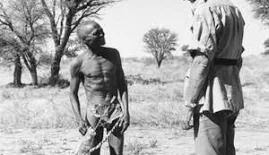
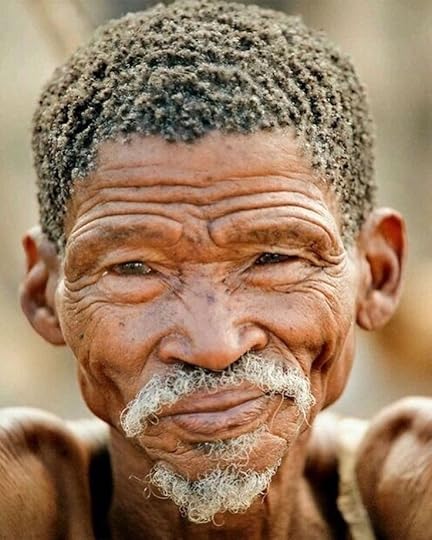
A fair amount of the book deals with the logistics of travel to locate a representative group of San people who by their very intent are not sedentary and don't wish to to interact with those beyond their clan. There are new Landrovers to outfit, a restive photographer to deal with, supplies to negotiate & a hazy plan enlisted for where & when to find a group of San people who they wish to locate & observe, coverage that may put some readers off but which seems necessary to document the quest.

When found, the San people are as curious about the outsiders as they seem about them. There are ritual dances when a bull eland is found & slain & another called a "sacred fire dance", a demonstration displaying how the tribe siphons water from beneath the sand and questions about their origin story. However, there is no response when asked about their relationship to a God-like figure.

The San have an amazing acuity for decoding footprints--those of every sort of animal, even recognizing the barefooted imprints of each other. They know every root & tuber, seem never to waste anything and are said to live in absolute harmony with nature, killing an animal only to live but even then always showing respect, as they do for each & every aspect within nature.

While music is as important as fire & water & concocted instruments are plentiful, their rich tradition of artistic renderings in caves, "a Louvre of the desert", seemingly going back countless centuries, appears to be a thing of the past. And it is mentioned when referencing an apparent intrusive slight on the part of the visitors, "Master, the spirits of the hills are losing their power. Ten years ago they'd have killed you."


Ultimately, Laurens van der Post concludes rather plaintively:
We have forgotten the art of our legitimate beginnings, the importance of being truly & openly primitive. We no longer know how to change the gap between the far past and the immediate present in ourselves. With our radioactive intellects, we we have hurt so deeply the first spirit of Africa.
There is a bittersweet ending to The Lost World of the Kalahari. As the author waves goodbye to the San people, he feels as if his rediscovered childhood was dying within him, the child now reconciled to the man. He comments that his "aboriginal heart now had kinsmen & a home on which to turn."

Alas, there is the serious matter of posthumous allegations against Sir Laurens van der Post, namely that he fabricated much of the material in books that include The Lost World of the Kalahari, and also that he impregnated a 14 year old girl in his care on a long voyage from Cape Town to England at a time when he was in his 40s.

To the first, my suggestion is that in reading the book just reviewed, it seems readily apparent that the author is in the thrall of his subject matter, perhaps losing control of authorial objectivity, if such a quality really exists. At least for me, this only serves to enhance the story.

As to the suggested misconduct with a minor, that is indeed a heinous accusation but one that at this point in time is best left to a DNA test, in the absence of the man accused, though the evidence now seems rather conclusive.

Lastly, as regards the book itself, my contention remains that we must allow "artistic license" to have its place in literature, whether it be fiction or non-fiction and permit the author's words to tell a story that the reader is free either to accept or to disavow.

*Within my review are images of the author, Laurens van der Post, one with a Bushman + another of a Bushman within his compound. **I read this book while recently traveling through southern Africa & at one point managed to meet a small family of San people.
Profile Image for Maddy.
137 reviews16 followers
April 29, 2018
Really, really fantastic. I never had too much of an urge to visit southern Africa before reading this, but the description in this book, wow! The author's purpose is to find the Indigenous people of the Kalahari, but I enjoyed reading about the wildlife, landscapes and even the spirits he encountered along the way just as much. For a Dutch-heritage South African in the 1940s, he's refreshingly and surprisingly non-colonial for the most part, though his obsession with finding 'pure' Bushmen instead of the 'tame' people living on farms and such is inevitably off-putting. Still, it's both a great adventure story and a really intriguing if brief glimpse into the lives of the Bushmen he met.
Profile Image for Nele Dekien.
154 reviews2 followers
December 10, 2021
Ik heb echt genoten van dit boek. Ook al werd nog maar eens duidelijk hoeveel culturen wij, Europeanen, hebben vernield. Sinds 1958 is er natuurlijk nog meer veranderd en ik denk niet dat er nog traditionele san-stammen leven in de Kalahari. Maar zoals ik al zei, dit boek is echt een aanrader om een idee te krijgen van Zuidelijk Afrika door de gedetailleerde beschrijving van de natuur en wildlife. Het helpt natuurlijk wel dat ik de streek al 2x bezocht heb, ik werd zo terug gekatapulteerd naar de Okavango (in een makorro) en de Kalahari, en zag de antilopen, vogels en andere wilde dieren die beschreven worden weer voor mij.
2 reviews
September 28, 2025
Van der Post has a gift for portraying landscapes almost mythically, turning the Kalahari into a stage where ancient and modern worlds collide. His descriptions of encounters with the Bushmen are suffused with a sense of reverence, portraying them as bearers of humanity’s earliest wisdom.

The book is at its most engaging in the tension between hardship and wonder, broken vehicles, grueling treks, and desert survival are set against moments of beauty and discovery. At times the narrative wanders into philosophy and these reflections give the book its enduring character.

A beautifully written exploration of Africa’s deserts and the people who inhabit them.
Profile Image for Chuckles.
458 reviews8 followers
October 23, 2025
I read this about ten years ago when my interest in the outdoors was reignited; I had read some of his novels when I was younger. I was frankly not impressed with this book, it is really written in an old style and I got the feeling he was painting things in the light he wanted rather than being completely honest. I think that was the style of many “explorer authors” back then, they tended to romanticize rather than write from a pure scientific absolute truth format. I felt the same re-reading Farley Mowat around this tine, after the style had changed and I had come to appreciate more “facts only” books and less romanticizing. Nature can do that on its own for me.
Profile Image for Adrian Fingleton.
427 reviews10 followers
June 26, 2018
I probably first read this book about 30 years ago, but with a trip to Botswana in the offing I decided to read it again. It’s a very compelling and gritty account from 1958 of a search for ‘the remaining Bushmen’ in the inhospitable Kalahari Summer. Most of the country boundaries in that part of the world did not exist back then, so reading it now I really enjoyed it as a historical chronicle. And the matter of fact way the ‘hunting down’ of the Bushmen is documented (regretfully) by the author is very illuminating. Still a great read…
Profile Image for Ritchie Wynants.
201 reviews18 followers
December 18, 2019
This book just takes you on a journey! You can tell by the way he writes that Van Der Post is really amazed by the Bushmen he's looking for in the Kalahari and that he's not just doing it for the money. He actually tells us the story about how he developed a love for these people and their history, including the brutal colonization which they underwent.

Great read if you're a nature lover and like to go on an exploration mission. One remark is that it can sometimes be a slow book to read. I found myself taking longer for this book than I would normally do for this amount of pages.
Profile Image for Jason Prodoehl.
242 reviews5 followers
November 29, 2021
Another excellent book by Laurens van der Post. His insight, and descriptions are truly fascinating. This is not a modern, action-packed book. In a way it could be seen as exploring the Kalahari desert: it may seem long and monotonous, but if you look closely and spend enough time getting to know it, it is rich in activity and interest. This was a slow read for me, but his writing and humanity made it compelling enough to finish. The last 2 chapters were my favorite. I look forward to continuing exploring his writing.
102 reviews1 follower
November 6, 2022
Although this book is a bit slow to begin with, it was an enjoyable read. More focused on Van Der Post’s journey than the Kalahari ‘bushmen’ (I suppose I’ll have to read the sequel ‘Heart of the hunter’ for that) but still a thoroughly interesting insight into a 1958 expedition in Africa, from somebody who gives the impression in this book of having an incredibly progressive attitude for the time.
Profile Image for Carlos Hernández.
29 reviews5 followers
August 18, 2023
He leído este libro en el transcurso de antes y después de un viaje a Namibia, en agosto de 2023. He de admitir que tenia una idea sesgada debido a comentarios de otros autores sobre la “idealización” de la cultura bosquimana que relata Laurens Van der Post. Aún así, se trata de un relato interesante para adentrarnos en la cultura de los últimos cazadores/recolectores. A veces la lectura se hace algo pesada, de ahí mi que no le de las 4 estrellas.
Profile Image for Amy.
381 reviews6 followers
October 20, 2025
I was hoping that most of the book would have been about the Kalahari. instead, most of the book is about his journey to find them. the last two chapter are about his experiences when he was with them besides a few stories about them from the author's childhood memories. I was hungry for more information about their traditions and culture. I have waited for years to read this book and was a bit disappointed.
Profile Image for Diego Atterbury.
74 reviews
June 11, 2024
Came highly recommended and didn’t disappoint. I’ll do the same and recommend it also. First couple chapters were confronting and rightly so. Thereafter the story picked up pace and the adventure followed. Wonderful education piece also. Growing up in South Africa I can’t recall us learning the details contained in the book. Thanks for sharpening the mind.
185 reviews1 follower
December 8, 2024
Some really enjoyable parts and the first chapter is super engaging as you learn this history of the San People, and it speeds up a little at the end …

…. But it’s just way too slow and detailed in the middle and bulk of the book. So much minute detail that made it a tad boring at times

Still though brilliant first chapter for anyone interested in the San people
Displaying 1 - 30 of 79 reviews

Can't find what you're looking for?

Get help and learn more about the design.