

What do you think?
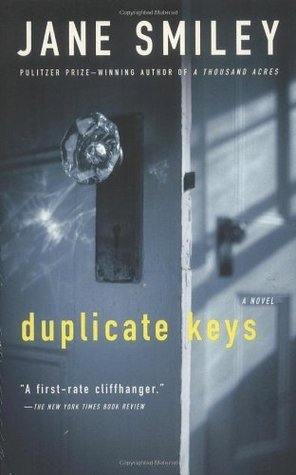
Duplicate Keys
From the Pulitzer Prize-winning author of A Thousand Acres comes a brilliant literary thriller set in Manhattan that’s “as taut and chilling as anything Hitchcock put on film" ( San Francisco Chronicle). “ A first-rate cliffhanger.” — The New York Times Book Review
Alice Ellis is a Midwestern refugee living in Manhattan. Still recovering from a painful divorce, she depends on the companionship and camaraderie of tightly knit circle of friends. At the center of this circle is a rock band struggling to navigate New York’s erratic music scene, and an apartment/practice space with approximately fifty key-holders. One sunny day, Alice enters the apartment and finds two of the band members shot dead. As the double-murder sends waves of shock through their lives, this group of friends begins to unravel, and dangerous secrets are revealed one by one. When Alice begins to notice things amiss in her own apartment, the tension breaks out as it occurs to her that she is not the only person with a key, and she may not get a chance to change the locks.
Jane Smiley applies her distinctive rendering of time, place, and the enigmatic intricacies of personal relationships to the twists and turns of suspense. The result is a thriller that will keep readers guessing up to its final, shocking conclusion.
Alice Ellis is a Midwestern refugee living in Manhattan. Still recovering from a painful divorce, she depends on the companionship and camaraderie of tightly knit circle of friends. At the center of this circle is a rock band struggling to navigate New York’s erratic music scene, and an apartment/practice space with approximately fifty key-holders. One sunny day, Alice enters the apartment and finds two of the band members shot dead. As the double-murder sends waves of shock through their lives, this group of friends begins to unravel, and dangerous secrets are revealed one by one. When Alice begins to notice things amiss in her own apartment, the tension breaks out as it occurs to her that she is not the only person with a key, and she may not get a chance to change the locks.
Jane Smiley applies her distinctive rendering of time, place, and the enigmatic intricacies of personal relationships to the twists and turns of suspense. The result is a thriller that will keep readers guessing up to its final, shocking conclusion.
320 pages, Paperback
First published February 12, 1984
About the author
Jane Smiley
149 books2,891 followersJane Smiley is a Pulitzer Prize-winning American novelist.
Born in Los Angeles, California, Smiley grew up in Webster Groves, Missouri, a suburb of St. Louis, and graduated from John Burroughs School. She obtained a A.B. at Vassar College, then earned a M.F.A. and Ph.D. from the University of Iowa. While working towards her doctorate, she also spent a year studying in Iceland as a Fulbright Scholar. From 1981 to 1996, she taught at Iowa State University. Smiley published her first novel, Barn Blind, in 1980, and won a 1985 O. Henry Award for her short story "Lily", which was published in The Atlantic Monthly. Her best-selling A Thousand Acres, a story based on William Shakespeare's King Lear, received the Pulitzer Prize for Fiction in 1992. It was adapted into a film of the same title in 1997. In 1995 she wrote her sole television script produced, for an episode of Homicide: Life on the Street. Her novella The Age of Grief was made into the 2002 film The Secret Lives of Dentists.
Thirteen Ways of Looking at the Novel (2005), is a non-fiction meditation on the history and the nature of the novel, somewhat in the tradition of E. M. Forster's seminal Aspects of the Novel, that roams from eleventh century Japan's Murasaki Shikibu's The Tale of Genji to twenty-first century Americans chick lit.
In 2001, Smiley was elected a member of The American Academy of Arts and Letters.
Born in Los Angeles, California, Smiley grew up in Webster Groves, Missouri, a suburb of St. Louis, and graduated from John Burroughs School. She obtained a A.B. at Vassar College, then earned a M.F.A. and Ph.D. from the University of Iowa. While working towards her doctorate, she also spent a year studying in Iceland as a Fulbright Scholar. From 1981 to 1996, she taught at Iowa State University. Smiley published her first novel, Barn Blind, in 1980, and won a 1985 O. Henry Award for her short story "Lily", which was published in The Atlantic Monthly. Her best-selling A Thousand Acres, a story based on William Shakespeare's King Lear, received the Pulitzer Prize for Fiction in 1992. It was adapted into a film of the same title in 1997. In 1995 she wrote her sole television script produced, for an episode of Homicide: Life on the Street. Her novella The Age of Grief was made into the 2002 film The Secret Lives of Dentists.
Thirteen Ways of Looking at the Novel (2005), is a non-fiction meditation on the history and the nature of the novel, somewhat in the tradition of E. M. Forster's seminal Aspects of the Novel, that roams from eleventh century Japan's Murasaki Shikibu's The Tale of Genji to twenty-first century Americans chick lit.
In 2001, Smiley was elected a member of The American Academy of Arts and Letters.
Ratings & Reviews
Friends & Following
Create a free account to discover what your friends think of this book!
Community Reviews
Displaying 1 - 1 of 1 review

April 22, 2024
Leider unrekonstruierbar, wie das auf meine Leseliste gekommen ist. Nach dem ersten Drittel habe ich oft darüber nachgedacht, aufzuhören. Im Mittelteil hängt es lange durch, alle Figuren nerven, es ist unendlich weitschweifig erzählt (Essen! Kleidung! 1000 uninteressante Gedanken!). Obwohl überall "literary!" draufsteht, ist es stilistisch nicht toll (ständig sind Frauen atemlos, und nur eine davon, weil sie gerade eine Treppe hochgestiegen ist), und die ganze Handlung funktioniert nur, weil einfach nie irgendeine Frau (vor allem die Protagonistin, aber auch alle anderen) aussprechen kann, was sie tatsächlich sagen will. Drei Sterne statt zwei, weil ich doch wissen wollte, wie es ausgeht, und weil es am Ende weniger öde ist als in der Mitte.
Displaying 1 - 1 of 1 review