

What do you think?
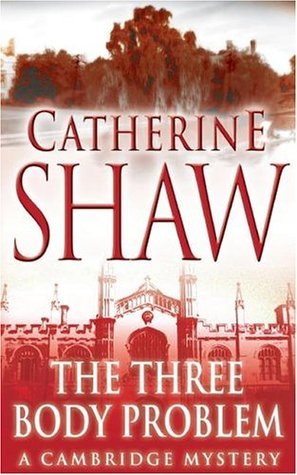
Cambridge Mysteries #1
The Three Body Problem
Cambridge, 1888. Miss Vanessa Duncan is a young schoolmistress recently arrived from the countryside. She loves teaching and finds the world of academia fascinating; everything is going so well. But everything changes when a Fellow of Mathematics, Mr. Akers, is found dead in his room from a violent blow to the head. Invited to dinner by the family of one of her charges, Vanessa meets many of the victim’s colleagues, including Mr. Arthur Weatherburn, who had dined with Mr. Akers the evening of his death and happens to be Vanessa’s upstairs neighbor. Discussing the murder, she learns of Sir Isaac Newton’s yet unsolved ‘n-body problem’, which Mr. Akers might have been trying to solve to win the prestigious prize. As the murder remains unsolved, Vanessa’s relationship with Arthur Weatherburn blossoms. Then another mathematician, Mr. Beddoes is murdered and Arthur is jailed. Convinced of his innocence and with a theory of her own, Vanessa decides to prove her case. But when a third mathematician dies, it becomes a race against time to solve the puzzle. . .
288 pages, Paperback
First published January 1, 2004
About the author
Catherine Shaw
67 books13 followersCATHERINE SHAW is a pseudonym used by Leila Schneps. She is a mathematician and academic and writer of murder mysteries. She lives in Paris, France.
After taking an undergraduate degree in pure mathematics at Harvard University, Leila Schneps moved to France definitively in 1983, where shortly after obtaining her Ph.D., she was hired by the French National Scienctific Research Centre as a researcher in mathematics. Over twenty years of doing maths, teaching, and mentoring graduate students, her interests have widened far beyond the horizons of pure algebra to aspects of mathematics - such as probability and statistics- that play a more visible role in the world around us, and to the way in which people absorb, reject or react to mathematics.
At the same time, a lifelong passion for mystery stories led Leila to try her hand at writing one herself, eventually leading to a series of "Cambridge Mysteries" published by Allison & Busby.
After taking an undergraduate degree in pure mathematics at Harvard University, Leila Schneps moved to France definitively in 1983, where shortly after obtaining her Ph.D., she was hired by the French National Scienctific Research Centre as a researcher in mathematics. Over twenty years of doing maths, teaching, and mentoring graduate students, her interests have widened far beyond the horizons of pure algebra to aspects of mathematics - such as probability and statistics- that play a more visible role in the world around us, and to the way in which people absorb, reject or react to mathematics.
At the same time, a lifelong passion for mystery stories led Leila to try her hand at writing one herself, eventually leading to a series of "Cambridge Mysteries" published by Allison & Busby.
Ratings & Reviews
Friends & Following
Create a free account to discover what your friends think of this book!
Community Reviews
Displaying 1 - 1 of 1 review

January 23, 2018
Dieser Krimi zeichnet sich eigentlich durch zwei Punkte aus:
- es ist ein mathematischer (!) historischer Kriminalroman
- er ist komplett in Briefform erzählt.
Die Briefform fand ich anfangs etwas irritierend und offenbar konnte auch die Autorin diesen Stil nicht wirklich durchhalten, denn die meisten Briefe (von Anfangs- und Endfloskeln mal abgesehen) lesen sich doch eher wie ein Ich-Erzähler. Normalerweise spricht man ja in einem Brief den Adressaten immer wieder an, nimmt auf gemeinsame Erlebnisse Bezug oder fragt nach. Dies fehlt in diesen Brief fast komplett, weshalb sie sich eben nicht wirklich wie Briefe lesen. Ich denke, die Autorin wollte etwas anderes (und zugleich ganz klassisches) ausprobieren, gelungen ist es hier leider nicht wirklich.
Die ersten hundert Seiten fand ich etwas langatmig, ich dachte schon, das Lesen dieses Buches würde sich endlos wie Kaugummi ziehen. Aber als der Gerichtsprozess begann, wurde es plötzlich sehr unterhaltsam (auch wenn die Handlung kaum voranging). Über die Befragungen vor Gericht konnte ich mich sehr amüsieren und auch danach flog ich geradezu durch die Seiten. Von Langeweile keine Spur!
Die Auflösung der Mord war wirklich sehr interessant und doch anders als der übliche Einheitsbrei.
Nach dem etwas langweiligen Start war es dann doch eine schöne Lektüre.
- es ist ein mathematischer (!) historischer Kriminalroman
- er ist komplett in Briefform erzählt.
Die Briefform fand ich anfangs etwas irritierend und offenbar konnte auch die Autorin diesen Stil nicht wirklich durchhalten, denn die meisten Briefe (von Anfangs- und Endfloskeln mal abgesehen) lesen sich doch eher wie ein Ich-Erzähler. Normalerweise spricht man ja in einem Brief den Adressaten immer wieder an, nimmt auf gemeinsame Erlebnisse Bezug oder fragt nach. Dies fehlt in diesen Brief fast komplett, weshalb sie sich eben nicht wirklich wie Briefe lesen. Ich denke, die Autorin wollte etwas anderes (und zugleich ganz klassisches) ausprobieren, gelungen ist es hier leider nicht wirklich.
Die ersten hundert Seiten fand ich etwas langatmig, ich dachte schon, das Lesen dieses Buches würde sich endlos wie Kaugummi ziehen. Aber als der Gerichtsprozess begann, wurde es plötzlich sehr unterhaltsam (auch wenn die Handlung kaum voranging). Über die Befragungen vor Gericht konnte ich mich sehr amüsieren und auch danach flog ich geradezu durch die Seiten. Von Langeweile keine Spur!
Die Auflösung der Mord war wirklich sehr interessant und doch anders als der übliche Einheitsbrei.
Nach dem etwas langweiligen Start war es dann doch eine schöne Lektüre.
Displaying 1 - 1 of 1 review