From behind the closed door, the man shouts, 'Be on your way - you have no business here!' 'Open up, I am the messenger of Death'.
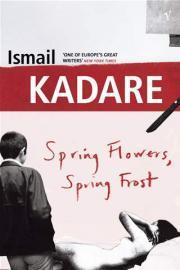
As spring arrives in the Albanian mountain town of B, some strange things are emerging in the thaw. Bank robbers strike the National Bank. Old terrors are dredged up from the shipwreck of history. And ultra-explosive state secrets are threatening to flood the entire nation. Mark, an artist, finds the peaceful rhythms of his life turned upside down by ancient love and modern barbarism and by the particular brutality of a country surprised and divided by its new freedom.
Ismail Kadare (also spelled Kadaré) was an Albanian novelist and poet. He has been a leading literary figure in Albania since the 1960s. He focused on short stories until the publication of his first novel, The General of the Dead Army. In 1996 he became a lifetime member of the Academy of Moral and Political Sciences of France. In 1992, he was awarded the Prix mondial Cino Del Duca; in 2005, he won the inaugural Man Booker International Prize, in 2009 the Prince of Asturias Award of Arts, and in 2015 the Jerusalem Prize. He has divided his time between Albania and France since 1990. Kadare has been mentioned as a possible recipient for the Nobel Prize in Literature several times. His works have been published in about 30 languages.
Ismail Kadare was born in 1936 in Gjirokastër, in the south of Albania. His education included studies at the University of Tirana and then the Gorky Institute for World Literature in Moscow, a training school for writers and critics.
In 1960 Kadare returned to Albania after the country broke ties with the Soviet Union, and he became a journalist and published his first poems.
His first novel, The General of the Dead Army, sprang from a short story, and its success established his name in Albania and enabled Kadare to become a full-time writer.
Kadare's novels draw on Balkan history and legends. They are obliquely ironic as a result of trying to withstand political scrutiny. Among his best known books are Chronicle in Stone (1977), Broken April (1978), and The Concert (1988), considered the best novel of the year 1991 by the French literary magazine Lire.
In 1990, Kadare claimed political asylum in France, issuing statements in favour of democratisation. During the ordeal, he stated that "dictatorship and authentic literature are incompatible. The writer is the natural enemy of dictatorship."
Fredes flors de març narra la transició d'Albània a la democràcia. L'arribada del capitalisme i les mels de l'Europa del progrés desperten un mal atàvic, latent. La serp, silent, representa el retorn de la tradició i la violència. Kadaré, que sempre havia estat molt crític amb el comunisme i la repressió governamental, fa aquí l'exercici invers. L'arribada de la modernitat és també l'arribada de noves formes de violència, d'una paranoia que s'obre pas des del passat.
Possiblement aquesta sigui la novel·la més dispersa que he llegit de Kadaré. Significa això que sigui un mal llibre? No. L'autor és un grandíssim narrador, i la seva destresa a l'hora d'afegir incontables capes de significat a un relat em sembla extraordinària. Amb aquest llibre m'ha passat una cosa ben estranya i és que les històries perifèriques, les que s'amaguen als contracapítols, m'atreien molt més que la trama principal, que trobo que està poc inspirada. Malgrat que el talent de Kadaré es fa palès en les seves magnífiques al·legories, el llibre no acaba de formar una unitat. Malgrat tot, és una lectura estimulant, fascinant i terrible.