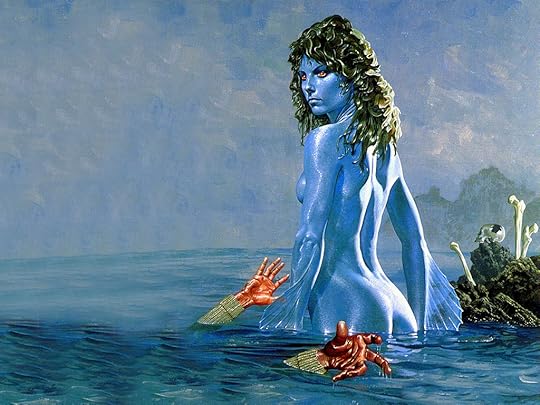
Pseudonym A. A. Craig, Michael Karageorge, Winston P. Sanders, P. A. Kingsley.
Poul William Anderson was an American science fiction author who began his career during one of the Golden Ages of the genre and continued to write and remain popular into the 21st century. Anderson also authored several works of fantasy, historical novels, and a prodigious number of short stories. He received numerous awards for his writing, including seven Hugo Awards and three Nebula Awards.
Anderson received a degree in physics from the University of Minnesota in 1948. He married Karen Kruse in 1953. They had one daughter, Astrid, who is married to science fiction author Greg Bear. Anderson was the sixth President of Science Fiction and Fantasy Writers of America, taking office in 1972. He was a member of the Swordsmen and Sorcerers' Guild of America, a loose-knit group of Heroic Fantasy authors founded in the 1960s, some of whose works were anthologized in Lin Carter's Flashing Swords! anthologies. He was a founding member of the Society for Creative Anachronism. Robert A. Heinlein dedicated his 1985 novel The Cat Who Walks Through Walls to Anderson and eight of the other members of the Citizens' Advisory Council on National Space Policy.[2][3]
Poul Anderson died of cancer on July 31, 2001, after a month in the hospital. Several of his novels were published posthumously.
Anderson’s fantasy is usually better than his science fiction, but not in this case. There were some magically worded passages throughout, but the content was weird, and it was a snoozefest. I don’t do DNF’s, but if I did, this would be one.
I've loved discovering Poul Anderson's work. The Merman's Children is my least favourite of his work so far, but it's still compelling: easy to read, and you get through chunks of it without realising you have. It does have the occasional example of Poul Anderson's devotion to rendering accents phonetically, which can be infuriating to read, but most of the main characters do not.
It's a sad and strange story, mostly about the passing of things. I love the way everything gets woven together toward the end, strands of the story that didn't seem as if they would come together.
I wasn't so fond of the Christian parts of this. It mostly seemed to push just one true way, which is... totally not the way I think.
This is a better-than-average fantasy, "better-than-average" because, unlike many others, it is rooted in European traditions and literature. Anderson often harkened back to his Danish ancestry in his works.
A group of brother and sister merpeople, the children of a merman and a human woman, are on a long journey questing for a new home after Christianization drives out the other merpeople. I think. I read this when I was ten or so and only recall it vaguely.
It took me a bit to actually get into the book but once I did I really enjoyed it. I miss the days of books such as this with grand, sweeping narratives that span multiple years. Anderson expertly wove many different cultures mythologies into this story and that’s what makes it such a good and entertaining book.
I thought I'd like this more than I did. I loved the short story about these characters that appeared in one of the 'Flashing Swords', I think. He's a great writer & I was a little disappointed in the book. Might just be me, though. He didn't seem to be so action oriented - wordier that normal.
Poul Anderson is brilliant. Every book I've read by him is entirely unique. There are others of his that I enjoyed more than this one, but this tale of the last days of Faerie was nevertheless fantastic.
When it wasn't full of descriptions of sailing and sea-fights, it was full of rape; all the females seemed to exist only to receive the males willy-nilly. Usually I love Poul Anderson, but not this one - abandoned mid-voyage.
Z bólem serca muszę przyznać, że poległem w starciu z tą książką. Ponad pół roku podczytywałem po dwie, trzy strony za jednym posiedzeniem i ciskałem ją w kąt. A dzisiaj w końcu spasowałem. Nie dam rady. Odczuwam wręcz fizyczny ból na samą myśl o przewróceniu kolejnej kartki.
Ta książka jest po prostu fatalna, i to na wielu poziomach. Przede wszystkim w sposób dziwaczny propaguje katolicyzm, jednocześnie traktując wodników jako istoty pozbawione duszy. Ale gdyby tylko! Przecież zwierzęta też wedle tej doktryny nie mają duszy, a jednak pochlapanie kropidłem nic im nie robi. A wodnikom i owszem. Odprawienie egzorcyzmów na powierzchni morza powoduje zawalenie się w gruzy całego ich podmorskiego miasta, a także literalnie odpędza ich od brzegu. Bo tak. Co ciekawsze - ochrzczenie wodnika produkuje mu duszę (że niby jak?), w związku z czym można znaleźć w pewnym momencie wypowiedź: "Nie mogę znieść myśli, że pewnego dnia staniesz się nicością. Proszę cię, ochrzcij się." A warto przy okazji wiedzieć, że wyprodukowanie duszy powoduje zupełne wymazanie poprzedniej osobowości i pamięci. Taki ogólny reset. Po czym księża biorą taką jedną wzbogaconą o duszę wodniczkę i... wsadzają ją do klasztoru. No ale niech tam, pal licho. Kreacja autorska.
Do tego dochodzą sceny ordynarne, prymitywnie seksistowskie, a często i w sposób brudny i chory traktujące sam seks, uprzedmiotawiające kobietę. Dlaczego? Bo tak sobie wymyślił autor. Autor, który w innych książkach nie stosował metod tak niskich. A że do niczego konkretnego ten zabieg nie służy? Któż by tam patrzył...
Oprócz tego szwankuje wewnętrzna logika. Wodnicy, którzy muszą się wynieść z okolic Jutlandii, w morzu nagle... marzną i koniecznie muszą co pewien czas nocować na lądzie, żeby się ogrzać. Wodnicy, którzy przez całe życie siedzieli w wodzie, i to nie należącej do ciepłych. Którzy unikali lądu jak zarazy. Jeszcze głupsze są sceny sztormu, kiedy to wodnicy, istoty w końcu wodne, posiadające skrzela, chronią się przed falami na... pokładzie rozsypującego się statku. Bo tam "bezpieczniej".
Potem były jeszcze inne kwiatki, łącznie z wydobywaniem "marnych kilku ton" złota z dna morza czy opisywaniem wodników jako dzieci kwiatów - z wolnym seksem, miłością do świata i niewinnością. Ale że powieść po raz pierwszy ujrzała światło dzienne w roku 1979, to trudno taki zabieg brać za oznakę czasów. To po prostu jakieś dziwne autorskie fanaberie.
So this is an unusual one. Generally, I'm a huge Poul Anderson fan in terms of his Norse fantasy and historical fiction. I've read most if not all of those titles: from The Broken Sword to Mother of Kings and much in between. I have not read any of his scifi, which I understand he is better known for, but I'm not into scifi. So there's that.
The Merman's Children blends some elements of Nordic (Danish) folklore with fantasy and is set in the later part of the middle ages (so after the Viking Age). For the most part, it's an entertaining enough story, but the basic premise that sets it off is a little hard to swallow. Much of the tale involves the children of the titular merman seeking their fellow people after they have fled the destruction of their underwater city. That's fine, but the merman's children are held behind due to the fact that the youngest of them is supposedly incapable of venturing elsewhere and is thus offered up to humans on land to take in and Christianize. This is the part I thought was weak. I never fully bought into the sense that this youngest child couldn't stay underwater, but it is that fact that sets off most of the events in the book. It's a fun enough story, but not fully convincing in that regard.
I was also a bit surprised by how apparently sex obsessed Poul Anderson was. Nothing graphic in the book, but he definitely let loose his thoughts on non-monogamy in its writing. I wasn't expecting that and suspect he would prefer to have been alive in the 21st century where such behavior is viewed more favorably.
All in all, it's an okay book. Not a bad read, and if you're a genuine devotee of mermaid folklore then you should definitely give it a go. But I suspect most readers will regard it as just fine, perhaps as a fun percursor to today's romantasy.
Although I didn't finish this novel, I read enough to understand the style and plot wasn't for me. In this short review, I'll post the positives and negatives.
First, the merfolk are more like sea nymphs; they don't have tails. They stick together like a tribe, and children are not raised in traditional family units. Rather, a mother takes care of whatever offspring she had with a random lover.
Positives: The action and plot pick up right away. The setting was phenomenally described in detail. The city of Liri reminded me of Atlantis!
Negatives: The beginning of the novel is strange. The group of merfolk leave their little sister on land because they believe she wouldn't survive the long oceanic voyage they must make in order to find their father. This seems to be the main idea: finding their father. However, when a human friend tells Tauno, the main merman, that she's suddenly sent to live in a monastery/church, he suddenly wants her back and seems to forget the main mission.
The first battle was against the Kraken who is supposed to be immensely powerful, but they kill him way too quickly. Even in the second battle against a group of ragtag pirates, they won the battle without any threats or challenges.
There's a lot of character perspectives to keep track of with some instances of head hopping. Also, I was surprised to see quite a lot of grammar mistakes.
I hope someone else enjoys this novel. If you like high fantasy or long sagas, perhaps you will like this book. -Sirenita The Selkie
There's a settlement of merpeople off the Danish coast, and they're tempting good Christian people to join in their revelries. In fact, one woman was living with them for a while and had children with them. The new Archdeacon is disturbed and wants to exorcise them. And that's the premise.
This book, Anderson says, is set in a Catholic universe - but not the universe of St. Thomas Aquinas; the universe as seen by an Early Medieval villager. Merpeople have reason but no souls; exorcism does drive them away... and because of things like that, "half-world" creatures like them are finding fewer and fewer places in the world.
This's fascinating worldbuilding that could be explored at epic length. On the one hand, it feels uncomfortable to me that a world could be designed this way (especially considering the uncomfortable results when one of them is in fact baptized). On the other hand, this sort of discomfort could be exactly the sort of thing that leads to a great epic tale wrestling with that and coming to a conclusion more emotionally satisfying to the reader.
Anderson... sort of does that. Some settlement is offered. But it doesn't really satisfy me, in part because we don't see why any of this is the case. Our characters move around at ground level (as it were) within their world; they don't get to see why it was set up that way. So I enjoyed this book, but I'm wishing it was more.
This is a skillfully written tragedy. No laughs at all, but some sad smiles. Poul wrestles with Christianity, it seems that he believes, but isn't quite sure. There is a very possible sequel, which unfourtunately didn't get written. A very philosophical tale that I recommend for anyone. If you are a fundamental Christian, you might not like to give it to a child, because an intelligent child will start thinking.
Nonostante il romanzo si intreccia con la mitologia nordica, che è di per se affascinante, sia la vicenda, sia i personaggi non sono mai riusciti a a catturare il mio interesse.
This book is OK. The author has done better work. I think this was an interesting idea, but it ended up being a bunch of clever elements that didn't gell together.
A somewhat melancholic, layered tale of the diminishing of Faerie. Having read bits of it in Flashing Swords, it's nice to have it all in one place, expanded.
I think I've see the Matthew Arnold poem. The poem is not really what that novel is based on, however. Anderson went back to Danish folklore and other European folklore.
I've always found Anderson better in the establishment of worlds than in the development of stories. I don't find the characters very well developed or very likable. Some of the humans are implausibly ruthless. This is not, however, a basis for murdering them--but it's too often used as such. Where is the negotiation? I think there's a bit more later on (I may have been getting into it in the last chapter I've read so far. But the intolerant attitude of the Christianized Europeans is far too rigid. There must have been MUCH more variation in how local communities ignored or enforced priestly prohibitions.
I did like the consensual social interactions and decisionmaking of the merfolk. I found the 'king' rather more like the elected kings of Scandinavia and various German principalities than like the Latinate 'absolute' monarchs. But I also wanted to know more about the individual characters of the merfolk in the larger group. The halfling children of the titular 'merman' were surely not the only ones with vivid, fully developed personalities. It's not, after all, only the ephemeral lives of humans that make them develop complex personae.
The ageless merfolk, after all, are nothing like invulnerable. They are, indeed, far TOO vulnerable. The fact that the half-human offspring of the merman have a 3 out of 7 mortality rate even before their unhousing is, apparently, not at all unusual. And, come to that, why SHOULDN'T they have 'souls'? They're all people, after all, whether they're human, part-human, or 'unhuman'.
The part about the ships is odd. Why DON'T the merfolk have something like ships? They've known that humans have them for centuries. You'd think they'd have developed ships, rafts, or something like that, in case they have to travel. And what about submarines? They wouldn't have to come up with things like compressed air and elaborations like that--they'd just have to develop things like more or less permeable hulls. Doesn't seem that hard, for skilled carvers.
The sort of false humility that's in the preface is an inverted form of boasting. It's a way of saying "Look how much I know about boats and Vikings and the Hanseatic League, and, and...Why, I can even point out that the things that seem anachronistic are really plausible...with a little stretching."
I found the part about conflicts between the Inuit and Vikings a bit far-fetched. There MAY have been some contacts in Greenland in the last days of the Viking settlements--or there may not have. Whereas there is good evidence of Viking interactions with the people they called 'Skraelings' in Vinland (characteristic loom weights and iron nails and that sort of thing), there's not as much evidence of such contacts in Greenland. And why would the Vikings have used the same name for both Beothuk and Inuit? The term apparently originally meant something like 'small men'. But would the Inuit actually have seemed small to the Vikings?
One important point is that there is no evidence WHATEVER that Giant Squid have (even once) attacked humans. People would have known of the existence of such animals from the carcasses that washed ashore (usually fairly decomposed by the time they made landfall). Giant squid, like other cephalopods, reproduce only once, after a short lifespan, and then die. It would be natural to weave romances about these huge corpses--but in fact, one of the reasons they're legendary is that they rarely to never come close to the surface. The imagined merfolk of the story might have had more knowledge about the creatures--but not much more, probably, since they spent little time in the deep ocean.
Note that the merfolk are NOT immune to cold. They compensate by eating much more than land dwellers--but it's not really clear how this works. Do they have something like blubber?
I'm not going to comment on the sex in the stories. It seems largely extraneous to me, despite appearing on many pages. It's not really very important to the narrative, except when it's used as an excuse for limiting the choices of women. Got to keep those lewd women under control, after all. But other peoples' responses tend to be rolled eyes and a tacit "Oh? Why's that?".
If nothing else I can say this book is unique. Unusual, a little dry/draggy in some parts, not altogether satisfying in a traditional sense. My sister lent me this book saying it wasn’t what she expected it would be (and she seemed at a loss for words for further explanation). Now that I’ve read it, I see where she’s coming from and I think I’d struggle to explain it to someone else as well. Also I felt super bad for Ingebord. This book is ~~okay~~ , like a 2.5 star read.
Many years ago, off the coast of Denmark, lived one of the last settlements of merfolk, the Faery children of the sea. The king of this people took for a wife one of the human mortals from the nearby town, who gave him four halfbreed children. Then the world of Christendom discovers their existence and exorcises them. Though the rites of the Church have no power over them, the family of the king find themselves as homeless as their father's kin. So, along with those of the mortals that still love them, they begin an adventure that leads them halfway around the world, and into dangers they could never have dreamed of, as they search for a new destiny.
Written in the style of old medieval legends, this tells of the ending of the time of wonder and magic, of love and deceit, and of the choices made by those who suddenly find themselves in a world that does not want them anymore. Full of both beauty and deep sorrow, it is a story that will long be remembered.
This downbeat story reminds me a lot of Anderson's "The Broken Sword" in that there's no out for the merfolk hounded by Christians as soulless fiends and searching for a place to call home. However, it ends surprisingly happily (Anderson said that as an older writer, he wouldn't have written Broken Sword the same way—maybe that's part of it); faerie may vanish, but these fair folk at least find peace within the Christian world.
I promise, I will finish it. I read a long time ago.....in a land far far away, when I was young and naive. Now I am mad at the story and need to put it away.