Kyle Reese, Sergeant Tech-Com, DN38416, was a soldier from a post-apocalyptic future in which machines drove humanity to the brink of extinction after decades of war. In a last-ditch effort to ensure mankind’s survival, he was sent back in time to protect Sarah Connor, the mother-to-be of the leader of the human Resistance, from the Terminator, a relentless cyborg assassin with a mission to extinguish humanity’s final hope. After a series of running battles, Reese was killed in one final attempt to destroy the Terminator.
Or was he?
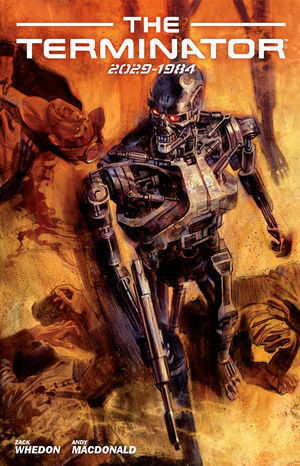
Before Terminator 2: Judgment Day catapulted the series to a science fiction, action-loaded blockbuster, the original Terminator film was a more low-key combination of sci-fi, film noir, and tragic romance. Terminator 2029—1984 follows in that tradition, focusing more on the character of Kyle Reese (so memorably played by Michael Biehn on the big screen) in the future and revisiting key events from the first movie in 1984 Los Angeles, taking another direction by postulating that Reese survived his final battle with the Terminator and spent decades imprisoned and interrogated, first by shady government black ops types, later by Skynet and its army of cyborgs, all of whom want to exploit his knowledge of the future for their own purposes. In some respects, it attempts to do what Terminator: Genisys attempted, years before Terminator: Genisys was conceived. A new character, Ben Oliver, is introduced with his own bittersweet love story, and his involvement allows a fresh prospective of The Terminator to be viewed, for better or worse.
The ideas visited are fun, even provocative, but ultimately futile once the end of the story is reached. In spite of Ben’s intervention in the timeline, Reese still dies by the end of the story (again, at the hands of a Terminator), although this death is far more poignant in that it’s now a moment shared with Sarah and the newborn John Connor. While some things change, some things stay the same. There’s some great foreshadowing of past/future events, with Sarah Connor herself kicking off the concept of the Resistance, and the concept of reprogramming a T-800 to fight on the side of humanity is alluded to, paving the way for the plot of Terminator 2: Judgment Day. The real tragedy, however, is that time travel has been used to such extremes in the entire Terminator series that no one can really say for certain what sticks and what doesn’t. Between the movies, the Sarah Connor Chronicles TV series, and other graphic novels, Kyle Reese has almost a half-dozen different outcomes to his mission, ranging from a full life to live with Sarah to only their few hours together, to at least two different deaths.
A brisk one-day read, Terminator 2029—1984 is a well-crafted take on the original movie and its human against machine dynamic, but will inevitably fall by the wayside along with other short-lived Terminator tie-ins and spin-offs, living forever in the shadow of James Cameron’s theatrical masterpiece and its blockbuster sequel.