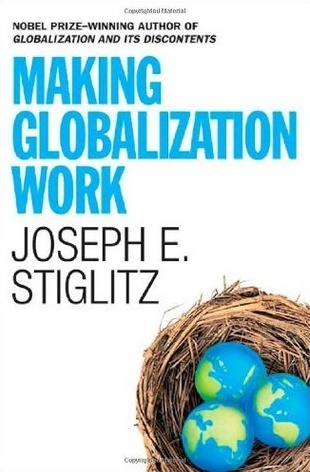
“A damning denunciation of things as they are, and a platform for how we can do better.”―Andrew Leonard, Salon Four years after he outlined the challenges our increasingly interdependent world was facing in Globalization and Its Discontents , Joseph E. Stiglitz offered his agenda for reform. Now in paperback, Making Globalization Work offers inventive solutions to a host of problems, including the indebtedness of developing countries, international fiscal instability, and worldwide pollution. Stiglitz also argues for the reform of global financial institutions, trade agreements, and intellectual property laws, to make them better able to respond to the growing disparity between the richest and poorest countries. Now more than ever before, globalization has gathered the peoples of the world into one community, bringing with it a need to think and act globally. This trenchant, intellectually powerful book is an invaluable step in that process. This paperback edition contains a brand-new preface.
Joseph Eugene Stiglitz, ForMemRS, FBA, is an American economist and a professor at Columbia University. He is a recipient of the Nobel Memorial Prize in Economic Sciences (2001) and the John Bates Clark Medal (1979). He is also the former Senior Vice President and Chief Economist of the World Bank. He is known for his critical view of the management of globalization, free-market economists (whom he calls "free market fundamentalists") and some international institutions like the International Monetary Fund and the World Bank.
In 2000, Stiglitz founded the Initiative for Policy Dialogue (IPD), a think tank on international development based at Columbia University. Since 2001, he has been a member of the Columbia faculty, and has held the rank of University Professor since 2003. He also chairs the University of Manchester's Brooks World Poverty Institute and is a member of the Pontifical Academy of Social Sciences. Professor Stiglitz is also an honorary professor at Tsinghua University School of Public Policy and Management. Stiglitz is one of the most frequently cited economists in the world.
fuck this "who would you recommend this book to?" shit. i want everyone to read everything that i've read so i dont have to hold their hand with basic shit everytime i open my mouth. this book illuminates a lot of the complicated systems of global economics and trade, as well as the politics surrounding them, in a very accessible and engaging style. im not saying everyone needs to make a pilgrimage to the world bank or something, but this shit affects all of us, whether you have money or not. do the knowledge.
There are harder-hitting and ideologically better books out there on neoliberal globalization, though Stiglitz’s status as a respected international economist and former chief economist of the World Bank raises the hope that his body of work will bring critiques of neoliberalism to new audiences. While at times Stiglitz seems to be bending over backwards to save capitalism from itself, instead of proposing alternatives to it, he does suggest important reforms that could better the lives of billions of people around the globe. His chapters on patents and intellectual property are particularly useful in countering myths about the supposed wonders of free-market innovations. Again, though one could more properly posit that the existing economic model needs to be scrapped entirely, instead of “made to work,” it is hard to argue with Stiglitz’s plea that, “In the long run, the most important changes required to make globalization work are reforms to reduce the democratic deficit.”
Skewed globalization dominated by the selfish interests of developed nations led by the United States has always been an area of concern. Joseph Stiglitz tries to remove the stigma associated with the concept of globalization as a whole, while attacking the roots of the skewed globalization of today. Here he offers certain remedies to make globalization work better.
Stiglitz, as usual, is at his best exhibiting how unfair globalization has been till date, yet this book follows a novel approach of offering solutions. The book starts with optimism that another world is possible, and there exist solutions within the framework of globalization, which can work.
In terms of trade, he recommends how a fairer trade regime as opposed to the present regime where developed nations take use information asymmetries tilted to their sides to their advantage, can be replaced by a better regime for the benefit of all. He exposes how developed countries resort to populist, unethical, and sometimes even pathetically populist methodologies for taking undue advantage over developing countries in trade.
He comes down heavily on the present systems of patents and intellectual property rights, and how they can impede development of newer technologies, especially in developing countries. He calls them an impediment to the spirit of globalization and calls for less stringent and just patent laws.
He points to the conundrum that resource-rich countries are generally poor and how manufacturing sector growth in these countries, instead of providing raw materials to manufacturers in the developed world, can contribute better in a globalised world towards development for all. Innovative measures are also suggested for having a better economic system in place so that it rewards green growth which protects environment.
He calls for administrative reforms in multinationals, where stricter norms are laid out against bribery; and environmental damage and reduction of monopolies take place. He also emphasizes on a better debt management policy, where following the IMF directives have been disastrous in the past for many a developing country. In the same tune he calls for sweeping reforms in the IMF and World Bank. He emphasizes the need for a better global reserve system at work, and doing away with dollar-based reserves as a possible solution. The overall conclusion is that these changes can occur only in a globally democratic environment, and calls upon internally democratic developed countries to have democratic foreign and economic policies as well, and do away with monopolist globalization.
A thorough and well researched book as you might expect. It is an eye opener in many ways, for those who are ignorant of the specifics of skewed globalization. A book written by a visionary, who can see through the dangerous consequences of the existing policies, both for developed and developing world.
His ideas are workable in many ways, but most of his ideas require countries like US showing a change of intent, which seems impossible at this moment in time. Thus, his expectations border on idealism, and hence may seem less practical. Just as people looked at Keynesian model after decades with awe and wonder, Stiglitz too seems too ahead of his time. His solutions may prove to be part of a useful framework in the future.
His suggestions of repairing up capitalism of its woes, (rather than the extreme of doing away with it altogether), with well-defined role of domestic savings in investment as opposed to unstable speculative capital (which was one big reason for recession) , and with emphasis on a democratic government to have at least some amount of regulatory mechanisms to check the ill-effects of market capitalism (like the woes of monopoly) may prove to be the benchmarks for a just, democratic and equitable global economic growth in the future. But, given the present scenario, we do not know how far that future lies.
I was surprised by this book. Stiglitz is an American who has worked for the American government, yet he criticizes the United States for most of the globalisations negative effects. Having this book as course literature was a good choice - for a commoner like me, Stiglitz explains globalisation with words I easily cab understand. Many examples are used too. But I missed a culture insight, since I only got to read about economy and politics. Culture is also a big deal, but it's understandable that Stiglitz didn't include this aspect since his thing litterary is economy and politics. I still appreciate the book for what it is, a good explanation on how you could make globalisation work. Because whether or not you agree with his plan for success, it's at least a plan. Which in this world today is all we need.
This is essentially a sequel to "Globalization and Its Discontents," which I read and reviewed earlier this year. But whereas the first volume was basically a descriptive catalogue of complaints, wherein Stiglitz highlighted the myriad places where he disagreed with the implementation of global economic strategies by both the International Monetary Fund and by his former World Bank colleagues, this book is more prescriptive. Here, Stiglitz actually discusses the policies and strategies he thinks will make economic globalization work for everyone - from the wealthiest among us to the poorest countries on earth.
This book is more technical than some non-economists will want to read, I am certain. Stiglitz has chapters that deep dive on topics like free trade and tariffs, intellectual property rights, the so-called "resource curse" in developing countries, how to control the influence of multinational companies, saving the environment and much, much more. I felt that he made this material generally accessible, even to the layperson, but again, some might find these discussions a bit dry. In fact, it was the technical nature of the discussions that led me to almost give this book just three stars instead of four.
Here's why I didn't: This book has to get at least four stars because Stiglitz's ideas are just too important to ignore. His basic premise is this: The pace of economic globalization has outstripped the pace of political globalization. In other words, we do not have international political bodies capable of regulating trade and other economic activity in such a way that it can be fair and just for all. The global political institutions that do exist (e.g. the UN, IMF, WTO and World Bank) don't have the power to make things right on their own AND they currently lack democratic representation from all affected stakeholders. All of Stiglitz's recommendations and suggestions are aimed at righting these imbalances.
What I liked most about this book is that each of Stiglitz's suggestions are discrete. Many of them can be implemented without having to buy the whole package - and any one of them would be useful. So whether you favor debt forgiveness for developing countries, like cap and trade, or see a reconfiguration of the international reserve system as crucial, Stiglitz has something for you.
If you care about how we implement economics on a global level, I encourage you to read this book. Stiglitz may not have all the answers - but at least he is bold enough to make some suggestions that cut against the grain. The world would do well to consider his point of view.
Another important book to be read by anyone who wants to be an informed citizen. Easily read by the average layperson. This book is now 2 years old though and I would love it if Mr. Stiglitz would print an update letting us average people know if any of his reforms are being implemented. The reason I didn't give it five stars is because the last two chapters got a tad boring for me. Also I was a little frustrated because as I read I kept thinking, "How can we ever accomplish the reforms he is proposing!?" But all in all, a very informative book.
When we talk about globalization, specifically economic globalization, we tend to refer to the Washington consensus and the policy recommendations that it has highlighted such as liberalization, deregulation, privatization, property rights, etc., which sets the platform for the globalised economy. And, institutions such as IMF and World Bank make sure that the policies get implemented. The real essence of globalization is the creation of a level playing field for every country. But, the real question is whether these policies and institutions have been able to create the so called level playing field for economic growth and development, or not?
Hence, in this book, Joseph Stiglitz questions that notion of globalization as a level playing field and criticizes the policies as well as the institutions which are the implementers of such policies. He argues that instead of creating global economic stability, these institutions have contributed in destabilizing the poor countries and enriching the rich countries. In the book, the author highlights the flaws and hypocrisies attached with the policies of trade liberalization, patents, environmental concerns, multinational corporations, debts and exchange mechanisms; and put forward his ideas of reforms to really make globalization work. To highlight his essence in one sentence, as Stiglitz puts it “The challenge in making globalization work is to universalize the concerns and to democratize the procedures”.
What I love about the book and the writer is the fact that even though Stiglitz was part of US government and worked in World Bank, he severely criticizes the Americanization of globalization. Having said that, I also see this book as the writer’s imaginative vision of the utopian world of economic globalization where rich countries help out the poor countries without any hidden agendas and everyone is happy. It seems practically impossible because economy is a zero sum game where one wins while the other loses.
Nevertheless, I recommend this book because it makes you understand economic globalization as a whole and the real politics behind the economic globalization in the present scenario. Give it a go and surely it would be worth your time.
Die Globalisierung ist seit mehr als 2 Jahrzehnten im vollen Gange, weshalb eine kleine Retroperspektive nicht verkehrt ist. Wer sind die Nutznießer der global vernetzten Erde? Was sind Handelsdefizite? Wie müssen Entwicklungsländern Hilfe geschaffen werden und warum sind die jetzigen Kreditvergaben durch die IWF nicht sonderlich förderlich? Joseph Stiglitz gibt eine Vogelperspektive auf die Vernetzung und praktische Vorschläge, wie man das Netzwerk optimieren könnte, so dass nun endlich auch Entwicklungsländer davon profitieren. Ein Buch was sehr gut die Globalisierung erklärt, anhand von vielen Beispielen vieler Länder.
Nobel winner Stiglitz's first book , Globalization and Its Discontents made a huge impact on me when I worked overseas, it definitely motivated the direction I took with my studies. I'll always remember sitting in Azerbaijan one night reading it and looking up at the TV to see Stiglitz being interviewed by a Baku station about his book-- he was visiting the country. That was one of those really weird coincidences that you feel have to be from God.
This is his follow-up book that, sadly, is not as good (maybe because I now know better). Stiglitz picks up where he left off in his previous book-- continuing to criticize the IMF and rehashing their ineptitude in East Asia, Argentina, etc. But Stiglitz also rails against the Bush administration and just about everyone else (sometimes without naming who he is railing against exactly). So much so that it seems the only entity he likes is the United Nations-- that wonderfully effective body. As such, there are a lot of inconsistencies and rambling.
The chapter on trade is pretty good, though. "We don't know what the benefits of free trade would be because we've never tried it." He points out all of the problems with trade agreements, particularly how the U.S. and other Western countries tip the playing field in their favor. Here is a favorite example:
U.S. industries will often file a petition alleging "dumping" by foreign countries. Rather than comparing the true cost of production in the offending country, trade officials will use costs in some place like Canada as a proxy. So, if one country is selling a product cheaper than what Canada can make it they can have anti-dumping duties (tariffs) imposed on their products. That hurts the developing world that happens to have cheap inputs due to abundant labor.
As the U.S. opened its markets to Vietnam, Vietnamese catfish quickly took 20% of the U.S. market. Congress passed a law stating that only U.S. catfish could be called "catfish," so Vietnamese exporters re-entered the market with a new name, "basa," which they could market as something high-end and sell it for a higher price. U.S. catfish farmers then charged Vietnam with dumping. Stiglitz witnessed all of this "kangaroo court" action while working in the Clinton administration.
He blasts the U.S. for engaging in bilateral trade agreements and rails that it hurts multilateral efforts. This is highly controversial theoretically (mathematically) but Stiglitz pronounces bilateral agreements as harmful as fact. Stiglitz criticizes the U.S. on one page for not doing as the EU did and unilaterally removing its tariff barriers to the developing world. Then a couple pages later he rants on how ridiculous it was that the EU unilaterally removed its tariff barriers because they kept their agricultural subsidy programs intact so as to render the removal ineffective. This type of inconsistency runs throughout the book.
My favorite quote from the book:
"China knows there would be high costs to it--and little benefit to the United States-- were it to allow its exchange rate to appreciate. And presumably, America understands this too."
America must not include Paul Krugman who is always ranting about China's currency (along with the media in the last year). A yuan appreciation would simply mean the U.S. would import the same amount of goods from other countries. We're a net importer because I > S while China's S > I. Economics 101.
In all, I give this book 2 stars out of 5. The problems he outlines are vast and complicated. His final solutions are to strengthen the U.N. and I.M.F. while making the I.M.F. more transparent and democratic. He proposes a single world reserve currency and to let U.N. representatives vote on who gets the shares. Just imagine how that would turn out...
For me, an inspiring book is one that leaves the reader thinking about it long after he/she has finished the book. I feel the same way for movies. Not a lot of books have had that effect on me, but undoubtedly, this book has.
Without question, Joseph Stiglitz is in support of globalizaion. But obviously this current process of globalization has not been purely positive. Wealth is being created, but too many countries and people are not sharing in its benefits. Developing nations are still stuck in informal economies without formal rights and stuck at the margins of the global economy. Even in developed nations, some workers and communities have been adversely affected by globalization.
One very important point is brought out -- a change in mindset will be essential if we want to change the way globalization is managed. Almost all of us live in local communities and think (to an extraordinary degree) locally. It is natural for us to value a job lost at home far more than 2 jobs gained abroad. Americans keep accurate count of the number of US soldiers lost during war, but when estimates of Iraqi deaths, up to 50 times higher, were released, it hardly caused a stir. Torture of Americans would have generated an outrage, whereas torture by Americans seemed mainly to concern merely those in the anti war movements... I think this is the hardest part to change about globalization. Even for me, it is hard to empathize with people who come from starkly different backgrounds, and my priority will always lie "nationally" and not "internationally" at the moment. But I do understand that in an idealized world, it has to happen. As the Declaration of Independence does not say, "all Americans are created equal," but "all MEN are created equal," I believe the Founding Fathers of America were concerned with the integration of all nations since the very beginning. As the richest nation in the world, United States does have quite a lot of responsibility in this issue. So does China, and India, and every other country in this world. But because this book focuses mainly on the states, I brought up the Declaration of Independence.
The best aspect about this book is that it offers solutions to problems. I will not go into detail here, but the topics discussed immensely in this book include fair trade, intellectual property, global warming, debt, arms, the global reserve system and multinational corporations.
For globalization to work, developing countries must also do their part. The international communtiy can help create an enviornment in which development is possible; it can help provide resources and opportunities. But at the end of the day, responsibility for successful and sustainable development rests on the countries themselves. I do not think in the near future that all countries will succeed, but I strongly believe that with the global social contracts described in this book, far more will succeed than in the past.
I recommend this book to everyone. I think everyone should know what is happening around them and somehow contribute and give back to the community (as in, not just locally, but also internationally). It's hard, that's why I am still thinking about the issue long after I finished reading the book, but it can surely be done. What haven't we been able to accomplish anyway?:)
Making Globalization Work by Joseph E Stiglitz is a book about the economics of globalization.
Globalization and it's discontent Globalization and setting-up of global organizations like World Trade Organization, International Monetary Fund, World Bank was to bring unprecedented prosperity. Everyone was supposed to be winner in both developing and developed countries. Globalization and economic efficiency due to comparative advantage has resulted into tremendous benefit for both developing and developed countries, but at the same time it has also created problems for many countries & sections of the society. There are many flaws in the nature of globalization that needs to be corrected. Factory workers in United States of America feel their jobs being threatened by people from countries like China, India etc. Environmentalists feels globalization is undermining environmental and is not effective in dealing problems like global warming and pollution. Many feel wealth is being created but the same is not being shared, it is limited to sections of the society and few countries. Globalization may have helped few countries, their GDP i.e. the sum total of goods and services produced may have increased, but it has not helped most of the people even in these countries. Therefore, it’s important to understand globalization and manage it well for global positive outcome.
“We may increasingly be part of a global economy, but almost all of live in local communities, and continue to think, to an extraordinary degree, locally. It is natural for us to value a job lost at home far more than two jobs gained abroad”
Developing adequate national infrastructure for managing globalization While market should be at the center of any successful economy, government has to create a climate that allows business to thrive and create jobs. Government has to create physical and institutional infrastructure, law & order, sound banking system and securities market in which investors have confidence that they are not being cheated. Poorly developed markets are marked by monopolies and oligopolies, governments lack strong competitive policies or through policies hinders competition and favors incumbents. Without appropriate structure of corporate governance, there might be too many instances of corporate frauds and plundering of assets rather than creating wealth. Unfettered globalization and market liberalization in countries that lacks such institutions gets negatively impacted by globalization. The lack of institutional infrastructure, understanding of globalization & its implication, trained individuals with understanding can result into much more ill effects than miniscule positive results of globalization. Sound environmental laws & policies are important otherwise GDP can be fueled by spoiling the environment, by depleting scarce natural resource, by borrowing cheap money from abroad. But such progress and development is not sustainable. Countries need time to develop adequate infrastructure for these institutions.
Conscious national policies to be adopted in order to benefit from globalization Globalization has tremendous potential to bring tremendous benefits for both developing and developed countries. Problem is not with the globalization itself but the way globalization has been managed by the developed countries directly or indirectly to their advantage ignoring the negative externalities of globalization. China’s economic growth was based on exports, manufacturing, it has lifted several millions people out of poverty. China managed its globalization carefully & was slow & conscious to move to market economy, it was slow to open up its market for imports, and restricts the flow of speculative money. But many other countries have not benefitted due to globalization. It has increased poverty and created social unrest in many countries.
The policies adopted by countries is not going to be uniform across developing and developed countries. The policies adopted by countries regarding mix of government and market will depend on its stage of development. Policies that promote employment and education of that country will depend upon its stage of development. Educating people but not having jobs for them can result into brain drain, and subsidizing the productivity of advanced industrial economies. The developing countries invest their scarce capital in education, and developed countries often attracts best talents of developing countries. Therefore, its essential that developing countries should offer adequate infrastructure to engage the talent in the job creation and development.
Reforms in the design and structure of globalization The rule of globalization has been set-up by advanced industrial countries, in many instances by special corporate interests within those countries. The way globalization has been shaped to further their own interests, it has not created a fair set of rules. The rules are particularly exploitative of countries endowed with minerals and other natural resources.
The focus of globalization is on liberalization of capital flows & investment which is favorable to developed countries rather than liberalization of labor laws which could benefit the developing countries and much more to the global output in terms of economy. The comparative advantage of advanced industrial countries is skill intensive sectors, whereas the comparative advantage of developing countries is labor-intensive sectors. Trade negotiations should be done taking into consideration the comparative advantage of countries. Developed countries are rich in capital and technology, while developing countries have an abundance of unskilled labor. A country with skilled labour produces skill intensive goods and services.
Simply opening up trade barriers, opening up of capital flows is not enough for global wellbeing and globalization. The need is of fairer trade regime. Unfettered capital market liberalization can result into instability rather than stability in the system in the global system. Globalization should be sustained economically, socially, politically and environmentally. Free trade as a result of globalization as evident from many countries is not necessarily welfare enhancing. It can result into tremendous inequality, and inequality can be very costly & counterproductive to the society. The current form of globalization is unable to solve problems of global warming, environmental degradation. The degradation of non-economic values i.e. social justice due to inequality, environmental degradation, limited healthcare accessibility can damage the benefits of globalization.
The framework of Intellectual Property Rights needs to be reviewed that it is also fairer to the needs of developing countries. It has been designed as per the needs and demands of developed countries. Poorly designed Intellectual Property Regimes can result into less efficient economy rather than accelerating innovation in the society. The need of the hour is balanced intellectual property regime.
The design and structures of globalizations are largely determined by few countries with economic power. Developing countries do not have the representation in the policy making of globalization. Votes are largely determined by economic power, and even that is not changing with shift in the economic power. The voices of developing countries are heard too little, and the voices of special interests are heard too loudly. Changes in the voting structure of IMF and World Bank , giving more appropriate weightage to developing countries.
Reforms in the global reserve system in the form of diversification of reserve currencies are required as the current system is creating much more instability rather than creating stability as a result of single reserve currency in the form of US Dollar. Making Globalization Work by Joseph E Stiglitz highlights negative externalities of current form of globalization and advocates a fairer pro-development form of globalization with effective democratic decision involving both developing and developed nations, respecting sovereignty & rights of nations.
In his latest book "Making Globalization Work", Joseph Stiglitz, chief economist at the World Bank until January 2000, has come up with a series of suggestions for reforming the global economy in the interests of everyone.
Stiglitz's book consists of an introductory chapter ("Another World is Possible") plus 9 other chapters, each dealing with a particular facet of the global economy: Development, Fair Trade, Patents, Primary Resources, the Environment, Multinationals, Debt and Democracy. The strength of the book is that prior to offering policy suggestions in each of those areas, Stiglitz describes the problem in a straightforward and readable manner. So not only is the reader presented with possible solutions (and Stiglitz is rarely proscriptive and offers multiple ideas for solutions laying out the pro's and con's of each), they are getting an education in how the global economy currently functions. The theoretical issues are outlined clearly with ample real world examples to illustrate points.
It would be easy, as some do, to dismiss Stiglitz as an insider turned reformist - a dispenser of sticking plasters - albeit large ones - for a system that has performed in an inherently unfair way over decades, and with particularly miserable results in the last few years. I personally think that there is quite a bit more to him than that. He takes the world as it is, and has looked to radically reform it in a way that would clearly improve the lot of a good deal of those who have been marginalized, particularly in the neo-liberal era of the past four decades. Though I'd personally go further, it is a measure of his radicalism that upon contemplating issues such as the environment, and the problems with regard to getting global agreement, Stiglitz bites the bullet to suggest that what is needed to deal with an intransigent U.S. is sanctions. One can't imagine Gordon Brown, Bono or Geldof, even at their most rhetorical and crowd-pleasing, identifying the problem and the solution in such a blunt manner.
If you have a propensity to pigeon-hole writers the most appropriate nesting place for Stiglitz would be likely be that of Radical Social Democrat along with writers such as Keynes and Galbraith. His book is well worth reading if you have an interest in learning about how the Global Economy actually functions, and if your interested in radical reforms that would help it to function in the interests of the majority of the worlds population. That would certainly be a novelty.
Great book, reminds me of my friend Ann Church (hello Ann!) who, as it happens, is a socially responsible economist much like Joe Stiglitz. I really like econ when it mixes with international political theory, although I can't say the same for it when it consists of irritating complex supply and demand curves. The author does a really good job saying some pretty tough things without sounding like he thinks the IMF/WB are inherently evil or run by Satan. I think his stance on finding a more reasonable balance between developing/developed nations' interests and attempting to look at the big picture in terms of the global economy is logical, well-stated, and has certainly adjusted the ways in which I view some things. Pick it up if you are in the mood for something intelligent and currently relevant. Well, jumping off my "I read non-fiction" high horse, I'm soon to be off to B&N for my copy of Breaking Dawn. Go team Jacob (I know I don't have a chance, but I'm ok with it) :)
Le livre du professeur Stiglitz, dont le titre original est 'Making globalization work' contient une analyse exhaustive des institutions et des mécanismes de la mondialisation depuis le début des années 90 jusqu'en 2007. En ce sens, l'auteur se livre à une critique des dérives du capitalisme, d'un durcissement des positions idéologiques des pays industrialisés depuis la fin de la guerre froide, surtout aux États-Unis, et des conséquences de la globalisation des marchés sur l'environnement, la qualité de vie des habitants de cette planète et les disparités qui se creusent entre les riches et les pauvres. L'auteur propose une série de solutions, fruit de plusieurs années de recherches académiques, allant de réformes institutionnelles à de nouveaux mécanismes de collaboration interétatique.
"The Nobel Laureate's take on globalization. He advocates a more balanced view than just focusing on GDP and having the government take a more active role than purely market driven. He advocates positions that are much more favorable to the developing economies than some of the current positions of the WTO, IMF and World Bank (none of which he seems to like much). It's really a macro economics view, a lot on trade deficits, reserves, etc. but I liked the book, in that it did provide a view that is more consistent with the "outside the US" view rather than a US or Euro-centric view. He also doesn't let developing governments off the hook either. Although seeing globalization from inside an MNC for 10 years, I thought some of his comments were a little too academic-driven."
A lot of good points about how globalization has been terribly implemented and ways to fix it. Ways that it would take a whole series of miracles--or disasters--to get the international community in general, and the US in particular, to sign onto.
Also, and perhaps understandably give that the book is a few years old now, there's no mention of the likely effects of automation, which even mainstream news outlets are waking up to now.
A must read book for everyone. The author speaks about how US (and at times the European and Japanese governments) worked to protect the interests of their corporate firms abroad - thereby resulting in losses to the developing nations. Skewed trade deals, companies despoiling the environment are spoken about with gripping examples. And also the solutions to all these problems- 'how to make globalisation work'- often citing instances of success stories in the developing nations.
1. Another World is Possible 2. The Promise of Development 3. Making Fair Trade 4. Patents, Profits, and People 5. Lifting the Resource Curse 6. Saving the Planet 7. The Multinational Corporation 8. The Burden of Debt 9. Reforming the Global Reserve System 10. Democratizing Globalization
The book's title grabbed my attention, the moment I saw it. And after buying it I tried many times to read it, but I felt extremely bored after reading a page or too. The book is really boring, and I am not sure if I am going to finish it someday, and my be then I'll change my rating to it here, or it will just stay there on my bookshelf waiting for someone else to read it.
Perspectiva sobre puntos clave que deben mejorar para hacer de la globalización un fenómeno mas favorable para todos, incorpora el gran conocimiento de Stiglitz sobre las organizaciones internacionales y el funcionamiento de los interés corporativos. de fácil lectura muy amigable para toda clase de lector
Stiglitz is a talented writer and fills the book with very rich vocabulary and language. Though the book was published ten years ago, the subjects discussed in the book (global warming, intellectual property, transnational trade agreements) are still central in our current societal and electoral discussions today.
a great follow on to earlier works but this is especially exciting in view of the specific suggestions he makes for remedial action. None of it will be enacted unless we have regime change in the US. very well written and convincing.
Too much like an Intro to Development class, could not get past the first couple of chapters to find anything new. I know Joe has more to say, but its not in this book.
A must read for all that want to know how globalization is crippling the system, and want to know how can this inevitable future of 'free-trade ... etc' can be viewed from a realistic perspective. Also, how can we make it work!
Making globalization work- Joseph E. Stiglitz Is another world really possible? From the Nobel Prize winning writer, who has created masterpieces such as Globalization and Its Discontents, Joseph E. Stiglitz has created a sphere for developing countries to understand their stand in the global market and economy. Stiglitz’s main criticism is the unhealthy growth of globalization and its ever growing malicious externalities. Many critics and economics understand the universal fact that globalization has gone too far to stop and that it is definitely not taking a shape which would benefit most developing countries (or even the developed ones). Hence, Stiglitz’s commentary on how globalization can and should work for the common good of the developing nations while not halting the developed nations’ innovation and corporative businesses is all the more necessary. It has been forgotten that today’s developed countries such as USA and Japan initially started their prosperity from protectionist policies. It is often advertised that only through free trade will we flourish globally. And some believe that free trade can happen best when the market is left alone to its means. No matter how many economists may believe that the lone concept of ‘laissez affair’ might work for bringing the world economy to its glory ‘that it never had’, history tends to disagree. It is not false to say that when there is a free market there is a market failure, thus there is lack of information meaning few know more than others…according to Stiglitz ‘someone always knows more than others when there’s a market failure’. The system of free-market is in itself a failed notion for the development of the masses i.e. the developing nations. Mainly because the free market advocates to some extend the concept of trickle-down effect. Simply defined, it means the trickling of money from the higher to the lower level of labor-force. Some statistics show that few large industries create few thousand job. No matter how much the economy has given employment, it has been seen that the living standard people has not improved little if not at all because those at the top feel that their wealth is their reward for hard work. It is often seen that the government lessen their taxes putting their eternal faith in the trickle-down effect theory. Free trade also means that developing countries have to compete with countries that have better technology and more well-trained labour force. It is unfair for the developing nations as they cannot out price developed countries in manufactured goods, mainly because developing countries mostly have a comparative advantage in primary goods. It seems unfair in the fair ground, but the devastating fact is that USA (when feels challenged from foreign primary goods) always increases its subsidies for their farming, while at the same time broadcasting that other nations should not practice the same, as it is an unfair practice. While globalization – free market— is advocated by the big guns as the only way for prosperity, (and frankly, since we are too deep in it, that coming out of it requires a revolution in itself) they themselves tend to contradict and close their economy to any competition from the outside world. Take for example Mexico. Mexico could be selling tomatoes at a lower cost than that of USA (as they have comparative advantage), USA could with all its rights charge Mexico of anti-dumping simply because Mexico’s tomatoes were sold for cheaper price than that of American tomatoes.
“Successful development requires not just a vision and a strategy, ideas have to be converted into projects and policies. But policies have to be designed to be implemented by ordinary people and if it fails to be executed, then there is fundamentally something wrong.”
In Uganda, all the laws that are passed get sent to the local level, so the villagers know what has been reformed and what needs working and more important what benefits they should be receiving—making sure that everyone gets their just share
Selected quotations from the book 1. The number of years of schooling is a an important indicator of how well a country is doing in advancing education, but just as important is what schools teach. Education needs to be compatible with the work that people will do once they leave school. 2. ‘Brain drain’, another way in which developing countries wind up subsidizing the developed. 3. But policies have to be designed to be implemented by ordinary mortals. 4. In Uganda, the government has been publicizing all checks sent to the local level, so that the villagers know what they should be receiving—and can make sure that those between Kampala and the village do not take their cut. 5. IMF conditionality undermines democracy, as, arguably, do demands that monetary policy be taken out of the hands of democratic political processes and turned over the ‘experts’. 6. Advocates of trade liberalization want developed countries to open themselves to exports from developing countries, liberalize their markets, take away man-made barriers to the flows of goods and services, and let globalization work its wonders. 7. Trade liberalization only promises that the country as a whole will benefit. 8. If Mexico could be shown to be selling tomatoes below cos, it could be charged with dumping, and anti-dumping duties could be imposed. 9. Even if trade liberalization may make the country as a whole better off, it results in some groups being worse off. 10. Trade liberalization requires more than just onetime assistance to move from the old industries to the new. 11. Critics of globalization accuse countries like Japan and USA, which have climbed the ladder of development, of wanting to kick the ladder away so that others can’t follow. 12. Advocates of liberalization sometimes seem even more to live in a dreamland, believing that almost any trade agreement, especially with the United States or European Union, no matter how unfair, will magically bring investment and create jobs. 13. But by whatever standard one uses, today’s international trade regime is unfair to developing countries. 14. The United States and Europe have preferred the art of arguing for free trade while simultaneously working for trade agreement s that protect themselves against imports from developing countries. 15. (Due to Seattle protest) In November 2001—a far-flung location well chosen for those not wanting to be bothered by demonstrators questioning what was going on behind closed doors. 16. The negotiations stall over the refusal of the developed world to cut back on agricultural subsidies—in fact, in 2002 the United States enacted a new farm bill that nearly doubled its subsidies 17. Preferential treatment has become a political instrument, a tool for getting developing countries to toe the line. 18. Bangladesh would be free, of course, to export jet engines and all manner of other products which are beyond its capacity to produce. 19. The United States is wealthy enough to afford an inefficient industrial policy hidden within its military. 20. The average European cow gets a subsidy of $2 a day! 21. The subsidies may not have been intended to do so much harm to so many, but this is the fore-seen consequence. 22. The history of protectionism goes back much further, to the first session of Congress in 1789. 23. In 2005, Mexico received an estimated $19 billion in remittances. 24. Dumping duties deter entry and cast a pall over the entire market: any firm worries that, should it succeed in entering the American market with the new product, it will face dumping duties that will render it uncompetitive. 25. High duties would be imposed preliminarily, causing the exporter to lose sales and go out of business. A year or two later, after a full investigation, revised ad often much lower duties would be announced—but by then the damage has already been done. 26. The developing countries simply don’t have the resources to negotiate effectively on a broad range of topics. 27. Typically the United States and EU would together select a few developing countries to negotiate with—often putting intense pressure on them to break ranks with other developing countries—in the Green Room. Having trade ministers closeted in a room, separated from the experts on whom they rely, negotiating all night may be a good test of endurance, but it is not a way to create a better global trade regime.