How greedy we have all been about the maintenance our respective cultures and traditional practices when with fat fingers grasping and reddening chuffed up faces we Europeans demanded the artificial fabrication of our respective nation states. Borders artificially drawn along vaguely linguistic and geographical lines were then supposed to, yes, bring about the social reality of the all concerning progressive state, but ideally provide the lining wherein communitarian communities could communalize their cultural commons. Truly ideally liberal constitutionally but alas what has happened instead? A completely homogenous consumer capitalist pseudo-liberal sociocultural landscape with the occasional EU sticker of 'local produce' plastered over a Romanian grape, or austerity weary theatre performers putting on a modern interpretation of some originally nationalist bardic odyssey. All things merely symbolic of some hypothesized identity, and all things merely reminiscent of decaying wooden seawalls sinking into a vast cultural quicksand as the tide sweeps in. This, after a 2 month sojourn in the area this summer, I can confirm also to have taken place even in the Eastern/Balkan states who despite their social conservatism were truthfully even more radically exposed to the systematic shock therapy and consequent soothing narcotic of the neoliberal crisis and consolidation. All this, and worse. However, from my now month of personal experience in the Basque city of Bilbao supplemented by Kurlansky's historiography... not so for the formally nationless Basques. This ancient land is alive with history and shot through with some strange pride.
I picked up this book, as well as my first words in Euskara (their language so ancient that it has no linguistic precedent in the world (read: Neolithic)) at the first book store I entered. I had recently arrived to live and labour in the Basque country for a year. Working for the EU I represented part of the civil apparatus of a supranational union that Kurlanksy rightly points out is moving in directions of 19th c. nation state itself; both I and my employer holding a broad appreciation of cultural expression but unable to claim anything of equal value as our own (read: antecedently individuated vacuous universalists). I hoped this would be no matter as the skill of easily accommodating identity and cultural mannerism proves a both a necessity and easily commodified virtue in both gentrified burrows and globalizing bureaucracies. This however proved false, despite having moved many times in my life: abroad and afar, a move to the Basque country proved the first real culture shock in the best of ways.
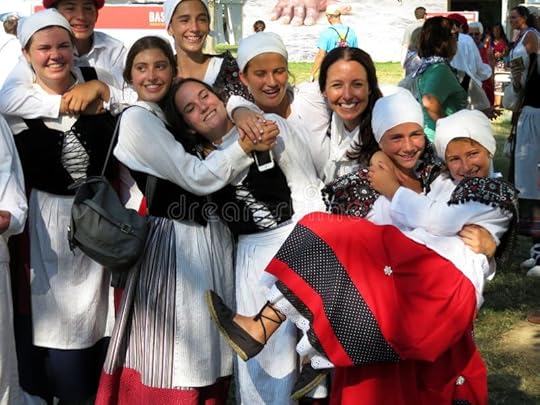
I suppose that if I had not read this book I would have remained blind, blind to the often outright paradoxical and thus utterly unique tendencies and tensions that belie the brusque but friendly people, the seemingly untouched but scarred landscape, and the intuitively leftist but actively conservative politics. Such blindness would have worsened the culture shock already not being helped by my understudied Spanish, this itself not being helped by my Basque postpunk band friends (who had randomly come upon me disoriented on my first night at a proto-pagan folk festival) insisting on the fact that it was not enough to learn only Spanish, that this in fact would be an offense: I must and would learn Basque. Kindly enough they also immediately offered to be the ones who would help me do so. Over the course of that night, and many since over this past month, I found myself caught in conversations that veered constantly between public lecture (not mine don't worry) and debate, on the history, culture, but most importantly: rights, of the Basques. Most gravitated around the heavier topics of ETA/GAL, the illiberalism of the social democrats post-Franco and missed opportunities during the reconstitution of Spanish democracy, each plea for autonomy somewhat vague in its precise demand (note: even the BNP (Basque nationalist party remains tactically obscure about its real positioning on further political autonomy) but none lacking in the excited conviction of my interlocutor. And although I can sympathize with my non-Basque Spanish friends that this attitude is more exclusionary than it is revolutionary, that the ancient laws (Fueros) defended and fought for with tooth and nail since proto-European history now largely serve to allow the Basques fiscal independence and thus no obligation to the welfare of less prosperous and rapidly degenerating areas of Spain, that claims of 'national' independence are made to demonstrate identity instead of express genuine desire (to which I liberally add that any nationalistic fervour is not only non-genuine but instead expresses false consciousness), I cannot deny the role of this element of general sentiment in creating what can genuinely be described as a community. In this sense Bilbao feels at once a village and a city. No excessive cultural funding and youth engagement programmes are required to motivate the young (and increasingly the once silenced under authoritarian structures elderly) to gather in the creation of their own festivals, their own cooperatives and social ventures. To celebrate and invest themselves in a language (and by extension its prose in literature/song). This Basque band I mentioned is, throughout the Summer and thankfully into the early Fall, invited to play at these local youth organised festivals 'txosnas' and will for 3 hours straight (often from 1-4AM) sing solely Basque songs.
There are many other examples I have of such, in the spirit of my thesis, 'extra-market communitarian ethics', but this is no journal entry nor philosophical case study (or is it) but a book review. Kurlanksy is both curious, sympathetic, and clearly a life-enjoyer. Besides his authorial talent, I believe these features make him an ideal ethnographer and thus author for this book. For as he recognised and clarified at the start of the book, this could be no simple historical survey, it would be lacking something non-reducible. Whilst historical narrative is usually situated within 'the world', Basque history is a history of a world unto itself. I discussed this with a Basque colleague at work: the minimal export of commodified Basque culture abroad and in turn the naturally endowed immunity of Basques towards Americanization and regression at home. We agreed (with my source being this not all too long historical survey, and hers being an entire lifetime richly filled with experience - but a la) that Basque culture proved too complex and contextually situated to be taken up popularly. No reference need be made here to a certain 'je ne sais qua' only to the epistemic privilege of a person exposed to the pre-indo-europea-lingual and politically paradoxical state of affairs folded between mist filled valleys circa the bay of Biscay.
An interesting historical formula is allowed to develop here the outcomes of which can be traced to the twin conditions of geography and existential political strife (or in its modern guise: international relations). Concerning the first, the Basques cannot be rid out of their valleys - many have tried - but an initial retreat into the mountains is only followed for the occupying force by years of economic attrition through sabotage from above. This has been the experience of the Celts, Carthaginians, and overly idealistic Napoleonic cavaliers that thought to pass across the border easily. Most recently of course the experience of advancing Francoist forces that took months, despite heralding the most advanced war-machine thus far created (the Italian and German horrors that darkened the 20th c. imaginary), to advance mere kilometres. This of course to the frustration of ample a fascist. Co-existence with an occupying force on the other hand is possible, though with many concessions on matters of legal and cultural authority and a promise of economic freedom. This has only been successfully achieved by the Romans and now the Spaniards (Then Castillians and Aragonese). But complete assimilation? The forgetting or gradual dilution of identity? No. What is possible is the reverse: the introduction of a foreigner into the privileged sphere of existence, it is why Kurlansky talks of the internationalist pride of the Basques - their flexibility in incorporating and instrumentally accommodating new trends/ markets upon a solid base of linguistic /cultural identity. This fact, and my practical experience of the excitement that is generated when a genuine interest is expressed, explains why Kurlansky as a curious life-enjoyer was able to write this book in the first place, and why in having read it and sharing his predisposition I might be able to at some point call this place 'etxe' (house and houses).