Juma is excited to go fishing with his grandfather, Babu Ali. But when they get to the beach, they find the sand covered in plastic pollution--flip-flops, plastic straws, toothbrushes, bottles, and shopping bags. One of the flip-flops floating in on a wave looks like a boat. That gives Juma and Babu Ali an idea.
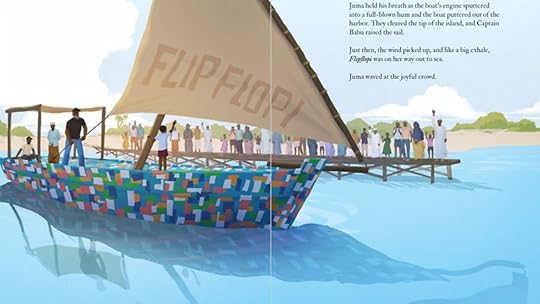
Based on the true story of the Kenyan dhow boat Flipflopi, this inspirational tale demonstrates how innovation, art, and determination can transform plastic pollution into something useful. In 2017, 30,000 flip-flops and other plastic waste items, all collected from the Kenyan coast, were melted, shaped, and carved into the dhow named Flipflopi. Weighing in at 7 tons, this boat is a testament to what can happen when awareness is turned into action.
Linda Ravin Lodding is the award-winning author of ten children’s picture books, including her latest, Babies Are Not Bears (Reycraft Books). Her stories brim with humor, heart, and curiosity—often inspired by the world around her.
Her debut picture book, The Busy Life of Ernestine Buckmeister (Flashlight Press), won the Comstock-Gág Read Aloud Book Award and was read aloud by Emmy Award–winning actress Connie Britton for the SAG-AFTRA Foundation’s Storyline Online. Its timeless message about the importance of play continues to resonate in classrooms and homes worldwide.
Linda’s other books include A Gift for Mama (a New York Times notable title), Painting Pepette, Hold That Thought, Milton!, The Queen Is Coming to Tea, Little Red Riding Sheep, Wakey, Wakey, Elephant!, When We Had to Leave Home, and Flipflopi: How a Boat Made from Flip-Flops Is Helping to Save the Ocean. Flipflopi has received both the prestigious Children’s Africana Book Award and the Skipping Stones Honor Award as a "timely and timeless resource in multicultural and global education."
A native New Yorker, Linda earned her BA in English from Barnard College, Columbia University, and an MBA from NYU’s Stern School of Business. She has since lived in Austria and the Netherlands and now calls Stockholm, Sweden home.
When she’s not writing, Linda works as Head of Communications for Global Child Forum—a foundation initiated by the Swedish Royal Family to advance children’s rights in the corporate sector. She’s also active in the writing community as founder of the Stockholm Children’s & Illustrator’s Network, faculty at the Stockholm Writers Festival, and a longtime member of SCBWI (Society of Children’s Book Writers & Illustrators).
Linda regularly offers school visits—both virtual and in-person—with a focus on international schools. Her sessions are engaging, curriculum-connected, and filled with laughter, behind-the-scenes stories, and practical tips for young storytellers.
To learn more, visit www.lindalodding.com, or follow her on Instagram (@lindaravinlodding_author) and Facebook.
There are three types of children's literature books: those that entertain, then there are books that serve to educate, and finally, from time to time, books appear that contain stories that manage to do both magnificently. Flipflopi, by Linda Ravin Lodding and Dipesh Pabari, is one of those books. This book is based on a true story, and while it is still a children's book, it has the ability to immerse the reader in the story through its illustrations and the use of a fairly easy narrative that helps make the reading effortless and engaging. It brings a captivating and powerful story about the plastic crisis in our world's oceans and the role that society's action and support play in solving this crisis.
The book tells the story of a group of children and adults who embark on an adventure. I say adventure because they want to build a dhow, a traditional boat used in the eastern part of the African continent. The challenge is to create this boat with a rather unusual material, using recycled plastic sandals and other waste found on the beach. This idea, which some may consider crazy but at the same time innovative, has become an environmental awareness movement, where a community unit is formed with the goal of showing that change is possible, a better, pollution-free world is possible.
This is the first book in this project, but when I reached the last pages of this book, I couldn't help but exclaim: "Wow!" Over the past few months, I've read several children's books, and it's true that many of them have surprised me, and I even liked many. But I'd dare say I've never read one like this one. Not because it's the best for me or because I think it's the best, but because I think this book is unique because of the message it conveys. In addition to the very moving story, one of the book's strong points is the illustrations, which made me feel as if the story came alive at times. It's a book that perfectly balances education with emotion, and that's not easy to achieve.
There are few criticisms I can make of this book, due to its excellent way of making the reader understand the importance of recycling and joint social action in solving the pollution crisis. Although, if I had something to improve, I would have liked to know what the direct consequences of pollution are for marine wildlife.
I have little experience recommending books of this type, but my feeling after reading Flipflopi is that it is a must-read for children, parents, and teachers alike. The book provides an exciting story for children, but it's also a way to inspire people who aren't so young and who don't recycle or aren't aware of the seriousness of this problem, it's never too late to start taking the right action. On a scale of 1 to 5, I give it a 4, as it combines an inspiring story with a crucial cause, but I hope to finish this project by reading books that I can rate 5 out of 5. If you're looking for a children's book that is both heartwarming and educational, Flipflopi is the perfect choice.
Earth Day is tomorrow and many of us are thinking about ways we can help keep our planet beautiful. One way is to stop using single-use plastics. This story is based on the true story of the boat, Flipflopi, an actual boat made from flip-flops and other plastic items that had washed ashore on a beach in Kenya. The story of Juma and his Babu (grandfather) walking to the beach and noticing numerous flip-flops that had washed ashore is told in this picture book with realistic illustrations along with a plea to do everything we can to keep plastic out of our oceans.
During a walk to the beach, while Juma is kicking a plastic water bottle, Juma notices what he thinks is different colored fish that have washed ashore. But, they are flip-flops and other various plastic items. As he begins to pick them up, he notices this is a job much bigger than what he can manage. Day after day, he and other friends return to the beach to find more plastic that has washed ashore. As the piles of plastic get bigger, Babu and Juma have an idea, to build a boat made from the melted plastic they have collected. Juma isn’t sure this will work, but as they sketch out a plan, Juma knows they will need more plastic. Unfortunately, they won’t have any trouble getting more plastic. The whole community rallies around to help gather the plastic and soon there is enough to melt down and construct the boat.
In September 2018, the real Flipflopi set sail from Kenya. Approximately 10 tons of plastic waste collected from the Kenyan shore was melted down and shaped and carved by the team. Over 30,000 flip-flops were used in the making of the boat. Since more plastic is being washed ashore, more boats are planned, including one that sails around the world to teach about plastic pollution.
The book includes a graphic about how the boat was made, actual photos of the boat and pollution in Kenya, and a page of ideas about how you can help including stopping the use of single-use plastic. If you’d like more information about this project visit their website, HERE.
This inspiring story will encourage your child to be more observant of their own plastic use and how to help your family reduce their contribution to the problem of pollution.
These pages awaken awareness for ocean pollution and inspire for action in a fun way.
Juma loves to head to the beach with his grandfather to go fishing, but the constant build-up of plastic trash is becoming a huge problem. When Juma sees a flip-flop floating on the water, he imagines it to be a boat and shares his thoughts with his grandfather. What Juma doesn't expect is that his grandfather, a boat maker, takes this as an inspiration to create a real boat from the trash on the beach.
The idea behind this book immediately had me curious to take a peek, and I'm so glad I did. The tale is written in an easy-to-tell fashion, making it a lovely read-aloud as well as something for steady readers to pick-up on their own. It's easy to get caught up in Juma's excitement and become curious as to where the entire idea of building a boat will go. It's interesting as well as informative to see how the boat comes together and detailed enough to learn along the way, but not so much so that it drags. There is also an illustration, which shows how the boat was constructed, at the end of the book. So, this one offers quite a few directions.
The main theme, of course, centers around the amount of plastic trash in the oceans. The illustrations bring this point home as the people on the island collect the needed amount of plastic from the beaches and place them in huge piles. There is more information at the end of the book, which briefly breaks down some facts surrounding this theme. While the pollution is addressed, it swings perfectly along with the tale, keeping any sign of preachiness away. Listeners will pause to think. Yet, the story stays centered on how Juma and his grandfather deal with the garbage and by doing so, inspire for action. This will awaken ideas in listeners and can act as an opportunity for them to do a similar project...so teachers and homeschoolers, be on the lookout for that!
I can recommend this one and find it a great way to address the topic, while doing so much more along the way. I received a DRC and found this to be well done.
Juma and his grandfather, Babu Ali, went fishing. But they discovered loads of flip-flops and other plastic waste when they arrived at the shore. Babu Ali sat in the shade with disappointment while Juma played with the trash, and he said the floating flip-flops resembled small boats. Then Juma suggested making flip-flop boats and racing them. Babu Ali laughed, but then he changed his mind. Hint - they are a family of master boatbuilders. What did he think? We chose this book based on its blurb. We enjoy books that discuss ways to protect the environment. The book tells the story of a young boy and his grandfather who start with a small idea, involve the community, and turn it into a meaningful movement for the region. The illustrations are stunning and help the story flow more smoothly.
Every significant change begins with one person, and Flipflopi by Linda Ravin Lodding and Dipesh Pabari, with stunning illustrations by Michael Machira Mwangi, tells one such heartwarming story that sowed the seeds of a plastic revolution in East Africa. Read the full review at Nothing But Picture Books
This book is pretty thrilling! Hear how some East Africans are making a big difference by organizing the removal of plastic waste from beaches, turning some of that waste into a traditional boat called a dhow and then sailing to less accessible communities to bring them into the plastics revolution - collecting beach plastic for other uses. The art is gorgeous, from a 27 year old self taught digital artist from Nairobi Kenya, Michael Machira Mwangi. The only drawback is that the Flipflopi project was conceived first by Ben Morison, a white Kenyan tour operator, while Linda Ravin Lodding writes as if it was the dhow builder with his (fictional?) grandson who came up with the idea. This does make the storytelling simpler and easier to follow for kids. This approach is why my library gives the book a fictional call number. It is still a joy to hear about African contributions to environmental action; I just wish it could have been a nonfiction book. More information at https://www.theflipflopi.com/our-story.
I love that the illustrator is Kenyan (OwnVoices) and a self-taught digital artist. It makes the pictures just a little different, a little more interesting than usual.
The only part I don't understand, even after reading the back matter, is the melting of the materials. How? And how much energy did that use? I'm sure the trade-off was worth it, but there is always trade-off.
I like the tips to reduce our own use of plastic. I save and reuse the spoons of my ice-cream cups and have always been given paper cups, but I can see the argument for using a cone and I admit that it never actually occurred to me. (I eat too slowly for a cone to work.)
A simple book, yes, but one that can't be downgraded because of that. I didn't know the story of how so much plastic rubbish was hitting certain shores of Kenya they were able to build a dhow out of it, so I count as one person educated by this little volume. Apparently tons of plastic was reformed for the structure of the boat, with its vividly coloured outer layer coming from thousands of pairs of flip-flops, while plastic bottles were repurposed to make the sails. All good news, except for the fact the world would be a better place if it were never possible, and so little plastic floated about the place nobody could think of sailing away on it. Still, this colourful and positive read focuses on an older man and his grandson to bring the boat-building struggle to life in our minds, and just the right touch of science afterwards to explain all the young reader needs to know about the issues at play here. A strong and welcome volume – four and a half stars.
Plastic pollution is a worldwide crisis. In this book, readers get to see how one African community came together, gathered the trash and plastic from their beaches, and turned that plastic into a real boat that's become a hopeful symbol of restoration, action, and what's possible when you tackle a problem together. This book does a beautiful job of sharing that journey with readers with simple, lyrical text and warm, colorful illustrations that bring this community and their accomplishment to life. The backmatter shares plans for an even larger boat project and how readers can help reduce pollution right now. A great selection for readers of all ages, including teachers, librarians, and families wondering what they can do to help reduce pollution.
This is an excellent read aloud for Earth Day or all year round. It is the story by Linda Ravin Lodding and Dipesh Padari about a Kenyan grandfather and grandson who organize the collection of plastic waste - mostly flip-flops and water bottles and repurpose/recycle them into a fishing boat called a dhow, which was aptly named “Flipflopi”. The story cites ingenuity and rallying to a cause that truly helps the environment as well as the local community. The artwork is colorful, bright, and almost sunny as it depicts the beachfront island setting beautifully. In addition the backmatter showcases illustrations of the actual building of the dhow as well as a photograph of the actual FlipFlopi, and details about the problem of ocean pollution.
I think this could be a perfect book to use on Earth Day or when talking about conservation/environmentalism with upper elementary or middle schoolers. It draws attention to plastic pollution but also shows a very innovative project that was developed to deal with some of that waste (in other words, had some hope mixed in rather than just bad news).
If you were to look at the front image, you could assume that plastic is just being hammered onto a wooden boat (which seems a little silly) but actually the whole thing is made from recycled/upcycled plastic, from its beams to its sail.
Brief summary: Juma walks with his grandfather to go fishing on the beach and is met with all sorts of plastic trash and thousands of flip-flops. The community comes together and gathers all of the endless plastic waste and melts it to make a dhow boat.
This is based a on a true story which is explained in the back pages along with sections: Ocean Pollution, How Dan You Help?, and Glossary.
My children and I found Flipflopi to be a fun, meaningful and interesting book.
The journey from trash to boat was interesting, my kids got a huge kick out of seeing if the boat would actually float. The added information about Flipflopi was amazing; after reading the story we checked out the website and watched some Youtube videos.
I rather liked that the story focused on pollution, with added tips at the end on ways to reduce said pollution by eliminating single-use plastics. I would have liked more details on how they melted down the plastics and the boat was actually crafted, and the impact it maybe had on air pollution.
The illustrations are colorful and help drive home the impact of pollution/trash on our lands and in the waters. The artist did a fantastic job capturing the characters facial expressions throughout the story.
A perfect Earth Day read aloud. This picture book based on true events brings to life both the problem of plastic in the ocean as well as showing people who found a creative way to reuse that plastic. This story of the people of Lamu, Kenya deserves a wide audience. A picture book for ages 6 and up.
This is an excellent book to use in science over many of the primary and even junior grades. Connections to environmental stewardship, recycling, design process, and how they are applied in the real world. Classes enjoy the book and then enjoy further exploring the project through research. I’ve used it with grades k-5 and students are always highly engaged.
The amount of plastic pollution in this world is disheartening. When flip flops wash up on an African beach, the characters in this book are determined to put them to use. I hope this book inspires future scientists as well as average citizens to be more mindful about what we throw away and how we can re-use things.
Based on the true story of Flipflopi, a boat launched in 2018 made entirely of plastic. A most interesting book about a very important subject - plastic.
An inspirational book about a small community in Kenya who made an actual sail boat from plastic they had gleaned off its beaches and the ocean off their coast. They used over 30,000 flip-flops for the skin of the boat.
The story is definitely written for younger children, grades K-3, and my grandson and I chatted about we could reduce our plastic usage.
If I had an elementary library, I'd add this book to my collection, for sure.
A young boy upset by pollution in Kenya notices many flop-flops littering the coast. "If flip-flops float, can we turn them into boats?" he wonders. And thus begins a true story of environmental sustainability, community, and the ability to make a difference.