

What do you think?

Stigmate
Tra dolore e grazia, nella città che non vede e non sente, la storia di un uomo che vive al margine di tutto, riceve le stigmate e non sa perché, in un'atmosfera da Leggenda del santo bevitore. Un atto di amore, quasi un mistero medievale su salvezza individuale e indifferenza del mondo, nato dall'incontro tra uno degli scrittori piú amati (e riservati) della sua generazione e un illustratore-poeta italiano famoso nel mondo.
186 pages, Paperback
First published June 10, 1998
About the author
Lorenzo Mattotti
114 books92 followersLorenzo Mattotti is an Italian comics and graphic artist living in Paris. A frequent contributor of covers for The New Yorker, he's recognized as one of the most outstanding international exponents of comics art. Mattotti won an Eisner Award for his graphic novel Dr. Jekyll & Mr. Hyde. He collaborated with Lou Reed in re-imaging Edgar Allan Poe's The Raven.
Ratings & Reviews
Friends & Following
Create a free account to discover what your friends think of this book!
Community Reviews
Displaying 1 - 30 of 72 reviews

June 19, 2023
GLI SGUARDI CATTIVI DELLA GENTE
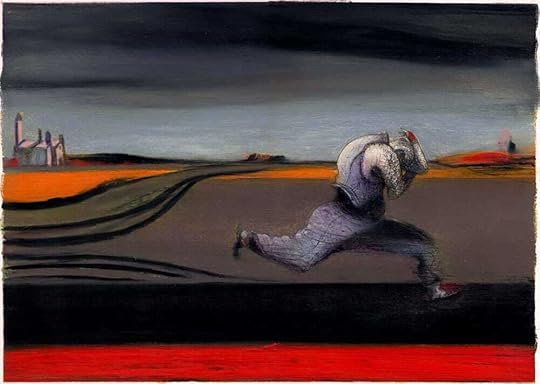
Da un lato c’è la poesia eterea di un segno grafico sottile e filiforme, che basta un nulla perché si spezzi al vento, per poi fluttuare nell’aria. Dall’altro, un tratto fuligginoso e vorticoso che ci trascina in un buco nero, anzi nel nero tout-court.
Così qualcuno definisce i disegni di Lorenzo Mattotti.
Il protagonista è un omone senza nome, grosso e brutto: ma è presto chiaro che è gentile come un bambino in un corpo esagerato.
Lavora come cameriere in un baraccio. Ma una mattina si risveglia con i palmi delle mani che sanguinano: come si è ferito? E perché il sangue non si ferma e continua a sgorgare?
Stigmate. In un corpaccio che non ne sembra proprio degno, che non saprà che farsene. Una maledizione?
I clienti si lamentano perché sporca i bicchieri, lascia macchie di sangue. Il padrone della bettola lo licenzia senza pietà.
Ma i poveri, gli emarginati vicini di casa, invece, lo accolgono come un santo che sa guarire i malati. Gli riempiono casa di candele votive fino a mandarla a fuoco.
L’uomo fugge, vive come un animale braccato. Approda tra giostrai, e forse l’ambiente del circo gli si confà. Incontra un’altra anima, se non gemella almeno simile, e trova l’amore.
Ma la felicità non è destinata a durare, è fuggevole come nella sua stessa essenza.
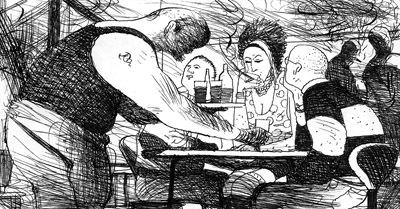
Un mondo abitato da reietti, marginali ed emarginati, senza dimora. Un mondo senza comprensione, senza tolleranza, senza civiltà. Il nostro mondo che vive attraverso questa fiaba nera dagli echi medievali, questo romanzo a fumetti che urla Pasolini.
Una riflessione sul mistero della santità, e sul mistero tout court.
Il corpo sanguina, il corpo soffre, ed è chiaro che a sanguinare e soffrire è prima di tutto l’anima.
Mattotti usa spesso immagini ovoidali, dai volti, a cominciare da quello del protagonista, ai buchi neri che dissemina: nelle figure a uovo si riconosce il grembo, il bambino ritorna, la gestazione, il feto, la nascita.
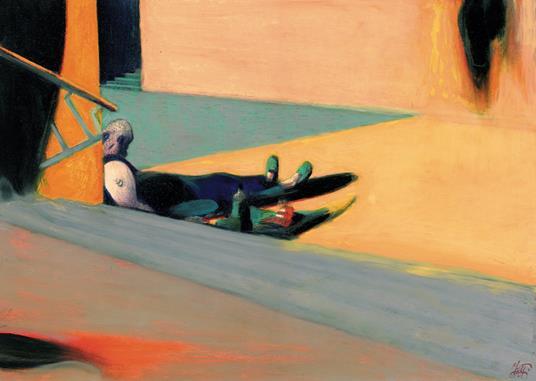
Mattotti mi piace sempre molto, perfino da prima di leggere (guardare?) il suo Fuochi.
Ma non credo sarei approdato a questo Stigmate se non fosse per la serie SKY che da questa graphic è liberamente tratta.
Molto liberamente.
Rimane che Christian, il protagonista che intitola la serie, ha un corpaccione (l’ottimo Edoardo Pesce) ed è un calimero, un anatroccolo nero. Rimane che la storia è ambientata in un piccolo mondo periferico, abitato da poveracci, da reietti.
Le analogie e i debiti non vanno molto oltre. La prima stagione, davvero potente, produzione al livello delle migliori internazionali, mi ha fatto ben sperare per il seguito.
Invece la seconda stagione, pur se sempre ottimamente prodotta diretta e recitata, diventa un guazzabuglio di angeli e demoni che si scambiano di ruolo. Ma il diavolo vestito di nero con occhiali da sole interpretato da Laura Morante è dotato di gran senso estetico: abita alla vecchia città di Monterano, luogo meraviglioso carico di fascino. Ma forse ho confuso, e quello è l’angelo?
Sono arrivato alla fine con una certa qual stanchezza e davvero poco interesse, se non per l’aspetto produttivo, non certo quello narrativo.

Da un lato c’è la poesia eterea di un segno grafico sottile e filiforme, che basta un nulla perché si spezzi al vento, per poi fluttuare nell’aria. Dall’altro, un tratto fuligginoso e vorticoso che ci trascina in un buco nero, anzi nel nero tout-court.
Così qualcuno definisce i disegni di Lorenzo Mattotti.
Il protagonista è un omone senza nome, grosso e brutto: ma è presto chiaro che è gentile come un bambino in un corpo esagerato.
Lavora come cameriere in un baraccio. Ma una mattina si risveglia con i palmi delle mani che sanguinano: come si è ferito? E perché il sangue non si ferma e continua a sgorgare?
Stigmate. In un corpaccio che non ne sembra proprio degno, che non saprà che farsene. Una maledizione?
I clienti si lamentano perché sporca i bicchieri, lascia macchie di sangue. Il padrone della bettola lo licenzia senza pietà.
Ma i poveri, gli emarginati vicini di casa, invece, lo accolgono come un santo che sa guarire i malati. Gli riempiono casa di candele votive fino a mandarla a fuoco.
L’uomo fugge, vive come un animale braccato. Approda tra giostrai, e forse l’ambiente del circo gli si confà. Incontra un’altra anima, se non gemella almeno simile, e trova l’amore.
Ma la felicità non è destinata a durare, è fuggevole come nella sua stessa essenza.
Un mondo abitato da reietti, marginali ed emarginati, senza dimora. Un mondo senza comprensione, senza tolleranza, senza civiltà. Il nostro mondo che vive attraverso questa fiaba nera dagli echi medievali, questo romanzo a fumetti che urla Pasolini.
Una riflessione sul mistero della santità, e sul mistero tout court.
Il corpo sanguina, il corpo soffre, ed è chiaro che a sanguinare e soffrire è prima di tutto l’anima.
Mattotti usa spesso immagini ovoidali, dai volti, a cominciare da quello del protagonista, ai buchi neri che dissemina: nelle figure a uovo si riconosce il grembo, il bambino ritorna, la gestazione, il feto, la nascita.
Mattotti mi piace sempre molto, perfino da prima di leggere (guardare?) il suo Fuochi.
Ma non credo sarei approdato a questo Stigmate se non fosse per la serie SKY che da questa graphic è liberamente tratta.
Molto liberamente.
Rimane che Christian, il protagonista che intitola la serie, ha un corpaccione (l’ottimo Edoardo Pesce) ed è un calimero, un anatroccolo nero. Rimane che la storia è ambientata in un piccolo mondo periferico, abitato da poveracci, da reietti.
Le analogie e i debiti non vanno molto oltre. La prima stagione, davvero potente, produzione al livello delle migliori internazionali, mi ha fatto ben sperare per il seguito.
Invece la seconda stagione, pur se sempre ottimamente prodotta diretta e recitata, diventa un guazzabuglio di angeli e demoni che si scambiano di ruolo. Ma il diavolo vestito di nero con occhiali da sole interpretato da Laura Morante è dotato di gran senso estetico: abita alla vecchia città di Monterano, luogo meraviglioso carico di fascino. Ma forse ho confuso, e quello è l’angelo?
Sono arrivato alla fine con una certa qual stanchezza e davvero poco interesse, se non per l’aspetto produttivo, non certo quello narrativo.

July 3, 2024
This is one of those hidden gems I stumbled upon in an online auction, and I'm so glad I did.
Mattotti's art is raw and savage, just the way I like it. I'm eager to see more from this talented artist.
But it's not just the art that stands out. Piersanti's writing is superb, and together with Mattotti's visuals, they create a compelling story of a man who has gone to hell and back.
The protagonist is a man with two open wounds on his hands that never heal, reminiscent of the holy wounds suffered by Jesus on the cross. Because of this, some people see him as a saint, but he despises the attention and just wants to be left alone. While he seems to bring good fortune to those he touches, only bad luck follows him.
This is a really good story with great art, though the style may not be for everyone.
Mattotti's art is raw and savage, just the way I like it. I'm eager to see more from this talented artist.
But it's not just the art that stands out. Piersanti's writing is superb, and together with Mattotti's visuals, they create a compelling story of a man who has gone to hell and back.
The protagonist is a man with two open wounds on his hands that never heal, reminiscent of the holy wounds suffered by Jesus on the cross. Because of this, some people see him as a saint, but he despises the attention and just wants to be left alone. While he seems to bring good fortune to those he touches, only bad luck follows him.
This is a really good story with great art, though the style may not be for everyone.

June 23, 2018
I wish I were more impressed by this - I would like to be, but somehow I can't stop myself from asking questions.
A drunkard has a weird dream and wakes up with stigmata on his hands. He bleeds and he goes to the hospital, where doctors see his wounds don't close, but consider them self-inflicted. The people around his home see him as some sort of saint and nearly worship him, but he refuses to consider himself such and continues to drink his life away. At this point in the book, I thought the idea was interesting and not without depth. What follows was underwhelming, though.
Then his house burns down and he goes off to look for his one remaining family member, his uncle who works in a traveling fair. When he gets there, he finds out the uncle is in jail, but he meets a lovely woman, Lorena, falls in love, and marries her. His stigmata start going away.
Anyway, he goes from tragedy to tragedy (Lorena dies in a flood), and he ends up in a madhouse where nuns are in charge. He spends some time in silence, catatonic, before coming back to life and helping around.
I guess you can say he develops as a character, but some things are never quite resolved:
- why does he get the stigmata in the first place?
- if they're there as a fluke, and their purpose is to change him, why do they go away for a while?
- if they go away for a while because he doesn't act like a holy man at all, why were they there in the first place?
- why is he followed around by tragedy?
- if that tragedy is there to try him, why does Lorena have to die? (in other words, why is God such a little shit?)
- if his stigmata really are weird even by medical standards, why do doctors send him away anyway?
Add to this the fact that the whole thing seemed a bit sketchy and underdeveloped, and I'm just... meh.
A drunkard has a weird dream and wakes up with stigmata on his hands. He bleeds and he goes to the hospital, where doctors see his wounds don't close, but consider them self-inflicted. The people around his home see him as some sort of saint and nearly worship him, but he refuses to consider himself such and continues to drink his life away. At this point in the book, I thought the idea was interesting and not without depth. What follows was underwhelming, though.
Then his house burns down and he goes off to look for his one remaining family member, his uncle who works in a traveling fair. When he gets there, he finds out the uncle is in jail, but he meets a lovely woman, Lorena, falls in love, and marries her. His stigmata start going away.
Anyway, he goes from tragedy to tragedy (Lorena dies in a flood), and he ends up in a madhouse where nuns are in charge. He spends some time in silence, catatonic, before coming back to life and helping around.
I guess you can say he develops as a character, but some things are never quite resolved:
- why does he get the stigmata in the first place?
- if they're there as a fluke, and their purpose is to change him, why do they go away for a while?
- if they go away for a while because he doesn't act like a holy man at all, why were they there in the first place?
- why is he followed around by tragedy?
- if that tragedy is there to try him, why does Lorena have to die? (in other words, why is God such a little shit?)
- if his stigmata really are weird even by medical standards, why do doctors send him away anyway?
Add to this the fact that the whole thing seemed a bit sketchy and underdeveloped, and I'm just... meh.

July 18, 2017
Я должна срочно прочесть что-то тупое про розовых пони(

July 21, 2013
Outstanding in every way. Mature, demanding- the point where comics truly becomes literature. Mattotti's art is a revelation- I know him mostly through his somewhat lurid pastels but this violent sweeping swirling expressionistic pencil work was astonishing. The story is beautifully written (and well translated). I respect the decision to leave unresolved the reasons for the stigmata and his own implied holiness. This is a comic I would happily recommend to someone who liked challenging art.

May 14, 2014
більше експресивною графікою, ніж словами, маттоті з п'єрсанті розповідають історію про людину, з якою стався бог. бог пробився крізь тіло стигматами, як нагадування про неможливе, як чудо, про яке ніхто не просив, як прокляття, – і тепер його доводиться всюди носити з собою, навіть якщо в нього не віриш. навіть якщо йому нема місця там, куди йдеш, – а довкола якось усе так, що ну ніяк не вмістити туди ще й оцього недоречного, невчасного бога.
може, це така притча про все хороше, що буває з людьми.
може, це така притча про все хороше, що буває з людьми.

January 7, 2018
A história é intensa e densa e tal e qual são os desenhos. Para quem gostar verdadeiramente de banda desenhada será uma leitura muito interessante, se se conseguir identificar com os temas que a obra aborda. Para mim foram difíceis de entender. Só me senti desconfortável ao longo de todo o livro, mas mesmo isso permite-me reconhecer algum valor na narrativa. Achei feio. A verdade é que não fala de coisas bonitas. Chega a ser espiritual e, mesmo não tendo gostado muito, conseguiu transmitir-me um tom especial, diferente, o que estabelece umas sólidas três estrelas.

July 5, 2018
Unde se termină credința și unde începe fanatismul? Niciun dumnezeu nu te poate scăpa de ,,răul ce zace între tâmple''. Un roman ca o revelație. De citit după ce terminați Biblia.
,,Nu reacționează la prezența altora. Pentru că nu așteaptă nimic de la nimeni.''
,,Suferim și sperăm în vindecare... dar nu de răul fizic trebuie să ne vindecăm, ci de asprimea inimii, de necredință.''
,,Nu reacționează la prezența altora. Pentru că nu așteaptă nimic de la nimeni.''
,,Suferim și sperăm în vindecare... dar nu de răul fizic trebuie să ne vindecăm, ci de asprimea inimii, de necredință.''

March 2, 2011
Phew! This one really hits you right in the face, and I mean that in the best way possible. The main character wakes up one day to find his hands bleeding and no matter what he does he can't make the wounds heal. The blood causes him to get into a fist-fight with the owner of the bar he works at, leaving the poor dude to wander homeless for a time. He stumbles across a travelling circus and joins up, first as a handyman and then as one of the attractions. His past catches up to him, though, in the form of his former boss. Although the main character is a bit of jerk through a lot of the book, it's hard not too feel sympathetic for him with everything he has to endure. Although the themes of redemption and struggling to come to terms with who and what you really are tie in quite heavily into Christianity I really appreciate how much Mattotti toned down the religious aspects of the story. That choice very smartly opens this book up to a lot of readers who might not otherwise pick this up.
The artwork is what really makes it---crazy, heavy lines swirl around these pages, carrying you through each trial the "hero" has to face. You really feel like this is a story of someone under great torment, and those feelings are largely communicated by the art. Absolutely fantastic and probably the most emotive book I've read so far this year. A great addition to any adult collection.
The artwork is what really makes it---crazy, heavy lines swirl around these pages, carrying you through each trial the "hero" has to face. You really feel like this is a story of someone under great torment, and those feelings are largely communicated by the art. Absolutely fantastic and probably the most emotive book I've read so far this year. A great addition to any adult collection.

July 10, 2012
Mattotti and Piersanti start with a strange but holy premise -- what if a ne'er-do-well drunk and thug suddenly found himself afflicted with stigmata on his hands? What would happen? Now add art that blends the scratchy style of Eddie Campbell with the rounded faces of Peter Bagge. Our protagonist goes through a spiritual journey from denial to cynicism to madness to acceptance to peace. The book doesn't try to answer any big questions, and it doesn't preach. It doesn't explain, and offers only the smallest bits of magic. That said, it didn't wow me either -- the writing isn't really compelling, and the scratchy art doesn't stand out--except that the scratchy style and the choice to stay black and white means the blood from the wounds seems to be on everything, staining the world around the main character. Worth reading, but probably not buying.
July 16, 2013
I'm a big fan of Lorenzo Mattotti. His line quality has a way of driving the narrative forward like a freight train or diminishing the scene to a slow pulse. This ability to command the timing of the sequence is the skill I most admire in a comic artist.

February 3, 2019
Tale of a sort of redemption; pretty christian, pretty dark. I mostly like this book for the art, which really spoke to me. I would call the art "expressionistic pen drawing", but I'm sure there's a better term for the style.

November 18, 2013
Brilliant artwork, the whole concept too, but marred by mediocre writing.
April 5, 2026
De los mejores comics que he leído y quizás el mejor de Mattoti. Sin color, puro cara a cara del blanco y el negro. Una lluvia de trazos en el mayor y más aséptico alarde expresivo del autor en una historia tan original y hermosa que es imposible no leérselo del tirón.

May 1, 2016
This is a fantastic book. While it does not play with big concepts, which is how I usually like my novels, the novel's strength lies in the complexity of its visual style that teases out implications with a force that the base storyline does not. There is a sense of violence, madness, and urgency conveyed through the linework, which perfectly illustrate the protagonist's anger and frustration as his life spirals out of controls. Catholic beliefs structure the story, and to a great extent this is a religious tale of redemption. Paul Gravett opines in the back cover that this is a "modern morality play." This is however not an Everyman story, for the characters, events and happenings here are truly extraordinary. The protagonist is not a deeply flawed character. Nor does he check the boxes for all seven deadly sins, mainly lust, gluttony, and wrath, and to a certain extent greed, and mild instances of all. His "big" flaws are that he does not believe in religion, and that he is an alcoholic and drug addict. In terms of narrative, that is the principal weakness of the book, because the protagonist's descent into madness are brought on by the "stigmata" which are a burden and a curse, neither wanted nor accepted. That said, the artwork is the source of the extraordinary in this book. For instance, when Mattotti illustrates Biblical passages near the end of the book, one is transported to an astounding dreamlike landscape of vision. A lot here is left unsaid except through the art, because a lot here is to be felt.
Graphic violence alert.
Graphic violence alert.

September 12, 2017
Pe mine m-a revoltat destul de mult și cred că dacă aș fi citit-o cu gânduri mai apropiate de divinitate, pașnice adică, aș fi tras alte concluzii. Așa însă, tot ce a făcut romanul Stigmata a fost să-mi alimenteze o ură (justificată, trebuie să mă credeți) față de religie și sacul opac pe care aceasta îl trage pe capul fiecărui adept dispus să-și încredințeze viața, moartea și speranțele în mâinile cuiva care locuiește, se zice, în norii pufoși de deasupra noastră. Și care ne face bine, teoretic, după ce ne face mult rău. Că întâi trebuie să se asigure că avem o existență maronie, abia apoi urmând să se decidă dacă, după ce murim, ne lasă-n lacurile lui din Rai, cele cu lapte și miere.
Personajul principal din Stigmata este un bărbat cu o existență banală – sărăcie, tristețe și tot „tacâmul” de nefericiri -, așa cum sunt mulți alții pe lumea asta. Dar drama începe abia după ce acesta se trezește cu „semnele divinității” pe mâini, niște răni în palme – așa cum se spune că a avut Iisus în urma crucificării.
Citește continuarea aici: Hyperliteratura.ro/Stigmata-roman-gra...
Personajul principal din Stigmata este un bărbat cu o existență banală – sărăcie, tristețe și tot „tacâmul” de nefericiri -, așa cum sunt mulți alții pe lumea asta. Dar drama începe abia după ce acesta se trezește cu „semnele divinității” pe mâini, niște răni în palme – așa cum se spune că a avut Iisus în urma crucificării.
Citește continuarea aici: Hyperliteratura.ro/Stigmata-roman-gra...

May 18, 2015
Great stuff, mais avec un bémol. The art, made up of "dark squiggly lines" might not be for everyone, but I do like it. It successfully conveys all the depression, somber moods and rainy days of this story but is also effective to portray light, innocent wonder.
But I can't shrug off the deja vu. A lot about the story, and everything about the art of Stigmata (late 2010), is SO similar to Manu Larcenet's 2009 Grasse carcasse that it borders of plagiarism. Of course, the plot is different but even the main characters are similar in a way (fat, self-hating, substance abusing middle-aged men).
Despite the annoying similarities with "Grasse Carcasse", I still hugely enjoyed this sad story of an incomplete redemption. 4 stars.
But I can't shrug off the deja vu. A lot about the story, and everything about the art of Stigmata (late 2010), is SO similar to Manu Larcenet's 2009 Grasse carcasse that it borders of plagiarism. Of course, the plot is different but even the main characters are similar in a way (fat, self-hating, substance abusing middle-aged men).
Despite the annoying similarities with "Grasse Carcasse", I still hugely enjoyed this sad story of an incomplete redemption. 4 stars.

April 29, 2012
Dark and gritty yet beautiful morality play. In scratchy black and white that goes beyond cross-hatch or typical renderings, this is gorgeous and deep drawings that perfectly match the writing.
In fact it really felt like it was done by one person.
Refreshing and original though it is also quite classic,
the art was almost too exciting for me to read slowly.
In fact it really felt like it was done by one person.
Refreshing and original though it is also quite classic,
the art was almost too exciting for me to read slowly.

Read
December 27, 2011The art, and the story itself combine ugliness and beauty in equal measure in every line. Shocking brutality and madness wrapped up in a christian parable, one where, just as with jesus, salvation is as painful as damnation, and one where happiness and redemption don't necessarily go together.

January 2, 2012
Powerfully emotional graphic novel. Loose, free illustrative style is deeply personal. Utilizes the graphic medium to its full capacity - well paced, silent frames. The content is dark and moody, but the finale brings a sense of hope, that hardships are necessary to reveal ones true self.

June 26, 2017
An Italian man with mysterious stigmata tries to find his place in the world; it doesn't really work. The hectic illustration really meshes well with this painful story.
June 13, 2018
i'm not religious, but i am still pretty touched.

March 10, 2023
Review : Met hun graphic novel Stigmata hebben Lorenzo Mattotti en Claudio Piersanti getoond hoe knap illustratie en beeld te combineren zijn. Kunst en tekst. Het boek opent met een abstracte reeks panelen van een dromerige spirituele aanroeping van een woedende behaarde man zwevend door de ether. Een kinderlijke, cloud-achtige wezen verzekert hem dat "binnenkort het (zijn) lijden zal voorbij zijn.". Vanaf de wolk zien we de potige man op zijn bed zien zitten, de voeten stevig op de vloer, zijn armen zijn gestrekt over de lengte van zijn matras, beide handen eindigen in een wervelwind van inktzwarte duisternis: Het is met een bijna Dostojewskiaanse duidelijkheid dat de getroffen man zijn stigmata begrijpt. Zijn lot was bepaald en hij moet beslissen of hij zich wil aanpassen aan zijn wonden of hen wil overwinnen.
De man probeert om zijn leven te hervatten alsof er niets met hem gebeurd was. Hij leidde niet zo een heel boeiend leven. Hij werkte in een bar, en buiten af en toe wat losse seks kende hij bitter weinig menselijke interactie. Zijn stigmata verandert drastisch deze levensstijl. 's Nachts, wanneer de man thuis komt, vindt hij zijn deuropening versierd met brandende kaarsen en religieuze iconografie. Hij verliest zijn werk en zijn huis brandt af door een omgevallen kaars. In het daklozenhuis doet hij zich voor als een wonderbaarlijk genezer. En zo kan hij wat geld vergaren. Maar dan blijkt dat hij werkelijk over helende gaven beschikt. Deze graphic novel is werkelijk imponerend, er gaat somberheid maar ook kracht van uit.
De man probeert om zijn leven te hervatten alsof er niets met hem gebeurd was. Hij leidde niet zo een heel boeiend leven. Hij werkte in een bar, en buiten af en toe wat losse seks kende hij bitter weinig menselijke interactie. Zijn stigmata verandert drastisch deze levensstijl. 's Nachts, wanneer de man thuis komt, vindt hij zijn deuropening versierd met brandende kaarsen en religieuze iconografie. Hij verliest zijn werk en zijn huis brandt af door een omgevallen kaars. In het daklozenhuis doet hij zich voor als een wonderbaarlijk genezer. En zo kan hij wat geld vergaren. Maar dan blijkt dat hij werkelijk over helende gaven beschikt. Deze graphic novel is werkelijk imponerend, er gaat somberheid maar ook kracht van uit.

October 7, 2024
L'histoire écrite par Piersanti est celle d'un homme solitaire et alcoolique qui un jour commence à présenter des stigmates sanglants dans les mains. L'apparition des stigmates provoque sa marginalisation de la société. Il se fait une place parmi des forains mais les drames s'enchaînent et le poursuivent. Je ne raconte pas davantage car je n'ai pas envie de spoiler le récit d'une histoire pour qui la tension est très importante et qui d'ailleurs se lit très rapidement.
Le dessin de Mattotti est très différent de son style très coloré et très soigné habituel. Au contraire, c'est une BD en noir et blanc avec beaucoup de gros traits et de ratures. C'est un dessin moche mais très expressif, qui colle parfaitement avec la laideur de ce qui est raconté. C'est un peu comme si on avait illustré un cauchemar, tout est sombre et brouillon.
L'histoire est trépidante, poignante, très dure, violente, avec des passages franchement horribles sur la méchanceté et la cruauté humaines. Pourtant, on y trouve aussi une espèce de douceur dans le regard qui est porté sur le personnage principal. Son destin tragique (car on dirait bien qu'il s'agit d'un destin où le personnage subit plus qu'il ne le choisit) ressemble à une série d'épreuves qui portent en elles une espérance pour l'avenir, non pas en termes de "il fut heureux et eut plein d'enfants" mais plutôt en termes d'apprentissage stoïque.
J'ai vraiment beaucoup aimé ce livre, je pense que je vais m'en souvenir pendant longtemps.
C'est un livre exceptionnel, mais je lui donne 4 étoiles au lieu de 5 car ce n'est pas quelque chose que je conseillerais à tout le monde : il lui faut un public avisé.
Le dessin de Mattotti est très différent de son style très coloré et très soigné habituel. Au contraire, c'est une BD en noir et blanc avec beaucoup de gros traits et de ratures. C'est un dessin moche mais très expressif, qui colle parfaitement avec la laideur de ce qui est raconté. C'est un peu comme si on avait illustré un cauchemar, tout est sombre et brouillon.
L'histoire est trépidante, poignante, très dure, violente, avec des passages franchement horribles sur la méchanceté et la cruauté humaines. Pourtant, on y trouve aussi une espèce de douceur dans le regard qui est porté sur le personnage principal. Son destin tragique (car on dirait bien qu'il s'agit d'un destin où le personnage subit plus qu'il ne le choisit) ressemble à une série d'épreuves qui portent en elles une espérance pour l'avenir, non pas en termes de "il fut heureux et eut plein d'enfants" mais plutôt en termes d'apprentissage stoïque.
J'ai vraiment beaucoup aimé ce livre, je pense que je vais m'en souvenir pendant longtemps.
C'est un livre exceptionnel, mais je lui donne 4 étoiles au lieu de 5 car ce n'est pas quelque chose que je conseillerais à tout le monde : il lui faut un public avisé.

January 14, 2022
Покупала этот комикс в первую очередь из-за рисовки Лоренцо Маттотти, обожаю его видение мира и самовыражение. Однако и сама история заинтересовала. С первых же страниц мы видим главного героя - алкоголика, разлагающуюся личность, находящегося на самых низких социальных ступенях. И вот у этого человека неожиданно появляются метки святых - стигматы.
Интересно наблюдать за реакцией окружающих, как это явление меняет жизнь героя и его самоощущение. Безусловно я не стану пересказывать комикс, чтоб не было спойлеров. Сама идея мне понравилась - в каком бы ужасном состоянии не была твоя жизнь все можно исправить и изменится, в конце всегда будет свет.
К иллюстрациям у меня нет претензий совсем - они идеальны. Сперва я расстроилась что комикс черно-белый, а потом подумала что это даже к лучшему. Они создают атмосферу, нагнетают напряжение и подчеркивают эмоциональный фон. Иллюстрации Маттотти это смесь экспрессионизма и безумия, а вот эти черно-белые рисовки, словно черновики альбома по рисованию какого-то безумца. В общем, мне нравится.
А вот сам текст понравился гораздо меньше. Возможно дело в переводчике, создается ощущение что он не очень старался. Плюс сам текст между частями книги не сильно связан, он рваный и скомканный. Насколько я смогла понять текст это адаптированные записки каких-то священно служителей, их стихов и молитв. Возможно рваность связана с этим.
Комикс депрессивный, есть жестокие сцены, но все это вместе выглядит органично.
Интересно наблюдать за реакцией окружающих, как это явление меняет жизнь героя и его самоощущение. Безусловно я не стану пересказывать комикс, чтоб не было спойлеров. Сама идея мне понравилась - в каком бы ужасном состоянии не была твоя жизнь все можно исправить и изменится, в конце всегда будет свет.
К иллюстрациям у меня нет претензий совсем - они идеальны. Сперва я расстроилась что комикс черно-белый, а потом подумала что это даже к лучшему. Они создают атмосферу, нагнетают напряжение и подчеркивают эмоциональный фон. Иллюстрации Маттотти это смесь экспрессионизма и безумия, а вот эти черно-белые рисовки, словно черновики альбома по рисованию какого-то безумца. В общем, мне нравится.
А вот сам текст понравился гораздо меньше. Возможно дело в переводчике, создается ощущение что он не очень старался. Плюс сам текст между частями книги не сильно связан, он рваный и скомканный. Насколько я смогла понять текст это адаптированные записки каких-то священно служителей, их стихов и молитв. Возможно рваность связана с этим.
Комикс депрессивный, есть жестокие сцены, но все это вместе выглядит органично.

December 18, 2022
Maybe I didn't totally get it, but I know I didn't like it. I did not like the art style, which seemed to be going intentionally for a gritty, difficult-to-decipher look and just ended up looking like scribbles of dirty old men. I don't think I totally understood the plot, but I didn't like what I did understand. And I definitely did not like how the male writers used the *very* graphic and violent SA of a woman to get pity of the male main character and how much worse it made *his* life. It had a "wow things were going so good for him and now his luck has turned" vibe. Including graphic SA in a book only to illustrate the hardships it has on a partner (oh I'm so sorry, your wife became very religious? she wears thick pajamas to bed? poor baby) and giving ZERO agency or thought to the woman is disgusting. This will be an unhaul for me. Now if only I could erase the r@pe doodles from my brain...

February 1, 2025
Il pensiero di questo fumetto è molto originale: un tizio ordinario, all’improvviso, si sveglia con stigmate sulle mani. È pure capabile di guarire qualcuno, ma non si vuole fare adorare; alla fine, stigmate sono ferite sanguinante, è soltanto fa schifo ovunque. È per quello que fugge e finisce con una troupe itinerante in un luna park.
Non sembra così interesante, e infatti, non ne è. Dopo la premessa iniziale, il protagonista sembra un po’ perduto nella storia, come un girovago che è prima qui, dopo là, senza arrivare a nulla.
L’aspetto grafico è molto originale, con linee facendo tutte le forme, senza colore, soltanto linee. Ma, eccetto con un capítulo al finale dove una orazione si mischia con una storia tutta originale, non sembrano una buone coppia. Una piccola delusione, quindi. Ma comunque un buon fumetto, molto originale.
Non sembra così interesante, e infatti, non ne è. Dopo la premessa iniziale, il protagonista sembra un po’ perduto nella storia, come un girovago che è prima qui, dopo là, senza arrivare a nulla.
L’aspetto grafico è molto originale, con linee facendo tutte le forme, senza colore, soltanto linee. Ma, eccetto con un capítulo al finale dove una orazione si mischia con una storia tutta originale, non sembrano una buone coppia. Una piccola delusione, quindi. Ma comunque un buon fumetto, molto originale.
February 25, 2021
the stages of grief, or the process of healing from depression, masterfully drawn in a dynamic and expressionistic style.
i liked how, in the end, he never really healed, but learned to live with his wounds.
i liked how, in the end, he never really healed, but learned to live with his wounds.

August 8, 2018
Mattotti é f o d a

September 11, 2018
Un Mattotti in stato di grazia per una storia sofferta e bellissima.
Displaying 1 - 30 of 72 reviews