Excellent and comprehensive book of Russia from before they were Russians – when they were non-Slavic people in an area that only became Russia in the nineteenth century. Raisanovsky covers a eight and one-half million square mile portion of the world over centuries. This book outlines how this largely brutal land controlled by usually poor leaders and getting into constant wars on all ends of their large land became captured by communists and a ruthless dictator. Despite some reforms, the country leaders did not improve the lot of the vast majority of the population – peasants.
The author starts the long journey of over 600 pages with the creation of the Kievan State; a part of the history Russian historians do not even include. The term Russian come from the Rus tribe who were part of Russia then but little of their culture stayed in the land. Even today, there is controversy of the involvement of the Normas and Scandinavians to this wide land. It was not until nearly 1000 when they had success and stability, creating a language, economic development and some power. They built an economy based on trade based on their largely agricultural society that also added wealth by raising cattle, mining metal and extracting salt. Prince Iaroslav (aka Iaroslav the Wise) had the most success, ruling from 1019 until his passing in 1054. He is known for producing laws, furthering education, fine architecture, and art. He granted his sons princedoms. Unfortunately, the son who took over control led the nation into constant civil wars and suffered losses to Turkic invaders. The entire empire was lost in 1240 when Mongols conquered the area.
Weaved into this book is the impact of religion on Russia and areas that were overtaken and in the country. Way back to the Kievan Russians time, the people converted from paganism to Christianity in a painless manner. The church secured large amounts of land and provided services to the ill, education and controlled literature and the arts. St. Cyril invented the older Glagolitic alphabet, adding to their language ongoing. Unfortunately, their churches were wood structures that did not survive due to fires. The author points out that Christianity in Russia originated not from Rome but from Byzantium. It helped to isolate Russia from Europe that they did not have the religious connection.
As the Russian state was taking hold, there was massive population movements between Russians, White Russians, Belorussians, and Ukrainians while Lithuanian and Polish states were also changing. Mongolia played an oversized influence compared to that of this country today; they directed their warfare to people that had internal conflict. Jenghiz Khan is probably the most widely known Mongol ruler with a focus on expanding his empire; he even overcame the Great Wall of China. The Mongols knew how to wage war with expertise spying, better equipment, willingness to engage in terrorism, and a focus on expansion. When they surprised the Russians on the attack on the town of Riazan in 1237, they massacred the entire population. They expanded to Poland and Hungry. Once they overtook a country, they made few changes to people’s everyday life. They controlled Russia from 1240 until 1380.
The rise of modern Russia was due to location, the inward movement of immigrants, and the use of their river. People hunted, fished, raised cattle, and farmed. Others were fine carpenters, engaged in tannery, weaving, and working in metal. Moscow became the center. By 1475, Ivan III brought Italian architects and engineers to work to build the Kremlin and churches. This is one of the many times when Russia opened to the west and had western influence on their country.
Ivan IV was the first Muscovite rulers to be appointed Czar. He was the first of many tyrant leaders who caused much suffering of the majority of their citizens, the peasants. Ivan the Terrible, Peter the Great, Paul I, and Nicholas I were all horrible leaders who caused much damage during the mid-1500’s and early 1600’s. No one was safe from future purges, even servants and family members were indiscriminately murdered. The turn of the century brought in the Times of Troubles from 1598 until 1613, combined with drought, famine and epidemics. The country had problems with successorships, leaders were murdered, and the country was often waging wars with neighbors. At one point, Russia realized four Czars in just over a year. Autocracy still survived all these horrible issues. The reign of Michael (1613-1645) stabilized the country and normalized relations with neighbors, but the country was still in financial straits.
In the latter portion of the 1600’s and ended with the communist revolution that set the economic and freedom of the country back to this day. While Peter the Great created a governing senate to spread power and decision making, provided municipal government more authority (while also taxing them more for the central government), established colleges, strengthened church schools, introduced his citizens to their first newspaper, and other reforms, the pressure of the nation’s wars lost the focus of reform – and also produced major losses to the population. The war focusses vastly decreased his western reforms and might have left him with less citizens after his reign.
Catherine the Great followed – and provided many interesting adventures. She is someone I would like to read more about in the future. She tried to bring the country closer to Western approaches and did succeed to start the Supreme Secret Council to deal with major issues confronting the nation. She was a ruthless and vane leader with both energy and an iron will that did not serve her – or her people – well. She traveled the country more than any other leader but also stressed their country by engaging in many wars. She did usher in more – and better – literature, museums, and public theaters. She also was engaged in many romances and lovers.
The 1800’s brought more expansion and movement to Western culture under Alexander I. It was surprising to read that Russia even expanded into northern California (Fort Ross was built in 1812) after settlements in what is now Alaska was started. There was infighting that led to the rise of Alexander’s brother, Nicholas I. Like we will see later, Russia instituted the political police, travel restrictions, and censorship to hold power. It seems he knew that many of his actions were not best for the country but best to maintain control, especially serfdom. He called it “evil” but worried that eliminating it would bring unrest.
Population was increasingly steadily through the and. part of the 1800’s – from 36 million at the turn of the century to 67 million by the half century mark. Freedoms also started to come to the people of Russia, with emancipation coming to them in 1861. Under Alexander II, he released those serving without compensation, spun the judiciary branch out to their own independence, reorganized military service, and modernized local government. He also provided freedom and autonomy to Poland. But, while conditions improved, the change was also providing the basis of the later revolution. There were successful strikes in St. Petersburg in 1878 and the following year and in Moscow in 1885. Stephen Khalturin helped to organize workers in the capitol. Strikes expanded to other cities and to Poland and Ukraine. World War I brought a halt to strikes but they started to take place afterwards. Conditions were improving through worker actions, reforms, and better conditions with industrialization. Expectations also increased. There was a revolution in 1905 but the movement to industrialization continued after a brief pause.
The story of the 1917 revolution and beyond has been well covered and it’s something I read a lot about from other books. Riasanovsky still provided some new perspectives and interesting information I have missed in other books. He did a good job covering the Provisional Government that lasted about eight months. There was true reform – liberty, freedom of religion, speech, press, assembly, and allowing unions – and strikes – to be possible. Living conditions were still tough and the government did not recognize it to it’s citizens. The take over by the communist was swift with Lennin pulling the strings from Finland. The struggle to consolidate power took years and mistakes were made from the other side that could have resulted in a very different Russia. Lennin continued to maintain power until he died of a stroke in May 1922.
Things changed dramatically when Stalin took power. He increasingly ruled by terror exercised by his secret police. He seized land, closed down churches, and church sponsored schools. Foreign trade was controlled by the Soviet government. Nearby groups broke away into their own governments and states once again – Finland, Latvia, Lithuania, Estonia, and Ukraine.
The book reviews the promises – and realities of Communist Russia, especially their five- no power due to the complexity of the body, the large size and the brevity of their sessions, normally a week or less. Political police operated outside the law, giving more power to their supreme leader. Russia became a world power at the conclusion of the second world war since they had troops – and therefore a hold – on most eastern European countries except Turkey and Greece. The author mentions that the fact that Finland remained free was puzzling.
A big part of this book discusses the weaving of western culture to the Moscow residents. There were constant movements to bring in more western culture, just to have the country pull back their western movement. Moscow was very different than the west. The book mentions how visitors from the west during the mid-1500’s were surprised by the rich costumes, especially the furs, the beards, the elaborate banquets, and the language. The cultural accomplishments far trailed the west. The government was slow to pick up ideas from the west, starting the postal service in 1664 and moving to western clothes later that century.
Riasanovsky’s book on Russia is also a lesson on the countries that touch this massive landmass, especially Poland and Lithuanian. Wars and peace agreements, expansion and even total elimination of Poland took place repeatedly through the years. It was interesting to read about Poland from the Russian perspective rather than the two serious books I read on Poland over the years. At one point, due to the Union of Lublin, Poland and Lithuania was bound together. Other times, Poland seized Kiev, Volynia and other southern areas of the Lithuanian population in 1569. The Treaty of Andrusovo in 1667 prevented Poland from being threatened entirely by Moscow and Swedin.
This book also continued to raise the complex relationship between Russia and the Ukraine, an issue so relevant today. Muscovite control of Ukraine in 1654 became even more complex with the church in Ukraine siding with the Pope but maintaining their own ritual after 1596. The Orthodox Bishops in Poland favored the union while many of the Orthodox did not support it. There was a constant push and pull between Poland and Moscow.
It is no wonder why Russia has been largely an underdeveloped country despite some attempts to engage in reform. Consider this: Since the mid 1500’s, Russia has engaged in war with Siberia, Poland-Lithuania, the Ottoman Empire, Livonia, Poland a number of times, Sweden repeatedly, Ukraine repeatedly, Persia, France, Spain, Japan, Turkey, Finland, plus World Wars I and II, civil wars, the government of Eastern European countries after WWII, Afghanistan, and the most recent wars. All these wars cost Russia population, missed production, considerable funds, loss of focus, and missed opportunities of trade and commerce.
The book ends before the recent reforms and then movement to a more stringent dictatorship, but the author noted boldly that the existing “Soviet system is not likely to last, not likely to change fundamentally by evolution, and not likely to be overthrown by a revolution.”


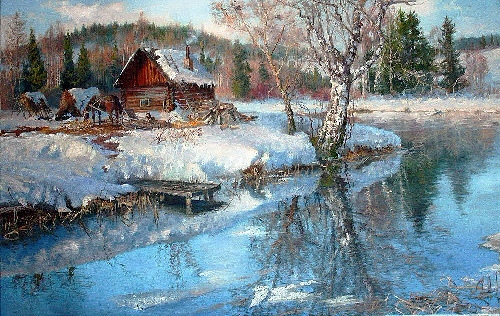 (Russian Winter by Vladimir Zhdanov)


