

What do you think?
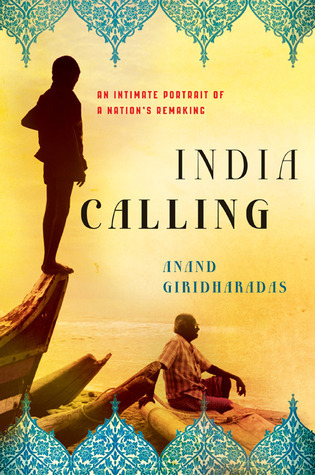
India Calling: An Intimate Portrait of a Nation's Remaking
Reversing his parents' immigrant path, a young American-born writer returns to India and discovers an old country making itself new
Anand Giridharadas sensed something was afoot as his plane from America prepared to land in Bombay. An elderly passenger looked at him and said, "We're all trying to go that way," pointing to the rear. "You, you're going this way?"
Giridharadas was returning to the land of his ancestors, amid an unlikely economic boom. But he was interested less in its gold rush than in its cultural upheaval, as a new generation has sought to reconcile old traditions and customs with new ambitions and dreams.
In "India Calling," Giridharadas brings to life the people and the dilemmas of India today, through the prism of his emigre family history and his childhood memories of India. He introduces us to entrepreneurs, radicals, industrialists, and religious seekers, but, most of all, to Indian families. He shows how parents and children, husbands and wives, cousins and siblings are reinventing relationships, bending the meaning of Indianness, and enduring the pangs of the old birthing the new.
Through their stories, and his own, he paints an intimate portrait of a country becoming modern while striving to remain itself."
Anand Giridharadas sensed something was afoot as his plane from America prepared to land in Bombay. An elderly passenger looked at him and said, "We're all trying to go that way," pointing to the rear. "You, you're going this way?"
Giridharadas was returning to the land of his ancestors, amid an unlikely economic boom. But he was interested less in its gold rush than in its cultural upheaval, as a new generation has sought to reconcile old traditions and customs with new ambitions and dreams.
In "India Calling," Giridharadas brings to life the people and the dilemmas of India today, through the prism of his emigre family history and his childhood memories of India. He introduces us to entrepreneurs, radicals, industrialists, and religious seekers, but, most of all, to Indian families. He shows how parents and children, husbands and wives, cousins and siblings are reinventing relationships, bending the meaning of Indianness, and enduring the pangs of the old birthing the new.
Through their stories, and his own, he paints an intimate portrait of a country becoming modern while striving to remain itself."
273 pages, Hardcover
First published December 22, 2010
About the author
Anand Giridharadas
10 books1,148 followersAnand Giridharadas is the author of the THE PERSUADERS (2022), the international bestseller WINNERS TAKE ALL (2018), THE TRUE AMERICAN (2014), and INDIA CALLING (2011). A former foreign correspondent and columnist for The New York Times for more than a decade, he has also written for The New Yorker, The Atlantic, and Time, and is the publisher of the newsletter The.Ink. He is an on-air political analyst for MSNBC. He has received the Radcliffe Fellowship, the Porchlight Business Book of the Year Award, Harvard University’s Outstanding Lifetime Achievement Award for Humanism in Culture, and the New York Public Library’s Helen Bernstein Book Award for Excellence in Journalism. He lives in Brooklyn, New York, with his wife, Priya Parker, and their two children.
Ratings & Reviews
Friends & Following
Create a free account to discover what your friends think of this book!
Community Reviews
Displaying 1 - 30 of 155 reviews

January 13, 2011
(Reprinted from the Chicago Center for Literature and Photography [cclapcenter.com]. I am the original author of this essay, as well as the owner of CCLaP; it is not being reprinted illegally.)
Regular readers know that in the last several years, I've been giving myself a crash course of sorts all about the regions we in the West refer to as the Middle East and Southeast Asia, mostly because these areas are becoming more and more important by the day in world affairs, and like most Americans I don't know the least little freaking thing about any of them; but unfortunately, I've learned that most of the contemporary books coming out these days that purport to teach us Westerners more about these regions usually fail at one extreme or another, being either overly simplistic book-length Wikipedia entries that teach nothing about what it's like to actually live there right now, or glorified doctoral theses with a mainstream-friendly cover slapped on the front, full of obscure political theories and lots of demographic data but failing to give the reader a good overall look at the area. But not so with India Calling, an almost perfect balance of these elements by Anand Giridharadas, accomplished mostly by the circumstances of him being a youngish intellectual Indian-American who wished and then got a long-term job with the New York Times to cover the subcontinent, moving there permanently after an American childhood filled with old stories and frequent vacations, which allows him not only to be an outsider and insider at once, but also to simultaneously understand the culture and history behind all the 21st century "quiet revolutions" going on there right now and still be surprised and somewhat awestruck by it all as well.
And of course, it helps quite a bit that Giridharadas's job as a journalist specifically sends him into a whole variety of fascinating situations on a regular basis, where he uses his keen intellect to not only report on what he sees but interpret to Americans why it's so important; and so from his time spent with a former "untouchable" who has entrepreneurially transformed himself into a laptop-owning middle-class motivational speaker, to a day at a rural and largely improvised "family court" system, to his talk with one of the richest and most powerful media moguls in the country, Giridharadas brings a mesmerizing sense of place and society to each of the strange little things he examines, giving us perhaps the best overall "insider's" view of Indian life in the 21st century that English speakers have now seen. A huge recommendation whether or not you're specifically interested in India itself, precisely because you will be after finishing no matter what your attitude was before, India Calling absolutely makes me want to now seek out Giridharadas's newspaper columns on a more timely basis, in the same kind of exhilarated way that I felt about Malcolm Gladwell after reading The Tipping Point.
Out of 10: 9.4
Regular readers know that in the last several years, I've been giving myself a crash course of sorts all about the regions we in the West refer to as the Middle East and Southeast Asia, mostly because these areas are becoming more and more important by the day in world affairs, and like most Americans I don't know the least little freaking thing about any of them; but unfortunately, I've learned that most of the contemporary books coming out these days that purport to teach us Westerners more about these regions usually fail at one extreme or another, being either overly simplistic book-length Wikipedia entries that teach nothing about what it's like to actually live there right now, or glorified doctoral theses with a mainstream-friendly cover slapped on the front, full of obscure political theories and lots of demographic data but failing to give the reader a good overall look at the area. But not so with India Calling, an almost perfect balance of these elements by Anand Giridharadas, accomplished mostly by the circumstances of him being a youngish intellectual Indian-American who wished and then got a long-term job with the New York Times to cover the subcontinent, moving there permanently after an American childhood filled with old stories and frequent vacations, which allows him not only to be an outsider and insider at once, but also to simultaneously understand the culture and history behind all the 21st century "quiet revolutions" going on there right now and still be surprised and somewhat awestruck by it all as well.
And of course, it helps quite a bit that Giridharadas's job as a journalist specifically sends him into a whole variety of fascinating situations on a regular basis, where he uses his keen intellect to not only report on what he sees but interpret to Americans why it's so important; and so from his time spent with a former "untouchable" who has entrepreneurially transformed himself into a laptop-owning middle-class motivational speaker, to a day at a rural and largely improvised "family court" system, to his talk with one of the richest and most powerful media moguls in the country, Giridharadas brings a mesmerizing sense of place and society to each of the strange little things he examines, giving us perhaps the best overall "insider's" view of Indian life in the 21st century that English speakers have now seen. A huge recommendation whether or not you're specifically interested in India itself, precisely because you will be after finishing no matter what your attitude was before, India Calling absolutely makes me want to now seek out Giridharadas's newspaper columns on a more timely basis, in the same kind of exhilarated way that I felt about Malcolm Gladwell after reading The Tipping Point.
Out of 10: 9.4

December 17, 2013
The parents of Anand Giridharadas left India when they were in their twenties to pursue new opportunities and greater freedom in the United States. The author reversed the trip, going to India to work as a management consultant, and later as a journalist. He looks at the changes in India through the view of his own family's history, and through years of interviewing Indians from all walks of life. He writes about the conflicts between traditional parents and their modern children regarding old traditions, especially arranged marriages. He interviews Indians of the new generation that escaped their low standing in society, and reinvented themselves as entrepreneurs and industrialists. As India goes through rapid economic growth, and attempts to throw off the divisions of class and caste especially in urban areas, the young Indians meld together old customs, modern technology, and new opportunities. As individual freedom and ambition grows, the importance of the large extended family declines. This was a fascinating look at the new India.

February 24, 2011
I approached this book with some hesitation. When outsiders go in, and attempt to write about the inside, I hesitate. But I read through this (quickly, I might add--the writing is easy, conversational, and fluid that way) and truly appreciated the perspective for what it was. Giridharadas does not attempt to be an insider; he recognizes where he is from (America), that he is on a journey to (not BACK to) India, and that he is writing about his own observations about a nation in some turmoil. In many ways, it resonated with my own experience of "returning" to India several times over the past decade, usually to live/volunteer/do seva. In the process, my own visits led to observations of the rapidly changing landscape of a country so fortified in her religious, cultural and social roots. I found myself laughing several times throughout the book, usually during moments of the author's own keen observations of that ever-present confident "undertone" that seems to pervade so many Indians' voices and thoughts. All in all, a good read, and definitely a commendable first book for such a young/new author.

May 17, 2011
As a one line review, If one wants to read a book on India , among so many in the market, this one can be given a miss.
But broadly, it is somewhat a different take on new India, and yet again by an "outsider". This book is largely a reflection of his personal and very intimate understanding of an India today, which happens to be on a path of tremendous change at all layers. And yet , there is the anger of lost simplicity and fractured familial bonds, of poverty, of growing chasm.
After some point, however, you begin to feel, "Well, I knew that!", and that is also overall feel you get after completing the book.Also, having read enough books on India, I could discern the fault insome the generalities drawn (like India has "now" become materialistic and it wasn't earlier, that Indians "do not " love romantically etc. etc. , which I know is not false, yet is only one side of the coin of an enigmatic Indian man. At several junctures it appears to drag a bit too much with "insider" "outsider" thing (A whole chapter to a visit by the "NRI" to an Indian family, one rich and other poor, and this puts you off with its banalities and triteness) which also gives you a feel that perhaps the book is for expatriates and other "outsiders" only.
Nevertheless, there was one point beautifully brought out by the author, and that was about the "actual morality" and the "wished for morality" of India. Accordingly, he states, India is "non-egalitarian" by its core, contrary to the "egalitarian-west" and west trained like Gandhi,Nehru,Marxist and its upper Middle class have tried to impose the same on its ethos. For an Indian, his known circle's well being matters foremost , and this explains the family, society, caste etc being such an important part of an average Indian life, whereas the "west-born" egalitarianism runs only among the groups mentioned above.And in present India, former asserts itself much more than the assumed hypocrisy of imported egalitarianism.
One would wish there were more such incisive insights of India in the book.
But broadly, it is somewhat a different take on new India, and yet again by an "outsider". This book is largely a reflection of his personal and very intimate understanding of an India today, which happens to be on a path of tremendous change at all layers. And yet , there is the anger of lost simplicity and fractured familial bonds, of poverty, of growing chasm.
After some point, however, you begin to feel, "Well, I knew that!", and that is also overall feel you get after completing the book.Also, having read enough books on India, I could discern the fault insome the generalities drawn (like India has "now" become materialistic and it wasn't earlier, that Indians "do not " love romantically etc. etc. , which I know is not false, yet is only one side of the coin of an enigmatic Indian man. At several junctures it appears to drag a bit too much with "insider" "outsider" thing (A whole chapter to a visit by the "NRI" to an Indian family, one rich and other poor, and this puts you off with its banalities and triteness) which also gives you a feel that perhaps the book is for expatriates and other "outsiders" only.
Nevertheless, there was one point beautifully brought out by the author, and that was about the "actual morality" and the "wished for morality" of India. Accordingly, he states, India is "non-egalitarian" by its core, contrary to the "egalitarian-west" and west trained like Gandhi,Nehru,Marxist and its upper Middle class have tried to impose the same on its ethos. For an Indian, his known circle's well being matters foremost , and this explains the family, society, caste etc being such an important part of an average Indian life, whereas the "west-born" egalitarianism runs only among the groups mentioned above.And in present India, former asserts itself much more than the assumed hypocrisy of imported egalitarianism.
One would wish there were more such incisive insights of India in the book.

June 10, 2012
I'm not sure what to make of this book. It was definitely written in a way that made it a quick-paced read. Giridharadas narrated a series of stories about various people in different parts of India to give a sense of how the country has changed/is changing. But at the same time I felt that something is lacking. It felt kind of superficial as if meeting one man with particular goals in one village can give one a sense of an entire nation. I like the way his personal narrative enters the story and think it would have been much more interesting had he narrated a book about the phenomenon of Indians raised abroad who are returning to India. There are elements of this in the book, but I think he might have been much better prepared to narrate that kind of book than one on the way India is changing from the perspective of someone who just returned to write about it for a few years.

January 17, 2012
This book has been on my shelf for a year or so, I received it as a gift. I needed the right time to read it, and since I haven't been in India since last summer, and am going again in a few weeks, it seemed like a good time. Overall, I really liked the book, and it's style. It's not just another, "Oh, look how India is changing", book, but for the most part seems to uncover the contradictions and daily struggles for people dealing with the change. What's the impact on aspirations? Family dynamics? Marriage? It's a daily conflict of old vs new, and how new acquires it's own unique Indian-ness. If you do business in or with India, I'd strongly suggest it. It's better to sit down with a friend in India over coffee to get these kinds of views, but this is the next best thing.

April 26, 2012
A beautiful meditation on the modernization of India. This is not a history, but rather a thoughtful book about what it means to lose and then find your cultural heritage. Bravo to this writer. His parents emigrated from India to the great melting pot and raised their son as an American. He returned to India and re-discovered what it means to be Indian. Against this journey of re-discovery is the context of the revolution of development and the crooked path of modernization taking place in India. Exquisitely written and very profound as well as informative. Highly recommend.

May 27, 2015
To be honest, I found the journalistic style often tedious, skimming through parts in a determined effort not to give up. I suppose the best way to express it would be that the author failed to convey why he prefers India to life in America, almost as though he were holding back why exactly he left. Really 2.5 stars, but two would slightly uncharitable.

June 11, 2011
As a second generation Indian, I found MUCH to relate to in Giridharadas’ book. It’s a compelling and deeply interesting look into the complexities of today’s Indian society.
I feel like we’ve generalized all Indian culture here in the west, as if to say, “All Indians are like…”, without acknowledging the enormous diversity in a country of 1 billion+ people. And no place, save perhaps China, is changing as quickly and as significantly as India. The old meets the new in one generation, one family even.
Giridharadas does a great job illustrating both the diversity and the changing India by introducing us to his friends and neighbors after moving to India.
Best of all, I feel like Giridharadas has given me some insight into the mind of my father, an immigrant who left the old India for America, only to have India change so drastically that he can call neither his true home.
I think anyone can enjoy this book, but especially so the children of an Indian immigrant, like me.
I feel like we’ve generalized all Indian culture here in the west, as if to say, “All Indians are like…”, without acknowledging the enormous diversity in a country of 1 billion+ people. And no place, save perhaps China, is changing as quickly and as significantly as India. The old meets the new in one generation, one family even.
Giridharadas does a great job illustrating both the diversity and the changing India by introducing us to his friends and neighbors after moving to India.
Best of all, I feel like Giridharadas has given me some insight into the mind of my father, an immigrant who left the old India for America, only to have India change so drastically that he can call neither his true home.
I think anyone can enjoy this book, but especially so the children of an Indian immigrant, like me.

March 28, 2013
Why are desis the way they are??
Why is it so hard for them to allow their ideas to be upset by better ideas?Is it really important to die where one is born? Is it really imp to be the clone of one's parents..or maybe a little bit better version somebody they wanted to be but couldn't be so now they they get to live a life they wanted for themselves through their kids.
Is it because they grew up as lotuses in filth, which makes them suspicious, over cautious, running through the days of their lives as if they will miss the opportunity to live the next day ..when actually they haven't lived today..
Why is it hard to understand the difference between taking pride in one's roots and holding on to them so hard that one can't look beyond them?
Why is it so hard for them to allow their ideas to be upset by better ideas?Is it really important to die where one is born? Is it really imp to be the clone of one's parents..or maybe a little bit better version somebody they wanted to be but couldn't be so now they they get to live a life they wanted for themselves through their kids.
Is it because they grew up as lotuses in filth, which makes them suspicious, over cautious, running through the days of their lives as if they will miss the opportunity to live the next day ..when actually they haven't lived today..
Why is it hard to understand the difference between taking pride in one's roots and holding on to them so hard that one can't look beyond them?
March 22, 2011
An interesting analysis of the "new" India, told from the perspective of a second-generation Indian-American writer who returns to India in his 20s. I found that I agreed with many of Giridharadas' observations about Indians, both in the U.S. and India; he was able to articulate things I had thought about but had never been able to express (and certainly not so eloquently).
But his story-telling approach didn't quite work for me--with the exception of the chapter about the Ambanis/Reliance. The stories were highly entertaining, but I didn't really learn anything new and found myself waiting for Giridharadas to push them just a little further.
But his story-telling approach didn't quite work for me--with the exception of the chapter about the Ambanis/Reliance. The stories were highly entertaining, but I didn't really learn anything new and found myself waiting for Giridharadas to push them just a little further.

February 5, 2011
Giridharadas is a wonderful writer and observer of people and the way they think. This is not a book about India, per se, or about India's role in the global economy, but is about the way that Indian people think. Highly recommended for those looking for insight into why India has developed as it has in the post-Colonial era and as to how its people might compare to the Chinese.

November 8, 2020
This was written in 2011 by the author when he was a young man of about 25. Very interesting insights about the old India juxtaposed with the new, seen through his personal lens and autobiographical, with fascinating snippets of his family.

March 20, 2026
I was pleasantly surprised by the rich syntax and densely woven stories. Long chapters gave way to deep dives, casting a wide net over many people’s lives and experiences peppered with the author’s own understanding of what it means to be Indian and Indian-American.

March 28, 2017
A great look into the evolution of the Indian identity in today's modern context. A great mix of history mixed with personal stories, to tell the story of modern day India in a compelling, engaging story.
September 11, 2021
Absolutely brilliantly written.
This is my first book I’ve read of his and absolutely loved it.
The mix of true event descriptions interwoven with personal stories is so well put together.
The flow of the book is great too.
Definitely want to read a few more of his non fiction 😀
This is my first book I’ve read of his and absolutely loved it.
The mix of true event descriptions interwoven with personal stories is so well put together.
The flow of the book is great too.
Definitely want to read a few more of his non fiction 😀

August 20, 2011
I think this is meant to be some kind of general overview about modern India in the last 10 years or so – BUT when I read this I thought of it more as being the author’s memoir, comparing the impression of India from his childhood in the US to the rapidly modernizing reality he found when he moved there. He then goes into in-depth investigations of different facets of this phenomenon, but he never really removes himself from the narrative.
I didn’t really know a lot about the topic – I have read a fair number of books on the experience of immigrants from the India of, say, the 70’s or 80’s coming to the US and the cultural issues that entails, but not much about India currently. It was especially interesting because the author and I are roughly the same age, and grew up in roughly the same way (except that I am obviously not Indian). But I was able to connect with the author’s story a little more because of this, I think.
Because this is such a personal story, it is hard to think of the subject on a nationwide (global?) scale. The author does score some fantastic interviews, though. And it’s much more interesting to me to read about cultural/political change from the perspective of the man on the street rather than that of a scholar or journalist or politician. The best parts of the book are the sections that involve the author’s personal experience or that of his family – it gets dry and stuffy and boring when he tries to address topics more formally.
I also kind of feel like this description of The Beautiful and the Damned: A Portrait of the New India makes it sound like it is the exact same book as this one, but by a more well-connected author.
I didn’t really know a lot about the topic – I have read a fair number of books on the experience of immigrants from the India of, say, the 70’s or 80’s coming to the US and the cultural issues that entails, but not much about India currently. It was especially interesting because the author and I are roughly the same age, and grew up in roughly the same way (except that I am obviously not Indian). But I was able to connect with the author’s story a little more because of this, I think.
Because this is such a personal story, it is hard to think of the subject on a nationwide (global?) scale. The author does score some fantastic interviews, though. And it’s much more interesting to me to read about cultural/political change from the perspective of the man on the street rather than that of a scholar or journalist or politician. The best parts of the book are the sections that involve the author’s personal experience or that of his family – it gets dry and stuffy and boring when he tries to address topics more formally.
I also kind of feel like this description of The Beautiful and the Damned: A Portrait of the New India makes it sound like it is the exact same book as this one, but by a more well-connected author.

July 18, 2016
This book has been disappointing for the most part, although it holds pockets of insight floating amidst the oceans of generalisation and definitions that arise from the West's definition of normal. I was curious to read this at the start because the writer is uniquely positioned (or so I imagined) to be commenting on this subject. Half-American, half-Indian, is how he would see himself and that puts him in an interesting place to comment on the nature of flux that India is in, at this point. He manages to do this in very small doses, but mostly it is shrouded in very over-simplified, rash evaluation of the Indian context, just because it has been portrayed thus very largely in the media and history books. To say that it is intimate, would also require one to be fairly sensitive and empathetic towards the context one is observing. However, this ends up a very confused effort, in that, as a reader, I am unsure if this is supposed to be anecdotal, biographical, narrative or journalistic in nature.
I really liked the structure of the book when I picked it up. It was intriguing to see India being described through it's values-those that were being defined and reinvented. However, when the writer talks about the Indian hypocrisy and ability to adapt into our culture something that is alien, he misses that India is almost like a human being - a very layered organism at that, in a constant state of breathing, with many different functioning levels and at conflict with itself, psychologically.
To say that it is an intimate portrait-as the cover claims- would be misleading, for this is, most certainly an outsider's account. An outsider, who is, undoubtedly acquainted with the Indian ways, and is also curious about it, but at the end of it still remains a little too far behind the observer's lens to lay claims to the intimate.
Can be skipped.
I really liked the structure of the book when I picked it up. It was intriguing to see India being described through it's values-those that were being defined and reinvented. However, when the writer talks about the Indian hypocrisy and ability to adapt into our culture something that is alien, he misses that India is almost like a human being - a very layered organism at that, in a constant state of breathing, with many different functioning levels and at conflict with itself, psychologically.
To say that it is an intimate portrait-as the cover claims- would be misleading, for this is, most certainly an outsider's account. An outsider, who is, undoubtedly acquainted with the Indian ways, and is also curious about it, but at the end of it still remains a little too far behind the observer's lens to lay claims to the intimate.
Can be skipped.
June 17, 2012
Really enjoyed this book. Referring to an Indian girl who had moved to England to escape the confines of her Indian family he writes: 'In England...she not only found a boyfriend and not only moved in with him, but also managed to find one who was a Pakistani Muslim. Her parents did not know, and it was assumed they would go into simultaneous cardiac arrest if they ever found out' Writing about attending a party to celebrate a visit home by the above mentioned girl: 'The men seemed more than shy; they appeared to be entirely incapable of contemplating what it would involve
to dance with a woman who was not their mother. It seemed likely that they would follow the traditional pattern of having no contact with a woman until the day when they would gain the legal right to force themselves on one. As one often observed at large gatherings of Indian males, they tended to make lusty eyes at one another instead. A man named Hemant, not long after being introduced to me for the first time, dragged me across the room and into the male dancing circle. He stood before me and began to pump his hips and thrust his hands into the air, with every expectation that I do the same, which very, very tepidly, I did'
to dance with a woman who was not their mother. It seemed likely that they would follow the traditional pattern of having no contact with a woman until the day when they would gain the legal right to force themselves on one. As one often observed at large gatherings of Indian males, they tended to make lusty eyes at one another instead. A man named Hemant, not long after being introduced to me for the first time, dragged me across the room and into the male dancing circle. He stood before me and began to pump his hips and thrust his hands into the air, with every expectation that I do the same, which very, very tepidly, I did'

February 10, 2011
Very insightful, intimate look into the blossoming modern society of India. The author touches on the outmoding of the caste system and the transference from that hierarchy to the hierarchy of class. Other subjects include the push towards capitalism from socialism and how that has left older generations behind in a wasteland of what once seemed secure dreams and the new idea of "twoness" as it relates to love relationships. The author did his research, interviewing everyone from the richest man in India to a young, "low-caste" upstart in a small town. His personal relationship with the country adds a nice anecdotal perspective and his flair for language adds poetry to a story about a land that is easily rendered by it. My one critique would be that sometimes he gets carried away with language and veers off on an avenue of gilded prose, leaving the point behind.

May 16, 2011
Tradition meets ambition and desire--India threw off its colonial rulers in the last century, but according to author Giridharadas that was just its first step in a struggle for freedom. This is a beautifully written, absorbing account of modern Indian society in an era of rapid change told through the personal lives of a diverse and well-drawn group of individuals in the midst of the transition. International call centers continue to multiply, but arranged marriages are still common and traditions like the caste system and old family loyalties are both intact and upended. The author is the son of Indian immigrants, which gives him the advantage of both an insider’s and an outsider’s point of view.

January 5, 2011
Just finished this book and I thoroughly enjoyed it. While I found the descriptions and stories of Indian modern culture enlightening and amusing, I thought that the deeper themes of being born to immigrant parents and seeing the "mother country" as a myth, then facing the reality of it; and being the foreigner in your country of origin themes and captivated my attention. Great book!

February 23, 2011
Giridharadas says things about the Indian philosophy of life that have gone unsaid, and are poorly understood by people who didn't grow up in India. Perhaps these concepts aren't even cemented in the minds of Indians living in India.
He's answered some questions I had about why things are they way they are there. His discussion of caste is the most succinct I've read yet.
He's answered some questions I had about why things are they way they are there. His discussion of caste is the most succinct I've read yet.

September 13, 2012
Definitely worth a read for the author's insightful attempt at dissecting India and her plunge into modernity. For Indians who are born and have lived through what he tries to decipher by immersing himself into the Indian "hangama", this might not be such a revealing portrait but more an entertaining find to see so much of it published on print for maybe the first time.

August 7, 2012
Excellent insight into the internal and psychic change as India emerges from 3rd to 2nd world status. Giridharadas explanation of the traditional Indian family structure and concept of self bellied by and the imposition of western ideals is really an eye opener. Recommended.
February 4, 2016
slim, a lot of the same
October 21, 2019
I usually read while riding my stationary bike (if I didn't have something to occupy my mind while riding, I would struggle to last 5 minutes). While reading this book, I was so engaged, I found myself exceeding my mandatory minimum every morning.
The book examines several themes: what it's like to return to your roots that you grew up with only minimally, struggling with cultural confusion, India's changing culture in the current era, vestiges of a past not really left behind. A quote about the cultural confusion was this one: "On the more difficult days, it was possible to feel that I didn't quite belong anywhere and that the burden of winning a place was heavier for me than for the other American kids." About India's confusion, he states: "...the colonial stain, that residual longing to be someone apart from yourself."
Giridharadas illustrates his points with very lovable characters: a successful entrepreneur from a tiny village who can't bring himself to admit love to a girl who also loves him thus loses her, committed leftists who work day jobs in industries contrary to their core values in order to pursue those values at night, a Punjabi family living separate lives (one modern, the other traditional) in two floors of the same house.
The chapter I loved most was the one on love in Indian culture. (Despite 4 decades of contact with Indian friends I still do not understand the love/marriage context in Indian culture). A quote I liked from that chapter is the following: "...Indian marriage making in those days operated according to its own burden of proof: after some initial vetting, there was a presumption of compatibility until proven incompatible." Another nice quote: "Love was a quiet habit." A final quote from this chapter: "India was the noise and chaos of family; it was love that stifled you and boxed you in and yet flooded you with care." All that said, Indian love/marriage remains a total mystery to me.
This is definitely a book worth reading for both the thoughts on dealing with more than one culture and for the wonderful people he characterizes in the book.
The book examines several themes: what it's like to return to your roots that you grew up with only minimally, struggling with cultural confusion, India's changing culture in the current era, vestiges of a past not really left behind. A quote about the cultural confusion was this one: "On the more difficult days, it was possible to feel that I didn't quite belong anywhere and that the burden of winning a place was heavier for me than for the other American kids." About India's confusion, he states: "...the colonial stain, that residual longing to be someone apart from yourself."
Giridharadas illustrates his points with very lovable characters: a successful entrepreneur from a tiny village who can't bring himself to admit love to a girl who also loves him thus loses her, committed leftists who work day jobs in industries contrary to their core values in order to pursue those values at night, a Punjabi family living separate lives (one modern, the other traditional) in two floors of the same house.
The chapter I loved most was the one on love in Indian culture. (Despite 4 decades of contact with Indian friends I still do not understand the love/marriage context in Indian culture). A quote I liked from that chapter is the following: "...Indian marriage making in those days operated according to its own burden of proof: after some initial vetting, there was a presumption of compatibility until proven incompatible." Another nice quote: "Love was a quiet habit." A final quote from this chapter: "India was the noise and chaos of family; it was love that stifled you and boxed you in and yet flooded you with care." All that said, Indian love/marriage remains a total mystery to me.
This is definitely a book worth reading for both the thoughts on dealing with more than one culture and for the wonderful people he characterizes in the book.

December 10, 2019
I recently discovered Anand Giridharadas on Twitter and was following his commentary on U.S. financial topics. When I went to research his latest book on "world elites", I discovered he had written this one, and I snapped it up immediately.
As a very Westernized American reader who has been studying Indian history and culture for the past year, I found this book to be extremely approachable, accessible, and empathetic. Critics of this book seem to imply its accessibility is actually banality and triteness. I can't agree, but I *do* think this book should be only a small portion of a study of "modern" India and not relied upon as any sort of definitive volume. In Giridharadas's defense, I don't think he intended it to be definitive. I read it like I'd read most any kind of memoir--understanding that so much of the information is filtered through personal perception and experience.
Mr. Giridharadas might be an outsider, but never as much as I will always be; for me, he's a bridge that makes the foreign more accessible and relateable and so much "less foreign" which is the whole point of cultural studies, IMO. The writing is conversational, yet also elevated. I enjoy Giridharadas's style and voice very much. I do, however, wonder how approachable this book would be to a Western reader who had no foundation in Indian culture before reading this book.
For me, India Calling confirmed a lot of conclusions I'd been starting to draw for myself and filled in some of the gaps of information that had been missing in my studies up to this point. It also inspires me to continue to read more, to seek out more sources, more authors, and a vaster array of opinions, perspectives, and experiences. I'd love for Giridharadas to write a follow-up now that almost a decade has passed. Would he still draw similar conclusions or has India (and/or his perceptions of it) evolved any over the last 8-9 years?
As a very Westernized American reader who has been studying Indian history and culture for the past year, I found this book to be extremely approachable, accessible, and empathetic. Critics of this book seem to imply its accessibility is actually banality and triteness. I can't agree, but I *do* think this book should be only a small portion of a study of "modern" India and not relied upon as any sort of definitive volume. In Giridharadas's defense, I don't think he intended it to be definitive. I read it like I'd read most any kind of memoir--understanding that so much of the information is filtered through personal perception and experience.
Mr. Giridharadas might be an outsider, but never as much as I will always be; for me, he's a bridge that makes the foreign more accessible and relateable and so much "less foreign" which is the whole point of cultural studies, IMO. The writing is conversational, yet also elevated. I enjoy Giridharadas's style and voice very much. I do, however, wonder how approachable this book would be to a Western reader who had no foundation in Indian culture before reading this book.
For me, India Calling confirmed a lot of conclusions I'd been starting to draw for myself and filled in some of the gaps of information that had been missing in my studies up to this point. It also inspires me to continue to read more, to seek out more sources, more authors, and a vaster array of opinions, perspectives, and experiences. I'd love for Giridharadas to write a follow-up now that almost a decade has passed. Would he still draw similar conclusions or has India (and/or his perceptions of it) evolved any over the last 8-9 years?

February 21, 2020
The book is about the author's observations about India after spending a few years in India in his twenties. Anand Giridharadas was born in the United States and had a mostly American upbringing (with some typical Immigrant traits). As most Indian immigrant families do, he's visited India a few times growing up, mostly to visit family - grandparents, uncles and aunts in India. After he graduated, he decided to spend a few years as a journalist/writer in India, writing for IHT. This book is notes about his family, his time in India, his observations on how much the India he remembered was different from the India he came to know.
He mostly succeeds when writing about his family and his immediate experiences. But where the book lacks is when he tries to present opinions on others or about others who he doesn't have a clear connection to. He appears somewhere between a snobbish westener and a condescending Indian Immigrant. His opinions on the Indian marriage, family life, the hopes and aspirations on the new generations, etc., carry with them a hint of a holier-than-thou attitude. Just a hint, but still present. And some of them are not necessarily correct.
But then again, they are opinions and hence subjective not factual reporting. The fact that he couldn't find a single Indian (outside his family) whom he can admire enough to write about, in a book about the Indian experience, explains some of the book's shortcomings. Some of them can be forgiven due to his youth and some of them really can't. Some of them, especially the name-dropping here and there even appear comical.
This book is still worth a read for both Indian and non-Indians due to its attempt at explaining the social evolution of India since Independence.
He mostly succeeds when writing about his family and his immediate experiences. But where the book lacks is when he tries to present opinions on others or about others who he doesn't have a clear connection to. He appears somewhere between a snobbish westener and a condescending Indian Immigrant. His opinions on the Indian marriage, family life, the hopes and aspirations on the new generations, etc., carry with them a hint of a holier-than-thou attitude. Just a hint, but still present. And some of them are not necessarily correct.
But then again, they are opinions and hence subjective not factual reporting. The fact that he couldn't find a single Indian (outside his family) whom he can admire enough to write about, in a book about the Indian experience, explains some of the book's shortcomings. Some of them can be forgiven due to his youth and some of them really can't. Some of them, especially the name-dropping here and there even appear comical.
This book is still worth a read for both Indian and non-Indians due to its attempt at explaining the social evolution of India since Independence.

May 18, 2015
“India Calling” is a book about the modernizing India of the 2000’s from an interesting perspective: that of a second-generation Indian (Anand Giridharadas) with immigrant parents. Sometimes derisively known as “ABCDs” (American-Born Confused Desis), their knowledge of their parent’s homeland is limited to infrequent visits during school vacations and the aspects of Indian culture that were retained by the parents, primarily language, religion and food. I have a similar, though not exactly the same, experience, with my school years (2nd to 9th grade) spent outside India. My exposure to Kerala and Malayalam was limited to the shared experiences with my parents. But I went to an Indian school which had its syllabus dictated from Delhi, so like other children there, we had a better understanding of India than I would suppose an American-born citizen of Indian origin would have. And also since I returned to India as a teenager and remained there for a decade, much of Indian culture seeped into me, though a few foreign elements would remain.
But back to Anand. He spent most of his childhood and college years in the United States and England, and then moved to Mumbai as a consultant for McKinsey. During this time, he started writing pieces about India and became a full-fledged writer. This is his first book and details many of his experiences and his impressions of the new India. It covers a lot of ground from the Reliance empire of the Ambanis to the Maoist threat facing the country. It uses the detailed profile of Ravindra, a young man who is able to make use of new opportunities to become the most respected man in town. We also learn of the new found confidence in Indian-ness. Anand also takes a look at changing social and sexual norms and how the older generation feels threatened.
There is much to like about the book. Anand is an excellent writer and the book is a beautiful piece of work. Anand also does not hesitate to bring in discussions of the divisive elements of caste and religion into the book. I don’t think an Indian-born writer would have done the same. Most Indians have a big blind spot when it comes to caste and how it affects society. When Anand talks about the question of whether an Indian Hindu would rather have cocaine than marry a Muslim, it strikes the target perfectly. There is so much pressure to conform to social norms that bigotry and oppression is normal in Indian society, even today. Anand does not intend this to suggest the superiority of the West, as he explains that several generations ago, Western societies too had similar standards – slavery, few rights for women and so on. Also, while Anand draws some comfort in the friendliness of Indian society, he is frustrated by the lack of empathy that seems at odds with the expressed values of the culture.
The book does have some weaknesses. One, I venture to say, is that the book is written too beautifully and the descriptions too flowery and insightful for a person of Anand’s limited years and experience. There is something that doesn’t quite feel real and it took me some time to understand it. What Anand tried to do in this book is not only explain the new India, but also try to analyze the minds of Indians. He tries to imagine what Indians must have thought in the past (before economic reforms took place) and what they think now. It is a risky exercise because quite honestly, you cannot know what someone is thinking. You can look at their actions, you can listen to what they say, you can even ask them what they are thinking. But ultimately you are guessing. And so when Anand writes an eloquent paragraph about Indian culture and why something is happening, he is making a hypothesis, an educated one, but still only a guess. And when that guess is wrong, you suddenly see the weakness in Anand’s approach.
Take for example, Anand’s amazing assertion of no sexuality in past Indian movies. Only someone who has zero knowledge of the content of mainstream Bollywood movies (even from the 1960s) would even suggest that. It is clear that Anand never watched (or doesn’t remember) older Indian movies with his parents or when he came to India. Because he gets this point wrong, a significant part of his writing about the changing romantic scene in India strikes one as silly. I remember reading front-page stories in India Today and the Illustrated Weekly in the early 1990s saying essentially the same thing that Anand writes, and I bet similar stories were written in the 1980s and even before. Urbanization has always changed the conventional family and Indian urbanization is not a new phenomenon – it has simply accelerated in the last decade.
The same mistake happens with the examples used by Anand, whether it is Ravindra or Mukesh Ambani. There has always been the aggressive, non-gentile, entrepreneurial personality in India and it has not been limited to the bania class. Almost everyone in India was and is hustling, trying to make a few extra bucks, starting a business and so on. But India was starting from a lower economic base, she shackled herself with socialist economic constraints, paid little attention to fundamental needs (primary education, health, social reform) and failed to address rampant, endemic corruption. In fact, in such a country, the people who rise to the top tend to be the corrupt, cheating hustlers, unlike a developed country where if you have one good skill, you can try to capitalize on that without worrying too much about government and mafia interference.
Also, there were several important holes. There was very little about Eastern India or South India, despite the fact that Bangalore is the hub of the technology revolution. Cultural differences between different parts of the country were missing. Anand seems to have taken a billion people and stuffed them into one pigeon-hole. Property rights, dowry, politics, systemic corruption, infrastructure, pollution, education, etc. all either unaddressed or given a cursory glance.
I guess the last few paragraphs may have given a bad impression of the book. But as I said, I liked it. It offers a great view into India and provides good insights. Just be clear that it is not complete (and I think the author will probably say that it cannot be complete) and the analysis not always right, especially when it comes to psychoanalysis.
But back to Anand. He spent most of his childhood and college years in the United States and England, and then moved to Mumbai as a consultant for McKinsey. During this time, he started writing pieces about India and became a full-fledged writer. This is his first book and details many of his experiences and his impressions of the new India. It covers a lot of ground from the Reliance empire of the Ambanis to the Maoist threat facing the country. It uses the detailed profile of Ravindra, a young man who is able to make use of new opportunities to become the most respected man in town. We also learn of the new found confidence in Indian-ness. Anand also takes a look at changing social and sexual norms and how the older generation feels threatened.
There is much to like about the book. Anand is an excellent writer and the book is a beautiful piece of work. Anand also does not hesitate to bring in discussions of the divisive elements of caste and religion into the book. I don’t think an Indian-born writer would have done the same. Most Indians have a big blind spot when it comes to caste and how it affects society. When Anand talks about the question of whether an Indian Hindu would rather have cocaine than marry a Muslim, it strikes the target perfectly. There is so much pressure to conform to social norms that bigotry and oppression is normal in Indian society, even today. Anand does not intend this to suggest the superiority of the West, as he explains that several generations ago, Western societies too had similar standards – slavery, few rights for women and so on. Also, while Anand draws some comfort in the friendliness of Indian society, he is frustrated by the lack of empathy that seems at odds with the expressed values of the culture.
The book does have some weaknesses. One, I venture to say, is that the book is written too beautifully and the descriptions too flowery and insightful for a person of Anand’s limited years and experience. There is something that doesn’t quite feel real and it took me some time to understand it. What Anand tried to do in this book is not only explain the new India, but also try to analyze the minds of Indians. He tries to imagine what Indians must have thought in the past (before economic reforms took place) and what they think now. It is a risky exercise because quite honestly, you cannot know what someone is thinking. You can look at their actions, you can listen to what they say, you can even ask them what they are thinking. But ultimately you are guessing. And so when Anand writes an eloquent paragraph about Indian culture and why something is happening, he is making a hypothesis, an educated one, but still only a guess. And when that guess is wrong, you suddenly see the weakness in Anand’s approach.
Take for example, Anand’s amazing assertion of no sexuality in past Indian movies. Only someone who has zero knowledge of the content of mainstream Bollywood movies (even from the 1960s) would even suggest that. It is clear that Anand never watched (or doesn’t remember) older Indian movies with his parents or when he came to India. Because he gets this point wrong, a significant part of his writing about the changing romantic scene in India strikes one as silly. I remember reading front-page stories in India Today and the Illustrated Weekly in the early 1990s saying essentially the same thing that Anand writes, and I bet similar stories were written in the 1980s and even before. Urbanization has always changed the conventional family and Indian urbanization is not a new phenomenon – it has simply accelerated in the last decade.
The same mistake happens with the examples used by Anand, whether it is Ravindra or Mukesh Ambani. There has always been the aggressive, non-gentile, entrepreneurial personality in India and it has not been limited to the bania class. Almost everyone in India was and is hustling, trying to make a few extra bucks, starting a business and so on. But India was starting from a lower economic base, she shackled herself with socialist economic constraints, paid little attention to fundamental needs (primary education, health, social reform) and failed to address rampant, endemic corruption. In fact, in such a country, the people who rise to the top tend to be the corrupt, cheating hustlers, unlike a developed country where if you have one good skill, you can try to capitalize on that without worrying too much about government and mafia interference.
Also, there were several important holes. There was very little about Eastern India or South India, despite the fact that Bangalore is the hub of the technology revolution. Cultural differences between different parts of the country were missing. Anand seems to have taken a billion people and stuffed them into one pigeon-hole. Property rights, dowry, politics, systemic corruption, infrastructure, pollution, education, etc. all either unaddressed or given a cursory glance.
I guess the last few paragraphs may have given a bad impression of the book. But as I said, I liked it. It offers a great view into India and provides good insights. Just be clear that it is not complete (and I think the author will probably say that it cannot be complete) and the analysis not always right, especially when it comes to psychoanalysis.
Displaying 1 - 30 of 155 reviews