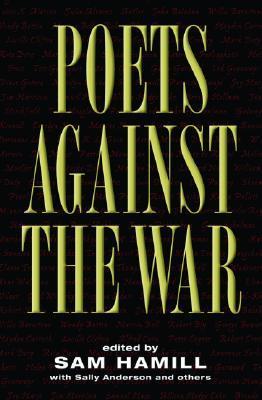
Led by poet Sam Hamill, February 12, 2003 became a day of Poetry Against the War conducted as a reading at the White House gates in addition to over 160 public readings in many different countries and almost all of the 50 states. Since then, over 9,000 poets have joined this grassroots peace movement by submitting poems and statements to www.poetsagainstthewar.org, registering their opposition to the Bush administration's headlong plunge toward war in Iraq. Poets Against the War features a selection of the best poems that were submitted to the website. Contributors include: Adrienne Rich, W.S. Merwin, Galway Kinnell, Robert Bly, Marilyn Hacker, Grace Schulman, Shirley Kaufman, Wanda Coleman, Yusef Komunyakaa, Hayden Carruth, Jane Hirshfield, Tess Gallagher, Sandra Cisneros, former Poet Laureate Rita Dove, and many others.
Poet, editor, translator, and essayist, Sam Hamill is author of more than thirty books including two from BOA Editions, Gratitude (1998), and Dumb Luck(2002). He has been the recipient of numerous awards and fellowships, including ones from the National Endowment for the Arts and the Guggenheim Foundation, the Woodrow Wilson Foundation, the U.S.-Japan Friendship Commission, two Washington Governor’s Arts Awards, the Stanley Lindberg Lifetime Achievement Award for Editing, and the Washington Poets Association Lifetime Achievement Award for poetry. He co-founded Copper Canyon Press, and has worked extensively in prisons and with battered women and children.
Compiled the same year that the U.S. war on Iraq began, Poets Against the War began as a call for poetry to the nation, due to Laura Bush (first lady at the time) cancelling a White House poetry event because of rumors that poets were going to read political poetry.
Not sure what Bush was expecting from poets. Maybe she was unfamiliar with poetry and was just trying to be supportive of the arts. But what initially backfired became a great project. The resulting book is a collection of approximately 150 poets' anti-war work (occasionally accompanied by a statement of conscious, and in a couple cases a poet ONLY provides such a statement). The quality and styles vary. The youngest poet is only 8 years old, and while it's obviously a kid's poem, it shows that wonderful depth of thought that often goes into poetry-making:
Untitled by Alexandra Indira Sanyal
Snow so fluffy and soft. I like to run and jump into it. It leads to peace and love. Snow stops war and fights that lead to killing. So snow come today.
There are big names (Adrienne Rich, Julia Alvarez, Joy Harjo, W.S. Merwin, Lawrence Ferlinghetti, and others, and a statement of conscience by Robert Pinsky) and completely unfamiliar names, mingled together in an egalitarian alphabetical-order layout. There's a lot of free verse, but also experimental and form poems. Ultimately, I liked the vast majority of the poems in this book, both the overtly political (the wondrous "Cambridge Rant" by William Irwin Thompson) and quietly sad. For the latter, I share with you this one:
Victory Gardens by Nancy Willard
We planted our garden small. After dinner my mother and I
tidied the beans, watching the apples fall, while the radio, hid in a melon pile,
counted the deaths in trenches and fields. The corn, tall as my brother, whose smile
I can hardly remember, pushed out green hands to my mother like awaited friends.
When he died, she hid in the tall sheaves. They too were cut down, a battalion
of comforters, yet the next year the leaves came again. How do such things survive?
cried my mother. We ploughed our grief under the stubble alive
and tried to imagine that field in France, very yellow and empty now, the stalks
of wheat pushing quietly out of the earth, those witnesses and quiet conquerors.
The 150 poems included in Poets Against the War were selected out of 11,000 submissions. It may be a personal pleasure, but poetry brings people together. One of the benefits of themed anthologies is illuminating that for us. I earmarked the heck out of this book. So yes, I recommend it.
What a wonderful book. It was the result of a White House fiasco, and what a great outcome. Although, unfortunately, not enough folks have risen to be heard since to stop this rediculous war.
The war is the 2003 invasion of Iraq (WMDs!!) lead by President George W. Bush. The poems and statements are written by known poets and citizens from all over the country and world. Still a wonderful book that remains undated.
This book made me cry on the city bus as I rode in to work. This book inspired me to begin a poetry reading series. This book, at turns, left me inspired, heartbroken, melting, angry, satisfied, learned, ready to fight, and hopeful. This book is worth reading for anyone who cares about the diversity of voices in and around America, for anyone who reads poetry, for anyone who writes poetry, for anyone who thinks poetry is outdated, crestfallen, or not enough.
In 2003, First Lady Laura Bush planned to host a White House Symposium on "Poetry and the American Voice", and she invited a number of poets to speak to "the voice" of American poetry. Poets declined, protesting the White House's actions in their rejection of the invitation, and Laura Bush cancelled the symposium. Her spokeswoman said, "While Mrs. Bush respects the right of all Americans to express their opinions, she, too, has opinions and believes it would be inappropriate to turn a literary event into a political forum." Sam Hamill was one of the poets invited to speak, and he declined. "Having only recently read George Bush's proposed 'Shock and Awe' attack plan for Iraq, which called for saturation bombing", his response was to instead address a letter to "Friends and Fellow Poets", asking for poems or statements of conscience. Over 13,000 poems were sent. This anthology appeared in the place of Laura Bush's symposium, and still stands as well worth the reading, returning to, and sharing.
One of the beauties of this anthology is that well-known poets (among them, notably, are Adrienne Rich, Hayden Carruth, Robert Bly, W. S. Merwin, Rita Dove, and Jane Hirshfield) appear alongside unknown names, some of them children. In this collection, the simple joins forces with the heavily allusioned and political, the documentary with the lyrical, the heartbroken with the angry, the young with the old, and the historical with the new. The juxtaposition of voices is not only powerful, but necessary and remarkable. In some cases, the poems were written in response to Hamill's call for poems, and in other cases, poems were written years before by veterans of WWII and the Vietnam War--and yet, they speak to the historical moment of this book, and to the respective quests for peace and war that are seemingly unending.
Simply, this book is both inflammatory and necessary, and it is worth reading and sharing.
This collection was especially depressing because the war isn't over; the poems are still relevant today, ten years after this book was published. However, it does remind the reader of the power of poetry: the lines make you think and feel differently--perhaps more deeply--than prose. Overall, an incredible collection of poets and poems including some of my heroes and some people I've shared the page with in the past.
These are important voices - the genesis of this work rose out of the war against Iraq. I remember my first fear after the 911 attacks that we would go to war and all the loss that would entail not just for our country but for the world.