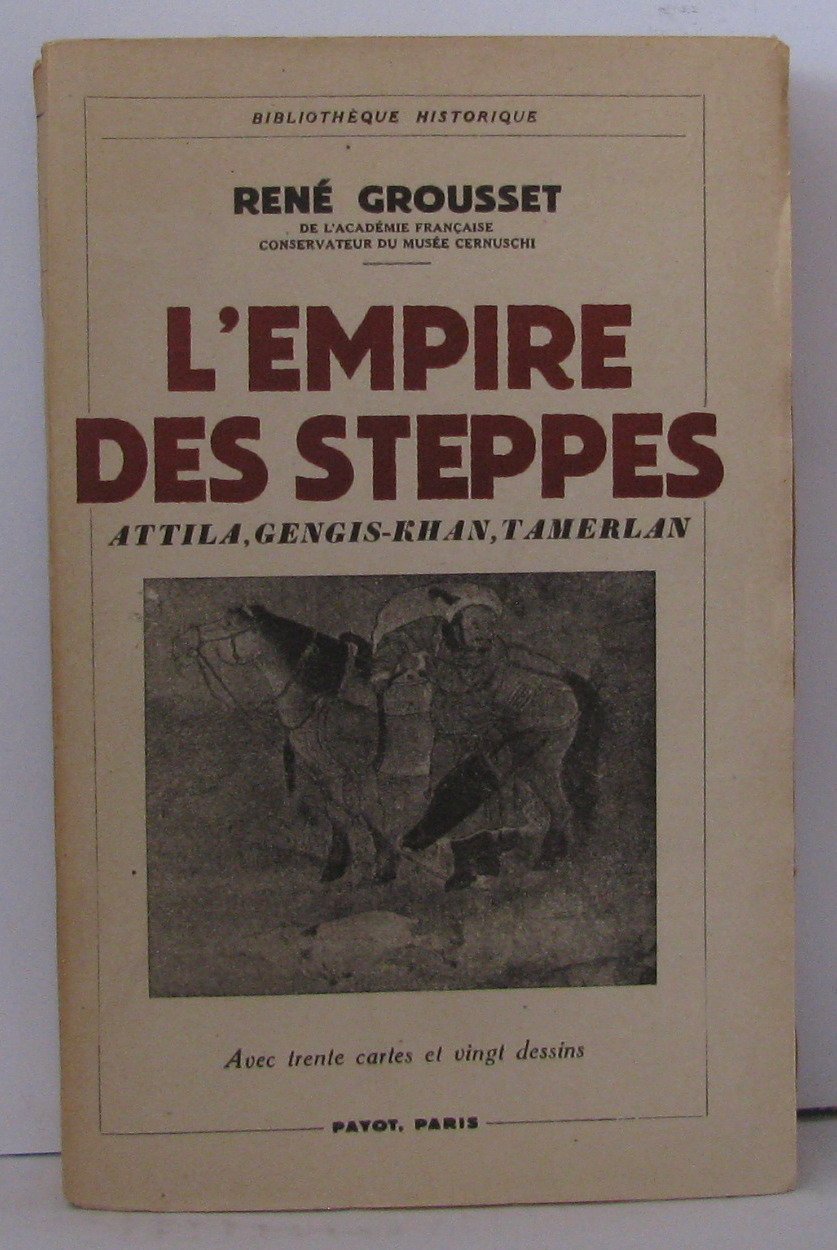
Rayon : Civilisation Editeur : Payot Date de parution : 1976 Description : In-8, 652 pages, broché, occasion, très bon état. Envois quotidiens du mardi au samedi. Les commandes sont adressées sous enveloppes bulles. Photos supplémentaires de l'ouvrage sur simple demande. Réponses aux questions dans les 12h00. Librairie Le Piano-Livre. Merci. Référence catalogue X15689. Please let us know if you have any questions. Thanks
René Grousset (September 5, 1885 – September 12, 1952) was a French historian specializing in Asiatic and Oriental history. He was born in Aubais, Gard in 1885.
Having graduated from the University of Montpellier with a degree in history he began his distinguished career in the French Ministry of Fine Arts soon afterward. He served in the French army during World War I. In 1925 Grousset was appointed adjunct conservator of the Musee Guimet in Paris and secretary of the Journal asiatique. By 1930 he had published five major works on Asiatic and Oriental civilizations. In 1933 he was appointed director of the Cernuschi Museum in Paris and curator of its Asiatic art collections. He wrote a major work on the Chinese buddhist medieval pilgrim Huien Tsang, particularly emphasising the importance of his visit to the northern Indian buddhist university of Nalanda.
Before the outbreak of World War II, Grousset had published his two most important works, Histoire des Croisades (1934-1936) and L'Empire des Steppes (1939). Dismissed from his museum posts by the Vichy government, he continued his research privately and published three volumes on China and the Mongols during the war. Following the liberation of France, he resumed his curatorship of the Cernuschi Museum and in addition was appointed curator of the Musee Guimet. In 1946, Grousset was made a member of the French Academy. Between 1946 and 1949 he published four final works, concentrating on Asia Minor and the Near East.
This is a great synthesis work on the history of Central Asia that may never be superseded because of the challenges in learning all the necessary languages.
It must be understood that this is purely a political history. There is no effort to touch social, economic or demographic, literary or architectural history.
The other GoodsRead reviewers who complained of the lack of maps, pictures and other illustrations are highly justified. With very little trouble, this excellent political history could have been transformed into a more informative book for the amateur reader.
I doubt I can be objective on this book. It was my first full-scale history of the steppe; my first real acquaintance with the life of Jenghiz Khan, too (as spelt in Grousset). First published 1939; in print for its 'majestic sweep and grandeur... the intellectual grasp of Grousset's original masterwork'... 'uniquely great'. That's from the forward to the 1970 edition in English, and I might just end my comments there.
It is a sweep of steppe history, and captured my imagination: his descriptions of steppe art; his portrait of Jenghiz Khan, and the latter's similarity to Attila. I met Jenghiz Khan here, and perhaps that's why I can't stand most biographies of him - because he's as Grousset paints him, at bottom, to me. It's a striking portrait and one not easily overwritten, if Grousset's came first.
Since he wrote in 1939 he has outdated knowledge and of course you have to read further. But for that 'majestic sweep' and steppe history seen as a follow-on whole, for his brave attempts to characterize such as Attila and Jenghiz, and not least for his open mind and sympathy with nomad peoples - I'm so glad that by mere accident, I started here.
A big ambitious book that seeks to describe two thousand years of history of a vast area in only 542 pages! It was dense writing, but surprisingly readable. Not that I absorbed everything. But I found if I kept reading the story would wash over me. I can't tell you much about most of the historical characters whose lives are recounted in the book, but the book taught me a lot about the overall history of Central Asia.
There were some problems and/or oddities with the book. It was written in the 1930s and at places it would show its age. The book used the word "orientalist" without any negative connotation. Grousset seemed to assume that ethnic groups and races had certain inherent characteristics that he talks about much more openly than a modern author would. He used a few turns of phrases that would not be used today because they have a sexual connotation (e.g. numerous times he writes that some military leader "took [his opponent] from the rear" meaning his military outflanked him and won the battle).
There's also a question about how much of the book holds up. For example, early in the book Grousset talks about the Hsiung-Nu, a Central Asian nomadic people who attacked the Chinese empire in the first century A.D. According to Chinese sources, the Chinese fought the Hsiung-Nu off, and they exited Chinese history after being driven into Central Asia to the West of China. Three hundred years later, the Huns invade Europe from Western Asia. Grousset claimed they are the same people, having traveled across Asia during those three hundred years, passing through an area where no one was recording history. It's an interesting idea, so I googled around and found out that the theory has not held up very well since this book was written. Grousset makes a whole lot of claims throughout the book. Obviously, I did not check into most of them. But the questionable Hsiung-Nu-Huns claim made me wonder what else in the book might not have held up.
Grousset is also very conscious of which groups are Persian, Mongol, Turkic or Chinese. But he refers to both the Kipchaks and the Uzbeks as Mongols, when in fact they are both Turkic. Again, what else did he get wrong?
But these are mostly quibbles when you consider the book as a whole. The above questions don't cut into his overall thesis, that the history of Asia was governed by a cycle up until the modern era. Settled cultures would be periodically invaded by nomadic people. Sometimes the settled people would fight them off, but the nomads had certain advantages (nomads tended to be tougher because they came from a harsher environment, and settled people had more stuff to defend) and a lot of times they would win and conquer the settled civilization. Once they were in charge, however, the nomads would be seduced by the comforts of civilized life and adopt the culture of the conquered people. Then they would becomes the settled culture, ready for the next nomadic invasion who sometimes turned out to be their distant cousins. Grousset fills the book with examples, of Mongols and Turks going from the barbarian hordes threatening Persia and China, to establishing dynasties that became Chinese or Persian.
An engaging narrative synthesis from the earliest artifacts to the fall of the Mongols. I have no idea how much is speculation nor how much has been superseded since the book was published in 1939. Nevertheless, I had a much better understanding of the course of Central Asian history, the religious affiliations of the various khans, and why the empire disintegrated.
This is an opinionated book, the author doesn’t disguise his affinity for Genghis Khan, or his loathing of Tamerlane. He makes educated generalizations about the effect of nomadic life vs. sedentary civilization.
His biases are showing, and I would really love to see someone re-translate with a knowledge of all the material released form Mongolia since the fall of the USSR, however I still give it four stars for its thoroughness on covering the topic.
Note: I skimmed this for a research paper, focusing on the late 13th century and early 14th century.
443-The Empire of the Steppes-Rene Grousset -History-1939
Barack 2022/11/20
The Empire of the Steppes was first published in 1939. It covers the history of Central Asia from ancient times to 1757, from the nomadic travels of the ancient Scythians to the final empire of the Mongols in the 18th century. It covers ten centuries of history and revolves around three main historical figures in the history of Central Asia - King Hun, Genghis Khan, and Timur.
Rene Grousset, born in 1885 in Aubais, Gard, died in 1952. He was a French historian, director of the Cernuschi and Guimet museums in Paris, and a member of the prestigious Académie de France.
Table of Contents 1. Early History of the Steppes: Scythians and Huns 2. The Early Middle Ages: T'u-chiieh, Uigur, and Khitan 3. The Turks and Islam to the Thirteenth Century 4. The Russian Steppe from the Sixth to the Thirteenth 5. Jenghiz Khan 6. The Three Immediate Successors to Jenghiz Khan 7. Kublai and the Mongol Dynasty of China 8. Turkestan Under the House of Jagatai 9. Mongol Persia and the House of Hulagu
Due to the terrain, most of the people living in Central Asia are nomadic people. Compared with the settled farming peoples, their influence in today's world seems to be relatively limited. So maybe when we look at the history of the world, it is easy to overlook the importance of the rise of Central Asian civilization, or we are deeply impressed by the several major foreign aggression wars in history.
From the perspective of China, the invasion of China by nomads has always been a big problem in history, and it is a serious problem that affects the rise and fall of dynasties. There is a big difference in the way of life between farming civilization and nomadic civilization, so the way of thinking will also be significantly different. If we want to understand civilizations different from our own, we must understand their history, understand their means of earning a living, and understand the geographical environment in which they live. Only by understanding the past can we understand the present; only by understanding the present can we predict the future. Whether it is an enemy or a friend, it will always be more beneficial for you to understand each other better. People's important decisions must be based on the mastery of information based on facts. "Whoever wins before a battle and the temple counts must be counted as more; if the temple is counted as invincible before a battle, it must be counted as less. More counts as a victory, less counts as invincibility, let alone nothing!"
There have also been great unified heroes on the grassland, but compared with the unified situation in the Central Plains, the time it can last is a little shorter. One of the reasons may be that the migratory lifestyle made it more difficult for the rulers to manage the empire, and they could not have stronger control over the people like the Central Plains. Once the people have land, they can rely on it, but at the same time, they are bound by the land. The bound people are extremely sedentary, and they can run away to monks but not to temples, so it is easier to manage and unify. Even if a few talented emperors can unify the entire grassland, once he dies, the empire will easily fall into a state of disintegration. His sons and brothers each occupied a piece of land and regained their dominance. In order to strengthen unity and strengthen the dominance of the empire, from the center of power to the edge of the empire, the passage of information and materials must be unimpeded. So Rome wants to build roads, and Qin also needs to build roads.
A country, like an individual, must deal with its relations with other countries. Before the advent of the era of the great ocean, from a geographical point of view, Central Asia was the only way for exchanges between the East and the West, occupying an important geographical location, which is one of the country's strategic advantages. A person will have many innate strategic advantages, such as IQ, appearance, family background, country and city of birth, and so on. The same is true for countries. The country's geographical location, resource reserves, population quantity, and quality are all strategic resources that the country should make full use of. These natural endowments are not easy to change, so we must pay more attention to the acquired strategies that have room for manipulation. This country is not friendly to me, so I choose to ally with another country. If this country does not do business with us, then we can try to do business with other countries. Whether it is the Silk Road on the road or the Silk Road on the Sea, it has its objective existence and development trend, but if it really wants to form a climate, it must be based on the subjective willingness of decision-makers to promote it and objectively invest resources to actually promote it.
The religions of various countries tend to divide the world into roughly three levels, the upper level is heaven, the middle level is the human world, and the lower level is hell. The ruler represents the upper class, and the rhetoric of being ordered by heaven is to prove his own legitimacy. Although force can make people submit, the minimum management cost can only be achieved by making people approve from the bottom of their hearts. The lower level is like a prison, which is used to punish wicked people who are not good for society. The beauty of heaven is eternal, and the pain of hell is also eternal, but only the world is short-lived. That is to encourage mortals to look to the future and endure the present. In all fairness, do the rulers themselves really believe this? As a ruling tool, this set of theories is naturally easy to use, but do those who promote this set of theories really believe it? Do those who make the rules really have awe of the rules?
From the perspective of farming civilization, some customs of nomadic people may be difficult to understand, and even hurt customs. But the living environment of these two ethnic groups is very different, and the difference in the living environment will inevitably lead to the difference in the concept. What may seem normal to one nation may not be normal to another. Making a living from hunting means paying more attention to flexibility, and there is no routine that cannot be broken; shooting a shot to change a place may lead to more extreme behavior. The wild environment is harsh, and women are scarce resources and are unable to protect themselves, so when the husband dies, the deceased's son or brother will continue his widow. Everything that exists must have a cause. Leaving aside the objective environment to talk about the logic of behavior, it is easy to be biased, thinking that it occupies the moral high ground.
The smooth development of China during the Sui and Tang Dynasties was not only completely dependent on the country's internal affairs but also closely related to the internal division of the Central Asian steppe empire and the external environment of confrontation between the east and the west. Looking at the rise and fall of a country, although it first depends on the domestic environment, the external environment is also extremely important. If the main competitors have their own problems, then we may win development opportunities. On the contrary, if external opponents frequently intrude, they may concentrate on developing themselves. In domestic and foreign affairs, any shortcomings will lead to lameness. "In the past, those who were good fighters were invincible first and waited for the enemy to be victorious. The invincibility is up to oneself, and the victory is up to the enemy. Therefore, good fighters can be invincible, and cannot make the enemy victorious. Therefore, it is said: Victory is known We cannot do anything.” The so-called good fighters do not try their best to win, but try their best not to fail; as long as they do not fail and wait patiently when the opponent makes mistakes, we can gain benefits to achieve ultimate victory.
Büyük Fransız Şarkiyatçı René Grousset'nin 1930'ların sonunda kaleme aldığı ve uzun yıllar önce Prof. Halil İnalcık'ın tercüme edip Türk Tarih Kurumu'nun "Stepler İmparatorluğu: Attila, Cengiz Han, Timur" adıyla yayınladığı kitap, Asya steplerinin göçebe halklarının tarihi açısından bir başyapıt niteliğinde.
Kitap, İskit-Sarmatlardan başlayarak, Hunlar, Tukyular (Göktürkler), Uygurlar, Juan-Juanlar, Oğuzlar, Kıpçaklar, Tunguzlar, Moğollar, Mançular ve Tümurlular gibi step haklarının tarihi ekseninde, hem bu kavimlerin yükseliş ve çöküşlerini, hem de birbirleriyle ve yerleşik Çin, Hindistan, İran ve Anadolu halklarıyla ilişkilerini ustalıkla ele alıyor.
Kitapta bence en ilgi çekici bölümler, bu step kavimlerinin tarihi, coğrafi, kültürel ve askeri açılardan birbirleriyle benzerlik ve farklılık gösterdikleri hususiyetlerin ele alındığı mukayeseli bölümler. Bu çerçevede Cengiz ve Timur'un, keza kurdukları imparatorlukların tüm yönleriyle karşılaştırması kaydadeğer.
Grousset ayrıca, step göçebelerinin yerleşik medeniyetler karşısındaki hayranlık ve nefret duygularını, ele geçirdikleri mamurelerde bir süre sonra eski hakim medeniyetlerin tesirine girerek "erimeleri ve kaybolmalarını" başarılı bir şekilde tasvir etmiş.
Velhasıl, içerisindeki fazlasıyla ayrıntılı tafsilatla tam bir başvuru kaynağı olmasının yanısıra, erken dönem Türk tarihi ve bilhassa Çin, Orta Asya ve İran Türk tarihi açısından da mutlaka okunması gereken kıymetli bir eser. İnalcık Hoca'nın dikkatli tercümesi de kitabı daha takip edilebilir kılıyor...
If you are interested in the history of the steppes, or how and why Russia, Iran, China or the rest of the half the world the steppes boarder: this is a good primer, but it is very academic. It is very dry. It covers 2500 miles east to west and a 1000 miles north to south. It covers 2200 years of history, from around 450 B.C.E to 1800 A.D., and the book covers this time and space quick. Lots of really good background for the areas conquered by the Mongols. This background gives one a more in depth idea of why certain areas of interest had the history they had. For me those area are Russia and Persia/Iran. Why these peoples have their ideas and how the Mongol invasions shaped those areas history are easier to understand after this read. It is a dry one though.
Interesting and very helpful, as it covers a lot of history, and tends to relate events simply; however, the book is full of biases, particularly an orientalist bias.
It's kind of out of date by now. There has been a lot more research since it was written. It also is often off by a year with respect to dates currently given for certain events in Central Asia (Tang Dynasty period).
I don't mind about the equation of the Xiongnu and the Huns so much. The Xiongnu (probably pronounced Shun in their own language) disappear to the west in the Chinese chronicles and later appear in the Roman empire as the Huns. No, it's not proven that there is a connection and yes, there would no doubt have been changes to the horde in between. However, when the group disappeared it must have gone somewhere. And when it appeared it must have come from somewhere. Absent other information it may be the best hypothesis we have.
- They’re well aware of cultural differences. Thus, when they establish a new “colony”, they would typically leave the existing infrastructure of the area in place: whatever the customs people in the colony have, let it be traditions and governmental structures, the steep rulers would mostly leave them as it and act as an overseer on top of it
- They also use merit base system to promote people
- In addition, their conquest is oftentimes their keen ability to perceive their key technological advance over their counterparts: for instance, archery on a horseback ride was far superior to a person with a knife
This book was foundational say a few decades ago, it is simply insufficient today. It is a very good introduction for someone new to the field but it lacks the scholarly depth and the advantage of having access to archaeogenetic data from the 2010s and 2020s. A 3/5 due to the sheer nature of it being outmoded today.
Too detailed listing of various asian rulers of different times, a battles they had and a relatives they killed. It's getting harder and harder to remind all of them, so you would easily miss a base line of the events. On the other hand a common view of the history of this nations is not so much clear.
Very comprehensive story of the eurasian steppe with good focus on the political and ethnic issues. The references were excellent. The book is lacking genetic evidence, however understandably when the book was written, these information was not available. An updated version of this book with new genetic studies would be an exciting read. Overall, worth reading
A huge brick of a book, and one with no photos or drawings, either (though there can be found a map here and there). For a translation and for an older volume written by a well-known scholar of his time as an academic history of this under-researched portion of the world, this book is fairly readable and interesting. In places, to be sure, it will come across to the modern reader as dry or overly academic, however, it remains perhaps the very best one-volume work on its topic and despite more recent research in Central Asian studies, no one can match the overall depth and scope of Grousset's efforts.
In places, as was common to writers of the 19th and early 20th century in academic works, Grousset fails to make all his details clear, as when he desribes the artwork of wall-hangings that depict animals engaged in wars and other anthropomorphic tasks, he doesn't quite make clear whether these are in fact animals depicted as warriors or men and only if you know the art history of these objects already, does the whole narrative quite make sense. I am sure in other places in the book where I lacked previous expertise on the topic, I was confused by instances where the author simply did not flesh out his topic as well as he could have, but you've got to also consider the sweeping geographic area, social groups, and time periods covered in this book. Again, whatever it lacks though, it makes up for via its comprehensive and deep insight into a vast region that is unfairly little-known to most Westerners and also lacking from serious English-language historiography . . . even the Russian scholarship of the region in fact is lacking. That said, this book helps the reader formulate a strong basis for further study of Central Asian history.
This is a very ambitious and impressive book. I knew little about Central Asian history when I began reading, and I learned a lot in the process. The first section of the book is a pretty slow read. It contains a wealth of information about many different tribes and cultures, so it's very hard to absorb it all. I'm sure I've retained only some small fraction, but even that made it worth my time! The second and third sections of the book form a more coherent narrative because they focus on the Mongol Empire. This makes them somewhat less difficult to read, but I still wouldn't call them easy. Incidentally, the author seems to be a bigger fan of Genghis Khan than most people.
Sweeping political history of Central Asia. Must have bought it 15 years ago and through starts and stops, I finally just started over and read it cover to cover. At times the minutiae leaves one wading into small bits of history one never really cared about.
His work on Jenghiz Khan and the Yuan dyansty - alone - make the work worth the read. But be prepared for some lost chapters as your eyes glaze over court revolutions in secondary dynasties.
Except two kinds of problems it is an impressive book. First, some problems are on knowledge related.For example, Zhu Huang, the Chinese king in 907 was not Kok Turk authors gave. Maybe the reason is he want to improve the continuity. Second, Huns as recent opinion are supposed to be unrelated to Hunnu. This kind of problem is lead by time, as this book is wrote in 80 years ago. Anyway, the problems never block it to be a great book that have ability to draw a picture of Steppes.
A book I almost finished some years ago when I was living in Nukus, Karakalpakstan. This heavy brick of a book (ca 550 pages) by one of the great authorities on Central Asian history was first published in 1939. It is very thorough, but maybe not the ideal first introduction to the topic. I hope to read also the remaining ca 70 pages sometime in the future.
This is the first book I read about Central Asia, and I like it so much that I read it a second time to take notes. It has a tremendous amount of information, but the writing is vivid and kept me turning the pages.
It's easy to find the cities and maps of the areas online. This book made me want to read more, and it has been a good base for subsequent books I've read.
Well written, but a bit like trying to take a drink of water from a fire hose in the sheer amount of information presented, particularly when one has little or no background in the history of the region.
As others have said, this is a thorough account of Central Asian history to the eighteenth century. Some of the concepts are a little outdated, but there really hasn't been anything of this calibre to replace it.