Growing up on the Gila River Indian Reservation in Arizona, Ira Hayes was a quiet, shy boy. He never wanted to be the center of attention, and at school, he felt lonely and out of place.
By the time Ira was in his late teens, World War II was raging. When the United States called its men to arms, Ira answered by joining the Marine Corps. He believed it was his duty to fight honorably for his country, and with his Marine buddies by his side, Ira finally felt as if he belonged. Eventually they were sent to the tiny Japanese island of Iwo Jima, where a chance event and an extraordinary photograph catapulted Ira to national awareness and transformed his life forever.
Filled with all the patriotism and tragedy of wartime and its afteraffects, Quiet Hero is the story of one person's courage in the face of both military and personal battles. It is a poignant tribute to Ira Hayes.
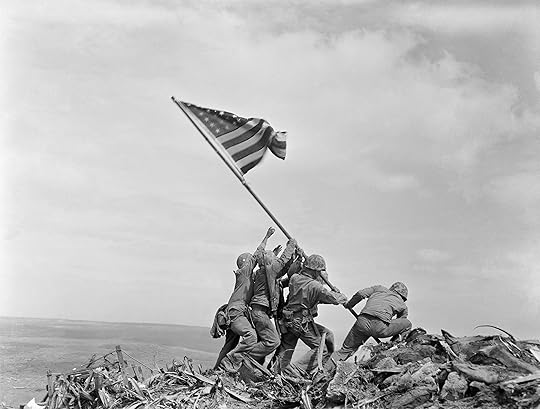
Born in 1923 on the Gila River Indian Reservation in Arizona, Ira Hamilton Hayes, a member of the Pima Native American nation, was a quiet young boy who grew up to be a quiet young man. Enlisting in the Marine Corps at the age of eighteen, after Pearl Harbor was attacked by the Japanese, he fought in the Pacific theater during World War II, and was one of a group of men who helped raise the American flag on Mount Suribachi, on the island of Iwo Jima. This action was forever captured in a photograph by photojournalist Joe Rosenthal, a photograph that would become a sensation back home in America, and around the world, a photograph that would come to symbolize American resolve and heroism:
"Raising the Flag on Iwo Jima" won Rosenthal a Pulitzer Prize, and went on to become one of the most reproduced images in the world. To Ira Hayes and the other surviving Marines of the group in the photograph, it brought fame and adulation back home. Despite this, Hayes struggled after the war with his loneliness, and with alcoholism, dying of alcohol poisoning at the age of thirty-two...
Although familiar with the work of Lakota artist and children's author S.D. Nelson, largely through his illustrations for other writers' books, Quiet Hero: The Ira Hayes Story is the first of his own books that I have picked up. I found it engaging and informative, well told and beautifully illustrated. Ira Hayes' story was already familiar to me, but I learned some additional details here, and I thought that Nelson captured his subject's troubled emotional state with sensitivity. I am always amazed and humbled by the patriotism of our Native brothers and sisters who, despite the troubled history between their tribal nations and the United States, continue to this day to volunteer for military service at higher numbers than any other demographic group. This wonderful picture-book captures the quiet heroism of its eponymous subject quite well, and could be used in educational units on WWII (particularly in the Pacific), as well as to open discussions about Native American military service, patriotism, veterans, PTSD, and substance abuse.
Quiet Hero: The Ira Hayes Story is a children's picture book written and illustrated by S.D. Nelson. It is a biographical picture book of Ira Hayes – a Pima Native American and marine.
November, at least in my part of the world is Native American Heritage Month, which I plan to read one children's book, preferably a biography, which pertains to the subject everyday this month. Therefore, I thought that this book would be apropos for today.
Ira Hamilton Hayes was a Pima Native American and a United States Marine who was one of the six flag raisers immortalized in the iconic photograph of the flag rising on Iwo Jima during World War II. Hayes was an enrolled member of the Gila River Pima Indian Reservation located in the Pinal and Maricopa counties in Arizona. He enlisted in the United States Marine Corps Reserve on August 26, 1942, and, after recruit training, volunteered to become a Paramarine. He fought in the Bougainville and Iwo Jima campaigns in the Pacific Theatre of Operations.
The text is rather simplistic, straightforward, and informative. Nelson tells the tale twice: once in simple language, accompanying dappled acrylic views of a bronze-skinned lad with downcast eyes, posing in and out of uniform, and again at the end in smaller type, with photos and more background detail.
The premise of the book is rather straightforward. Hayes grew up as a shy, lonely lad raised on Arizona’s Gila River Indian Reservation, he found his place serving as an honorable warrior in the Pacific battlefield and was one of the WWII marines captured in the famous Iwo Jima photograph. He returned to the States a celebrity, took to drink to help deal with his feelings of isolation and died an alcoholic less than ten years later.
All in all, Quiet Hero: The Ira Hayes Story is a wonderful biographical picture book about the good, the bad, and the ugly about a marine who happens to be a Native American – Ira Hayes.
This story was a story that talks a lot about many different things that may not be talked about enough in school. Most importantly the story talks about how native Americans fit into our culture and how things used to be in the past. The story also focuses on world war 2 and the Native American individual who helped put the flag down in Japan which was a historic moment. This story gives information about both native Americans and world war 2.
2006. Biography 1. Good for talking about Iwo Jima war, read aloud, or during a Native American Month. About the life of Ira Hayes a man who is in the Iwo Jima War statue. Talks about it and a timeline is in the back of the book.
I appreciate the honesty with which the book was written. I appreciate the way alcoholism was discussed and then further addressed in the authors note and acknowledgement. I am saddened that we lost so many to the heartbreak of Indian Schools, colonialism and alcoholism.
I didn't realize this was a children's book when I ordered it online. It was a good read but I was looking for something with a bit more information. Completely my fault for not reading the online description....
Not the most outstanding informational picture book, but notable for highlighting a modern American Indian hero and for unflinchingly acknowledging Hayes's struggle with alcoholism.
This book was great considering it was about fighting wars across the world, it can be a great lesson for children to understand what war is really about.
The last book I reviewed here, The Liberators, was a novel about two friends who joined the Marines and serves in the Pacific theater. Our Hero, the Ira Hayes Story is about a man who really did serve in those sames places - Vella LaVella, Bourgainville, and who ultimately became one of the heroes who raised the flag at Iwo Jima.
Ira Hayes was a Pima Indian, born on the Gila River Indian Reservation in a remote part of the northern Sonoran Desert in Arizona in 1923. His family were poor farmer, working the land, but living without electricity or running water. They had four sons, and Ira was the oldest. He was quiet and shy, but always felt lonely and seemed to fit in with the other kids on the reservation or in the Phoenix Indian School when he was sent there.
But, while still in his teens, the Japanese attacked Pearl Harbor and the United States went to war. Ira felt it was his patriotic duty as an American to fight for his country and he joined the Marine Corps in August 1942 at age 19. Sent to basic training in San Diego, Ira didn't experience the kind of segregation and low level jobs reserved for the African American soldiers because many believed that Native Americans were fierce warriors and so they trained with the white soldiers.
After basic training, Ira volunteered to train as a Paramarine. Joining the military and going through such rigorous training seems for forge strong bonds of friendship among the soldiers, and it was in the Marines that Ira finally felt like he belonged. Ira and his fellow Marines arrived in the Pacific theater in March 1943 and fought there for two years. After the month long battle at Iwo Jima, Ira was one of six Marines who raised the flag over Mount Surabachi, a moment captured in a photograph by AP photographer Joe Rosenthal.
Ira came home a true Native American hero, but civilian life wasn't easy for him. Most of his buddies didn't survive the war and Ira found it difficult to be celebrated knowing the terrible price his buddies had paid. And once again, Ira felt like an outside, not fitting in anywhere. Ira became severely depressed, and started drinking heavily. In 1955, at the age of 32, Ira Hayes passed away. He is buried in Arlington National Cemetery.
S. D. Nelson has written a very moving and insightful picture book for older readers about a real hero, showing us that even heroes aren't perfect. He could have easily written the Ira Hayes story up to the flag raising at Iwo Jima, and left it at that, but instead he chose to continue and let his readers see that heroes are human and sometimes flawed. Ira Hayes may have officially died of alcoholism, but I would say the loneliness, despair and depression were the real causes of his death.
Hayes' wartime experiences make up the majority of this book, but Nelson doesn't ignore his youth on the reservation and his time at the Indian School, giving us a clear picture of this very sensitive, isolated Pima Indian growing up in poverty, but surrounded by a loving family.
As you can see from the illustration above, Nelson's text is accompanied and complimented by his beautifully detailed acrylic illustrations using a widely varied palette of colors. And be sure to read the Author's Note at the back of the book, where he includes a more detailed account of the life of Ira Hayes, as well as very useful Bibliography for further investigation.
This book is recommended for readers age 8+ This book was borrowed from the NYPL
Hailed by President Harry Truman as an “American hero,” Ira Hayes’ life is an example of how Native Americans proved their patriotism amidst injustice and discrimination. Hayes was a Pima Native American who grew up on an Indian reservation in Arizona. Living in poverty, his parents allowed him to attend school at a government-run boarding school for Indians. At the school, students were taught how to be “civilized.” Shedding their traditions, culture, and language was a part of the education in this school. Although more lax when Ira attended it, this school was originally created to train Native American girls to become maids, and Native American boys to become laborers. When Pearl Harbor was attacked, Ira decided to join the marines to serve his country. Because he was a Native American, he was considered to be a fierce fighter by the marine recruiters. They allowed him to train for combat instead of forcing him to cook or carry supplies as other Native Americans in the military did. Serving on the island of Iwo Jima, Hayes participated in raising a flag on the island during a battle. This was captured by a photographer who immortalized Hayes’ involvement for humanity. The picture he took of Hayes and his five fellow marines is the most reproduced photograph in U.S. history. The photographer received a Pulitzer Prize for the photo. Because of the attention through the media, Hayes became a national hero. Hayes struggled with his newfound fame and took to drinking, succumbing to alcoholism at the age of 32. This book addresses many of the injustices that Native Americans suffered. The attempted eradication of Native American culture by the American government is evident through the story. There are several ways I think teachers could approach using this story in their curriculum. Frontloading information on World War II, focusing on the most famous photograph of the war, and then learning about the true story of one American soldier would emphasize the conditions of many Native Americans at this time. It would also serve to remind students of the diversity of our armed forces. It could also be included in a unit of minority Americans in history or a unit on heroes. This is a story that I believe few K-12 students know, but should be told.
Summary: A member of the Pima Indian tribe, Ira Hayes grew up on an Indian Reservation in Arizona. He was always a quiet, shy boy and never wanted to be the center of attention. When he was in high school, The United States called men to arms to fight in WWII. As a result, Ira signed up with the United States Marine Corps where he served his country honorably. Finally, his unit was sent to Iwo Jima, a Japanese island. There, he was photographed by chance erecting the United States flag with his fellow soldiers.
Classroom Use: The back of this book has great resources and a documentary type spread where more facts are given for further reading. As a follow-up to this story, I would have them research the other five soldiers who were captured in the flag raising picture. The following website has a list of the other men and some basic information on them. http://www.iwojima.com/raising/raisin...
Great read-aloud for secondary students for Veterans Day, studying of World War II, and alcoholism in Health. Illustrations are incredible.
*Veterans Day at my school is huge. The students make a fabulous breakfast for Veterans in our community and serve in our gym. It's all made by the students and the students serve the veterans. It's a great program our school does each year.
Themes: World War II, in the famous Iwo Jima marines sculpture (US Marines War Memorial) Ira Hayes is the one with his hands in the air, Alcoholism.
Quiet Hero, The Ira Hayes Story is a unique tale of an unlikely World War II hero. A Native American solider whose benign personality has always kept him in the shadows until he found his place working side by side with other courageous men in the Marine Corps. Sadly, Ira Hayes survived the war only to lose himself to alcohol and died at age 35. This book should be a reminder to everyone how important it is to support our veterans, since the scars of battle run much deeper than can be shown.
Quiet Hero: The Ira Hayes Story is a nonfiction picture book about a modest war hero who fought in WW2. Ira Hayes is a fascinating story of an unlikely hero. He is one of six private first classmen who raised the flag atop Mount Suribachi in Iwo Jima. Award-winning photographer, Joe Rosenthal, captured the infamous scene that is well-known throughout the world. The back matter includes 3 pages of author's note and photographs. A bibliography is listed at the end.
S.D. Nelson did a fabulous job sharing the life of Ira Hayes from boyhood to his tragic death as writer and illustrator.
Very interesting biographical book about Ira Hayes and the background behind the United State Marine Corps War Memorial in Washington D.C.
Could be an interesting springboard into discussions about alcoholism, positive ways to cope with loneliness and depression, war, and multiculturalism. We didn't talk about these things much except a brief background of WWII.
This book was about the life of an American Hero named Ira Hayes. The book describes his life beginning from when he was a child to when him an five other soldiers raised the United States flag on Iwo Jima during World War II. I would use this book in the classroom one as a motivator from children with interest in war heroes and also in describing how to write biographies or autobiographies.
A thoughtful look at the life and death of Ira Hayes who faced personal and institutionalized racism, who became a Marine and served bravely for the United State of America, and who died from alcoholism. Gorgeous art, poignant historical photos, and the painful story of a hero whose country treated, and still treat, him and his fellow First Peoples without deference, respect, dignity, and honor.
INFORMATIONAL I loved everything about this book! I had a special connection to this book, because I have a brother who is also serving in the current war and I am Native American. The book was extremely accurate of Native Americans at the time. I loved the illustrations too!!
For sure read this before a trip to DC so you can have the background to the US Marine Corps War Memorial. Kind of depressing--but all too true nonetheless.
This is a biographical picture book. It was published in May of 2002. I loved that this book is about a World War II hero who is Native American. You do not hear stories like this very often. You could use this book when teaching about Native American or about World War II. It is also a book that I have read to a few younger children and they loved it so just having it in your classroom would be a good idea.
This was such an inspirational book!! The way Ira was so humble even when he was considered to be so talented and famous!! It would be a great book to read to the class as a project.