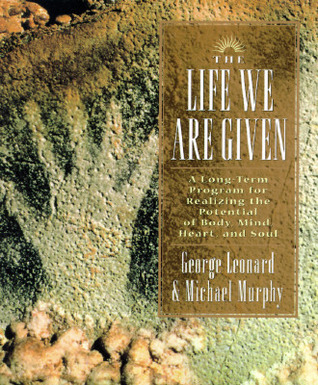
The author of The Future of the Body and the author of Mastery team up to present a proven method for reaching the next stage of human development.
Can people with the time-and energy-consuming concerns of job and family find a way to transform their lives through a regular, long-term program of body/mind/spirit development? Is it possible, through conscious choice, to participate in the next step of human evolution? Two of the most distinguished theorists and teachers of human transformation believe the answer to these questions is yes.
In this inspiring and practical book, George Leonard and Michael Murphy offer a comprehensive program of Integral Transformative Practice (ITP) based on a two-year experimental class that grew out of their lifework. Drawing upon some seventy years of combined experience in the study of human potential, along with the significant findings of their recent experiment, they present step-by-step instructions for joining body, mind, heart, and soul in an evolutionary adventure that has powerful personal and social implications.
Their message will be especially refreshing to those who have become disillusioned by promises of immediate gratification, instant learning, and effortless enlightenment. This book shows the way to profound and lasting transformation through long-term practice. It celebrates the day-by-day joys of the path while opening fresh vistas to human futures.
Bestselling author Michael Murphy has been called the father of the human potential movement, one of the most influential movements in twentieth-century American culture. His bestselling book Golf in the Kingdom (1972) inspired the creation of the Shivas Irons Society, a nonprofit group dedicated to finding beauty and discovery through the game of golf, and has recently been adapted into a movie starring Malcolm McDowell (2010). His other books include Jacob Atabet (1977), An End to Ordinary History (1982), In the Zone (1995), and The Kingdom of Shivas Irons (1997). He lives in California.
At the time I read this, I predicted it would be in my top 20 life-changing books of all time. Of course, predictions like this don't often turn out to be true, especially when they are made in times of upheaval or stress. I read this book in search of inner peace, at a time when my life was in major transition. It did very much ease me through the transition, but then I moved on.
My very favorite thing about this book is its exercises, especially the physical, pseudo-yogic exercises, which are very doable and very useful in strengthening and calming. Two of them in particular stayed with me for months, and they were easy to fit into my routine. The rest of the book dealt with the potentials of being human--all the potential that we have to develop physically and spiritually; all the potential that goes untapped. I grew to appreciate the authors very much, and I was inspired to purchase a lot of books they recommended for further reading.
In the end, as almost always happens, the exercises and the ideas ran their course, and I let it go. It's been a long time since I thought about it. But perhaps books are just like that: They can have a strong affect on the psyche, and then they fade. I believe that a kernel (of the good ones) stays along though, more or less permanently, even if it's tucked away into the unconscious somewhere. I believe that's the case with this one, which I read almost 4 years ago.
Anyway, this is recommended for anyone who wants to build their potential as a human being, holistically.
Authors George Leonard and Michael Murphy wrote in the Preface to this 1995 book, “Like the human heart, the world points beyond itself to something greater and more beautiful than its present condition. That something … leads many of us to seek transformation. Does it secretly inform the entire evolutionary adventure? Could it be that the human heart and the world’s heart are one in their self-surpassing? We believe that they are… More and more of us are waking up to this fact… We are fortified in this perception by the emerging story of our universe… this immense panorama of universal evolution from the incredible birth of space and time to the emergence of human culture… The idea that divinity is present in all things, manifesting itself through the immense adventure of evolution, helps account for the mystery of our great surplus capacities, our yearnings for God, our inextinguishable creativity, our sense of grace in human affairs. It helps explain our quest for self-transcendence and humanity’s proliferation of transformative practices… Every person on this planet can join the procession of transformative practice that began with our ancient ancestors. That is the guiding idea of this book. The ways of growth described here… embrace our many parts. We call them ‘integral’ to signify their inclusion of our entire human nature---body, mind, heart, and soul.”
They explain in the first chapter, “For years, the two of us had wanted to try out our ideas about the realization of extraordinary human abilities, to see if people with busy lives could change themselves for the better through long-term practice. We had long held a vision of human evolution and the transformation of human societies. Separately and together, we had worked for most of our adult lives inspired buy the belief that all of us possess a vast, untapped potential to learn, to love, to feel deeply, to create, and that there are few tragedies so pervasive … as the waste of that potential.” (Pg. 3)
They continue, “It’s hard to say how much of the world’s neuroses, drug abuse, illness, crime, and general unhappiness can be traced to our failure to develop our God-given abilities. But surely people who are involved in lifelong learning, in practices that encourage community, good health, and a sense of oneness with the spirit of the universe, would be unlikely to sink into the despair, unrest, and cynicism that lead to so many individual and societal ills. Early in 1992, sustained by our faith in the human potential, we convened an experimental class in what we called Integral Transformative Process (ITP). The experiment lasted for two years and provided material and inspiration for this book. But it isn’t just this one class that informs our words, but rather the gleanings of a long journey, a lifetime’s quest.” (Pg. 4)
They observe, “In a culture intoxicated with promises of the quick fix, instant enlightenment, and easy learning, it was hard to accept one of the most important lessons that came to us out of those powerful but short-term experiences. Any significant long-term change requires long-term practice, whether that change has to do with learning to play the violin or learning to be a more open, loving person.” (Pg. 8)
They outline, “from our years of experience we had drawn certain basic principles for the enterprise of human transformation…that would guide us in leading the class and which continue to guide us today. Among them are...: "Lasting transformation requires long-term practice… The most effective transformative practices involves the whole person---body, mind, heart and soul… Transformative practices in this age are best guided by several mentors rather thana single, all-powerful guru… Though practitioners at times must surrender creatively to mentors, community, and transformative agencies beyond ordinary functioning, the final authority always remains with the induvial.” (Pg. 15-17)
They explain, “Integrative Transformative Practice (ITP)… is based on a vision of evolutionary transcendence and offers the possibility of positive changes in many aspects of your being. We also feel that it has significant social value… [It] has greatly improved the overall health of the great majority of those who have undertaken it… Without a significant shift toward a healthier way of life among its citizens, every advanced… nation now faces a … perhaps unbearable strain on its health care system… The only solution… lies in changing the way we live. In terms of social responsibility, the pursuit of good health is a moral act.” (Pg. 40-41)
They add, “On the path of Integral Transformative Practice, our affirmations are clear, straightforward statements of positive change in body, being, and performance. They represent a firm contract with ourselves. They focus our best conscious efforts on transformation while seeking to enlist powers beyond our conscious understanding.” (Pg. 53)
They state, “The Japanese word ‘kata’ means ‘form.’ Our usage here is … where the practitioner performs a series of predetermined moves. The ITP Kata was designed by George Leonard to be performed in forty minutes… You can trace its lineage to hatha yoga, the martial arts, modern exercise physiology, Progressive Relaxation, visualization research, and witness meditation.” (Pg. 73)
They say, “Kata’s last exercise [is] a ten-minute period of mediation. By ‘meditation’ we mean the disciplines observation of thoughts, feelings, impulses, and sensations, as well as the spontaneous turning of heart and mind toward a Presence beyond the ordinary self. This practice, which combines self-observation with what is sometimes called ‘contemplative prayer,’ helps practitioners contact new depths of being, awareness, and delight.” (Pg. 107)
They observe, “In Integral Transformative Practice… we prefer to view vigorous physical movement not as a mechanical process that yields so many benefits for so much effort expended, but rather as a fundamental expression of our embodiment, essential to our practice precisely because it is valuable FOR ITS OWN SAKE.” (Pg. 117)
They clarify, “we prescribe no specific diet, nor do we push for weight loss. In fact, we explicitly oppose the whole idea of ‘dieting.’ We do, however, recommend that everyone eat a healthy, balanced, low-fat diet. The ITP commitment on the subject of food is quite simple: ‘We are conscious of everything we eat. We bear in mind the many benefits of a diet low in fat and high in fiber.’ Top be conscious means to pay attention … as you choose or prepare food and as you eat, and that you stand mindful of the aftereffects of the food eaten.” (Pg. 134)
They explain, “In our ITP practice, we offer exercises that call upon this teacher not only to show us how to live a more balanced, vital, and healthy life but also to point the way toward the next stage of human evolution… we see body, mind, heart and soul as coequal manifestations of the human essence. But where deep down human change is concerned, there is no more effective teacher than the body.” (Pg. 145)
They state, “there is an ‘all-at-once’ quality about certain activities that constitute transformative practice… the cognitive aspects of integral practice have this all-at-once character. A good intellectual grasp of our ITP programs went along with improvements in the emotional and physical functioning of class members. The ancient adage that body, mind heart and soul mirror one another has been confirmed by our ITP practice. By embracing the intellect, integral practice enhances ALL our parts.” (Pg. 183)
They conclude, “We believe that … each of us carries a spark of divinity in every cell and that we have the potential to manifest powers of body, mind, heart, and soul beyond our present ability to imagine, We believe that a society could find no … more appropriate compass course for its programs and policies, than the realization of every citizen’s positive potential. We mean the potential inherent in every aspect of our lives… Such a compass might create clarity where there is now confusion and bring the human psyche into harmony with nature and the cosmos.” (Pg. 202-203)
This book will be of keen interest to those seeking ‘transformation’ and ‘human potential’ ideas and practices.
I just read the most recent review. As an ITP practitioner, "The Life We Are Given" Is wonderful introduction to the practice. No book, without practice, will produce significant personal change, it takes work!
After about 10 years of practice, my entire life has changed. Stress-free job, new home through good decisions and timing on right-sizing, significant health improvements (I am now at a weight from 30 years ago, and have not had any illness in recent memory.) On the relationship side, I am as close to my grown daughter as could be, there is an intensity and love that comes from truly knowing one another. Even my love life has improved.
Reading the book was only a starting point. Practicing in connection with others, that makes the difference. Taken this way, it becomes a reference point and practice guide, not just a self-help read!
The integration of mind and spirit with body is very well covered. This is a useful book to offer clients who are very strong cognitively AND somewhat out of touch with the knowing center in their bodies and hearts.