A BRACING ACCOUNT OF A WAR THAT IS EITHER MISUNDERSTOOD, FORGOTTEN, OR WILLFULLY IGNORED. For Americans, it was a discrete conflict lasting from 1950 to 1953. But for the Asian world the Korean War was a generations-long struggle that still haunts contemporary events. With access to new evidence and secret materials from both here and abroad, including an archive of captured North Korean documents, Bruce Cumings reveals the war as it was actually fought. He describes its origin as a civil war, preordained long before the first shots were fired in June 1950 by lingering fury over Japan’s occupation of Korea from 1910 to 1945. Cumings then shares the neglected history of America’s post–World War II occupation of Korea, reveals untold stories of bloody insurgencies and rebellions, and tells of the United States officially entering the action on the side of the South, exposing as never before the appalling massacres and atrocities committed on all sides.Elegantly written and blisteringly honest, The Korean War is, like the war it illuminates, brief, devastating, and essential.
A specialist in the history of Korea, Bruce Cumings is the Gustavus F. and Ann M. Swift Distinguished Service Professor in History, and former chair of the history department at the University of Chicago.
The Korean dimension of the Korean War may have been too long overlooked. We Americans tend to think of Korea as “the forgotten war,” a lacuna to be placed between the great victory of the Second World War and the shocking defeat that was Vietnam; but in his 2010 book The Korean War: A History, University of Chicago historian Bruce Cumings takes pains not only to demonstrate that the “forgotten war” has never been forgotten, in either part of long-divided Korea, but also to place the war of 1950-53 within a larger context of Korean history.
Cumings, whose scholarship has centered mainly around Korean and East Asian history, is not interested in providing a strictly military history of the Korean War – the sort of thing that can be found in books like British historian Max Hastings’s The Korean War (1987). As if to demonstrate, only about 30 pages of a 243-page book – or, to put it another way, part of the book’s opening chapter, “The Course of the War” – actually provides that chronological, events-driven summary of military history that readers might expect. The rest of the book focuses upon how the war is seen and remembered – within the context of Korean history, in both North Korea and South Korea, and in the United States of America.
Generally, modern writing on North Korea has focused on the cruelty and the human-rights abuses carried out by the North Korean regime, or on the way in which the government of contemporary North Korea constructs a bizarre cult of personality around its leaders past and present. Cumings, by contrast, seeks to understand the thinking and motivations of the North Koreans, going all the way back to when North Korea started the war with its June 1950 invasion of South Korea.
For Cumings, the key factor at work here is the North Koreans’ knowledge that a number of South Korea’s post-World War II leaders had collaborated with the Japanese during Japan’s 1910-45 occupation of Korea: “To the North Koreans it is less the Japanese than the Korean quislings that matter: blood enemies. They essentially saw the war in 1950 as a way to settle the hash of the top command of the South Korean army, nearly all of whom had served the Japanese….The Japanese occupation of Korea from 1910 to 1945 is akin to the Nazi occupation of France, in the way it dug in deeply and has gnawed at the Korean national consciousness ever since” (pp. 44-45).
Whatever the validity of Cumings’s points regarding North Korean motivations, however, the fact remains that North Korea started that hideous war, launched the invasion, initiated all that bloodletting. I do think it is important that those facts not be forgotten.
Indeed, one of the salient features of The Korean War is Cumings’s determination to be fair and accurate to the North Koreans. While noting, accurately, that “North Korean political practice is reprehensible,” Cumings denounces “the incessant stereotyping and demonizing of this regime in the United States,” and adds that “After seven decades of confrontation, the dominant American images of North Korea still bear the birthmarks of Orientalist bigotry” (pp. 97, 100).
I appreciate the critical-thinking spirit in which Cumings looks at American media coverage of this important country, but I can’t help pointing out that American media and American organizations are not the only ones denouncing North Korea’s cruelty to its people. International human-rights organizations like Amnesty International, after all, have been diligent in pointing out how the North Korean regime abuses the rights of the North Korean people. When these human-rights groups, including many based in Asia, denounce the behaviour of the North Korean government, would Cumings claim that they too are engaging in Orientalism?
Another of Cumings’s emphases in The Korean War: A History is his wish to deconstruct some of the American myths that have sprung up regarding the conduct of the war. In the traditional Korean War narrative, Americans and their allies fought in the same fundamentally honourable manner in which they fought in the Second World War; only Vietnam, with its numerous and well-documented examples of American atrocities against Vietnamese civilians and enemy prisoners, offers a departure from that paradigm. Au contraire, Cumings might say, pointing to specifics like the American air war against North Korea: “[W]e carpet-bombed the North for three years with next to no concern for civilian casualties….[W]hen foreigners visit North Korea, this is the first thing they hear about the war” (p. 149).
Comparing the Korean War experience with the Allied application of heavy bombing tactics against the Axis powers during the Second World War, Cumings observes somberly that “The United States dropped 635,000 tons of bombs in Korea (not counting 32,557 tons of napalm), compared to 503,000 tons in the entire Pacific theater in World War II” (p. 159). If Korea is, from the American perspective, the “forgotten war,” then perhaps there are some very serious reasons why we are in such a hurry to forget the damned thing.
The picture becomes even more complicated – and, for American readers, potentially even more uncomfortable – when Cumings addresses the issue of atrocities committed against civilians during the war by both the South Korean and North Korean forces. Since 2005, a Korean Truth and Reconciliation Commission has been documenting massacres of civilians; its grim findings are that “South Korean authorities and auxiliary right-wing youth squads executed around 100,000 people”, and that “Communist atrocities constituted about one sixth of the total number of cases” (p. 202). Again, this is not the depiction of the Korean War that Americans conventionally get.
Cumings’s emphasis on cruel actions committed by the South Koreans, and by their American allies, might lead some readers to wonder whether this book constitutes a sort of apologia for the North Koreans. But I do not think so. Rather, Cumings feels that “it is increasingly likely that the ROK’s authority will someday be extended to North Korea” (p. 199). It becomes all the more important, Cumings might argue, that in a future united Korea, Koreans from both north and south look at the difficult and painful history of their country with clear eyes.
Cumings dedicates this book to Kim Dae Jung, the former South Korean dissident. Under the former system, Kim Dae Jung had been jailed and threatened with death for his criticisms of South Korea’s then-authoritarian government; as President of South Korea, he instituted democratic reforms in his country, worked for peace with North Korea, and won the Nobel Peace Prize.
I purchased The Korean War: A History at a bookstore in Seoul’s ultra-modern Incheon Airport, which occupies the site of a major battlefield of that war. Reading it on a flight from Seoul to Washington, I often felt that Cumings was working too hard to provide a revisionist perspective, and in the process was letting the North Korean regime off too easily. At the same time, I read Cumings’s book as an expression of hope that modern South Korea – and, someday, perhaps, a possible united Korea – will move forward in the spirit of peace and democracy that Kim Dae Jung represented.
While reading through the reviews of Bruce Cummings "The Korean War" I noticed more than one reviewer complain that Cummings book isn't a history of the war. Up to a point they are right, it is not a conventional history of that war beyond the first thirty-seven pages of two hundred and forty-three that narrate the actions of leaders and armies from beginning to end of the "war". But it only takes a moment of reflection to realise that the remainder of the book is as valid a part of the history of that war.
Cummings places the war of 1950-53 firmly in its historical context, making it clear that there had in essence been conflict going back decades in Korea, exacerbated by the Japanese invasion of Manchuria, and between those who collaborated with the Japanese and those who didn't. To an extent this division was also class based. He also disabuses the reader of any notion that South Korea was a land of peace and tranquillity prior to the war, insurrections were endemic and the South Korean regimes response were extremely brutal. The background detail on the two regimes that formed when the U.S. artificially split Korea in 1945 is useful in so far as it diminishes assumptions based on the current state of North & South Korea.
Other issues dealt with include a fresh look at how the war started, the role of foreign powers (of whom the U.S. followed by the Chinese were the most important), the question of U.S.'s possible use of nuclear weapons, the role the war played in the origin of the Military-Industrial complex, attrocities (Cummings claims the U.S. & South Korean forces were responsible for roughly six times more attrocities than the Chinese & North Korean forces), how both sides viewed one another, and how memories of the war have effected all sides (not least the North where the War and their previous experience with Japanese Imperialism provide historical justification for the regime).
This is a fascinating book, and in my opinion gains more than it loses for not being a chronological account of the movements of armies and the decisions of generals and political leaders. Instead its thoughtful analysis, and multifaceted approach serve to give the reader a richer view of a war that in the West has largely been eclipsed by the Second World War that preceded it and the War in Vietnam which was the next Asian country to feel the effects of U.S. military intervention. "The Korean War" is a book I wouldn't hesitate to recommend.
I've spent the pandemic learning some introductory 한국어 which has highlighted for me my ignorance of anything more than the broadest outlines of Korean history. My first attempt to read a standard work about the war stalled out by page 50. So I went back to Goodreads and read reviews of other books. This one has plenty of negative reviews excoriating it for being revisionist and not a blow-by-blow account of the war, which for me was a recommendation. In the end, this was exactly what I wanted: a book that refuses to valorize the war (even though the author is American) and spends most of its pages situating the conflict in a more expansive cultural and political context.
I wouldn't have expected any account of American military adventures post-World War II to make us look good, and this doesn't. Above all, Cumings shows that the US didn't know what it was doing in the first place (for example, putting collaborators with the Japanese in charge of things after the the end of WWII), changed strategy partway through the war, (from ejecting the North Koreans from the South, to defeating them in the North), and then proceeded to forget about the war even though it has never officially ended. (This connects to one reason for my interest: Germany and Korea have both been divided countries, but Korea has now been divided for over twice as long as Germany was.)
Giving a basic chronological timeline of what happened when isn't the author's goal here, but I felt like I got the basics under my belt. Cumings deals with memory in several interesting sections, contrasting blithe US cluelessness about Asia in general and memory-holing of atrocities, with South Korean truth and reconciliation work and with North Korean efforts to keep the fires of memory alive through the generations. The US may consider the war to have taken place in just a few years in the early '50s, but Cumings shows how it relates to currents of Korean history from the 19th century to the present. And on the US side, he discusses how the Korean War marked a change in US military policy with obvious implications for Vietnam, but also Iraq.
The descriptions of atrocities here are difficult to read but essential for honest learning. His account of the experiences of comfort women smokes with righteous indignation. (The index of the Hastings book, by the way, jumps from "Collins, Lawton J. 'Lightning Joe'" to "Commonwealth Division.") Cumings won't excuse America's willingness to close its eyes to atrocities committed against ostensible Communist foes (no matter how far removed from actual Communists) or its goal of laying waste to the countryside to prevent the Communists from benefitting.
This is the kind of book that is hard for me to summarize the major points of because there is a new insight at every turn. It is however true that it could have been more clearly organized, especially if it is meant to be an all-in-one introduction, hence four stars.
I had issues with this book. Many, many issues (though, I didn't outright hate it, I have to give it that).
The first being that, for all the title is "The Korean War", this book really isn't about the Korean War. The first chapter is a brief summary, and then they talk about the atrocities committed during the war, but it's hardly the focus of the book. While I found a great deal of what he wrote about interesting, such as pre-Korean War rebellions, that's not what I bought a book to read about,
On top of that, the book bounces all over the place time wise.
I also didn't like Cumings's writing style. The North Korean bias, that didn't bother me (actually, it was fairly refreshing, reading that, given how vilianized the country normally is), not really. When he went and made sweeping statements that take that bias way too far. One example that stood out to me was basically 'South Korea fought with the Japanese and supported colonialism', which completely undermines/undervalues any resistance that South Korea made in ejecting the Japanese colonial government. Cumings also writes from one extreme to another, without ever finding a middle ground. For example, in the introduction, the tone comes across as basically 'Korea should be grateful that Japan colonized it and effectively tried to eradicate it's culture, because modernization! Really, the only reason they're still holding a grudge is because they're sore losers'. Then, not long after, he goes to the complete opposite when talking about the horrendous crime that was comfort women, and goes straight to Japanese bashing. I will give him kudos for focusing on the brutality of the allies side, given that it's usually only focused on North Korea, since they were the 'bad guys'.
On top of that, the language was too flowery and repetitive.
This is the book to read for an understanding of Korea--not just the Korean War, but Korea itself, north and south. North Korea will be much less enigmatic once you read this book. Cumings goes deep into Korean history, and especially into the Japanese occupation of Korea and Manchuria from the 1930s until the end of WWII. In Cumings' retelling, the North under Kim Il Jong was heroic in its determination to rid the country of their Japanese overlords and return to Korea to the Koreans. The South under Syngman Rhee was controlled Japanese collaborators who cooperated with the the U.S. in its dedication to ridding the country of leftists, whether or not they were working in league with the Northern communists. Worse atrocities were committed by the South than any committed by the North. And, even after the outcome at the 38th parallel was rather well settled, the U.S. continued a bombing campaign for 2 years to decimate all northern economic activity. Thus, the attitudes of the North toward the Japanese, the U.S., and the South were cemented by the reality of their subjugation and persecution. They blocked out the rest of the world (other than the Chinese, who had helped them), and became the North Korea that we know today.
Cumings does not approve or condone the dynasty that has developed in North Korea, their manipulation of mythology and superstition. But it becomes clear, from reading his book, why it became that way.
Beyond being great history, this book is also historiographical, and discusses how the history of Korea and the war were written with a non-Korean bias, making the actions of Kim Il Jong seem like those of a fanatic rather than one seeking a legitimate nationalistic goal.
About the worst book I've read about the Korean war, the author tries so hard to discredit others who have written about this war. And the American men who fought and suffered there.
I assume the author never fulfilled his military obligation.
When GI's were dying in Asian countries, he was probably sipping mint julips and playing with himself.
The author has a very scattered style of writing with mentions of Marilyn Monroe, Picasso, and a lot of other silly trivia.
He does the usual MacArthur bashing.
AND, he tries to minimize Dean Acheson's idiotic Press club speech where he says that "South Korea is outside America's defense perimeter"
The north Korean's thought about this for 6 months, got backing from Russia, prepared for war, then invaded.
Cumings thinks this" "worked beautifully for Acheson, who was seeking ambiguity and trying to keep BOTH the Communists and volatile allies GUESSING ABOUT WHAT THE U.S. WOULD DO IF SOUTH KOREA OR TAIWAN WERE ATTACKED."
Yeah, right, when did Acheson ever say this?
And with the communist countries tightly allied from 1945 to the 1950's, did we REALLY want Russia to wonder about our "AMBIGUITY"?
They did have nukes from 1948 on, everything I've read about our nuclear policy was that it was the OPPOSITE of ambiguity.
They nuke us and we retaliate with everything we have.
MAD.
The author is a college teacher, so one has to accept that he doesn't live in the real world.
He seems to like the Korean war, every couple of years he writes another book about it.
This is not a survey of said conflict and is such an unusual choice for the Modern Library Nonfiction catalogue. Cumings asserts that for myriad reasons the Korean War drifted out of collective consciousness. The American stewards of the War (Acheson MacArthur) never understood the origins and prosecuted it in a heavy handed way which only exacerbated antipathy between North and South. The author asserts that the war can only be understood in the context that Japan made Korea a colony in the early 20C and that the ruling elite of the South collaborated with the Nipponese until the end of WWII. The propaganda of the time (racist Orientalism) used the grievance of Koreans invading Korea as it is moral compass. This was followed by the subsequent US/UN invasion of the North -- which isn't viewed as egregious. Then the Chinese came roaring across the Yalu and it became rather cold outside. Unfortunately this book launches asides at other books on the conflict, books I have lined up to read over the next couple days.
This work is not "a full and many-sided account of the Korean War" (p.231) as the author himself concedes. In large measure this is because, unlike the United States and South Korea, the archives of North Korea are unavailable. We know enough from recently opened Soviet archives that "it was exactly the war Truman said It was at the time: Kremlin aggression" (p. 228). We know even more from American and Korean archives, and from the work of the Korean Truth and Reconciliation Commission, that U.S. forces were complicit if not actually responsible for some of the worst human rights violations during the war. No wonder Americans would like to forget all about it.
Nevertheless, the Korean War changed the United States in ways that World Wars I and II and Vietnam didn't. The author claims that Korea was the real origin of the "military-industrial complex," with American bases around the world and an explosion in defense spending and contracting. It "turned the United States into a country entirely remote from what the founding fathers had in mind, where every foreign threat, however small or unlikely, became magnified and the fundamental relationship of this country to the world has changed forever."
This argument isn't new and I find it a bit overblown. The original military-industrial complex emerged during the U.S. Civil War and revived during World Wars I and II. The Manhattan Project, for example, brought military, science, and industry into collaboration that has never ended. Nonetheless, Korea did bring us unprecedented "peacetime" spending on the military and a necklace of U.S. installations around the Soviets' necks.
The ignorance of U.S. policymakers about Korean history, culture, and politics was also nothing new. When have the Americans ever understood the countries they occupy or meddle? Not the Philippines, certainly or Brazil or Greece or Iran or Iraq or....well, hell, pick the country. Americans never learn because they have sufficient power to overlook those different from us. As Thucydides long ago wrote, "The strong do what they can and the weak suffer what they must." I don't think that has changed.
The Korean War: A History is first and foremost a scream of rage into the void at the precipice of past-present-future U.S.A..
Bruce Cumings is mad as hell that the Korean War is "forgotten" by those nations who fought on the peninsula under the banner of the UN and at the behest of the United States and the Truman Doctrine. He is disgusted by the crimes against humanity committed by those who made the war happen, those who vilified and continue to vilify an enemy to which they gave little choice, those who got in bed with fascists and imperialists only to become the world's policeman in a rush to "stop the spread of communism." He wants us all to know that Korea -- more than the World Wars, and more than Vietnam -- led to the kind of nation the U.S. has become, from its bullying ways to its inner tensions to its financial priorities to its untenable place in the greater world.
He wants us to see the truth. And for Cumings seeing that truth means that if his words aren't enough to convince you, all you need do is follow his sources. He tells you exactly which box in which archive, or which book in which library, or which article in which journal each and every piece of evidence comes from. He wants you to see that what he has laid out before us isn't revisionism, nor is it a take down of American spirit, it is simply the uncomfortable truth about one of the 20th century's most pivotal moments -- if not its most pivotal.
And he wants you to remember that the Korean War is not over. And he wants you to fear what will happen when it spills out of the DMZ, and the hawks of that war return to the sky. And he wants you to think about how you and I and we can stop new Koreas and Iraqs and Afghanistans from being added to the U.S.'s growing list of failures of imagination. He wants peace for us all because there is value in peace.
This entire book is honestly essential reading, but a few of the quotes really stood out to me.
The indelible meaning of the Korean War for Americans was the new and unprecedented American military-industrial complex that arose in the 1950s. Until that time Americans never supported a large standing army and the military was a negligible factor in American history and culture, apart from its performance in wars. (p. 211)
In the end upward of 100,000 Koreans in the southern part [of Korea] were killed in political violence before the Korean War; once the war began at least another 100,000 were killed … (p. 138)
Senator Joe McCarthy was supplied documentation on alleged subversives, most of it classified, by J. Edgar Hoover, Willoughby [known as MacArthur’s “my little fascist” (p. 85)] and Whitney of MacArthur’s staff … (p. 87)
In January 1951 “correspondents were placed under the complete jurisdiction of the army.” Criticism of allies and allied troops was prohibited—“any derogatory comments” met the censorship’s black brush […] worst of all, some U.S. journalists and editors even concocted false reports. (p. 84)
This is a wonderfully comprehensive look at the political, social, cultural and military underpinnings of the armies which converged and combatted on the Korean peninsula in 1950. Not just a military overview of the war's events, Cumings specifically centres the historical (and complex) relationships between Korea and Japan, Japan and the US, and ultimately the US and the ROK in the broader context of the conflict, which existed long before the US and UN involved their militaries, and thus provides essential context for the sentiments of the soldiers and civilians.
This book is awful! I picked it up because a book club group I semi-follow was reading it and I had just read another book on the history of the war. I really tried, but I just couldn’t make myself finish it. Gave up with about 70 pages to go. The book isn’t really a history of the actual war itself. Author is clearly anti-American, attempts to portray North Korea as the victims, seems to think bashing other books and authors on the subject make him more credible, and uses the New York Times as a major source. I do agree with him that this is a largely forgotten war and many Americans tend to ignore it or simply aren’t interested in learning about it. If you want to read about the Korean War, pick another book because in my opinion, this one isn’t worth the time.
“The Pacific War began in 1931 and ended in 1945, just as the Korean War began in 1945 and has never ended, even if the fighting stopped in 1953. Nor has the North Korean–Japanese war that began in 1931–32 ever ended; South Korea normalized its relations with Japan in 1965, but through many failed negotiations Pyongyang and Tokyo have never normalized or reconciled—and thus there has been no “closure” to either war from the North Korean standpoint;”
I was glad to find this book on my audible list, because I really don’t know very much about the Korean War. I was five or six, so have no memory of it happening. I have never read very much about it.
But this book tells a good deal of the story, but not with much of a focus on the Battlefield events other than very generally. This is a book that will help you understand that this was yet another Civil War within the country that the United States got involved with because of its own reasons. And the reasons and the way it participated are not a very pretty story.
The author tells the story about how this war is the reason that the United States has ended up with a ever increasing military force and budget and troops all around the world. And, of course, telling the truth about what is happening or what happened is clearly optional. We were of course the good guys. Or were we? This book will show you that in war there are no good guys.
Lots of footnotes in this book as well as references in the text to books and sources of information. If you look up this author, you will be amazed at how many books he has written about Korea. This country is his specialty and has been for quite some time. This particular book was published in 2010 so it has the benefit of a point of view that includes quite a few years “after“ the war. Most of us do know that the war has never formally been ended with a truce. And that the US still has an army there.
This book was informative about mostly ghastly and terrible war crimes that were committed during the Korean war. It did not go in depth about the actual battles or the White House strategy of the war as I was hoping. It was clearly written by a hard core liberal with a lot of anger built up for his own country. The book demonized the South Koreans and the Americans in the war while trying to make Kim Il Sung look not so bad. The most damning part of the book was when he stated and I'm paraphrasing. Yes the North Koreans killed several American POW's but it was a merciful bullet behind the ear. He then went on to make the crimes committed by the North Koreans pale in comparison to the evil south Koreans and explain why the communists hate us so much. It was well written but it did not focus on the war so much and if I were in the Kremlin I would use this book as propaganda for young students studying the west. Too liberal, too anti American, too many exceptions for communist crimes.
I can see why Blowback used this frequently as a source in their third season of the podcast. This is a great example of a history that doesn't shy away from reality. This is no play by play of the movements of armies but a book that lays bare the Korean war in amazing historical context. Cummings spends time tracing the impacts of the separation of the Korea's post WW2 and does not shy away from displaying and discussing atrocities committed during the war , and while some would call this at times biased towards North Korea. The truth is that the DPRK , it's land and it's people were ravaged by this war, the west and the UN should be ashamed that their "defence" of the RoK turned into a march on the Yalu and the destruction of nearly an entire nation.
Parts that struck me include when Cummings discusses the immense bombing and destruction of the DPRK by American/UN forces (an absolutely disgusting act), and the comparative killings of PoWs and surrendered troops (30k by DPRK to 100k+ killed by Americans) and the beginnings of the US military industrial complex and professional US Army as we know it today.
Other reviewers have already pointed out that the title is a misnomer. While Cumings manages to cover the history of the war (as well as the pre- and post- history), it is definitely not a straight narrative history.
The book is a revisionist look at the "forgotten war" which tries to show the darker side (atrocities by our soldiers and allies) of our participation rather than just that of the North Koreans. I don't know enough about the events to judge his point of view but I found it interesting and I do like reading both (or all) views of an issue. There was a lot of overlap with this book at "The Icarus Syndrome" which I just finished (see my review) in that Cumings sees the US "forgetting" the failed attempt to take the North and focused solely on their successful push back to the 38th parallel and then using this as pretext to launch similar campaigns elsewhere.
"The Korean War was thus the occasion for recasting containment as an open-ended, global proposition." (219)
"Finally, it was this war and not World War II which established a far-flung American base structure abroad and a national security state at home, as defense spending nearly quadrupled in the last six months of 1950, and turned the United States into the policeman of the world." (243)
Cumings has accessed recently declassified documents, as well as testimonials from survivors, to paint a portrait of Korea that no American has ever seen before. He attempts to bring the mysterious war-between-the-wars into the light--a conflict forgotten even before it was finished--while casting doubt on our perceptions of heroes and villains.
The fights against Communism and colonialism are the backdrop for this painful dissection that begins with Korea's nineteenth-century occupation by Japan. A culture as old and as rich as any other was then pushed and pulled, ripped apart by influence and interference from the United States, the Soviet Union, and China. Fears and prejudices sparked atrocities by both north and south Korea, against each other and against their own people, and Cumings shows that America shares much responsibility for letting it happen, as well as taking part.
A civil war that was won quickly by an outsider, The Korean War then became an attempt to put a foot to the throat of growing global Communism, a transgression that turned victory into stalemate and perceived defeat.
A short book and otherwise easy read, with revelations that are hard to accept and impossible to forget.
I've read a lot of criticism of this book and it's author in the past, so much so that I delayed reading it for a long time. I'm glad I finally read it because, while there are certainly problems with it, it certainly does fill in the gaps in the literature in regards to atrocities committed by allied, and, especially, South Korean forces.
Not too long ago I visited the POW camp on Goeje Island while on vacation and many of the things I saw there didn't make any sense, like signs explaining the percent of inmates that were believed to be communist, number believed to have converted to communism while in the camps, numbers that wanted to be returned to North Korea versus South Korea, etc. I have read other books about the Korean War, but it wasn't until I finished this one that I realized that these were essentially internment camps filled with the regular citizens of entire South Korean towns and villages that were emptied upon suspicion of the slightest leftist presence. This included people that had no connection to North Korea whatsoever, but were opposed to the iron-fisted rule of South Korea's own leaders, or even the 'citizens committees' that sprung up in the countryside for the very practical reason of having some kind of government during the leadership vacuum after the expulsion of the Japanese.
This all being said, I do agree with other reviewers that said the book's title is inaccurate. This is not a history of the Korean War. This is a collection of essays intending to fill in the gaps of knowledge and correct misconceptions about the context of the Korean War. In fact, I would offer as an alternative title: "Contextualizing the Korean War."
I also agree with other reviewers that stated this should not be the first book one reads about the Korean War, and certainly not the only book. The author is open about his primary intentions to provide some balance to the conventional wisdom about the war. While he doesn't say that other historians have been wrong, he says they have neglected to tell the whole story (namely, about war crimes committed by allied forces- mostly ROK troops). This strikes me as an entirely reasonable position to take.
One question that lingers in my mind is in regards to the original drawing of the line at the 38th parallel during the plans for sharing interim governing duties with Russia. In this book and in others, Cumings keeps coming back to it as if it is some kind of self-evident damnation of responsibility the United States has for dividing the peninsula. I just don't see the significance that he seems to put on it. Seen in context, drawing the line there was part of negotiations with Stalin, whom they believed to have been hungry for expansion. In retrospect this may have been a miscalculation, sure, but I would say the US hand picking Syngman Rhee, and relying on a bureaucracy and infrastructure put in place by the Japanese, was probably far more of a mistake in the long run than splitting hairs over where, or if, a line should have been drawn.
I mean, who is to say that there wouldn't have been a Korean War if Roosevelt's trusteeship council idea had taken off? The bottom line is there were deep wounds in the Korean psyche after the Japanese occupation and there was no serious attempt at justice or reconciliation. It's easy to see how a civil war still could have erupted, and perhaps been even more complicated than a North/South war.
But hey, I'm no historian. In spite of its imperfections, this book will get you thinking about what you know and what you thought you knew. It's a must read for anyone seeking to get beyond a surface understanding of the Korean War.
Cummings book is another attempt of a liberal academic to write a convincing apology for the U.S. overthrow of the Korean people’s government that emerged from efforts by efforts of Korean workers and peasants in 1945. Cummings apology extends to the subsequent repressive US military occupation and setup of the US sponsored Rhee dictatorship. Korean collaborators with the Japanese from northern and southern Korea, many of whom officered in the Japanese Imperial Army in its subjugation of both Korea and China were hand picked by the US and Rhee as the core of the new governing power, ROKA officer corp, police and right wing death squads from the very beginning of US rule in the south. Cummings only tells part truths about the repression so he can continue the big lie. I’m not buying it. His line is not much better than David Halberstam’s salute to the US military “experience” in Halberstam’s The Coldest Winter. Cummings gives props to the Reconciliation campaign and then uses those revelations to try to justify a position of his moral superiority. (And I’m always wary of intellectuals who like to cite Nietzsche for their clinching analogies) Missing were the chapters on the struggles of those who shed blood to make those revelations possible. The Stalin lead Soviet Union went along with the drawing up of an arbitrary division and with the subsequent US occupation below the 38th parallel and that’s a betrayal on the part of the USSR. That doesn’t justify the division. Korea is One!
This should not be the first book that you read about the Korean War. Cumings assumes that the reader has a basic understanding of events and then proceeds to explain how and why our common America understanding of this "forgotten war" is false. Very interesting but I need to read more basic historic narratives before jumping into this discussion.
What I liked: 1. 38th parallel was an imaginary boundary that we have enforced for more than 60 years. The Korean War was and is a civil war that we stepped into. We have created our own reasons for fighting... but they are not the reasons that the North Koreans recognize or use. 2. The Americans chose a side that was conducive for their economic goals, not because they were morally superior. (In fact, at the time, they were the complete opposite.) 3. The Korean War was a prototype of Vietnam... without the pesky media broadcasting what was really happening to the folks back home. Fragging military officers and civilian slaughter happened here first. 4. Truth and justice can still be looked for and found. It's never to late to rewrite the history books. By doing so we learn more about our enemy and more about ourselves.
Revisionist. Op Ed pieces from the NYT and official North Korean Army documents seem to be the main source documents. To suggest that a full retreat from the Pusan Perimeter to the Yalu was "strategic" and that the Inchon landings were fully anticipated is buying into DPRK propaganda as much as journalists buying into McArthur's censored reports, whom Cumings clearly detests. Pot calling the kettle black. Comparing atrocities is a fool's game: lots of bad things happen to innocents on all sides (and I say that without minimizing the actual suffering and terror that occurs). The lesson should be that we should be very cautious about going to war, not that one side is morally right for having killed less innocents. I also have a problem attacking people based on who their parents or grandparents were during WWII. To suggest that the grandson of a war criminal will commit the same atrocities or follow the same ideology based on heredity is entirely baseless and stupid.
I appreciated that this book, despite its title, is not a blow by blow history of the war activity in North and South Korea. While Cumings describes the atrocities of the Korean War (1950-1953), his focus is also on the historical background events of Korea, the involvement of the Soviet Union and China, the Japanese occupation, the internal guerilla activities and American intervention. Understanding the past ellucidates the present. I have not read enough books or studied the Korean War (this history was rather glossed over in my history classes) to determine the possible biases in Cumings' book, but he is correct that the war has been the "forgotten war" or, as Cumings prefers - the unknown war, the repercussions of which are still present.
This book has inspired me to read further about the Korean War and American relations with Southeast Asia.
But war is a stern teacher; in depriving them of the power of easily satisfying their daily wants, it brings most people's minds down to the level of their actual circumstances.
So revolutions broke out in city after city, and in places where the revolutions occurred late the knowledge of what had happened previously in other places caused still new extravagances of revolutionary zeal, expressed by an elaboration in the methods of seizing power and by unheard-of atrocities in revenge. To fit in with the change of events, words, too, had to change their usual meanings. What used to be described as a thoughtless act of aggression was now regarded as the courage one would expect to find in a party membership; to think of the future and wait was merely another way of saying one was a coward; any idea of moderation was just an attempt to disguise one's unmanly character; ability to understand a question from all sides meant that one was totally unfitted for action. Fanatical enthusiasm was the mark of a real man, and to plot against an enemy behind his back was perfectly legitimate self-defence. Anyone who held violent opinions could always be trusted, and anyone who objected to them became a suspect. - Thucydides Warning: Some of what is to come below is not for those with weak stomachs.
At a time when "Rocketman" and "the dotard" are exchanging insults and placing their miniscule members on the table for comparison by those whose eyesight is necessarily more acute than my own, I have turned to the history of the Korean conflict for some perspective. And immediately, on the first page of Bruce Cuming's The Korean War: A History (2010) I find without surprise the following: Forgotten, never known, abandoned: Americans sought to grab hold of this war and win it, only to see victory slip from their hands and the war sink into oblivion. A primary reason is that they never knew their enemy - and they still don't.
The Heavens wept!
As emphasized by both Cumings and Allan R. Millett in his yet unfinished massive trilogy on the Korean War - The War for Korea, 1945-1950: A House Burning (2005) and The War for Korea, 1950-1951: They Came from the North (2010) have appeared so far - the Korean conflict was primarily a civil war, and, as is unmercifully normal in civil wars, the Koreans were particularly murderous with each other. After decades of either denying or suppressing the truth, the South Koreans followed the example of the South Africans and set up a nonpunitive commission to investigate the crimes committed during the war. Nearly a decade later, it estimated that between 100,000 and 200,000 civilians, children included, were massacred - without trial - on the suspicion of Communist sympathies by South Korean police and military. The North Koreans and their sympathizers in the South were apparently slightly less profligate in their random murders of the populace, but not much less.(*) Needless to say, North Korea has had no Truth Commission to date.
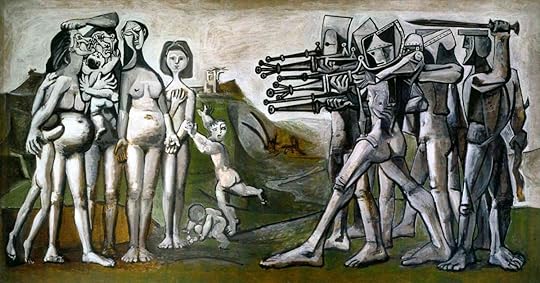
Pablo Picasso - Massacre in Korea (1951)
This was no artistic fantasy any more than the Guernica was, or, for that matter, Goya's The Third of May, 1808.
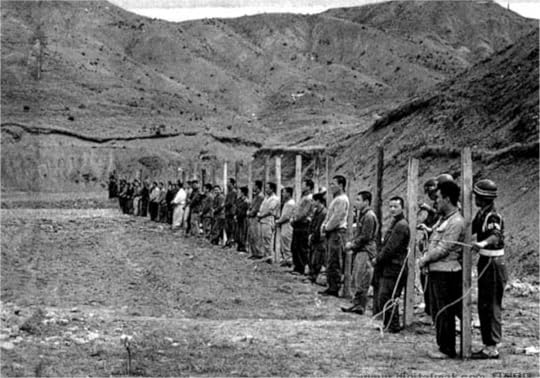
Some of the 3,400 civilians suspected of Communist sympathies executed without trial by the Republic of Korea in Pusan alone.
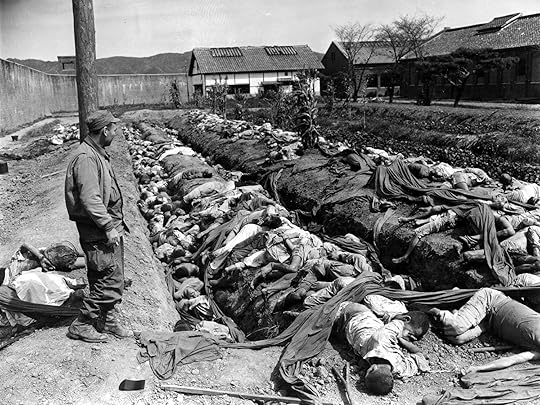
More Korean civilians bound and slain for political reasons, Taejeon, 1950 (**)
The roots of the Korean War go far deeper than the window-dressing ideological trimmings of Communism and anti-Communism. The aristocratic class in Korea had held the people in a stranglehold for centuries; at certain points in history over half of the Korean populace were, literally, slaves and the rest weren't much better off. Then the Japanese arrived and soon made Korea into a colony (from 1910 till 1945), ruthlessly capitalizing upon Korean resources and labor to set up and maintain their Asian empire. Their suppression of Korean resistance and later the very culture and language of the Korean people was equally ruthless. The Koreans came to loathe the Japanese with a passion. As usual there was a certain number of Koreans who collaborated; these people also came to be despised by their countrymen.
What I didn't know before is that most of the North Korean leadership came from the anti-Japanese armed resistance forces who fought the Japanese in China and Manchuria and much of the South Korean leadership (with the exception of Syngman Rhee himself - his name was actually Yi Sung-man) were notorious collaborators. Small wonder then that when the collaborators had themselves voted into power in the South in an election that many Koreans boycotted, a Korean had no need to caress Communist sympathies in order to find the government of the new Republic of Korea to be objectionable. But, of course, when the murdering commenced, all were painted with the same brush.
There was no simple story in Korea after its liberation from the Japanese in 1945; released from the Japanese death grip, many ideas for a new Korea were rampant in the populace. Unfortunately, those willing to commit violence for their ideas rose to power both in the northern portion, occupied by the Soviet Union, and in the southern, occupied by the USA, with the more or less active collaboration of the occupying powers. Both Cumings and Millett provide insight into the many political forces at play in Korea in the mid 1940's; really, anything I write here is necessarily an oversimplification.
Cumings takes a long view, from the late 19th century to the late 20th, and he does so with a deliberate polemical intent that is stirring but which left me with questions since some of his more important assertions were not backed up by Millett's more narrowly focused but much more intensely detailed tomes. Though not averse to directing criticism at all the parties in this conflict, Millett's yet incomplete work(***) provides a detailed look at the political and military aspects of the war without polemics.
Both the South and North Korean leadership were raring to go at each other's throats but were held back by their Russian and American masters through various kinds of threats. But then serious misapprehensions came into play. The North Korean leadership thought they didn't need the Russians (except for arms, munitions and training) - their longtime comrades-at-arms, the Chinese, would have their backs - and that the Americans wouldn't risk a nuclear war to prop up the South. The South Korean leadership thought that the Russians and Chinese wouldn't risk nuclear war and that it could handle the North Koreans easily with American help. The Americans thought the North Koreans and Chinese couldn't fight their way out of a paper bag (and that the Russians wouldn't risk nuclear war). The Chinese thought that the Americans would not be willing to sacrifice much of anything for this obscure Asian appendage. All were wrong, and millions and millions had to pay for their mistakes.
Shall we guess the misapprehensions now current among the Korean, American and Chinese leadership?
The mindset during the Peloponnesian War described so well by Thucydides in the epigraph has manifested itself repeatedly throughout Humankind's lamentable history, including in the Koreas during the late '40s. Its humors rose again in my homeland in 2001 and need but one overt act to overflow once more. The approval ratings of the glowing orange toad croaking in the White House actually edged up when he began his bluster about Korea. Nothing assures re-election like a war against a mannequin tarred and feathered by propaganda, particularly when that mannequin's own bluster has overreached into the absurd. And in Asia, face is everything. It's difficult to be sanguine about this...
(*) A particularly poignant story told by Millett: When a Communist infiltrated regiment of the South Korean Constabulary (precursor to its army) revolted and massacred hundreds of police, officials, rightists and ordinary citizens in Yosu and Sunchon in 1948, they also killed two sons of a Korean pastor for being Christians. When the governmental troops regained control of the area, the pastor pleaded for the life of the young man who had betrayed his sons to their death, promising to raise him as his son and a Christian. In 1950 when the North Korean army came through the area, the pastor and his newly adopted son were executed by the Communists for being a propaganda embarrassment to them.
(**) This massacre was initially attributed by the South Korean government to the North (and is still so attributed on some internet sites), but, no, see here:
(Nonetheless, there were many such massacres by the North Koreans.) The corrupt and brutal South Korean police and their helpers generated such blazing resentment in the general populace that when a mob rioted in Taegu in late 1946 dozens of policemen were massacred with boundless brutality (but not before they killed hundreds of rioters); I quote from The War For Korea: "Policemen, youth auxiliaries and officials were found impaled through the rectum, mutilated, burned, castrated, disemboweled and buried alive."
(***) Volume two of Millett's history ends with the preparations for the Kaesong "Peace Talks"; two more years of shooting war remained at this point before it was ended temporarily with an armistice, not a peace treaty.
For a book that’s only 240 pages, this took me a long time to read, partially from being busy, but because of how involved the content is. Several times I had to revisit parts of this, but I guess that’s the sign of something good more often than not.
Bruce Cumings is an author I’ve always respected and wanted to read a full work on for a while, and now I have several others I need to hit down the road. The Korean War is not simply another historical breakdown of an overlooked part of the 20th century, but one that takes the details from that and extrapolates several different narratives. Maybe only 40 pages covers the boots-on-grass combat, mostly near the beginning, but it does tie in the relevant precursors ranging from Japanese imperialism to the Cheju occupation and rebellion. It of course then ties in the aftermaths, the years of napalm dropped on the north, China’s involvement, etc. In other words, it places an otherwise brief history into all sorts of different contexts, and even highlights thing from the American experience and draws comparison to other books (noting which are worthwhile and which are worth skipping).
Cumings is also VERY good at tying philosophy and real world anecdotes into this, going heavy with the Nietzsche references. The main narrative boils down to being that the Korean War was less a “forgotten war” and more an “unknown war,” in the way Americans especially know little about it. From the very beginning, soldiers landed there without a proper idea of what the fighting was for and who it was against, tying into why the North crushed so quickly at first. It also clears up questions around why that happened in the first place, concluding that an imaginary line drawn by an outside foreign power meant very little to those who lived there, with border tensions and constant fighting leading to Kim Il Sung’s advance to the Ongjin Peninsula. Finally, it allows the reader to understand how the significance of US involvement here kicked off what would build the military industrial complex we now see, and how the nation has never conducted itself in the same since. It begs the questions of; how would you feel if an outsider drew a line in the U.S. during our own civil war? (Because to Koreans, this was a civil war). How would U.S. citizens feel about foreign bases on our land? What conditions led to the neo-Confucius type government we see in the north, and military dictatorships in the south for so long?
Truly this is incredible. Context is truly everything, and this book nailed it. I saw a few morons acting like this was being apologetic to the North, which means they simply didn’t pay attention, as the author clearly points out the flaws with the state that was born out of this conflict. The importance is also highlighted of understanding also South Korea’s history, which the book ends with that nations reconciliation with its past, allowing it to thrive a little more (well that, and the billions of US investment to create an economy there for Cold War purposes). Highly recommend this to anybody who loves history, especially in this region.
First, despite the title this is not a book about the Korean war. It is about all the things around the war and about the atrocities in it. I could handle the pro north bias of the author but not his pompousness. The writing style is smug condescension and the author comes across as the epitome of ivory tower intellectual. I gave it 3 stars as I learned quite a few new things and got to see this conflict from a very different perspective and that alone is worth it getting 3 stars
I'd say this is less revisionist history and more reconstructed history, and much context is excavated and restored from the mists of memory, propaganda and bigotry. An excellent reassessment of the circucumstances and impact of the Korean War.