Jump to ratings and reviews
Rate this book
Rate this book
A historian, trying to finish a long-overdue book on Isaac Newton, rents a cottage not far by train from Dublin for the summer. All he needs, he thinks, is a few weeks of concentrated work. Why, he must unravel, did Newton break down in 1693? What possessed him to write that strange letter to his friend John Locke? But in the long seeping summer days, old sloth and present reality take over.

96 pages, Paperback

First published January 1, 1982

15 people are currently reading
1341 people want to read

About the author

John Banville

133 books2,391 followers
William John Banville is an Irish novelist, short story writer, adapter of dramas and screenwriter. Though he has been described as "the heir to Proust, via Nabokov", Banville himself maintains that W.B. Yeats and Henry James are the two real influences on his work.
Banville has won the 1976 James Tait Black Memorial Prize, the 2003 International Nonino Prize, the 2005 Booker Prize, the 2011 Franz Kafka Prize, the 2013 Austrian State Prize for European Literature and the 2014 Prince of Asturias Award for Literature. He was elected a Fellow of the Royal Society of Literature in 2007. Italy made him a Cavaliere of the Ordine della Stella d'Italia (essentially a knighthood) in 2017. He is a former member of Aosdána, having voluntarily relinquished the financial stipend in 2001 to another, more impoverished, writer.
Banville was born and grew up in Wexford town in south-east Ireland. He published his first novel, Nightspawn, in 1971. A second, Birchwood, followed two years later. "The Revolutions Trilogy", published between 1976 and 1982, comprises three works, each named in reference to a renowned scientist: Doctor Copernicus, Kepler and The Newton Letter. His next work, Mefisto, had a mathematical theme. His 1989 novel The Book of Evidence, shortlisted for the Booker Prize and winner of that year's Guinness Peat Aviation award, heralded a second trilogy, three works which deal in common with the work of art. "The Frames Trilogy" is completed by Ghosts and Athena, both published during the 1990s. Banville's thirteenth novel, The Sea, won the Booker Prize in 2005. In addition, he publishes crime novels as Benjamin Black — most of these feature the character of Quirke, an Irish pathologist based in Dublin.
Banville is considered a contender for the Nobel Prize in Literature. He lives in Dublin.

Ratings & Reviews

What do you think?
Rate this book

Friends & Following

Create a free account to discover what your friends think of this book!

Community Reviews

5 stars
142 (17%)
4 stars
308 (38%)
3 stars
253 (31%)
2 stars
87 (10%)
1 star
19 (2%)
Displaying 1 - 30 of 98 reviews
Profile Image for Cecily.
1,322 reviews5,336 followers
March 7, 2019
This early novella has all the buds that blossom in Banville's later novels: beautiful imagery of nature and light; sensual evocations of smells and stinks; an older man of dubious character; a younger woman - and an older one as well; a frustrated writer; complex, sometimes covert relationships, and gradual revelations of uncertain veracity.


Image: Apple blossom and fruit (Source.)

Banville himself told The Guardian that this is a good place to start with his works: "It's pretty well all there. And it's short."

Peel the Apple

This is a story about what’s beneath the skin. About flesh.
It’s a story within a story, though it’s light on plot.
A biography wrapped in an autobiography.
History wrapped in fiction.


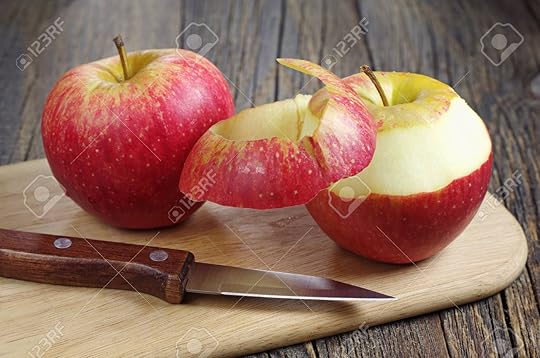
Image: Partially peeled apple (Source.)

It opens with the unnamed narrator writing to Clio, explaining why he’s abandoning the book he’d been working on for seven years. It was based on a letter 50-year old Newton wrote to John Locke, when his best work was long behind him, and he was turning to the Bible and alchemy.

As he focuses on Newton’s breakdown, his own work loses momentum and fizzles out. There are parallels - and perpendiculars - between the two men, and rather than an apple falling from a tree, apocryphally onto a person, it's a person who falls from a tree.

The narrator turns his attention to the family in whose grounds he’s renting a cottage. His interests and perspective shift: imagining - mythologising - about their relationships, lives, and finances. Like a scientist, he recalibrates and modifies his assumptions as he learns more. Newton was a man of laws, but they are Lawless, and the women have an alchemical effect.

Life will insist on tying up loose ends.
I’m glad that Banville does not.

Other Apples

I seem to have been only as a boy playing on the seashore, and diverting myself in now and then finding a smoother pebble or a prettier shell than ordinary, whilst the great ocean of truth lay all undiscovered before me.” Sir Isaac Newton

Apart from that opening quote, Newton barely features explicitly, apples even less (though there are apple trees in the garden), and there’s not much plot. Yet afterwards, my reveries were mainly of apples.

Apples feature in so many proverbs, myths, and fairytales, they are weighted with symbolism, whether poisoned, golden, forbidden, or ordinary. Most fundamentally, they are associated with revelation and insight: Eden and Newton, both. But knowledge isn’t necessarily good, or even recognised and understood, as the Newton quote suggests.


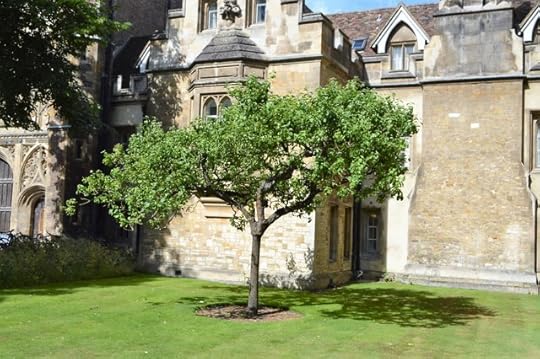
Image: Descendant of Newton’s apple tree, Trinity College, Cambridge (Source.)

See Also

Banville’s Revolutions Trilogy / Scientific Tetralogy
This is one of three short novels Banville wrote, connected to scientists, the rest of which I’ve yet to read. Some add Mefisto and call it a tetralogy:
Doctor Copernicus (1976)
Kepler (1981)
• The Newton Letter (1982)
Mefisto (1986)

Banvilles I’ve Reviewed
It was devious, and heartless, and horribly pleasurable. Who knows the sweet stink of power like the disenchanted lover renouncing all claim to loyalty?
That is a quote from this, but it could just as easily be Max Morden (in The Sea) or Alex Cleave.

Because I’d read The Sea (written 13 years after this), I noticed references to smell in this far more than I would otherwise. See my review HERE.

The Alex and Cass Cleave trio can be read in any order, as all switch back and forth, like waves breaking on a beach:
Eclipse (2000). See my review HERE.
Shroud (2002). See my review HERE
Ancient Light (2012). See my review HERE.

Elective Affinities
Long ago, I read Goethe’s Elective Affinities, because I was on a Kafka kick, and heard it was a favourite of his. Only after finishing this novella, did I realise similarities between Goethe’s and Banville’s stories: the names of the wife, husband, and orphaned young adult niece that the unnamed interloper encounters, as well as something of the muddied, shifting relationships in a claustrophobic house and garden. See my very brief review HERE.

Quotes

• “The weather… sunny and still, and tinged with sadness.”

• “The sycamores were stirring faintly, almost surreptitiously in the bright air, ,ike dancers practising steps in their heads.”

• “A pond… overhung by the sadness of willows.”

• “In an alcove a clock feathered the silence and let drop a single wobbly chime.”

• “I confess I enjoyed the sexual freemasonry with its secret signs and glances and the covert smiles.”

• “We were so quiet I could hear the rain’s whispered exclamations at the window.”

• “The chestnut tree murmured softly in its green dreaming.”

• “The bruised light of late afternoon conjured other days, their texture felt but they themselves unremembered.”

• “In moments like that you can feel memory gathering its material, beady-eyed and voracious.”

• “Is it possible to love someone of whom one has so little?”

• “It was an eighteenth-century day, windswept and bright, the distances all small and sharply defined, as if painted on porcelain.”

• “The flat insinuating odour of other people’s intimacies.”

• “The night came in, smelling of wet and the distant sea.”

• “The gaseous light of dawn.”

But I found this sex scene more comical than was probably intended:

In the city of the flesh I travel without maps, a worried tourist: and was a [sic] very Venice. I stumbled lost in the blue shade of her pavements… Then, when I least expected it, suddenly I stepped out into the great square, the sunlight, and she was a flock of birds scattering with soft cries in my arms. We lay, damp and chill as stranded fish.
Profile Image for Fabian.
1,004 reviews2,116 followers
July 17, 2020
Practically flawless, this taut tale is all about knowing that you actually know very little after all. And that some laws of nature are not fixed: the human element messes everything up. And elevates it.

Here, a master of beautiful, careful prose. Contender for my favorite novel of this year (2015).
Profile Image for Ian "Marvin" Graye.
948 reviews2,785 followers
September 7, 2021
CRITIQUE:

Embroiled with Women

On September, 16, 1693, Isaac Newton wrote a letter to the philosopher John Locke that accused him of endeavouring to "embroil me with women, and by other means". It isn't clear from the letter what he was being embroiled in, but it seems that Newton was lobbying via certain friends (including Locke and Samuel Pepys) to acquire a job in London, possibly the Warden of the Royal Mint, to which he was eventually appointed in 1696.

Newton apologised for his allegation on the basis that he had been ill and had been getting very little sleep:

"I had not slept an hour a night for a fortnight together, and for five days together not a wink." (1)
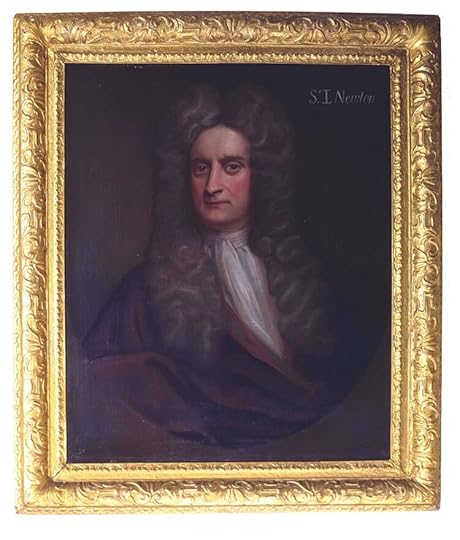
description
Sir Isaac Newton, Warden of the Royal Mint

The Narrator, Too, is Embroiled

The nameless narrator of "The Newton Letter", an historian, is fascinated by this letter and plans to make it a focus of his biography of Newton, upon which he has been working for seven years (he believes that Newton had suffered a nervous collapse which detached him from the absolutes of his scientific world of space, time and motion). In fact, at the beginning of this novella, the narrator has rented a lodge on an estate in southern Ireland to finish his work in one last dash.

His project comes to an end when he becomes embroiled with two women who live in the big house (Ferns) on the estate. The question is whether he's embroiled in fact or only in his imagination?

The Failure of Words and Text

The novella purports to be a letter (or a sequence of letters) from the narrator to a woman called "Clio" or "Cliona" ("my teacher and my friend, my inspiration"), who might actually be his editor or his publisher.

He declares to Clio that "words fail me" and "I've lost my faith in the primacy of the text." Ironically, the details of his story are communicated by words in a text, albeit a different one from the biography he had originally contemplated (because he had become the subject of his own history). Perhaps, what his failed words and text establish is that the imagination, being the source of fantasy, invention and irreality, can prevail over reality, if not exactly text itself (which can and does convey fantasy).

The Big Game of the Intellect

The narrator relates to "all those high cold heroes who renounced the world and human happiness to pursue the big game of the intellect."

This reference seems to apply equally to some of the characters or subjects of the two previous novels in John Banville's Revolutions Trilogy ("Doctor Copernicus", and "Kepler").

The Renunciation of the Ordinary World

Like Newton, the narrator is trapped in his imagination, in pursuit of the big game of the intellect (and the biggest gamer in the big game of the intellect).

The imagination removes the narrator from the (real) world (to the extent that there is such a thing) and deposits him in a romantic world of his own creation. This world is secret and difficult to share with anyone else (apart, possibly, from the objects of his love or fantasy).

"The Spawning of Multiple Selves"

One of the narrator's romances (the real one is with 24 year old Ottilie; the other, imagined one is with her aunt, the older Charlotte, who is married to Edward Lawless)(2) removes him from the day to day reality of life and "the ordinary world" around him. He feels that his secret life has developed multiple selves or personae:

"Being a man with a secret was a full-time role...

"In this spawning of multiple selves I seemed to see the awesome force of my love, which in turn served to convince me anew of its authenticity.

"Perhaps this sense of displacement will account for the oddest phenomenon of all, and the hardest to express. It was the notion of a time out of time, of this summer as a self-contained unit separate from the time of the ordinary world.

"The events I read of in the newspapers were, not unreal, but only real out there, and irredeemably ordinary; Ferns, on the other hand, its daily minutiae, was strange beyond expressing, unreal and yet hypnotically vivid in its unreality...

"There was no sense of life messily making itself from moment to moment. It had all been lived already, and we were merely tracing the set patterns, as if not living really, but remembering...

"Now I saw this summer as already a part of the past, immutable, crystalline and perfect. The future had ceased to exist. I drifted, lolling like a Dead Sea swimmer, lapped round by a warm blue soup of timelessness."

description
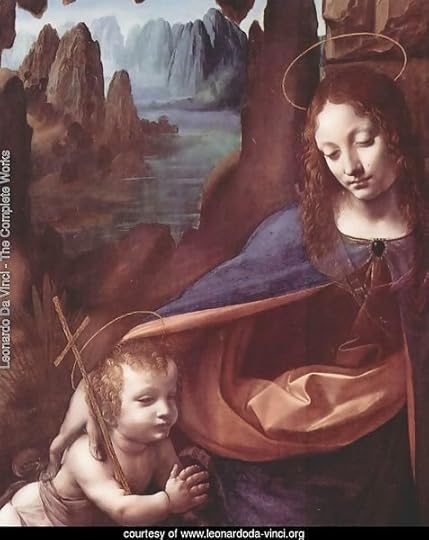
Madonna of the Rocks (Leonardo da Vinci)

"An Anchor in this World Adrift"

He even returns to his book project: "I needed something on which to concentrate, an anchor in this world adrift." Like Newton, he craves "a language none of whose words is known to me; a language in which commonplace things speak to me..."

It's tempting to read and construe the novella in terms of Proustian memory. However, I wonder whether it's more analogous to Sartre's differentiation of perception (observation) of an external object, cf. imagination, in which we picture something imaginary (quasi-observation).

Imagination vs. Perception

In contrast to observation (which is one perspective on the object), Sartre argues that imagination is total. In the object that appears in our imagination, we have all sides of the object supplied to us at once. Imaginary objects are a "melange of past impressions and recent knowledge". In effect, imaginary objects are what we intend them to be. Because imaginary objects appear to us in a way which is like perception but is not perception, we have a tendency to treat them as if they were real. That is not to say we are deluded; we know that they're imaginary. But we tend to ascribe emotions, traits, and beliefs to these irreal objects as if they were real. (3)

One of the women, Ottilie, "took on the high definition of a figure seen through the wrong end of a telescope, fixed, tiny, complete in every detail. Anyway, from the first I had assumed that I understood her absolutely, so there was no need to speculate much about her."

The narrator's relationship with Charlotte is almost wholly fantasy: he describes it as "the delicate dance I was doing with Charlotte in my mind." They were "fevered imaginings" like "some obscene surrealist fantasy." The people around him "seemed part of a dream." There was "no world around us anymore, only the vast darkness, stretching away. Everything was possible, everything was allowed, as in a mad dream."

"A Passion of the Mind"

Ottilie's appeal is equally imaginary; he describes it as "the sense of her essential otherness, made poignant and precious because she seems to be offering it into my keeping."

It's not always an affectionate relationship. "I slapped her face. It happened so quickly, with such a surprising, gratifying precision, that I was not sure if I had not imagined it."

"More Self-Delusion"

Soon, the narrator realises that his longing for Ottilie is "devious, and heartless, and horribly pleasurable...more sentimentality, more self-delusion." (4) It's just his imagination running away with him. "Is this what love is really for, to lend us a new conception of ourselves?"

Ultimately, this beautifully-crafted novella invites the reader to ask questions about love: Is love fired by the imagination, or does love fire the imagination?


SENTENCE-CRAFT
[Alliteration and Sibilance]:


"I took her in my arms and felt the soft shock of being suddenly, utterly inhabited"... "In her family they were a kind of Scott and Zelda, beautiful and doomed, hair blown back and white scarves whipping in the wind as they sailed blithely, laughing, down the slipstream of disaster"... "I saw her come out in the tawny light of evening"... "...a stilted sonnet, say, by a silver poet"... "I spent hours, a smiling spider, weaving webs to trap them into talking about her"... "There are moments like that, sunlit and still, when the worst and deepest fear of the heart will drift out with the dreamy innocence of a paper skiff on a pond"... "Shall I awake in a few months, in a few years, broken and deceived, in the midst of new ruins?"


AVIAN VERSE:
[In the words of John Banville]


Hawk

The hot day
Hummed.
Above the
Distant wood
A hawk
Was hunting.

Blackbird

That blackbird
Was still singing,
In the dark,
Pouring out
Its heedless heart.

Seagull

The seagull
Flew away,
Scattering
Its mewling cries
Upon the air.


FOOTNOTES:

(1) See the context of the letter. See also the article here. Newton wrote to numerous other friends and acquaintances as well. His deranged letters reminded me of those written by the protagonist in Saul Bellow's "Herzog".

(2) Many of the named characters are named after characters in Goethe's fiction.

(3) (Source.)

(4) I wonder whether this is, in part, an allusion to Nabokov's "Lolita".


SOUNDTRACK:
Profile Image for Pedro.
825 reviews333 followers
November 1, 2025
Equívoco

Por alguna razón los editores y exégetas, desconozco si por ignorancia o marketing, incluyeron esta novela en una saga llamada La trilogía de la ciencia (o, luego Teralogía), lo cual es un equívoco o un engaño.

Llegué a este libro por la satisfacción que me produjeron sus libros previos, la magnífica Copérnico y la correcta Kepler. Pero, más allá del título, la figura de Newton aparece sólo a través de una anécdota, una carta y el proyecto de novela basado en ellos. También se insinúa una analogía entre el bloqueo del científico, después de haber revolucionado la ciencia entera a través de su teoría de la atracción de las masas o de la gravedad a los 24 años, con el bloqueo del escritor, el síndrome de la página en blanco que se ha retirado a un lugar aislado para escribir su libro. (Hay que tener mucha autoestima para compararse con Newton.)

En esta novela, Banville, que comenzó su carrera de escritor con las primeras obras mencionadas, comenzó a mostrar una transición de la categoría de escritor de novelas histórico-científicas, a el gran Escritor, a secas, que llegó a ser.

Respecto a su contenido, creo que está muy bien resumido en la presentación, y hay poco más que agregar.

Me pareció correcta, aunque la leí con la sensación irritante de haber sido estafado. Tal vez merezca una relectura, cosa que seguramente no haré; tal vez en otra vida.
Profile Image for Kathy.
3,869 reviews290 followers
September 1, 2019
Perhaps too many stars for such a short book (81 pages), but I am a fan of Banville's writing. I was anticipating spending time with Newton, but that was not to be.
A man heads off to the country to have a peaceful setting away from life's distractions to finish his book on Sir Isaac Newton that has been in the works for seven years. The lodging is outside of Dublin in a rundown property called Fern House. What he finds there is a willing bedmate and some other complicated distractions.
He is invited to the table when they have company in honor of a child's birthday where the conversation is ghastly. "I realised, with the unnerving clarity that always comes to me with the fifth drink, that if there were to be a sixth I would be thoroughly drunk." There is piano music and dancing and then the owner of the house, Charlotte, sits down to play. She is the writer's object of love rather than the younger bedmate. "...in this moment at the end of a past that now was utterly revised. I hiccupped softly. On the piano lid there was an empty glass, a paper party hat, a browning apple core. These are the things we remember."
Well, that lady presented other problems including a husband nearing death who should not have been drinking. He ends with a new problem on top of the unfinished book he must finish. Telling would be a spoiler, so I won't.
The format of the book is as a letter being written to his friend and mentor, Clio. He feels he needs to explain where he has been and what he found himself doing rather than writing his book. As to our main character's name, there is not a clue, interesting in itself.
Reading part of this book at the Chicago Jazz Festival today added to the enjoyment for me.

Library Loan
Profile Image for John Dishwasher John Dishwasher.
Author 3 books54 followers
October 24, 2021
Once in a while I fall into this lethargic funk where I don’t care about anything. Everything seems so meaningless that I just don’t see the point of going on. The protagonist of this book feels the same way. As the book opens he has slumped into a lull where he cannot continue his years-long biographical project on Isaac Newton. Turns out Newton felt the feeling also. After Newton’s life’s work crested with Principia, he delved into some weird occultish research that went nowhere; and then he just kinda gave up on everything. No one’s immune, apparently, to this existential surrender. The Newton Letter explores this feeling metaphorically, postulating where it comes from.

Banville attributes it ultimately to our inability to grasp the true source of things, the locus of existence, that meaningful, unshakeable center of everything. We just can’t seem to touch it, he shows, no matter what kind of will we put toward it, or genius. He personifies that ultimate truth as a woman he cannot love. She is blurred, as if drugged, and opaque, and remote. Degraded, she is -- worn out, wasted away. He recognizes that what he sees of her superficially is merely a ghost of her hidden self. And she is inaccessible to him for all kinds of reasons -- Because of the dissipation of the world that surrounds her; because of how the world obstructs and distracts him while in her presence. In the end we all end up accepting a substitute for this ultimate truth. A younger, more persistent and gauche creature. “Unlovely” the protagonist calls this other entity, though entertaining and physically satisfying. She is the regular world that, by default, we all inhabit.

Banville portrays a haunting kind of nostalgia in this book. As if we humans are aware of something we’ve never actually experienced, longing romantically for a memory we’ve never actually lived: That ultimate truth that continually escapes us.
Profile Image for John.
Author 537 books183 followers
February 9, 2016
I'd assumed this would be a historical novel following on from Banville's Doctor Copernicus and Kepler, but it proved to be a novella set in the modern day (well, the mid-1980s).

A historian is blocked towards the end of his chunky biography of Isaac Newton, the sticking point being the unexplained nervous breakdown that Newton suffered relatively late in life. Our hero rents a cottage for the summer in the grounds of a ramshackle house in the countryside in hopes that the solitude will force him to concentrate on finishing his book. Instead, he becomes slowly embroiled in the lives of the family living in the larger house, entering into an affair with the younger woman, believing himself to fall in love with the older, despising the husband of the latter, trying to form a relationship with the child.

What becomes apparent to us is that the historian is incapable of interpreting these people with whom he's interacting, and the relationships between them; just about every assumption he makes proves false. How then -- although he seems never to face directly this question himself -- can he hope to unravel the workings of one of the most complicated minds there has ever been, and one who's not alive and two hundred yards away but dead centuries ago?

I found a great deal to like in this short piece, but at the same time I'm uncertain how long it'll stay in my mind. If I'm still thinking about it in a month's time -- in other words, if on reflection I find it has greater depths than I can currently see -- I may come back and update these notes. For now, though, all I can say is that it gave me a very enjoyable couple of hours' reading.
Profile Image for Taylor Lee.
399 reviews22 followers
August 13, 2016
Excellent, masterful, startlingly precise.

Banville's art, to speak superficially at first with reference to language and to style, which of course find their origin in the sentence, its structure, namely, which is shaped by punctuation on the one hand, a paucity lending a staccato-like rushedness and an abundance, on the other, tainting the writing baroque, overwrought, excessive-- Banville's prose is almost surgical, but warms to escape the frigid expanse that Nabokov's writing so often inhabits. He is precise here, and with such exactness manages a tone of almost indifference. The language, the word choice, often, is impeccable.

The Newton letter itself, the figure of Newton, in fact, both appear only briefly. But the occult and legendary scientist towers, and spills a shadow in his isolated and mad-tinged obsession over the narrator, a historian writing a Newtonian history.

How can this small story, placed gently in a rural year, weave and wind so effortlessly, and present a picture so humanly real? The Newton Letter is highly recommended.
Profile Image for Trevor.
1,528 reviews24.8k followers
December 8, 2007
I'm very fond of Banville's writing, and I've liked many of his books, but this one is his best, I think. It is quite a short novel.

There are lovely little allusions to Newton's life in the book - for example, when the main character meets his love interest it is when she comes carrying a boy who has fallen out of a tree and landed on his head. Just lovely. Banville often captures something terribly human about our relationships - one of the things I remember most from this book is the main character watching the female character absent-mindedly picking her nose.

And like Newton we are left wondering about how trustworthy our narrator is when it comes to relationships.
Profile Image for Vishy.
808 reviews286 followers
August 12, 2014
Slim novella. Banville's prose is exquisite as always. Made me realize why I love Banville so much. Need to read all his books some day (this is my third book of his). Beautiful book by one of my favourite authors.
Profile Image for Vani.
637 reviews15 followers
August 19, 2014
I read The Newton Letter in one sitting primarily because it was a thin novel at only 96 pages. I like the story but found the language cumbersome. The narrator tells his tale using metaphors and at times it felt over done to the point of weighing the story down.
Profile Image for Conor Tannam.
265 reviews1 follower
August 18, 2019
Short, beautifully crafted and dominated by a note of sadness throughout. Definitely worth reading!
Profile Image for Robert Knox.
Author 3 books7 followers
January 20, 2017
I've read a number of novels by John Banville, a world-class Irish writer, whom I would nominate for a Novel Prize (though it was sweet to see Dylan get in this year), but I was wholly unaware of his early series of fictions based on central scientific and mathematical figures. "The Newton Letter" was published back in the 1980s, and since I am reading this so-called 'trilogy' out of order, I have no context in which to place. Standing completely on its own, it's another beautiful piece of writing but less completely mind-blowing than some of his later novels. It's short; almost more of a novella. And according to the criticism (which I would not otherwise know) is an updating of a famous novel from a couple centuries before by Goethe described as the paradigm demonstration of the relativity of point of view. Things, in this case relationships, look to be a certain way to the narrator, who involves himself in the lives of characters who all know about each other truths that escape the narrator. In Banville's treatment of this idea, his narrator -- a rather vain, self-absorbed scholar facing a problem in his current book project -- moves to the sticks for a quiet place to work, but does nothing but 'get involved' with the local family renting him his cottage. What he perceives to be the reality of their lives is a mere glimpse through a glass darkly. The demonstration-plot relates to Newton, the subject of our narrator's blocked book, because it suggests that time and space are not 'objective,' as Newton would have it, but 'relative.' I appreciate it, and I appreciate Banville's marvelous wielding of the English language here, as ever, but as a character the narrator is not only rather despicable but flat and rather uninteresting. He has no name --no doubt, a literary choice to make a point. He also has no heart. The central figures in other of Banville's novels -- and countless works by other authors that I care about -- are equally flawed and lack an appreciation of the harm they cause, but somehow they make me care about what I'm reading more this privileged cypher does.
Profile Image for Hamish.
545 reviews236 followers
February 26, 2020
Now this is Banville. I was expecting another literary biography ala Copernicus or Kepler; instead I found myself back in contemporary Ireland with another of Banville's self-hating narrators chronicling the past. I expected to see a slow movement from the previous novels to his current style, but instead found a 35 year old novel that could pass as his latest without anyone batting an eye. The prose, the tone, the characters, it's all here and it's glorious.

I'm curious about the genesis of this novel. Did Banville plan a book on Newton in the vein of the previous two entries in the series, but then found himself unable to write it and channeled that difficulty into the fictional tale of a historian unable to complete his Newton biography? Or did he never intend to write a Newton novel and was instead inspired by difficulties with the prior entries in the series?

I also wonder if the process of writing Copernicus and Kepler influenced the direction of his subsequent fiction. In the process of researching those historical figures and trying to create a coherent psychology and personality out of disparate factoids, did he realize how impossible it is to really know someone other than oneself? All his novels since then have involved first person narrators acutely aware (if somewhat deluded) of their own psychology, surrounded by people they don't really know or understand, that remain mysteries.
Profile Image for rr.
144 reviews3 followers
Read
December 29, 2008
A novella that beguiles and keeps its distance, The Newton Letter reflects on (as well as enacts) the tension, slippage, and oscillation between intimacy and unknowability, things and thoughts, the world and words.
(She hesitates, then adds: That sentence may have said nothing; or maybe it's said everything?)
Profile Image for Chrystal.
997 reviews63 followers
January 13, 2019
Pointless, pretentious, and mercifully short.
Profile Image for Rushyenka.
3 reviews3 followers
January 3, 2015
The review over at my blog: http://readingaroundtheglobe.tumblr.c...

To be utterly honest, I hadn’t heard of John Banville till I came across a tome of his books at a local bookstore that happened to be clearing out their stock at half-price. I grabbed an armful of books that day and picked two by Banville, going purely by the descriptions on the back. I got The Newton Letter and Mefisto, easily missing his most famous and award-winning title The Sea (of which I now recall, with the retrospective clarity of regret, seeing a billion copies that day).

The Newton Letter is a novella that centers around the absolute unknowability of others and to a great degree, oneself. It’s a story about love and our helplessness in face of curiosity regarding the person we are in love with. The narrator is untrustworthy but so is the object of his appraisal and we realize half-way through as we see the protagonist as someone on the outside, always looking in through a pane that we ourselves are on the outside.

The story begins when a historian rents a crumbling cottage in Southern Ireland to finish his grand book on Newton with the benefit of isolation. He hopes the book will win him favor at Cambridge and produce better prospects for him. But in the manner of all academic work, he finds himself more drawn to the new surroundings than to the book itself. This part is nicely littered with introspection on the ease with which procrastination becomes a regularity when you are simply avoiding finishing something you have labored relentlessly on, so much so that you feel completely severed from it. Reminded me of thesis days, it did.

His exploration of the country soon lapses into what will eventually be the remainder of the novel: a relentless search for the private details of the lives of his tenants. We are told early on of our protagonist’s unusual fondness for speculating about the particulars of the lives of strangers. You’ll relate to this if you have ever, like me and the protagonist, wondered about the life of people you’ve seen passing by or imagined the daily routines in houses on streets you’ve crossed. He is seeking ordinariness and that is what he hopes to find in the lives of his tenants. His tenants are an old (probably aristocratic/gentry) family that has now been stripped of everything but the refinement of their manner. This refinement is actually only possessed by one member the family who, for that very reason, becomes the focus of all of our protagonist’s actions and arouses in him what he deems to be love.

There are complications as he engages in an affair with another member of the family, all the while obsessing with the unattainable, older, married woman he loves. The figure of Newton is looming but has very little significance in the narrative except to parallel the protagonists’ declining faith in his work. He is striving to understand why Newton lost his senses and wrote an ignominious letter to Locke but this is not a preoccupation for him, it just crops up now and then. I’m not sure if his attempt to understand Newton’s descent into madness is meant as a reflection of his own descent into a state he cannot make sense, especially since he believes Newton lost pride in his work as relativity emerged and he too is losing faith and hope in his manuscript.

What should really make you read this book is the prose. It has the beauty of precision daring to be indulgent. And while you will be doubtful about whether there is any love (what is ‘love’, though?) or warmth in the protagonist (you should know by now he doesn’t have a name; damn tough it makes typing this thing), you will know that words have been as perfectly arranged as they can to convey the moment.

Consider this, for instance. Ruminating on Newton’s later years and his disappointing (to some/ ok many but not me) turn to theology, the protagonist remembers (give me a medal already for not resorting to using “protag”) the fire in Newton’s office which destroyed much of his work, he writes:

You know the story of how his little dog Diamond overturned a candle in his rooms at Cambridge one early morning and started a fire which destroyed a bundle of his papers, and how the loss deranged his mind. All rubbish, of course, even the dog is a fiction, yet I find myself imagining him, a fifty-year old public man, standing aghast in the midst of the smoke and the flying smuts with the singed pug pressed in his arms. The joke is, its not the loss of the precious papers that will drive him crazy, but the simple fact that it doesn’t matter. It might be his life’s work gone, the Pricipia itself, the Opticks, the whole bang lot, and still it wouldn’t mean a thing. Tears spring from his eyes, the dog licks them off his chin. A colleague comes running, shirt-tails out. The great man is pulled into a corridor, white with shock and stumping like a peg-leg. Someone beats out the flames. Someone else asks what has been lost. Newton’s mouth opens and a word like a stone falls out: Nothing. He notices details, early morning light through a window, his rescuer’s one unshod foot and yellow toenails, the velvet blackness of burnt paper. He smiles. His fellows look at one another.

It had needed no candle flame, it was already ashes.

Or his description of his beloved:

She made me think of someone standing on tiptoe behind a glass barrier, every part of her, eyes, lips, the gloves that she clutches, straining to become the radiant smile that awaits the beloved’s arrival.

Yep, that.
Profile Image for Mark Joyce.
336 reviews67 followers
January 27, 2018
First of all, Amazon, six pounds forty is an absolute piss take for a Kindle novella of just over 100 pages. If it were anybody other than John Banville I'd say that was impossible to justify but as always with this writer there is more beautiful, lyrical prose crammed into those 100 pages than most authors manage in a lifetime. A concise, perfectly formed piece of brilliance.
Profile Image for Keerthi Vasishta.
396 reviews8 followers
August 22, 2019
I dived into this without any clue about Banville's trilogy, except for the fact that it said so on the cover but that was not a hindrance to the reading at all. The narrator is a oldish man who moves to a lodge for the purposes of finishing a Life History of Sir Isaac Newton but becomes fixated on trying to understand two letters Newton wrote to John Locke and Newton's own breakdown in 1693. However the book is largely to do with the various histories he gives to the residents of the Lodge- who are named 'Lawless'. Banville is known for having an image in every sentence and this book is no different. It flows relatively quickly and is a very short book so the effect of such dense language lasts through the book. It must be added that books like these are about the experience of reading over the content or even the images because it the collective effect those things have on you, the rhetoric is a little confusing at times but it is well worth the read, even the slowest reader would only need an afternoon to get through this one.
Profile Image for Rob.
566 reviews11 followers
October 18, 2010
A nice, tidy little novel of ideas. This one had the deserves-to-be-savoured prose that has become my main reason for reading Banville, but also, unusually for Banville, had some moments of humor reminiscent of Amis.

"Outside the kitchen windows the chestnut tree murmured softly in its green dreaming. The afternoon had begun to wane."

"He carries his satchel like a hunchback's hump"

"He brooded a moment, frowning, and the blue of the Dardanelles bloomed briefly in his doomy eyes. I watched the hawk circling. What did I know?"

"It all has the air of a pastoral mime, with the shepherd's wife and the shepherd, and Cupid and the maid, and, scribbling within a crystal cave, myself, a haggard-eyed Damon."

With a judicious use of superlatives, Banville's slightly over-saturated imagery more effectively pulls one in, immerses in it's environments and achieves emotional resonance without ever feeling cloying.
Profile Image for Steve.
337 reviews43 followers
May 10, 2021
Well-written novella with some gorgeous lines that begged to read over and over. Not sure why this was classified as #3 of Banville's "Revolutions" novels as it has almost nothing to do with Isaac Newton. But it is a fine example of Banville's artistry and technique and is easily read in one or two sittings
Profile Image for Lewis Manalo.
Author 9 books18 followers
December 18, 2008
I'd call it an uneven promise of things to come. The prose is often masterful, though at times cringe-worthy. With a less than thrilling story, the Newton Letter contains the beginnings of all there is to love and hate about Banville.
Profile Image for Liz Wager.
232 reviews8 followers
October 29, 2013
I found this very disappointing -- Banville has such a good reputation but I just found this dull and depressing and couldn't get into it at all
Profile Image for Lukasz Pruski.
973 reviews141 followers
March 21, 2019
"Then comes that cold, that brave, that almost carven signature: Newton. What did he mean, what was it those commonplace things said to him, what secret did they impart? And so I sat in the shadow of lilacs, nursing an unrequitable love and reading a dead man's testament, trying to understand it.

One might say that the passage above summarizes John Banville's The Newton Letter (1982), a slim and beautifully constructed novella. Written in dazzling prose, it tells a story of a writer who has worked seven years on a book about Isaac Newton and seems to be unable to finish the work. He struggles to understand what happened to Newton who apparently suffered some kind of nervous breakdown in 1693 and wrote a strange letter to the philosopher John Locke in which he threatens to quit his scholarly pursuits:
"My dear Doctor, expect no more philosophy from my pen. The language in which I might be able not only to write but to think is neither Latin nor English, but a language none of whose words is known to me; a language in which commonplace things speak to me; and wherein I may one day dare have to justify myself before an unknown judge.
In the letter Newton also accuses Locke of endeavoring "to embroil [him] with woemen."

Yet in the epigraph, the narrator-writer also mentions his "nursing an unrequitable love," which introduces the other thread of the novella (to me, the more important one). The writer has rented a lodge to work on his book and there he meets two women with whom he himself becomes "embroiled." The two threads are entwined together, almost as if they were revolving about each other. The parallels between the two threads are both superficial - inability to continue the work or embroilment with women - but also much deeper, reaching to the core of the human behavior: why do we do what we do. Why had Newton written that letter? Why does the writer sleep with one woman while he loves the other? He does not know this any more than he knows the reasons for Newton's temporary "madness." This is a similar motif as the one in The Book of Evidence, where Freddie does not know why he committed murder.

While I admire the duality and entwinement of the motifs it is the unrequited love theme that resonates with me most strongly. Maybe because of the beautiful prose:
"Love. That word. I seem to hear quotation marks around it, as if it were a title of something, a stilted sonnet, say, by a silver poet. Is it possible to love someone of whom one has so little?
(I quote another breathtaking passage after the rating.) Sex scenes are notoriously difficult to write: even greatest authors sometimes stumble and produce passages that sound ridiculous, technical, disgusting, or just plain vulgar. Mr. Banville offers a beautifully written, delicate, almost metaphorical scene of physical love between the narrator and Ottilie. I am not able to quote because the entire longish paragraph would be needed to fully convey the beauty.

I also love the author's sense of humor: amidst all these serious events the author suddenly inserts a pseudo-literary-essayistic footnote, a reference to a fictitious paper. The effect is hilarious because it is so utterly unexpected. A wonderful novella that can be read in 90 minutes yet remembered forever.

Four stars.

"I used to picture my deathbed [...] I, a wizened infant, remembering with magical clarity as the breath fails this moment in this bedroom at twilight, the breeze from the window, the sycamores, her heart beating under mine, and that bird calling in the distance from a lost, Oh utterly lost land."
129 reviews2 followers
November 26, 2024
I’m not a particularly well read person. I know that Banville admires Henry James and I’ve read exactly one piece by James, The Aspern Papers. With that limited perspective, I can say that this book reflected the narrative approach of The Aspern Papers and thus of James. The erudite will undoubtedly have more to bring to the table.

I read The Newton Letter after having read its predecessors in the “Revolutions” trilogy, Doctor Copernicus and Kepler. The Newton Letter is a literary left turn, a wisp of a narrative that almost cruelly abandons what Banville so lovingly established and seemed dedicated to - rigorous and convincing depictions of momentous minds moving within their flimsy bodily vehicles through the steeped, weathered texture of a Europe both weary and reborn.

Banville, perhaps disgusted by his own unmet self-expectations, seems to poke fun at himself through a comment by the narrator:

“Sitting at my table before the window and the sunlit lilacs I thought of Canon Koppernigk at Frauenburg, of Nietzsche in the Engadine, of Newton himself, all those high cold heroes who renounced the world and human happiness to pursue the big game of the intellect. A pretty picture - but hardly a true one."


The Doctor Copernicus and Kepler psycho-biographies mirror each other. Conversely, The Newton Letter only mentions its titular scientist in passing, focusing instead on a transient ménage of personalities thrown together hodge podge in an idyllic countryside flower nursery. Unless I'm missing some secret code in play, this story has nothing to do with the laws of physical nature and the mystery of revolutionary genius.

What The Newton Letter is
is
a finely etched depiction of romantic delusion, pitching physical desire against idealized romance. It’s narrated in the form of a letter by a man who retreats to a rented apartment on a remote estate called Ferns. This man, completely inconsequently, it turns out, has sought isolation to complete a book he’s been writing about Newton. He abandons his writing posthaste and embroils himself in a turmoil-soaked tangle of confused love. He ruminates relentlessly on nocturnal demons of suspicion and subterfuge that flutter away in the cold hard light of information.

Once the reader recovers from the unmet expectation set up by Doctor Copernicus and Kepler and accepts this 80-page wisp of a story for what it is, there’s literary fulfillment to be had. Banville writes in his usual rhythm of unexpected but perfect similes, composing elaborately complex but often severely reducted interactions between people who try in vain to understand and connect with each other.

It’s insightful, involving and very artful. But I can still allow myself to wish that Sir Isaac and his circumstances had been given the vivid, passionate and uncompromising depiction that Koppernigk and Kepler were afforded. Did Banville decide that he just wasn’t that interesting?

Parental suggestion: Age 16+
343 reviews15 followers
August 13, 2020
A brilliant conclusion (and demolition?) of a trilogy. Banville foils expectations that this will be another fictionalized biography of a scientist to follow Doctor Copernicus and Kepler. Banville himself said this short work would be a good starting point for first-time readers, but I disagree (the Guardian was right to suggest The Untouchable instead--it's much more accessible).

It's not that the reader won't get anything out of The Newton Letter as a stand-alone work, but the point of the book is only made clear in context. Reading it immediately after Copernicus and Kepler makes the collapse of this fictionalized Banville a complete surprise, even as the events of this book mirror what he was doing in the previous two: portraying a protagonist whose inner turmoils are reflected and intensified by the unrest of the world around him. It's a genius twist on the concept, and far more effective than a third historical novel could ever have been.

But it does leave one with an overriding question: was this the plan all along, or was it a reaction that came on Banville after completing the previous two books? I suspect the answer lies in some article or interview, and I look forward to finding it someday. But either way both the premise and its execution work perfectly, while also preparing the reader for the kinds of novels that Banville will really begin writing from this point forward.

(Hat tip to Cecily for including the Guardian link in her review. )
Profile Image for Guillermo.
848 reviews33 followers
October 26, 2019
Hay que sacarlo todo afuera, como la primavera, cantaba Piero pero jamás podrán entender que quiso decir en las islas británicas, regiones notorias por amistades que prescinden de la intimidad en el comienzo para campear luego en el silencio.
Edward farfulló unas palabras y salió del cuarto. Bunny observó cómo la puerta se cerraba tras él y entonces se volvió con ansiedad hacia Charlotte.
-¿Cómo está?
Ojos encendidos, muriéndose de ganas de saber, dime, dime....
Hubo un momento de silencio.
-Oh- dijo Charlotte-, no... quiero decir... no está mal, ya sabes.
Bunny puso la taza en la mesa y se sentó, su rostro podía muy bien ser un estudio de dolor y compasión, su cabeza se movía de un lado a toro.
-Pobrecita de ti, pobrecita... -Entonces me miró a mí-. Supongo que usted sabe de qué se trata... ¿no?
-No- dijo Charlotte instantáneamente.
Bunny se tapó la boca con la mano.
-Ay! Lo siento.
Edward volvió con la botella de whisky


Novela corta de ingleses (irlandeses también). Señores que toman té, son más pobres que sus padres, viven entre la niebla, el rocío, el sol y la nieve. Jóvenes rubias de piel muy blanca. Honestidad y orgullo.
El protagonista no consigue terminar de escribir un libro sobre Newton y desorientado pasa una temporada de inquilino en la casa de Charlotte. Donde vive su sobrina Olivia, de la cual se hace amante. Hay un niño de cinco años, y hasta el final no se sabe quién es su padre, quién es su madre. Porque al huésped no se lo dicen y obviamente él nunca lo va a preguntar.
Son pocas páginas. Se trata de la vida intramuros de una familia donde las cosas no marchan muy bien y sobre eso no se habla.
Displaying 1 - 30 of 98 reviews

Can't find what you're looking for?

Get help and learn more about the design.