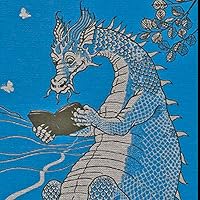
In the mind of Ayako, an old woman in exile on a mountain in medieval Japan, nothing is certain, and nothing holds a familiar shape for long. This is a map of a psyche exalted and destroyed by solitude, and on its contorted surface Shinto philosophy, Greek mathematics, Hawaiian goddesses, Egyptian legend, quantum physics, and Babylonian myth meet and merge... In Catherynne M. Valente's second novel since the critically acclaimed The Labyrinth, language and myth construct a strange new geography of the self. This is The Book of Dreams: open it and walk the shadowy paths of this extraordinary landscape.
Catherynne M. Valente was born on Cinco de Mayo, 1979 in Seattle, WA, but grew up in in the wheatgrass paradise of Northern California. She graduated from high school at age 15, going on to UC San Diego and Edinburgh University, receiving her B.A. in Classics with an emphasis in Ancient Greek Linguistics. She then drifted away from her M.A. program and into a long residence in the concrete and camphor wilds of Japan.
She currently lives in Maine with her partner, two dogs, and three cats, having drifted back to America and the mythic frontier of the Midwest.
Yume No Hon is a beautiful, poetic, mythic, dreamlike book. It has very short chapters, following the calendar of the Heian era, which follows the year with titles to do with what plants and animals are doing at that time of year.
It doesn't have a plot, as such -- though several become discernible, or certainly there's several threads to follow, it's not the important thing to me. I don't normally read books without clearly defined plots and characters, but Yume No Hon is worth it. It's prose-poetry, essentially, with a beautiful flow and rich imagery. Almost too rich, at times: for some reason, I have in my head the image of a tree so weighed down with its own fruit that its struggling to live. But beautiful, anyway.
Also, I love the way she uses mythology. Valente has an interesting way of looking at it -- I'm not sure I can see it the same way again.
This story runs the emotional gamut. If it is Your Sort of Thing, it will hollow you out, as surely as it will lift you up. Yume No Hon is a lyrical, visceral, and powerful tale, highly evocative and deeply moving.
It paints the story of Ayako - and indeed it often felt to me more like painting than prose - an old woman-hermit who has lived alone on a mountain with only her thoughts and dream-forms and the natural world as companions since her youth. Her memories, imaginings, physical reality, and dreams come together to lay bare all that she is, might have been, could be, and will be. The reader is left to puzzle out what is real and what is other-than-real, as is Ayako...and to question whether such distinctions truly matter. With words both delicate and raw, to melodies joyful, keening, noble, broken, naked and seeking, we dream with Ayako as she dances the patterns of her life. This is a story of Potential and a story of Convergence, existing at the crossroads of many seemingly-unrelated myths.
If you gravitate to archetypes, myths, and explorations of the facets of the psyche, give Yume No Hon a go. Valente is known as a mistress of evocation and intoxicating language, and she is in fine form here. As much poetry as prose, there are stories within stories to be discovered within this modest volume.
I have read a number of Valente's works and really enjoyed them all. This book was no exception; it is beautifully written and reminds more of poetry than a traditional story at times.
This book tells the story of a women who has fled a village when it was invaded and chosen to live the life of a hermit on a mountain. She lives in a pagoda, an old temple, on the mountain and learns lessons from the river and the gate. She is very old and at times had trouble separating dream and reality; the villagers of the village below think she is a ghost and bring offerings to her.
The beautiful descriptions and lyrical phrases in this book are outstanding. As always I am blown away by the poetic quality of Valente's writing. She is able to create wonderful imagery of both beautiful and violent things.
This book won't be for everyone; as with her book Labyrinth, the story is vague and at times it is hard to tell what is reality and what is dream...but then that is kind of the point. If you like easy to read stories, with clear-cut plots this isn't the book for you. If you don't mind vagueness and enjoy poetry you will love the lyrical quality and beauty of this book.
The book ties together a number of themes. There is a Japanese overtone to it, Babylonian creation myths are included, and theories of quantum physics are touched on. I know it sounds odd, but for this book it really works. There are also illustrations throughout, which is something new for Valente and I enjoyed those as well.
Overall another outstanding book from Valente. I love the poetry of her written and the way she makes lush descriptions of everything with analogies. The story is vague and dreamy, so it is not for everyone. If you like poetry and if you don't mind vagueness I recommend you pick this up. If you have enjoyed Valente's previous works I also recommend you pick this up.
A story with no definite plot unfolds and refolds like origami as the narrator describes her dream-visions—which may actually be her life, memory or imagination. The narrator might be Ayako, an ancient hermit living on a mountain, or she may be “The I-that-is-Ayako,” “a hinge which opens and shuts strange windows, who dreams she is more than her flesh.” Several forces propel this book. First, Ayako’s visions cross cultures and time with the vast range of mythology she encounters. In one dream, her dream-sister is Pele, the Hawaiian volcano goddess. In another, she births the Egyptian god Horus. Others involve quantum physics, circuses, Oedipus, medieval Japanese culture, and a host of dream-guide animals. All deal with themes of change, transience and uncertainty. The second force behind the book is its lush, adjective-laden language, which fluidly draws comparisons and metaphors that employ even more images. Chapters are named after months from the Japanese Heian period calendar, and they detail changes in animals and nature that signal seasonal cycles, like “Grasses Wither” and “Earthworms Come Out.” While the storyline is sparse and buried in surrealism, glimpses of plot emerge from Ayoko’s interactions with River, Mountain and Gate—beings who teach her Zen koan-like lessons. With its poetic style, abundance of symbols and ambiguous plotline and characters, the book can be overwhelming, despite its short length. Too many symbols, after all, can become meaningless. But Valente may have intended this shadowy environment to immerse us in the same confusion Ayoko experiences, as she tries to navigate and interpret her visions and distinguish her thoughts from her Self.
On the back, Kij Johnson describes it as an opium dream, which I think is very fair. That is how it should be read. Each small chapter contains its own dreamlike rumination. There is no single narrative, but many dream selves of Ayako, filled with blood and gore, rape and rage, desolation and destruction. It is a book of dreams and they are unhappy, lonely ones.
In exile on a mountain in medieval Japan, Akayo is an old woman whose psyche has fractured into a number of dreams with range from her mountain land to Egyptian myth and Greek mythology. In the passage of a year, Ayako explores these dreamsand, ultimately, unites them. Lyrical, mythic, and loosely bounded by plot, Yume no Hon is beautiful but a bit overwrought. However, as the plot develops the book gains focus and ends strongly. It's not for all readers, but I recommend it to those who love lyricism and are willing to put time and effort into reading it.
For the first half of Yume no Hon I was somewhat underwhelmed: the book is beautiful prose poetry, but its weak plot leaves it unfocused. I love Valente for the beauty of her books: vivid images, lyrical language, mythic contenther writing reads like music. But Akayo's dreams range a broad spectrum from the Greek sphinx to creation myths to the mountains of Japan, and for the first half of the book the plot is weak, stranding the reader among the shifting dreams with little direction to guide him. The beautiful images and language grow repetitive and it's too easy to lose focus, and pages skim by read but not understood or fully experienced.
As the book goes on, however, the plot comes together and grows stronger. It's still easy to get lost in the lyricism, but the disparate influences seem less random and the dreams gain direction as the book gains purpose. And as it comes together, the book redeems its slow beginning. With less anxiety about the book's direction, it's easier to enjoy the lyricism and mythology. Akayo's journey has a satisfying conclusion which has a pleasing sense of closure but remains expansive and pregnant with potential. The book's end also begs an immediate reread, to better experience the story with the entire plot in mind. All in all, Yume no Hon is not Valente's bestit can be difficult to read, it lacks some of the magic and joy of her other books, and the plot forms too late. I would recommend readers pick up her more recent novels (The Orphan's Tales or Palimpsest), but if you've read those or find Yume no Hon more intriguing, then by all means pick it up. For readers who love lyrical language and mythic content, and who are willing to put some effort into the work of reading, this is a beautiful and meaningful text.
Incredible. Valente weaves together stories from diverse cultures - Japanese of course, but also Egyptian, Greek and some that I can't identify in a web of wondrous words. The basic storyline is the tale of a hermit, Ayako, who dreams she is various women, who received periodic visits from a child sent from the nearby village to bring her offerings of food, who learns lessons from the mountain, the river, a snail and more and who slowly ascends the levels of her pagoda to unravel the mysteries of of her many selves. Sheer verbal magic and mythic-poetic dazzle. Just don't expect any semblance of a simple, linear plot!
I must admit to not being in a particularly thoughtful mood when I read this book, so I had a low appreciation for its complexities, and its attempts at lyricism struck me as forced and a bit precious in places.* Good if you like stories about stories, feminist fantasy, or books that do odd things with narrative. Also gets points for being a fantasy novel dealing with non-Western mythologies.
*These same accusations have been levelled at Greer Gilman, who is forever stainless in my opinion; I don't know how it reflects on Valente that I'm willing to let her take the low blows.
I wish I had something pertinent and insightful to say about this book, but I don't. I don't even pretend to understand it all, except in broad terms. I understood that while I was reading it, but was never tempted to quit. The prose was simply too gorgeous on a line by line level to pass up, and that was what kept me reading, even when Valente was being her most symbolic and obscure. Even if I'd understood nothing at all of what the book was about, it just wouldn't have mattered. I'd have read it for the language alone.
Admittedly, this is not one of my favorite of CMV's works. The book, though beautiful, is in some ways exhausting. Constructing meaning out of the images and words is very difficult, and the meanings one comes up with never last long. It's a brilliant experience, but in a very different way from some of her (more accessible and) more exhilarating works.
Valente's novellas often feel longer than they are because they are so rich, every sentence thick with metaphor and symbolism, and looking more like a line of poetry than a clause in a story. So I take my time with her books, savoring the beautiful prose as much if not more so than the plot. Yume No Hon was no different, but it flowed much better than her other novellas, probably because the extremely short chapters create a steady rhythm. The Book of Dreams includes some theoretical physics along with the mythology of a few different cultures, all incorporated into the dreams of an old Japanese woman in a pagoda on the side of a mountain, who is not sure if she is dream herself. It felt like an epiphany when I began to understand the connections between Ayako's dreams.
I am a big fan of Cat Valente in general, and appreciate the hell out of her skill with language. Yume No Hon is a excellent showcase for that - there's a lot of gorgeous imagery and deeply-felt emotion, couched in myths and metaphors that I was only half-able to follow.
And that's the downside of stuff like this for me, really. I like a plot, and this is more a long prose poem built around a couple of character studies. I appreciate the artistry without really enjoying the form - it's not the best possible book for me. So definitely recommended if you like gorgeous language for its own sake - if you like a little more novel-esque structure, Valente has a number of other books that serve very well indeed.
I enjoyed this one more than the Grass Cutting Sword, I think mainly due to less grisly descriptions. As usual, Ms. Valente's style is ornate and lyrical. I think the premise of a woman's mind which had been shattered into the various perspectives you read from is a great match for this style, which other wise seems a bit jumpy and stuttered to me.
I love this author, and I like historical fiction about Japan. In this book, the author's strength - the ability to write prose that feels like poetry - went too far. The words were beautiful, but they drifted dreamlike and incoherent through the chapters. Who was the main character? What was the plot? I had only a vague idea, and finally gave up. I was hoping for a novel, but this was more of a beautiful dream journal.
This is a rather strange book, in which a hermit Japanese woman, who has lived alone ever since her village was destroyed by marauding soldiers when she was much younger, dreams that she is, variously, the Sphinx, Isis, a fire goddess destroying Troy, Tiamat, and possibly other women from myths that I didn’t recognize. The dreams are expressionistic, sometimes even psychedelic: the non-dreaming part is often not all that much more grounded, as the woman asks various features around her — the River, the Mountain, etc. (all capitalized, as she only knows one) for lessons. This search for answers leads her to climb to the top of the ruined temple that she lives in: alas, though she makes it to the top, she never achieves the revelation she desires. In the meantime, there are a lot of mystical musings about the reality of the dreamer and the dreams, and the possibility that the dreams reflect the existence of some sort of connection among all women, which I found not entirely fascinating. (I did enjoy the Sphinx dreams, though: she prefers to ask travelers riddles about relativistic photons, or Fermat's last theorem.) This is balanced by the most down-to-earth parts of the book, when the hermit is most truly there: for instance, when she interacts with the boy who brings her a yearly tribute from the village that has grown to replace the one she once lived in. At this moment, when the presence of another human being, albeit one who regards her as part holy woman and part witch and is therefore scared to death, brings her back to herself — or as far back to herself as she can achieve, being at least partially mad — the book achieves a surprising sharpness. The dreamscapes have a certain interest, thanks largely to their images, but in the end it’s the character of Ayoko that holds the most appeal, and it’s too bad that Valente doesn’t focus more on her.
Definitely the least accessible of Valente’s books I’ve read, it took me a while to get into it, but I really enjoyed it once I did.
Ayako is maybe an old woman living in a five storied pagoda on a mountain in Japan, maybe an embodiment of the earth, maybe a riddle-telling man-eating sphinx, maybe every woman, maybe you. We follow her as she ascends the levels of the pagoda like someone attaining enlightenment.
I have discovered over time that sometimes I’m a little sensitive to rape imagery, which occurred a few times at the beginning of the book, related to the Mountain and River who are simultaneously teachers, abusers, and something like lovers of Ayako. Once I got past most of the metaphors and understood the multiple Ayakos better, however, the magic of Valente’s writing and complex storytelling drew me back in again.
I would have to say this would not be my recommendation for someone’s first Valente to read, as it was at times almost overly flowery in writing style. I think she manages to balance that part of her writing better in some of her later books. Maybe someone who loves abstract, atmospheric poetry could try this for an entry book. Regardless, as a devout lover of Valente this is well worth reading.
Like Valente's early poetry, this novella showcases the depth and breadth of her knowledge of folklore and philosophy, among other avenues of academia, and balances somewhere between a nuanced, contemplative exploration of psyche and culture to a hot, beautiful mess. Frequent typos, misprints, and the apparent absence of an editor mar the dream-like, sensual, and symbolically-rich, if heavily-wrought, prose. For the devout Valente fan or hardcore readers of surreal, psychedelic explorations of myth and legend this book will hold interest, but not for a broad audience. As a Valente fan, I'm exploring her earlier works, which differ greatly from the campy, snarky, layered dark humor and commentary of her newer sci-fi and fantasy works.
Is this a fantasy novel? Is this even a novel? Each chapter exists in a sort of dream world of prose that tends more toward poetry at times, at times bending over backwards in pursuit of a poetic image. But ... I don't really like poetry that much.
I've now read two Catherynne M. Valente novels -- her first, The Labyrinth, which was very much like this (sacrificing plot at the altar of dreamlike imagery), and one of her most recent, Space Opera, which is "Fake Freddy Mercury competes in the Space Eurovision Song Contest." I am extremely interested to see how THAT stylistic evolution plays out in the rest of her bibliography.
“What is a Riddle? It is not merely a word game, or a puzzle, or even, truly, a question. It is a series of locks which open only onto each other, in a great circle that leads back to a Truth—and this is the secret I tell you now on the great wall of Thebes: the Truth is always in the Question, never in the answer. All conceivable truths are in a single question. If I ask a boy-child to tell me my name, I have already told him the ancient truth that a name holds power. I have told him that I am more than a monster, for I possess a name. I have told him that in names lies the path to freedom, not only of the body, but of the ineffable Self.”
I am probably not sophisticated enough to really appreciate this book. It's very dream-like, where themes seem non-linear and kind of melt into each other, and the narration is very poetic and touches on mythology of several different cultures, and also quantum physics (!?).
Anyway, I think I'll stick with some of Valente's other works with a more conventional plot. Although I do like the idea of "sardonic knees".
I feel so conflicted about rating Yume No Hon-more of an abstract poetry book than a plot-driven novel-a mere three stars. Catherynne Valente's writing is out of this world, and I say that rather literally. The way she manipulates language is fascinating, leaving me eager to read more. I adore how her descriptions seamlessly switch between beautifully eccentric and evocative to downright grotesque and disturbing. I would love to live inside her imagination for a day. She's the kind of writer I dream of becoming.
This Book of Dreams is not for everyone and will take you through many bizarre out-of-body experiences. Despite the short length, this was a hard yet worthwhile book for me to digest. I have a feeling it will take several re-reads to even understand most of it. Preferably when sitting on my bed, completely focused, with quiet mood music and a phone nearby for researching the mythology scattered throughout. (Note: Not a good book to bring on public transportation or other places you might casually read. This is the sort of story that requires your full attention!)
Despite my admiration for the language, was it flawed? Yes, in a few areas. In my edition with the blue cover, I noticed a handful of spelling errors right away, which looked-I hate to say it-sloppy and unprofessional. I don't know if they were corrected in the other edition, although the spelling mistakes were jarring and easily avoidable.
The metaphors and similes became overwhelming near the middle and end. This is why I've put another Valente book, In the Night Garden, on hold for so long. Her writing is gloriously rich, don't get me wrong. I love the aura I get from it-like reading poetry that has been unearthed for the first time in thousands of years. While some readers won't like the adjective-heavy style, I find Valente's images still linger in my mind almost a year later.
Enter with caution. If beautifully disturbing poetry is your niche, you may find yourself inspired by The Book of Dreams.
Beautiful descriptions, lyrical prose -- but not really a plot-filled book. It read more like a kind of poem that doesn't know it's a poem, or that detests labels so prefers to just be. That being said, some lush descriptions, some noted below:
p. 13 "I cannot tell if it is me curled on the damp earth. The gray spider perched on her dusty wall seems equally myself. I apologize, it is what happens when the loneliness is built up and frescoed in costly paints. Solitude becomes populated with a legion of selves, each laid on each like stacked frames of films, like pig's ears in the noontime market, or the floors of a pagoda that once was red. The original is lost, just one of a thousand thousand silvern copies, scattered upwind."
p. 42 "She is embodied and unbodied, the Saturnine silver of me that haunts the corners of my elbows, eyelids, and sits fecund in her smoke-lodge creating universes from pine needles."
p. 68 "I am bombarded by photons with cruel masses, with high cheekbones and stiletto heels."
p. 113 "It [a book] is full of dark, nameless things decaying into each other, dissolving in acid, jostling for position. Kingfishers dive into the water and become women; women dive into the earth and become books."
This took a bit of time to read, though not because I found it dull or anything particularly slow. It's one of those rare books for me that I savored and didn't want to get through because I didn't want it to end. (Greer Gilman's Cloud & Ashes is probably another that ended up being read in such a way.) Like Liza Dalby's East Wind Melts The Ice (and a few others), Valente uses the Japanese calendar to move through the seasons of the story. I can't remember now if I found anything confusing, not in regard to the calendar, but the story itself as it is such an amazing dreamscape that travels from mythic creatures, to things that feel like memory, to the land as body and so on. I don't think that I did. As always, Valente used some of the best images that I've come across as I paused often on the middle of a page just to consider the description she used or the way she phrased things. Just utterly amazing in that regard.
Told with fascinating imagery, it is a little hard to get used to at first. Also, if one doesn't have a wild range of knowledge of various myths from various times and cultures, it is a little hard to know where they originate from. The book clap inside says "This is a map of a psyche exalted and destroyed by solitude, and on its contorted surface Shinto philosophy, Greek mathematics, Hawaiian goddesses, Egyptian legend, quantum physics, and Babylonian myth meet and merge." Oh, yes, this is definitely true.
Broken into very short chapters where Ayako/the narrator tells her dreams and interactions, it is a fresh read, and illustrations are good. The only reason I give it 4 instead of 5 stars is besides there are typos speckled throughout the book that interrupted my reading. Perhaps this is fickle of me, but I would expect better.
Catherynne M. Valente is by far my favorite living female author. My all-time favorite author is Mary Renault, but she passed away in 1986, I beleive.) In recommending her books to friends and family I can only ever describe her works as "a word-gasm". In YnH especially, you don't simply read the book. You feel it in your blood. You taste it on your tongue. This is a book that you LIVE. You are She and She is You.
I have so many things I want to say bout YnH, but it's so difficult to take something so vast and complex like emotion and cram it into the confines of a word. But Ms. Valente's writing skillfully offers you the foundations of the idea so that you might have something to hold onto while your body is rocked by the full force of the experience.
Five stars isn't nearly enough to rate this deceptively slim volume.
An interesting idea, in the beautiful prose I've come to expect. A little disconnected from itself at times.
"A closed book is beautiful, because anything can be written in it, and so everything is... An open book is ugly, it is splayed open like a whore. It can only be what it is. I am afraid of it, I do not want to touch it. It does not fill me with light... What do I need with a book of dreams?"