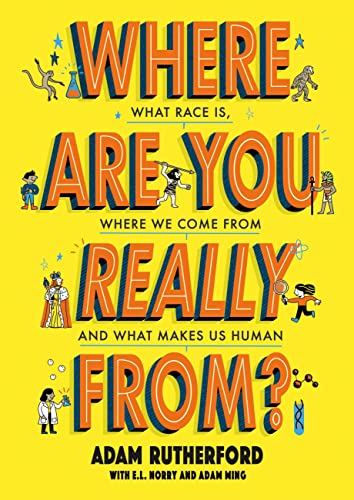
This nonfiction book is written for middle-grade readers, roughly ages 9–14. When I first started it, I thought I’d found a rare gem that explained DNA and evolution in a truly child-friendly way. The first four chapters really impressed me — they felt like a light, humorous version of Some Assembly Required by Neil Shubin.
The book begins with the formation of Earth, moves to the earliest living things, and then to human evolution and the present day. These topics are delivered in short, lively sentences with the help of illustrations that make abstract ideas accessible and even funny. One example I liked: I learned for the first time that the moon may have formed from a chunk of Earth knocked out by an asteroid — and that this might be what gave Earth its tilted axis. Coincidentally, my son had just learned this at school and asked me if I knew. (Yes! For once, I was ready with an answer.)
It also uses diagrams to show how DNA inheritance and mutation work. The book explains how each person gets half their DNA from their mother and half from their father, and how mutations can arise during the copying process. One figure illustrates this in a simple but vivid way: a character with no ears passes on a "mistaken" copy that includes ears, and suddenly the next generation can hear. If the unmutated version gets passed on instead, the next generation still has no hearing.
Another fun example: adaptation through spelling errors. The book walks you through how a meerkat turns into a dead cat in just four steps by changing one letter at a time — meer kat → deer kat → dear kat → dead kat → dead cat. The humor and visuals are great.
I also liked the clever timeline metaphor: imagine the entire history of Earth compressed into one calendar year. In that case, humans don’t show up until 11:20 p.m. on December 31 — and you, the reader, were born one second before midnight. That image really lands.
So by chapter 4, I thought I’d found exactly what I was hoping for: an engaging, age-appropriate intro to biology and evolution. But starting from chapter 5, the focus shifts. The remaining chapters deal more with race, stereotypes, and social identity. The authors spend several pages explaining that almost everyone can trace their lineage back to royalty, and from there they move into discussions of racism. The tone also shifts — it's less concise and more wordy, with a lot more commentary than science.
While I understand that race and identity are important topics for children to reflect on, this wasn’t the direction I expected. The book occasionally includes examples of racism faced by various groups, but it focuses most heavily on the experience of Black people, with brief mentions of Asians and Native Americans. I assume this is partly because one of the authors is British, so the examples skew toward British and European history.
I wouldn’t say the later chapters are bad — they just belong to a different kind of book. If you're expecting a purely science-focused introduction to evolution and genetics, this may feel off-track. But if you're looking for a broader book that includes some biology alongside social commentary for kids, this might suit your needs better.
The authors do present one message throughout the book that I do appreciate: scientists don’t know everything. Saying “I don’t know” is part of doing science — asking questions, making mistakes, and staying curious matters more than having all the answers. That’s a healthy mindset for children to absorb.
That said, a couple of things bothered me. There are at least two or three typos, which is frustrating in a published book for kids. Also, it uses expressions like “it sucks,” which I personally find unnecessary and not particularly suitable for young readers.
All in all, the first four chapters were just what I was looking for — accessible, educational, and fun. The rest of the book wasn’t quite what I expected, and some parts felt a bit forced. Still, I’ll let my child read it and see what sparks his curiosity. And I’ll keep looking for other nonfiction books that balance science and storytelling in a way that really works for kids.