Jump to ratings and reviews
Rate this book

Across the Plains

Rate this book
Across the plains --
The old Pacific capital --
Fontainebleau --
Epilogue to "An island voyage." --
Random memories --
Random memories continued --The lantern-bearers --
A chapter on dreams --
Beggars --
Letter to a young gentleman --
Pulvis et umbra --
A Christmas sermon.

206 pages, Paperback

First published January 1, 1892

52 people are currently reading
198 people want to read

About the author

Robert Louis Stevenson

7,057 books7,093 followers
Robert Louis Balfour Stevenson was a Scottish novelist, poet, and travel writer, and a leading representative of English literature. He was greatly admired by many authors, including Jorge Luis Borges, Ernest Hemingway, Rudyard Kipling and Vladimir Nabokov.

Most modernist writers dismissed him, however, because he was popular and did not write within their narrow definition of literature. It is only recently that critics have begun to look beyond Stevenson's popularity and allow him a place in the Western canon.

Ratings & Reviews

What do you think?
Rate this book

Friends & Following

Create a free account to discover what your friends think of this book!

Community Reviews

5 stars
16 (14%)
4 stars
22 (20%)
3 stars
30 (27%)
2 stars
30 (27%)
1 star
10 (9%)
Displaying 1 - 17 of 17 reviews
Profile Image for Owlseyes .
1,813 reviews308 followers
January 20, 2021
This is a travelogue of a fair good quality, in my view. It’s the New York-San Francisco route, as the title implies, via the plains landscape.


Despite all the troubles and harshness inherent (for some time Stevenson is a 3rd class train-passenger), it conveys very well this new-continent impressions, the beauty of the language, and this mix of peoples encountered.

“All times, races and languages have brought their contribution”.

Stevenson (a great traveler) could say ”no place in the world” had he found “where nomenclature is so rich, poetical as in the US”.

Take the case of the word “SUSQUEHANNA” (a river)…how beauty it sounded, to Stevenson's ears.

"A SONGFUL, TUNEFUL LAND"


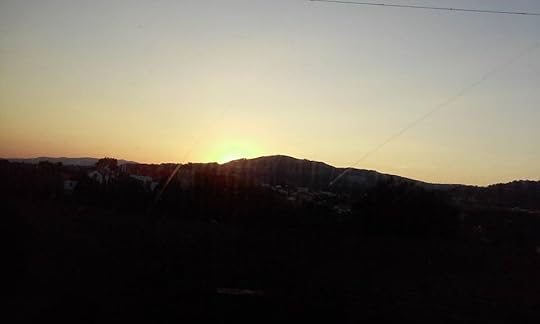
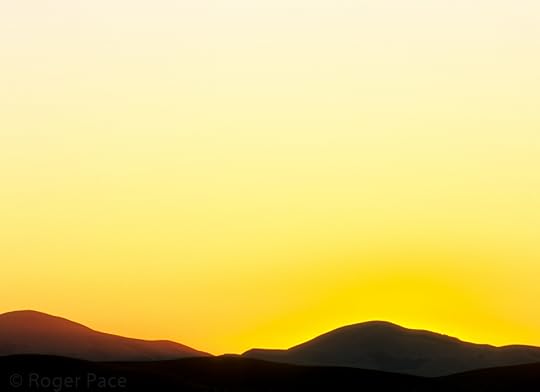
(Rising sun, in Europe or in America?)

I’ve found it pretty good, his sensibility. Take the example of the rising sun: its differences when you consider Europe and the US. Stevenson would perceive differences in “splendor” . In the US “more purple, brown and smoky orange”. In Europe, “more clear gold and scarlet”, in the morning.


(USA or Europe?)

“ALL ABOARD”

He departed from New York, as I’ve said, feeling like “sheep”…enduring long waits….having a “refection of oranges”…. he’d started at 5 a.m. in the ferry depot of the railroad.

He’ll get through Ohio (the favorite of his imagination, yet turning not to be as he imagined it), Indiana, Illinois, Iowa….

For some time he’ll travel with a Dutch woman, who would tell him the story of her life, though she was aversed to the writer.

He would arrive to Chicago on an evening, then a “gloomy-looking “ city. A“meal” offer would be good, he thought to himself, because some years ago he had made a monetary contribution to the city.

He’ll travel also in the company of a German gentleman, but of him he only recalls a “gabbling sound of words”. Stevenson had gotten into a “dreamless stupor”.

AH! He had had his 1st meal back in Pittsburgh after 30 hours....

With him he took the 6 volumes of the Bancroft’s History of the USA.

Impressive, had been, him being introduced to a “colored man”. A man quite “unlike the negroes of [writer] B. Stowe”.


Stevenson called the travelogue “leaves from the Notebook of an emigrant between New York and San Francisco". It would be related to his meeting with Fanny, his future wife. Someone he already knew from Paris.


(neither Europe's nor America's, but Samoa's)

The travelogue prepares the reader for the next great lifestep of Stevenson: the South Seas: “where I was to recover peace of body and moral”.


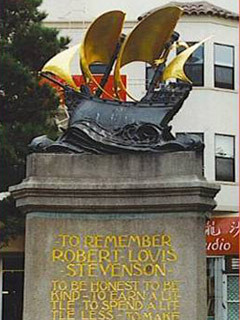
(Stevenson monument in San Francisco)


(Stevenson ...the musician)
Profile Image for Dan.
656 reviews59 followers
August 8, 2020
Across the Plains is the middle book of a trilogy dealing with some of Stevenson's travels. I do not recommend starting with this book any more than I would recommend starting with the middle book of The Lord of the Rings trilogy. The first book of the trilogy is The Amateur Emigrant, which chronicles how Stevenson came to be in New York at the start of Across the Plains. The Amateur Emigrant is available on the Gutenberg website under the title "Essays of Travel." E-readers that offer the complete works of Stevenson put it under the same title. Why Across the Plains rates its own book and The Amateur Emigrant (256 printed pages long) does not is a mystery to me.

The Amateur Emigrant was written shortly after the events it describes took place. However, it was not published until just after the writer's death. Many regard The Amateur Emigrant as Stevenson's greatest work because it is here that he really tackles issues of class in Victorian society head on, and has a number of profound insights to share with readers. I am going to finish The Amateur Emigrant and then re-read Across the Plains quickly in order to do the work justice in my review of it here.

One final caveat because others who are reviewing Across the Plains are giving it such low marks. Stephenson was in part a travel writer. Travel writing exists today, but was a genre that was much more popular in the late 1800s than now. D H Lawrence, a contemporary of Stephenson's, was even more of a travel writer, although like Stephenson he also wrote great fiction masterpieces. The reason for travel writing's popularity during this period is because not many people could do much extensive travel back then. Nor could they go see movies or televison programs about far away places. The only way people could experience exotic locales was through the work of travel writers. Therefore, travel writers' work of this era takes on much of the elements a National Geographic documentary film of today might. Readers expecting something like tightly plotted narrative fiction, or even deeply probing historical analysis of the place and time being described will invariably be disappointed when their expectations are not met. All Stephenson is trying to do with his travel writing is transport his 19th century reader to a different time and place, shoot some footage, and let the reader make up his mind as to what is to be made of it. If this doesn't sound like it would be of interest to you, I recommend reading Stephenson's literary work instead, the best of which would be Kidnapped, Catriona, and The Master of Ballantrae. Stephenson's work has been reevaluated in the last 5 or 10 years by literary scholars to be on a level with Stephen Crane and Jack London, certainly, and almost up to Henry James' or Thomas Hardy's quality. Stephenson is worth some effort.
Profile Image for Jess.
212 reviews5 followers
July 12, 2011
It's very rare that I am so bored by a book I can't keep reading it - but after the first part about the American west, I couldn't force myself to keep going.
Profile Image for Charles Sheard.
629 reviews19 followers
November 9, 2024
Review of the 2004 Folio Society Edition from the three volume collection Travels with Robert Louis Stevenson 3 Volumes, which contains the seven essays that make up "Across the Plains" but in place of the original collection's "with Other Memories and Essays" substitutes a different selection of various travel-related essays from numerous collections of Stevenson's essays.

I continue to be a very devoted fan of Stevenson's prose, as much for his non-fiction as his fiction, and since I also happen to be fan of travel-literature and wanderlust, this book (as I hope its two siblings in the Folio edition will as well) hits the mark for me. The insights into humanity, as well as the descriptive and insightful portrait of place, are what make Stevenson's travel writing illuminating. In this collection, we even find him discussing the very things that make the traveling such an emotional need:
He who is indeed of the brotherhood does not voyage in quest of the picturesque, but of certain jolly humours - of the hope and spirit with which the march begins at morning, and the peace and spiritual repletion of the evening's rest. He cannot tell whether he puts his knapsack on, or takes it off, with more delight. ["Walking Tours"]
And just as importantly, he gets to the heart of why travel-writing itself fills a related, but different, emotional need:
The knowledge that another has felt as we have felt, and seen things, even if they are little things, not much otherwise than we have seen them, will continue to the end to be one of life's choicest pleasures. ["Roads"]
Beyond that, of course, observational writing from the pen of so talented a writer, ranging from Scotland to California from nearly 150 years ago, offers us a unique and treasured glimpse into our history. Including those parts of it that are not so different from our present:
Equality, though conceived very largely in America, does not extend so low down as to an emigrant ...

Of all stupid ill-feelings, the sentiment of my fellow-Caucasians towards our companions in the Chinese car was the most stupid and the worst ...

A while ago it was the Irish, now it is the Chinese that must go. Such is the cry ...
["Across the Plains"]
265 reviews
September 26, 2022
RLS is by far my favourite writer. This little collection of non- fiction includes Across The Plains, an account of his journey across America, mainly by rail. He is a fascinated observer of what we might now term, 'The Wild West' and gives us an unromanticised version of the 'melting pot' of the USA, where immigrants and natives are treated like an underclass by the white overlords. I wish I had known him. He seems smart, kind and tolerant, for a man of his time.
Profile Image for Jeff Carpenter.
570 reviews4 followers
April 12, 2024
Interesting to read the fountainhead of fable and adventure from my childhood here in a different mode as travel writer. The writing is out-of-date, a bit cumbersome. There's not a lot of spark in his observations, although he does make a good go of it describing the little seaside village where he spent summer vacations. Otherwise, it never became much more than a curiosity.
Profile Image for Michael .
283 reviews28 followers
July 2, 2010
In Across the Plains, Stevenson recalls his journey by emigrant train from New York City to San Francisco. He describes scenery and events along the way. He is a Scotsman. His opinion of his fellow Europeans was not too good. He seemed to think that as a group, Anglo-Saxons, as he called them, were less than honest, didn't bathe and therefore had offensive body odor. He referred to Native Americans as a 'Nobel race' with good manners. The Negro as 'friendly, honest, and loyal within themselves.' The Chinese he found hard working and clean of body and spirit.

After the emigrant train came to San Francisco he went to the Monterey Peninsula. Then he told us how the Mexicans were cheated out of the land by the whites. That area is now one of the richest places in the country... Carmel...Pebble Beach, etc.

The other essays dealt largely with writing and art in France and Scotland. They were okay, but not as good as the Across the Plains story; hence only two stars for my rating.
861 reviews5 followers
April 7, 2016
This book was interesting in the respect of describing an overland trip across the plains from New York to San Francisco. The journey seems to take weeks on hot, crowded trains with a motley assortment of passengers and no facilities to keep clean. A special car held the Chinese travellers and he notes that while the Europeans looked down on the Chinese for being dirty, in fact the Chinese carriages were the freshest and their passengers the cleanest.
In one section he describes how the Mexican way of life and mores have influenced American attitudes in adjoining states, leaving people less inclined to approach the law with problems, but more inclined to settle arguments with a gun. He speaks of 'absolutely mannerless Americans' and of a distinct sense of 'Jack is as good as his master' something of a shock to Stevenson initially. So, some good social history but still a long read for a few gems.
Profile Image for Emily D..
901 reviews25 followers
May 9, 2017
This travelogue describes RLS's voyage across the "flyover" (not in his day!) states. He takes a delight in their beauty that few seem to share today.

"None can care for literature in itself who do not take a special pleasure in the sound of names; and there is no part of the world where nomenclature is so rich, poetical, humorous, and picturesque as the United States of America."

His observations on the people along the way are enlightening and I don't think they'd be much different today.

"This is one of the lessons of travel - that some of the strangest races dwell next door to you at home."

After the descriptions of his travels across the US, he spends much time discoursing on a variety of philosophical discussions about humanity, literature, and morality.
Profile Image for Merwyn Haskett.
73 reviews4 followers
December 6, 2016
Random essays without any common theme

The title essay and one or two others were decent, the rest are wasted time I'll never get back. Can't understand how anyone would have read and enjoyed them.
Profile Image for Jess.
212 reviews5 followers
April 24, 2013
It's very rare that I am so bored by a book I can't keep reading it - but after the first part about the American west, I couldn't force myself to keep going.
96 reviews1 follower
Read
August 5, 2011
The part about the train ride across America is a great look at the 19th Century West but the rest is pretty forgettable.
8 reviews
December 13, 2011
I found the first part somewhat interesting but the rest read like a very boring diary.
193 reviews1 follower
May 16, 2012
Definitely not Stevenson's greatest work. However, it was still interesting to read his thoughts on a trans-continental trip.
Displaying 1 - 17 of 17 reviews