

What do you think?
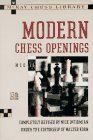
Modern Chess Openings: McO-13, 13th Edition
This text is a comprehensive guide to opening moves in the game of chess. Covering every standard line of play, it provides the essence of contemporary opening theory, and should be useful to both club and tournament players.
708 pages, Paperback
First published January 1, 1972
Ratings & Reviews
Friends & Following
Create a free account to discover what your friends think of this book!
Community Reviews
Displaying 1 - 28 of 28 reviews

November 14, 2016
In view of recent political events, Modern Chess Openings is proud to announce some improvements in nomenclature for its upcoming 15th edition:
1. d4 Nf6 2. Bg5
Trompovsky Attack Trumpovsky Attack
1. d4 d5 2. c4 c6 3. Nf3 Nf6 4. Nc3 e6 5. Bg5 h6 6. Bf6 Qf6
Moscow Variation Putin Variation
1. e4 e5 2. Nf3 f5
Latvian Gambit West Russian Gambit
[That's enough tasteless chess openings - Ed.]
1. d4 Nf6 2. Bg5
1. d4 d5 2. c4 c6 3. Nf3 Nf6 4. Nc3 e6 5. Bg5 h6 6. Bf6 Qf6
1. e4 e5 2. Nf3 f5
[That's enough tasteless chess openings - Ed.]

June 25, 2017
A good chess friend, John Creeke, decided to pass his 1952 (8th) edition on to me. It might be old, but so is the game of chess itself. As such, there's much to learn - even from this extremely old book ... my father has a more modern version of it and the two of us occasionally tried out the opening moves it features. It took me a very long time to understand the chess shorthand used in the book, but John helped me and we played it this way via SMS for some time.
John lost his fight against cancer at the beginning of 2017, making this book (and his letter to me pasted into the front) a cherished possession.
And here's something else I wrote about my chess endeavours: https://www.linkedin.com/pulse/chess-...-
John lost his fight against cancer at the beginning of 2017, making this book (and his letter to me pasted into the front) a cherished possession.
And here's something else I wrote about my chess endeavours: https://www.linkedin.com/pulse/chess-...-

June 6, 2021
I don’t think I’ve ever reviewed a reference book before. But this one is solid. I suspect that if I continue to play chess, then I’ll continue to refer to this book for years to come. There were some aggravating typos (incredibly important in a book like this), but otherwise it’s a good book for a novice chess player to look into.
(I have published a longer review on my website.)
October 12, 2016
I am crap at chess. I spent a lot of money on books that I thought would at least make me competitive. Nothing worked. I think these chess books will all sit in a box gathering dust and one day I might get the urge to rejoin the local club and get butchered by 12 year olds so then may have a further look. (Generic review for all half finished chess books I will never finish)

August 20, 2020
I thought the only good openings books of the early days were
The 1919 Bilguer's Handbuch
Fine's 1939 Modern Chess Openings
1964 Horowitz Modern Openings in Theory and Practice
1965 Larry Evans Edition of Modern Chess Openings
1970s The Encyclopedia of Chess Openings 5 Vols
1993 Gufeld Inside Chess Openings
The 1919 Bilguer's Handbuch
Fine's 1939 Modern Chess Openings
1964 Horowitz Modern Openings in Theory and Practice
1965 Larry Evans Edition of Modern Chess Openings
1970s The Encyclopedia of Chess Openings 5 Vols
1993 Gufeld Inside Chess Openings

February 24, 2019
This book is a waste of time and money.
Has been a fossil for most of the last fifty years and longer. There are so many much more valuable opening books nowadays, that explain, rather than dump thousands of variations, with a +/=/- at the end of each. Sixty years ago it was one of the very few English language offerings.
If a comprehensive book of this type is desired, better to consider Fundamental Chess Openings by Paul Van der Sterren.
There are also many much less comprehensive openings books for less experienced players. Maybe contact the U.S. Chess Federation, and request a catalog. Search some online sites for used, less costly copies until you get a better idea what you might like (Thrift, Alibris, Betterworld books are a few that are usually much less expensive than Amazon, although Amazon does often have good reviews).
Has been a fossil for most of the last fifty years and longer. There are so many much more valuable opening books nowadays, that explain, rather than dump thousands of variations, with a +/=/- at the end of each. Sixty years ago it was one of the very few English language offerings.
If a comprehensive book of this type is desired, better to consider Fundamental Chess Openings by Paul Van der Sterren.
There are also many much less comprehensive openings books for less experienced players. Maybe contact the U.S. Chess Federation, and request a catalog. Search some online sites for used, less costly copies until you get a better idea what you might like (Thrift, Alibris, Betterworld books are a few that are usually much less expensive than Amazon, although Amazon does often have good reviews).

February 14, 2026
Of course I haven’t finished it! One does not simply finish such a fun reference work. But it’s been hanging around and getting periodically consulted for nigh on two decades and it deserved its moment in the sun. Usefully pointed me to some lines in the Chigorin Defence, as I really do need a proper response to d4. The Chigorin is not really my normal style (being neither wild nor sharp nor unreliable) but it has helped to keep my head above water!
Of course the in-depth opening books I have suggest things that de Firmian poo poohs or states lead only to equality. And great grandmasters can continue to disagree and champion certain lines even if the game is ‘solved’ by AI…
It’s a meaty book, nice little opening paragraphs, satisfyingly chunky, but not actually too heavy to wield.
Of course the in-depth opening books I have suggest things that de Firmian poo poohs or states lead only to equality. And great grandmasters can continue to disagree and champion certain lines even if the game is ‘solved’ by AI…
It’s a meaty book, nice little opening paragraphs, satisfyingly chunky, but not actually too heavy to wield.
March 17, 2023
Throughout the years, chess has been a game played by many around the world. Starting in what is now modern-day India, chess has been populated for the past thousand years. Over the last two hundred years, people have started to change the play of the game. It has gotten increasingly more competitive and because of that, there are people who are now studying the game for a living. Many people, do not study chess and only play for fun. This book introduces the history of chess and how to play the first few opening moves, which is critical when playing competitively.
This book primarily focuses on the first few moves of the game, which are arguably the most important you can make. If you make mistakes, some of your opponents can easily take advantage of them. In this book, helps the reader understand some basic opening strategies and can even divulge some information about higher playing styles. I would call myself below an intermediate player of chess, but certainly not a beginner. I bought this book to review some concepts and openings related to chess. Those openings were the Vienna Game and English openings.
The Vienna Game is one of the most played openings from what I have seen personally, and because of that, I figured it would be important to read more about it. I learned a few basic strategies to have a slight upper hand in the opening, but the key to it is to remember it all. If you are to purchase this book and are seriously considering becoming an intermediate player, you must memorize parts of the game and how they can go wrong.
Despite the Vienna Game being more common, I personally prefer the English opening. It allows me to set up my bishops to have a powerful diagonal against the opponent's pieces and strive to eventually have an upper hand in the game. It is an interesting opening to me due to the fact that you have so much control over certain spaces of the board, it allows you to focus either on defense or offense, depending on what your opponent is up to.
Without this book, I would not be able to climb my chess rating points by over 300 on Chess.com. While this is all online, I eventually hope to climb that rating even higher, perhaps trying to participate in a handful of tournaments. This book certainly lives up to the title of ‘The Chess Player’s Bible’ in all circumstances and I could not be able to progress as much as I did without it. All in all, I strongly recommend this book not only to the novices of chess but to intermediate players who are looking to have more of an advantage in the early game.
This book primarily focuses on the first few moves of the game, which are arguably the most important you can make. If you make mistakes, some of your opponents can easily take advantage of them. In this book, helps the reader understand some basic opening strategies and can even divulge some information about higher playing styles. I would call myself below an intermediate player of chess, but certainly not a beginner. I bought this book to review some concepts and openings related to chess. Those openings were the Vienna Game and English openings.
The Vienna Game is one of the most played openings from what I have seen personally, and because of that, I figured it would be important to read more about it. I learned a few basic strategies to have a slight upper hand in the opening, but the key to it is to remember it all. If you are to purchase this book and are seriously considering becoming an intermediate player, you must memorize parts of the game and how they can go wrong.
Despite the Vienna Game being more common, I personally prefer the English opening. It allows me to set up my bishops to have a powerful diagonal against the opponent's pieces and strive to eventually have an upper hand in the game. It is an interesting opening to me due to the fact that you have so much control over certain spaces of the board, it allows you to focus either on defense or offense, depending on what your opponent is up to.
Without this book, I would not be able to climb my chess rating points by over 300 on Chess.com. While this is all online, I eventually hope to climb that rating even higher, perhaps trying to participate in a handful of tournaments. This book certainly lives up to the title of ‘The Chess Player’s Bible’ in all circumstances and I could not be able to progress as much as I did without it. All in all, I strongly recommend this book not only to the novices of chess but to intermediate players who are looking to have more of an advantage in the early game.

August 26, 2024
With the advent of online chess databases, this tome is now obsolete, but it was once the go-to bible for opening variations and novelties. The style is a bit funky but easy to get the hang of. It's lacking in the "opening understanding and knowledge" department, so amateurs looking for information about the why of the opening variations will be left baffled and confused.
Also, by today's theoretical standpoint, there are some glaring holes:
- Only 1 page about the Giuoco Pianissimo.
- Nothing about John Bartholomew's Qd8 Scandinavian.
- Nothing about the Tiger's Modern Defense.
- Nothing about… the LONDON SYSTEM???
- Only 2 pages about the Exchange Grunfeld, one of the most theoretically dense openings.
- 6. b3 in the Fully-Accepted Benko Gambit is given as the main option - strange.
- A rook blunder is given as the main option in a variation of the Marshall Attack
And probably many more. It's not the fault of de Firmian, as the last edition came out in 2008, and theory has inevitably advanced since then. But just to say that, while a useful resource, no one should be using it as their end-all-be-all in this day and age.
Also, by today's theoretical standpoint, there are some glaring holes:
- Only 1 page about the Giuoco Pianissimo.
- Nothing about John Bartholomew's Qd8 Scandinavian.
- Nothing about the Tiger's Modern Defense.
- Nothing about… the LONDON SYSTEM???
- Only 2 pages about the Exchange Grunfeld, one of the most theoretically dense openings.
- 6. b3 in the Fully-Accepted Benko Gambit is given as the main option - strange.
- A rook blunder is given as the main option in a variation of the Marshall Attack
And probably many more. It's not the fault of de Firmian, as the last edition came out in 2008, and theory has inevitably advanced since then. But just to say that, while a useful resource, no one should be using it as their end-all-be-all in this day and age.

July 6, 2020
An encyclopedia of chess openings. A perfect reference guide for building an openings repertoire. Granted that in our modern age all of this information is available for free on the internet, I still find it refreshing to have an in-depth offline resource at hand.
I would definitely recommend this to chess players who are about to build their first openings repertoire, and as a reference book for players rated 1400+
I would definitely recommend this to chess players who are about to build their first openings repertoire, and as a reference book for players rated 1400+

August 10, 2010
I don't think anyone every "reads" a book like this all the way through; however, from the bits I explored it was very helpful. Learning openings can be tough, becuase of the sheer volume of possibilities, so MCO allows one to narrow down what openings to try. I, for one, don't understand all the reasons certain lines make sense, but at least it gets you going in the right direction.

July 29, 2013
This book is a very nice tool - I've often found it very helpful when trying out new systems.
This book may not be the best tool available for the 2500+ GM seeking the small edge in a Marshall Attack endgame, but for the rest of us it's a very useful work.
This book may not be the best tool available for the 2500+ GM seeking the small edge in a Marshall Attack endgame, but for the rest of us it's a very useful work.

May 17, 2022
This book is more of an encyclopedia for chess players than a book that you just read for pleasure. While it is a pleasurable book for me and other chess players to study and use, I am thinking that non-chess players would be bored to distraction.

September 29, 2017
Modern Chess Openings 14th edition came out in 1999. I don't know if there is a new edition out, but there might be after such a long time. This book is more of a reference than a book you read through all the way. Just find an opening you are interested in and go from there. The book is organized by the first move, split into five main sections. So it starts out with Double King Pawn Openings like the Ruy Lopez and Giuocco Piano, moves on to Semi-Open Games like Alekhine's Defense and the Sicilian, covers Double Queen Pawn Openings like the Colle System and the Slav, goes on to Indian Openings and finishes off with Flank Openings like the English Opening and the King's Indian Attack.
It covers pretty much every opening I can think of and then goes into the lines that follow, commenting on them along the way. So opening the book randomly leads to the Sicilian Defense Richter-Rauzer Attack. This opening goes like this:
1. e4 c5
2. Nf3 Nc6
3. d4 cxd4
4. Nxd4 Nf6
5. Nc3 d6
6. Bg5 e6
7. Qd2 a6
8. O-O-O Bd7
After that, there is some section that looks like a table containing moves beyond the 8th move. Some of the lines are commented on, so if there was a famous game that used that particular line, it will talk about it and say whether or not it was successful. The book contains a bibliography at the beginning if you are interested in a more detailed account of an opening.
It covers pretty much every opening I can think of and then goes into the lines that follow, commenting on them along the way. So opening the book randomly leads to the Sicilian Defense Richter-Rauzer Attack. This opening goes like this:
1. e4 c5
2. Nf3 Nc6
3. d4 cxd4
4. Nxd4 Nf6
5. Nc3 d6
6. Bg5 e6
7. Qd2 a6
8. O-O-O Bd7
After that, there is some section that looks like a table containing moves beyond the 8th move. Some of the lines are commented on, so if there was a famous game that used that particular line, it will talk about it and say whether or not it was successful. The book contains a bibliography at the beginning if you are interested in a more detailed account of an opening.
July 23, 2018
a bit outdated in regards to the sicilian najdorf, the ruy, the caro kann (their play for white goes awry according to caruana), the grunfeld, the petrov (which they say is weak sauce), and the benoni/benko gambit.

December 24, 2019
Outdated now, but I still use this edition for a lot of variations.

October 20, 2021
The Bible of chess openings. Slightly outdated. Fascinating to see how the openings have mutated over time.

January 1, 2022
Who wants to fight me

March 17, 2023
I will be reading this continuously for a long time.
August 18, 2025
Hard to review as a book, it's more of a reference manual for various opening lines. Still, a useful study tool if you're looking to improve, and are good at remembering long sequences of moves.

June 17, 2007
technically mco11 is the one i grew up on. if you're going to book up on chess, this is definitely the place to start.

February 26, 2009
Not a read, really, but an indispensible companion and how to know when you've begun to go too far.
Read
May 10, 2010not so borring

September 27, 2012
Long considered the classic one volume opening book. Offers a fine collection of opening lines that are useful. Still "current".

October 9, 2012
I was glad to find this at Half Price Books. I'm getting a lot out of it.
It is my understanding that the newer Encyclopedia of Chess Openings surpasses it.
It is my understanding that the newer Encyclopedia of Chess Openings surpasses it.
August 2, 2013
The "Bible" of chess openings this is a resource that should be on every player's book shelf.

January 14, 2014
You won.

May 20, 2014
Actually I have 13.
Displaying 1 - 28 of 28 reviews