

What do you think?

The Sway of the Grand Saloon: A Social History of the North Atlantic
The well deck forward was littered with ice knocked or scooped from the iceberg. But from the point of view of most of the passengers, contact between the ship and the ice was so slight as to be negligible. "I wound my watch—it was 11:45 P.M.," one of them recalled, "—and was just about to step into bed, when I seemed to sway slightly. I realized that the ship had veered to port as though she had been gently pushed. If I had had a brimful glass of water in my hand not a drop would have been spilled, the shock was so slight." But, almost as if she had been gutted by a fishhook, the huge starboard hull of the ship was already opened lengthwise. In moments, watertight bulkheads were transformed from bastions of protection against the sea to deadly containers weighted with tons of salt water. —from The Sway of the Grand Saloon, on the Titanic
599 pages, Hardcover
First published January 1, 1971
About the author
John Malcolm Brinnin
51 books3 followersWhen still a boy, Brinnin's parents moved to Detroit, Michigan. Brinnin went to the University of Michigan for his undergraduate studies where he won three Hopwood Awards in 1938, 1939 and 1940. He worked his way through school in an Ann Arbor book store. During part of this time (1936–1938), Brinnin served as the editor of the journal Signatures. Graduating from Michigan in 1942, Brinnin went to Harvard University for graduate work.
From 1949 to 1956 Brinnin was Director of the Young Men's and Young Women's Hebrew Association Poetry Center, popularly known today as the 92nd Street Y. While there he raised the center to national attention as a focal point for poetry in the United States. He was, for example, the first person to bring Dylan Thomas to the United States and his 1955 book Dylan Thomas in America describes much of his attempt to befriend and help the troubled Welsh poet.
In addition to his work on Thomas, Brinnin published six volumes of his own poetry. Brinnin also wrote scholarly works on T. S. Eliot, Gertrude Stein, Truman Capote, and William Carlos Williams; and published three personal travelogues.
Brinnin taught in a number of universities over his career. At various times, he gave courses at Vassar College, Boston University, the University of Connecticut, and Harvard University.
Brinnin died in Key West, Florida on June 25, 1998. His papers were left to the University of Delaware.
From 1949 to 1956 Brinnin was Director of the Young Men's and Young Women's Hebrew Association Poetry Center, popularly known today as the 92nd Street Y. While there he raised the center to national attention as a focal point for poetry in the United States. He was, for example, the first person to bring Dylan Thomas to the United States and his 1955 book Dylan Thomas in America describes much of his attempt to befriend and help the troubled Welsh poet.
In addition to his work on Thomas, Brinnin published six volumes of his own poetry. Brinnin also wrote scholarly works on T. S. Eliot, Gertrude Stein, Truman Capote, and William Carlos Williams; and published three personal travelogues.
Brinnin taught in a number of universities over his career. At various times, he gave courses at Vassar College, Boston University, the University of Connecticut, and Harvard University.
Brinnin died in Key West, Florida on June 25, 1998. His papers were left to the University of Delaware.
Ratings & Reviews
Friends & Following
Create a free account to discover what your friends think of this book!
Community Reviews
Displaying 1 - 9 of 9 reviews

September 2, 2022
John Malcolm Brinnin, author of The Sway of the Grand Saloon: A Social History of the North Atlantic is perhaps best-known for having brought the Welsh poet, Dylan Thomas, to America for a speaking tour, one that expanded the spirited poet's North American following but may have shortened his life due to his heavy intake of alcoholic spirits while in the U.S.
Brinnin was born in Halifax with an eye to the sea & incoming ocean liners and with a room overlooking the birthplace of Samuel Cunard but also not far from rows of headstones signaling the final resting place of a great many voyagers who perished on the R.M.S. Titanic. The focus in this book is very much on the social history of the North Atlantic, as conveyed by the ships employed to cross that body of water.
The book also encompasses the economics & engineering of shipbuilding, the quest for the "Blue Riband" awarded to the fastest vessel to cross the Atlantic, notable shipwrecks, even a famous ship disappearance but it primarily concerns itself with the Trans-Atlantic crossing by sea as a connection between the Old World & the New, a kind of traveling metaphor reflecting stratified realms within society, while indicating the nature of social change, beginning in 1818.
At that point, even 1st Class cabins were cramped chambers, without running water, accompanied by chamber pots rather than flush toilets, though to be sure, in 1st Class the chamber pots were gold-rimmed. Voyages could take a month or longer via early sail-assisted, paddle-wheelers & prior to the coming of wireless operators, could be unheard from for weeks at a time while at sea.
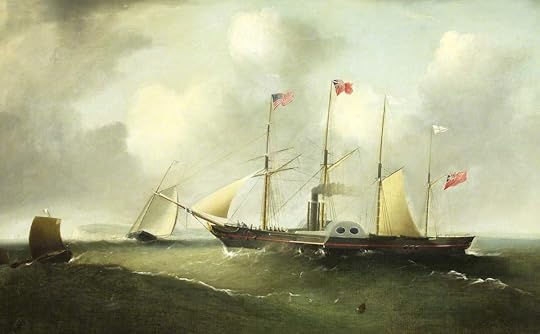
The ships, including the Great Western, Great Eastern & the 1st Cunard liner, the Britania were emblazoned with the national character of the country they sailed from & represented while at sea. The German Imperator had a large eagle masthead with the words, Mein Feld ist Die Welt ("My Field is the World") & early French liners such as the Ile de France, sought to convey the spirit of Paris, accompanied by the finest French wines.
As ships became increasingly elegant, "ships' captains had to learn to merge seamanship with savoir faire", extending themselves to mingle with passengers, as each company competed to offer the most enhanced elegance, with smoking rooms, all male sanctuaries, rivaling the finest British clubs. Even the funnels became emblems of power & symbols of status, many ships built with four funnels, even though one was non-operative.
Always the class system was enforced on board, with the preeminent class often traveling with a maid, a governess, a nurse, a valet. Far below the water line, the poorly paid "black devils" shoveled coal into furnaces & the emigrant class, with very limited deck space, was completely barred from any contact with the more exalted passengers.
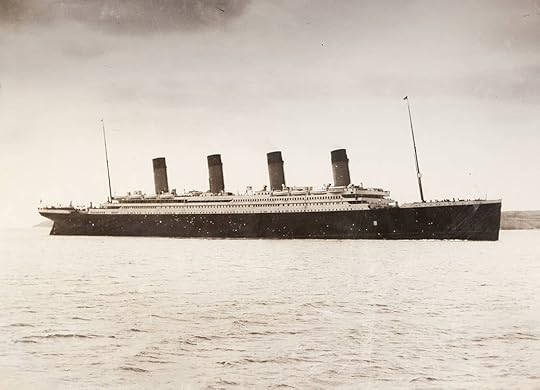
Of course, no book about Trans-Atlantic ships could fail to devote space to the demise of the Titantic on April 14th, 1912, where 1st class passengers paid $4,000 to cross the Atlantic, at a time when the average American family existed on less than $1,000 a year. Vanished with the thought of being an unsinkable ship was the sense that technology would always prevail over life's vicissitudes, the loss of the great ship on her only voyage standing as "a monument & a warning to human presumption", in the words of the English Bishop of Winchester.
Meanwhile Theodore Dreiser is homeward bound after his 1st experience of Europe amidst heavy fog...
After WWI, the litany of great Trans-Atlantic liners continues with the British supplanting the lavish Mauretania & Aquitania with the newly-built Queen Mary & the Queen Elizabeth, while the French countered with the Normandie and Germany with the Bremen & Europa, each jousting for national pride, nautical dominance via heightened speed & the embrace of well-heeled passengers. However, U.S. vessels had considerable trouble competing until the repeal of the Volstead Act in March 1933 because American ships served no alcohol on board.
May 27th, 1927 may have been a day as ominous for Trans-Atlantic ships as it was exultant for the rest of the world, as Charles Lindbergh made the 1st crossing by air, passing over countless passenger liners en route to his landing at Le Bourget airfield in Paris. By 1960, with the inception of jet airliners, more passengers crossed in planes than on ships.
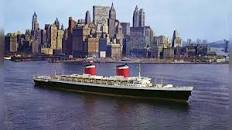
Brinnin devotes space to the creation of the fastest ship ever developed, the S.S. United States, developed by Wm. Gibbs, which on its initial crossing in July 1952 won the "Blue Riband", awarded to the fastest vessel making a Trans-Atlantic crossing, in this case knocking more than 10 hours off the former holder of that award, R.M.S. Queen Mary, making the crossing in 3 days 10 hours & 40 minutes, at a speed of 36 knots (41 land miles per hour) but capable of a speed of 48 MPH if pushed to her limit.
Interestingly, the author also addresses "the scourge of travel by sea"...
To my mind, having made 2 Trans-Atlantic crossings, including one via the QE2 in 1975, there is a considerable difference in modes of travel between countries & particularly when made by sea. In times past, one referred to "booking passage" and this designation seems very appropriate, not just to change countries while flying over them but to undergo a passage in one's life while in the midst of a journey.
Some will find John Malcolm Brinnin's Sway of the Grand Saloon stodgy, as indicated by a few G/R reviewers but I enjoyed his appraisal of North-Atlantic travel, with an emphasis on social history.
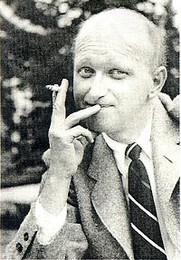
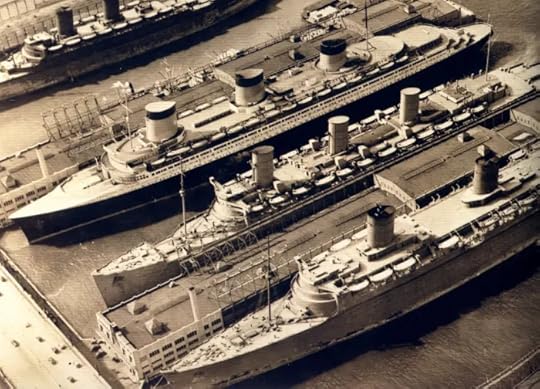
*Within the book are many black & white illustrations of ships, those who engendered them & those who traveled on them during the apex of Trans-Atlantic crossings. **Within my review are photo images of author, John Malcolm Brinnin; the R.M.S. Great Western; the doomed RMS Titanic; the 3 great liners, Normandie at left, RMS Queen Mary at right & RMS Queen Elizabeth, at center; lastly, the American nautical marvel, the S.S. United States, no longer in service but with an ongoing attempt to save & restore her.
Brinnin was born in Halifax with an eye to the sea & incoming ocean liners and with a room overlooking the birthplace of Samuel Cunard but also not far from rows of headstones signaling the final resting place of a great many voyagers who perished on the R.M.S. Titanic. The focus in this book is very much on the social history of the North Atlantic, as conveyed by the ships employed to cross that body of water.
The book also encompasses the economics & engineering of shipbuilding, the quest for the "Blue Riband" awarded to the fastest vessel to cross the Atlantic, notable shipwrecks, even a famous ship disappearance but it primarily concerns itself with the Trans-Atlantic crossing by sea as a connection between the Old World & the New, a kind of traveling metaphor reflecting stratified realms within society, while indicating the nature of social change, beginning in 1818.
At that point, even 1st Class cabins were cramped chambers, without running water, accompanied by chamber pots rather than flush toilets, though to be sure, in 1st Class the chamber pots were gold-rimmed. Voyages could take a month or longer via early sail-assisted, paddle-wheelers & prior to the coming of wireless operators, could be unheard from for weeks at a time while at sea.
The ships, including the Great Western, Great Eastern & the 1st Cunard liner, the Britania were emblazoned with the national character of the country they sailed from & represented while at sea. The German Imperator had a large eagle masthead with the words, Mein Feld ist Die Welt ("My Field is the World") & early French liners such as the Ile de France, sought to convey the spirit of Paris, accompanied by the finest French wines.
As ships became increasingly elegant, "ships' captains had to learn to merge seamanship with savoir faire", extending themselves to mingle with passengers, as each company competed to offer the most enhanced elegance, with smoking rooms, all male sanctuaries, rivaling the finest British clubs. Even the funnels became emblems of power & symbols of status, many ships built with four funnels, even though one was non-operative.
Always the class system was enforced on board, with the preeminent class often traveling with a maid, a governess, a nurse, a valet. Far below the water line, the poorly paid "black devils" shoveled coal into furnaces & the emigrant class, with very limited deck space, was completely barred from any contact with the more exalted passengers.
Of course, no book about Trans-Atlantic ships could fail to devote space to the demise of the Titantic on April 14th, 1912, where 1st class passengers paid $4,000 to cross the Atlantic, at a time when the average American family existed on less than $1,000 a year. Vanished with the thought of being an unsinkable ship was the sense that technology would always prevail over life's vicissitudes, the loss of the great ship on her only voyage standing as "a monument & a warning to human presumption", in the words of the English Bishop of Winchester.
Meanwhile Theodore Dreiser is homeward bound after his 1st experience of Europe amidst heavy fog...
while standing on the promenade deck, reflecting on his adventure abroad & listening to the foghorn mooing like some Brobdingnagian sea-cow wandering on endless watery pastures.Dreiser had meant to book passage on the Titanic but was warned that it did not fit his budget & that 1st voyages often served to shake out the kinks on a new ship. When informed of the loss of the grand White Star vessel while he was at sea, sailing 2nd class on board the lesser Red Star liner, Kroonland, Dreiser went to his berth, "thinking of those doomed 2000, a great rage against the fortuity of life."
After WWI, the litany of great Trans-Atlantic liners continues with the British supplanting the lavish Mauretania & Aquitania with the newly-built Queen Mary & the Queen Elizabeth, while the French countered with the Normandie and Germany with the Bremen & Europa, each jousting for national pride, nautical dominance via heightened speed & the embrace of well-heeled passengers. However, U.S. vessels had considerable trouble competing until the repeal of the Volstead Act in March 1933 because American ships served no alcohol on board.
May 27th, 1927 may have been a day as ominous for Trans-Atlantic ships as it was exultant for the rest of the world, as Charles Lindbergh made the 1st crossing by air, passing over countless passenger liners en route to his landing at Le Bourget airfield in Paris. By 1960, with the inception of jet airliners, more passengers crossed in planes than on ships.
Brinnin devotes space to the creation of the fastest ship ever developed, the S.S. United States, developed by Wm. Gibbs, which on its initial crossing in July 1952 won the "Blue Riband", awarded to the fastest vessel making a Trans-Atlantic crossing, in this case knocking more than 10 hours off the former holder of that award, R.M.S. Queen Mary, making the crossing in 3 days 10 hours & 40 minutes, at a speed of 36 knots (41 land miles per hour) but capable of a speed of 48 MPH if pushed to her limit.
Interestingly, the author also addresses "the scourge of travel by sea"...
not piracy, boredom, satyriasis, nymphomania, mildew, impressment into a foreign navy,scurvy, gluttony, claustrophobia, agoraphobia, diarrhea, shipwreck, shanghaiing, malaria, sunstroke, fire, ice, fog or St. Elmo's Fire--the one claiming the most victims & responsible for the deepest suffering was, by all odds, seasickness!At long last a synthetic antihistamine called Dramamine was developed at Johns Hopkins University to cope with this dreaded affliction.
To my mind, having made 2 Trans-Atlantic crossings, including one via the QE2 in 1975, there is a considerable difference in modes of travel between countries & particularly when made by sea. In times past, one referred to "booking passage" and this designation seems very appropriate, not just to change countries while flying over them but to undergo a passage in one's life while in the midst of a journey.
Some will find John Malcolm Brinnin's Sway of the Grand Saloon stodgy, as indicated by a few G/R reviewers but I enjoyed his appraisal of North-Atlantic travel, with an emphasis on social history.
*Within the book are many black & white illustrations of ships, those who engendered them & those who traveled on them during the apex of Trans-Atlantic crossings. **Within my review are photo images of author, John Malcolm Brinnin; the R.M.S. Great Western; the doomed RMS Titanic; the 3 great liners, Normandie at left, RMS Queen Mary at right & RMS Queen Elizabeth, at center; lastly, the American nautical marvel, the S.S. United States, no longer in service but with an ongoing attempt to save & restore her.

May 26, 2022
For some reason, I found the author's account of ocean travel during the Victorian period much more engaging than his descriptions of the 20th century. Interesting but glad to be through it.

January 23, 2021
This is a well-written, comprehensive, and mostly interesting history of the North Atlantic passenger liner industry from the days of the sailing packets to the paddle-wheel steamers, right up to the ultra modern Queen Elizabeth 2. After reading about the hey day of the great Cunard liners it makes me wish that I could experience a sea voyage on one of them. Personally I think I'd sooner spend four days in relative freedom and luxury going to England by ship than four hours crammed into a flying cattle car like 747. But I guess that's just me.

September 25, 2017
A magisterial history of the liner trade, from its dawn in the 19th century to a haunting account of the "Queen Mary" and the "Queen Elizabeth" passing one another for the last time in the 1960s. Written by a professor of English and an accomplished poet, "The Sway of the Grand Saloon" is not just fine history but a study in the art of writing it.

July 7, 2022
Fantastic research resource. The plethora of information, details, and the few images provided were a great boon for my writing project. Details I wouldn't be able to bring to life otherwise were easily found in this book. The list of resources in the bibliography provides further ground for study. I highly recommend it for those interested in the social aspect of oceanliner history.
December 1, 2025
A VERY LONG BOOK! With index, close to 600 pages of small print. Interesting to read about the vessels that crossed the Atlantic over close to two centuries. I would doubt that many people would enjoy this book. I did, it was a stretch, but I’m a former Naval officer and Merchant Mariner.

August 9, 2023
A wonderful read. A fantastic social history and review of a bygone era. I enjoyed the book immensely however somewhat stodgy and dated in its manner of presentation. Well worth its reading however.

April 18, 2017
The Sway of the Grand Saloon is a must read for anyone with a faint interest in how cruise lines came to be. Mooney has written a superb tome on what sailing as a passenger was like in the last three hundred years. He has a sense of humor that he brings to the work while telling intriguing stories about how liners came about and their stories until their retirement. I'll be keeping this as a reference. Amazing research, good writing, and fun to read. I enjoyed re-reading out loud to family so took awhile to get through.

December 28, 2013
A somewhat romantic tale of the passenger ship industry and life on the high seas, but really too much of the business side of things for me. Brinnin’s quite a bit of a snob, too. He really looks down his nose at the cruise ship industry, but he does nicely describe the change from regular passenger service to the cruise business.
Displaying 1 - 9 of 9 reviews