Lupita, a budding actor and poet in a close-knit Mexican American immigrant family, comes of age as she struggles with adult responsibilities during her mother's battle with cancer in this young adult novel in verse.
When Lupita learns Mami has cancer, she is terrified by the possibility of losing her mother, the anchor of her close-knit family. Suddenly, being a high school student, starring in a play, and dealing with friends who don't always understand, become less important than doing whatever she can to save Mami's life.
While her father cares for Mami at an out-of-town clinic, Lupita takes charge of her seven younger siblings. As Lupita struggles to keep the family afloat, she takes refuge in the shade of a mesquite tree, where she escapes the chaos at home to write. Forced to face her limitations in the midst of overwhelming changes and losses, Lupita rediscovers her voice and finds healing in the power of words.
Told with honest emotion in evocative free verse, Lupita's journey toward hope is captured in moments that are alternately warm and poignant. Under the Mesquite is an empowering story about testing family bonds and the strength of a young woman navigating pain and hardship with surprising resilience.
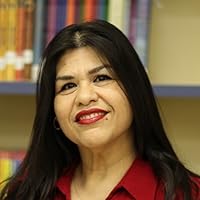
I was born in Piedras Negras, Coahuila, Mexico. My family immigrated into the U.S. when I was six years old. I grew up in Eagle Pass, a small, border town in South Texas. Eagle Pass is the setting of both, my debut novel in verse, UNDER THE MESQUITE, and my 2nd novel, SUMMER OF THE MARIPOSAS, fall of 2012 from TU Books. After high school, I went off to Alpine in West Texas to study to become a teacher. I have a BA in Theatre Arts and English from Sul Ross State University. In Alpine, I met my husband, Jim. We have 3 grown sons. Currently, I am an Assistant Professor of English at George Fox University in Newberg, OR and live with my husband in the Pacific Northwest.
"Someday my words will take flight and claim the sky."
This is such beautiful little book. Little. That is why this review is not going to be like my others because it would take you less time to just read this book than it would be to read my full review. So this is the Theatrical Cut. I could go on and on about how gorgeous Ms Garcia McCall’s writing is and how she seamlessly flits between Spanish and English words and explores two completely different cultures and the issues that come with being uprooted and how perfectly she captures and portrays the emotions that come hand-in-hand with illness in a close, loving family and pain and sadness and hope and about growing up and letting go and looking to the future without forgetting the past and the journey you must go on and maternal love and…. and…. and…..
You know what? Just read it and I promise you won’t be disappointed.
I received a copy of this from the publishers.
You can read this review and lots of other exciting things on my blog here.
I hadn't planned on writing a review for this book today, but my mind just kept turning the book over and over in my head and creating a restless energy that I can't seem to stop. This is going to sound corny but I wish that my heart could write the review for me because I don't think my mind has the ability to translate and convey why this book had such a strong impact on me. I can just feel myself get achy inside thinking about the book. A good ache though.
Lupita has many dreams. She moved to the United States with her big family when she was six years old from Mexico. They have moved to the land where dreams are possible. Lupita has gotten used to America and her big family seems to be doing well too. When Lupita is a freshman in high school she finds out that her mom is diagnosed with cancer. How can her beautiful, strong, and caring mother have this and how can Lupita and her family hold onto their dreams when everything seems to be falling apart?
This book had the perfect format for it. I can't imagine the book being written in any other way, it had to be in verse. It gives the story a beautiful flow and matches the pacing of Lupita's journey beautifully. I loved this character so much because she is responsible but also ambitious. I know lots of people believe the American dream is dead but I think it's there, we may just have to dig around for it a little deeper. These people come with fresh eyes and hearts and still cling and strive for this dream. How can you not love that? The author weaved in so much nature into the book as well, and how it can calm and move us at the same time. I love the analogy of the mesquite tree and people's perseverance. Garcia McCall also hits the Mexican American culture right on. The only reason why this book didn't get a five star rating from me was because I felt the ending lost a little steam, but there was so much for me to love about this book.
I'm contemplating whether I should keep this paragraph or not but I guess I'll decide when I'm done. I would like to share the reason why I could connect so much with this book, and I think it's because of my background. I come from strong Hispanic roots and when I was in high school my mom had cancer (I am happy to report she's doing fantastic now). While Lupita is the eldest of eight, I am the eldest of four and though I wasn't as resilient as her, I felt a weight of responsibility just as she did. I recognized everyday things in my own life as well. People watching telenovlas, hardworking fathers, green-thumbed mothers, the close knit-siblings, the importance of religion, the power of praying as a family and so much else that I could identify with. The author perfectly described how empty and lost a home feels when a mother is ill. I hadn't realized it before but my mom was and is the pillar of our home. It seemed all the joy and ease was erased when she had gotten sick, and I saw the same thing happen to Lupita's family. There are a lot of books that I have read that I can relate to and make me feel the universal emotions all human beings feel, but I don't find many books that mirror my life so much. Lupita and her life weren’t exactly like mine but it's the closest thing I have come across and for that I am grateful.
Sometimes I unintentionally hit a theme in my reading, and as I started tearing up at a section in this book, I realized it’s the one of many stories I’ve read in the last few months about a young person dealing with the loss of a parent to cancer. (The others are A Monster Calls and Putting Makeup on Dead People, and if I expand it even more, I can count Liesl & Po, where Liesel’s father has just died from illness.) They all are wildly different in plot and execution but have the same emotionally resonant tone and take the characters through similar emotional landscapes: denial, bargaining, melancholy and sometimes outright despair, regret, anger, and the most complicated of tangled emotions, relief, the “thank God it’s over”, and accompanying guilt. They all experience cathartic moments as well, where they eventually accept the loss and finding new meaning in their own lives.
I don’t know where I’ll go from here, but I want to make my own way. This feels right to me— starting to walk toward the doors, holding Mami’s old, blue suitcase, and remembering the love I carry with me.
This doesn’t mean that I think these books aren’t all unique, because they are. But the big, weighty issues of what happens to a child, and by extension the rest of the family, when a parent dies provide the basis for all of these different stories, and I find the connections among them fascinating.
The language Guadalupe Garcia McCall uses is pared down, shifting seamlessly between English and Spanish, and the line breaks are simple, but each poem tells a story, a little moment in Lupita’s life, that add up to a complete picture: moving to America and feeling uprooted, trips back to Mexico, losing her accent to be a better actor and being made fun of for it, winning drama awards, watching telenovas, having her fifteenth birthday, writing poetry, running out of money and food, trying to parent her siblings, while the undercurrent is always her mother’s illness and how that affects even the little things in Lupita’s life. The poems are often tied together with metaphors, especially involving Mami’s rose garden and the mesquite tree that grows stubbornly in the middle.
Instead, I am outside looking for a sign from her. Where her garden used to bloom, dusty holes stare back at me from the barren soil of what is like a miniature graveyard. But the mesquite is as strong as ever.
This is really quite a meaningful, beautifully-written verse novel from a debut author (but accomplished poet).
An honest and beautifully written novel told in amazingly gorgeous prose. I loved how the author didn't hold back any of her emotions/experiences and really drew the reader into life on the Texas-Mexico border. I read this in under an hour and cannot recommend it highly enough!
Beautiful absolutely beautiful. Under the Mesquite is a story about a young girl growing up to adulthood. It is a story about saying good-bye and about the loss of a loved one so integral to one’s life that it is impossible to imagine life without them. Under the Mesquite is about a family’s journey across the border of one country and into another country and how people make cultural adjustments and acclimate to a new home. And, this story is about going home and how going home can help us figure out how to move forward. Despite the numerous threads of storylines and themes running through this book, it is a short book, written in verse and readable in a few hours. Do not let the style of the book – verse – turn you off from reading this. Unfortunately, I am not a fan of poetry; I just can’t attach myself to the words of poetry in the same way I can a story. But this story is different. I immediately became emotionally involved in this story.
The topic of meshing cultures and the journey of emigration is a difficult tale to write. Inevitably, multiple languages must be woven together to write the story; descriptions of cultural rituals – such as cooking – must be described. And it takes a very special author to write these day to day things in a way that is authentic in both the language of the originating country (in this case Mexico) and the language of the new home (USA) and is authentic culturally. Ms. Guadalupe Garcia McCall does this so very well; it is obvious that she has experienced this. Many authors try to make their story appear to contain a bilingual character and to do so, the author translates the occasional word in to, say Spanish. But from my experience, many authors who have not experienced the cross cultural reality – they translate the wrong word in to Spanish, putting emphasis where there never was. Or the author may describe a cultural habit that just does not take place. Ms. McCall never makes these mistakes; she uses Spanish in her English novel in a very authentic way but she also makes it accessible for her English only speakers, for example:
“Look at my beautiful, talented muchachita,” she keeps telling Papi.”
“As the latest episode of her favorite telenovela unfolds, the soap opera drawing her in, the skins from the potatoes she is peeling drop into her apron like old maple leaves.”
“Eyes shimmering, I am a ratoncita, a sly little mouse.”
And to aid her readers, the author includes a glossary of Spanish terms and cultural references at the back of her book.
On the topic of maturing, the main character is conflicted. She is already the oldest child in a house of 8 kids and has quite a few responsibilities but she is not ready to grow up:
“But for me, señorita means melancolia; setting into sadness. It is the end of wild laughter. The end of chewing bubble gum and giggling over nothing with my friends at the movies, our feet up on the backs of theater seats …. Señorita is a niña, the girl I used to be, who has lost her voice.”
Ms. McCall writes very effectively the pull of adulthood and the sadness in leaving childhood behind. As I write this I think of my own oldest daughter and how conflicted she is about growing up. McCall captures it perfectly.
Because, the main storyline is the young girl interacting with her beloved family, much of the book involves the lead character taking care of her siblings and waiting for her mother to die.
“Mami’s cultivating six budding daughters and two rowdy sons; eight thriving blue roses clustered together so closely, they tremble as they cling to the withering stem of her life.”
“Waiting for la Muerte to take Mami is like being bound, lying face up on the sacrificial altar of the god Huitzilopochtli, pleading with the Aztec priest, asking him to be kind while he rips my heart out.”
“Sometimes she was a comfortable as a blanket, enveloping us in her warmth. She was so soft, we never wanted to let her go.”
Despite the difficult topics tackled in this verse driven novel, in the end, the story leaves the reader with hope, “sometimes it’s best to take things down and start all over again.” I highly recommend this short novel.
So I'm going to tell you a secret. Back in middle school/early high school I used to write bad poetry. Then one day I had an epiphany that I was writing mopey teen poetry and stopped. Then I went through a phase where I decided that I didn't like or understand poetry. Until senior year of college when I took a literature course. We studied poetry and I discovered that I do in fact like some poetry (mopey teenagers need not apply.)
So I'm still on shaky ground with poetry. I love "Do not go gentle into that good night" BUT I'm iffy when it comes to most new poems. Books written in verse make me EVEN MORE NERVOUS. I blame the indecent amounts of Wordsworth I had to read for a class during college. (During which my brain spazzed and was like novel length poem, I GET IT YOU LIKE NATURE).
For a book written in verse to work there has to be a damn good reason for the stylistic choice. For Under the Mesquite it worked. The book is driven by emotion. The writing is not overdone, at times even sparse and always poignant. It's the story of a girl growing up as her mother slowly succumbs to cancer. It's heartbreaking, but not in a cheap way. Rather than focus on the details of the disease, the reader experiences what Lupita feels throughout her mother's sickness. Somehow the verse gives the emotion room to breathe.
The emotions about growing up, sickness, family and loss ring so true. Because the verse is so genuine and natural, I cannot imagine this story told any other way.
Here is one of my favorite passages: For my sisters, senorita means having someone to worship: it is the wonder of seeing their older sister looking like Cinderella on her way to the ball. But for me, senorita means melancolia: settling into sadness. It is the end of wild laughter. The end of chewing bubble gum and giggling over nothing...
Stories involving cancer have been done, re-done and will continue to be done. I read those Lurlene McDaniel books back in middle school (aka all the teens die but HEY at least they fall in love first books). But this book felt different and refreshing. There is nothing trite about the the way this story is told.
It's not a long book but there's a lot of life and growing up between it's pages. It flits between spanish and english, Texas and Mexico, childhood and adulthood seamlessly. It's a beautiful little book that I'm glad I stumbled across.
This was a book that I selected for one of the categories of my young adult materials class. We were given the option of choosing a book that was either nominated or won the Pura Belpre medal. I read through the descriptions of quite a few books; however, for some reason this book stood out to me. And after it was all said and done I’m glad that I actually took the time to read this book. It was heart-wrenching. The oldest of eight children is forced to figure out life after her mom gets cancer. She not only becomes somewhat of an adult, but she also has to figure out how she wants to continue her life if her mother was to pass away.
If you’re looking for more books that would be classified as #ownvoices, I would definitely recommend this one. It has a lot to offer for such a small book.
I have a full review written. I'll update this review with it as soon as it goes live on my blog.
‘Under the Mesquite’ was kindly provided to me by Netgalley for Lee & Low Books. Interested in more of my reviews? Visit my blog!
2.5 stars
The Storyline
‘Under the Mesquite’ tells the story of Lupita and her Mexican American family. Lupita struggles with finding her own identity in a new place after her family moves from Mexico to the United States. To make matters worse she has discovered that her mother has cancer and will undergo surgery to hopefully give her more time on this Earth. Desperate to help in any way she can, Lupita takes care of her 7 younger siblings so that her father can take care of her mother. Unable to handle the stress of the situation, Lupita resorts to writing ‘seeking refuse in the healing power of words.’
Thoughts
I picked this book up after finding out that it’s written in free-verse; I’ve been a sucker for any type of book written in that format recently. Getting a few of these types of books under my belt, I’ve never felt that books have suffered from being written in that format. Unfortunately, this was the case here for me. This was an emotional story that could have been extremely heart-wrenching, but I didn’t feel this emotion come through sufficiently for me. It was an emotional-disconnect for me and it should have been the exact opposite.
This is such a gorgeous little book. This author has a gift with words as she tells the story of her mom's cancer and how she has to step in and help take care of her younger siblings while her mom gets treatment. There's much more to it, though.
This tenderly written novel in verse describes one family's move from Mexico to the United States. Life was good for the large family--there are eight children--in Mexico, but because the father found work across the border, they moved north to Eagle Pass. They return to Mexico as often as possible, savoring happy times there as well as new experiences in the United States. Mami loves her rose bushes and plants them in the front yard. When a stubborn mesquite tree refuses to die, she finally gives up and leaves it there amid the roses. The tree will provide a sanctuary later when times get hard--and they certainly do. The book focuses on the period of time when Mami is diagnosed with cancer and must endure various treatments. Lupita, the oldest daughter, stays busy with drama and with her writing, but much of the burden for taking care of the younger children falls on her. Words provide her solace, even as all of the family's savings are used up to help pay for her mother's treatment.
This is a story filled with pain and suffering but also hope and triumph as Lupita manages to survive all the difficulties that come her way. Clearly, the family bond and their cultural heritage help this young woman survive and thrive. There are so many magical moments and so much humor threaded through the pages, and the author juxtaposes those moments effectively, reminding readers that there are joyous times to be found amid life's challenges. A case in point is the event she describes of an unexpected haul of ice cream brought back to the house when an ice cream truck breaks down nearby. This is a memorable first book sure to inspire others. Spanish terms are sprinkled throughout the narrative with a glossary at the end.
Gorgeous. I didn't want it to end. Cancer can be a tricky slope to write about since it, well, has been written about. A lot. And most not well. Under the Mesquite is not that kind of book.
This is a book that pulls at your heart, makes you recognize yourself no matter where you live or who you are, and keeps you thinking long after the cover closes.
I loved the Spanglish words mixed in. Truthfully, I miss hearing them hit my own ears. As a gringa in San Antonio twenty years ago, I struggled to make sense out of many of the words sprinkled throughout Garcia McCall's book, and prided myself on understanding the rich history and terminology in Under the Mesquite.
But this is the genius of the book. You don't need to know the culture to understand and appreciate the artistry.
Beautiful novel-in-verse about identity, grief, and healing - officially YA, but this is great title for middle school kids and even some younger, I think. Sad and hopeful - perfect for readers who love emotional books and for classes studying the immigrant experience and Latin American culture.
Enjoy the words in this novel-in-verse as they unfurl and scoop you through the inked pages. Lupita, the oldest of eight children, learns to deal with her mother getting cancer as a high school student. Lupita's family lived in Mexico before moving to the United States. Fluent in both English and Spanish, Lupita, poetically narrates this story enriching the text with a beautiful blend of two cultures and languages. The chapter, Uprooted, can stand alone as a free verse poem. "I doubted los girasoles [sunflowers] would understand me anymore, because now I was speaking a different language. I swallowed consonants and burdened vowels with a sound so dense, the words fell straight out of my mouth and hit the ground before they could reach the river's edge." The author's frequent use of nature-based metaphors and similes reminds me of the Romantic poets.
Part One shows the family learning about mom's secret. The frightened Lupita barters with God that she'll become a nun if he will let her mom be free of cancer. She goes so far as to tell the nuns at church she wants to join their vocation. When the nuns show up at their house, her mom says, "No!" Part Two is a flashback to when they lived in Mexico. Sometimes I am impatient with flashbacks because it feels like the story is being interrupted and the pacing slows too much. I felt that at this point in the story. We just find out Lupita's mom has cancer and then I'm reading about Lupita being told she can't go play with her friends Mireya and Sarita but has to play with her sisters. It didn't seem to move the plot forward but the author is showing that Lupita's mom expects family to come over friends. It is one of the reasons Lupita became a caretaker of her siblings as the cancer progressed, weakening her mom and drawing her dad's focus to be solely on taking care of her mom. At one point Lupita is taking care of the seven siblings while her dad takes care of their mom at the hospital six hours away. Lupita scrounges for food and tries to keep tabs on everyone as a 17-year-old. Her success is meager.
Part Three, Four, and Five have more action and are emotionally charged as the family deals with their moms cancer. Many times I found myself making connections with the verses to my own life. For instance, my dad and his actions toward me as he deals with my mom's Alzheimers: "Many times, though, / his anger is nothing more/ than a change of weather - / a blistering breeze, / a pool that's cooled -/ and he doesn't want to talk/ to anyone about it./ So now, not knowing / which face of sadness/ he might show, I play it safe/ and leave him alone." The rich evocative passages and unique images make reading a delightful traipse.
Lupita changes internally from putting her family first to putting herself first. She realizes that she must move on with her life and dreams, while holding onto hope and memories. This is at the end and the change seemed somewhat abrupt. She comes to a realization at her Grandma's house, but I needed one more chapter to show her thinking about how to communicate with her dad who she knows will resist her wanting to go to college. Up to this point the parents have supported college, but now dad doesn't. I can infer why but I felt it needed to be told from Lupita's viewpoint why dad is having a change of heart.
It did cross my mind that there is quite a bit of content that is going to appeal more to girls than boys. Lupita likes to watch soaps with her mom, thinks about clothes, puts makeup on her mom when she is sick, and cooks, cleans and watches her siblings. The theme of friendship is touched on when she gets into a fight with Mireya and Sarita about loosing her accent and trying to act white. Lupita uses drama to deal with her mom's cancer and her teacher gives some wise advice as she copes. While this is a short novel, it has a higher vocabulary and might be confusing for some readers with no prior knowledge of Mexico and its culture. The glossary will be helpful for defining words. A wonderful novel debut.
A novel in poetry and a Morris Debut Novel Honor Book. Garcia McCall tells her story of moving to Texas from Mexico, life in a large family and her mother's death. I found her telling of the story very moving.
This is book 11 for the YALSA best books challenge. I can see why it was on my list twice (once for the Morris Award and once for the Best Fiction for Young Adults).
This is a book of poetry (which also means quick read for those reluctant readers). Lupita is the oldest of eight kids. She was born in Mexico but her family moved to Los Estados Unidos when she was young. Although she often goes back to Mexico to visit her family there, she doesn't quite believe her parents when they tell her she has two homes. She feels like a transplanted Mexican girl in the United States. And to top it all off she hears The Secret that her parents have been hiding from her. Her mother has cancer and is very sick. It will take all that Lupita has to not only figure out who she is but to hold her family together as well. That is why she takes the time every day to write under the mesquite, a stubborn tree that is stronger than it looks.
This was good. Lupita has a powerful voice and intense struggles. Each word is well chosen and echos her emotions well. The reader will feel the shock that Lupita has when her friends are cruel at lunch. Don't her friends know what she has been through and what she is doing? Why would they be so heartless when she is always on the verge of breaking down? Lupita states the harsh reality of what life is like when she has her father go to Houston with her mother. The desperate cunning to take care of and feed herself and her siblings was subtly mentioned and yet it magnified the character of who Lupita is and why the book was so powerful. Although there are not as many words as a traditional young adult book, the text sinks into the mind and won't let go of the reader's imagination...almost like the stubbornness of a mesquite growing in a garden of roses. Beautiful.
Lupita is the oldest of eight children, and just beginning high school. Born in Mexico, she and her parents immigrated to Texas when she was a six years old and have lived in Eagle Pass ever since. They are a close-knit family and Lupe does all she can as the oldest to help her mother care for the younger children. Like all teens she has to find her individual voice amid the cacophony of siblings, friends and relatives, and juggle the expectations of her parents, grandparents and teachers against her own passions and fears. When her mother is diagnosed with uterine cancer the illness will forever change the family relationships. Struggling to find her own path to adulthood, and taking on more responsibility as her mother’s illness progresses, Lupita finds solace in writing poetry.
This is a semi-autobiographical novel, written entirely in verse. Presented as a journal, the story follows Lupita as she deals with high school classes, friends and teachers who don’t understand, and her desperate desire to support her mother and help her siblings as they all deal with the devastating news of Mami’s cancer.
Garcia McCall says so much with so few words! Her poetry is evocative and restrained, powerful and tender, vivid and elusive, full of sadness and joy, but mostly full of love. One quote: Waiting for la Muerte to take Mami is like being bound, lying face up on the sacrificial altar of the god Huitzilopochtli pleading with the Aztec priest, asking him to be kind while he rips out my heart.
I liked the writing a lot here, as I think the verse actually served the story well. However -- and a big one -- the ending really left me a little disappointed because the entire book revolves around how Lupita gives up everything to take care of her family (her mom's got cancer and needs treatment) yet suddenly she decides to attend college. She's been writing and acting at school and she was passionate about both, but she didn't suggest to me she wanted more than that.
My biggest issue came in that I never saw that outcome in the story line. There's not enough internal grappling with what Lupita wants for HERSELF, but rather, she's much more concerned about her mother and her family. It made the ending where she suddenly makes waves for herself feel a bit out of place. I wanted to believe it though because I think that was the ultimate message in the story, but it wasn't quite there. I never felt compelled to want Lupita to overcome where she was -- not because I thought she had it great (she didn't) but because she didn't make me believe SHE wanted more. She didn't offer enough insight into her own hopes and dreams because, while she made it clear her life wasn't easy, she also didn't pine for something for herself (she does for her mother, of course, but not herself). The story with her mother compounds this a bit.
Good story and a quick read. One that would make an excellent readalike to Ashley Perez's WHAT CAN('T) WAIT.
I'm not sure what I think of Under the Mesquite. I'm typically a huge fan of verse, but I felt like the verse in this novel didn't always work. At times the verse was really choppy, but there are also plenty of beautiful lines. The actual story, though, felt like it was missing something, and the ending really threw me. Her mother and family are important to her, but I often felt like I needed more from the story. More needed to be fleshed out.
Written as a collection of poems, this book about a family struggling with the illness of their mother is brimming with love and pain. Metaphors abound, including the metaphor of the stubborn mesquite tree among the delicate roses, and lend the book additional beauty. My favorite quote:
"And the pomegranates,/ like memories, are bittersweet/ as we huddle together,/ remembering just how good/ life used to be" (p.129).
A lovely YA book written in verse, this is the story of a family moving back and forth between the US and Mexico, cultural changes they experience, and dealing with loss.
a very sad but also hopeful book, i really enjoyed how lyrical this was and it tugged on my heartstrings more than a couple of times. this was like a very bittersweet coming of age.
Quick read because of the format the book was written in (verse). I appreciated the Spanish to English translations that were provided at the end of the book, which really helped me learn more Spanish words and additionally Spanish traditions, food, and games. Although I enjoyed the pace of this book I never really got connected to the character in any deep way. This book is more for anyone who would like to read about a hard topic in a more simple way, which could be better for younger readers.
Under the Mesquite is a wonderfully written story. Lupita the oldest daughter tells the story of her journey between Mexico and Estados Unidos. Lupita is dealing with the challenges of moving to the United States, keeping with her culture, and being the eldest daughter. I hope McCall writes a sequel just to continue on Lupita's journey.
I can't wait to tell my students at school about this wonderfully written story that is in free verse.
Lupita is a young woman, growing up at the Texas-Mexico border with her big family. When her mother becomes ill with cancer, she has to take on adult responsibilities and help care for her siblings. This is a beautiful coming of age story, told in verse. McCall explores the challenges of bridging two worlds, the beauty and love of a close knit family, and the desire to find your own path and identity as you grow up. I wish I could remember who recommended this wonderful book to me - I owe them a thank you.
Very moving story of a young Mexican girl who moves to Texas with her family, her journey to decide if she belongs in her new country or her old country, and the impending illness and death of her mother. The story is done in verse, which is not my favorite format, but it works here, especially as Lupita is a budding writer/actor herself.
Under the Mesquite is a beautiful book. While it was a quick read, it lingered in my mind. I found myself continuing to think about it days after I'd finished it. It's a book that is certainly worth a second (or even third) read. The first time through I was engrossed in the story, only subconsciously aware of the beauty and simplicity of McCall's verse. When I returned to the novel later, I found myself incredibly moved by the imagery and sentiments conveyed through McCall's words. I think Lyn Miller-Lachmann describes it best in her own review: ". . .one of the most achingly beautiful novels I’ve read in a long time. It is a story from the heart, not written to fit into a marketing category but to remember, to honor, and to bear witness."
As many of you may already know, one of my favorite reads from the past year was Sammy & Juliana in Hollywood by Benjamin Alire Sáenz. To borrow Miller-Lachmann's words, it too, was achingly beautiful. I found myself reminded of Sammy & Juliana as I read Under the Mesquite. Both are poignant coming of age stories that refuse to sugar-coat the reality of their protagonists who have to grow up too quickly, shouldering responsibilities not meant for teenagers. Like Sammy, Lupita is strong--she struggles, but she is resilient. Often times our students learn too early that life isn't always fair, much like Lupita. Unfortunately, they're not always given the support or the knowledge to deal with it. Under the Mesquite offers an example of how to not only survive, but to eventually thrive. An important symbol throughout the story is the mesquite tree. No matter how hard Mami tries, she can't seem to get rid of the mesquite growing in her rose garden. Yet, by the end of the story, the mesquite has come to represent Lupita as she writes,
I agree, but it isn't its beauty that strikes me. I envy the mesquite its undaunted spirit, its ability to turn even a disabling pruning into an unexpected opportunity to veer in a different direction, flourishing more profusely than before (p. 141).
Lupita's strength doesn't just show in how she deals with the death of her mother, but also in how she navigates the difficult waters of identity. Lupita must struggle to determine for herself what it means to be a Mexican and a woman. When Lupita becomes involved in drama, her teacher Mr. Cortés, suggests that they must work on getting rid of her Spanish accent. Yet, when Lupita does this, her identity as a Mexican is questioned by her closest friends:
"You talk like you're one of them." She spits out the word in disgust and looks down at her lunch tray, like she can't stand the sight of me. "One of them?" I ask. "Let me translate for you," Sarita sneers. "You talk like you wanna be white ". . . "What," Sarita asks, "you think you're Anglo now 'cause you're in Drama? You think you're better than us?" "No---" "Then stop trying to act like them," Mireya says accusingly. "You're Mexican, just like the rest of us. . . " (p. 80-81).
But Lupita doesn't let others define her identity. Instead, she responds,
Being Mexican means more than that. It means being there for each other. It's togetherness, like a familia. We should be helping one another, not trying to bring them down. . . . I'm not acting white! I want to shout after my so-called friends. I couldn't be more Mexican if you stamped a cactus on my forehead (p. 83).
One of my favorite poetry sections is "señorita" where Lupita describes the various ways her family members and friends define the significance of señorita. Lupita must grapple with what it means for her, and the conclusions she arrives at reveal the ways in which Lupita has realized she must grown up. For Lupita, a señorita
. . .is the end of wild laughter. The end of chewing bubble gum and giggling over nothing with my friends at the movies, our feet up on the backs of the theater seats. . . .I'm trying my best to be a good daughter and accept the clipping of my wings, the taming of my heart. . . .Señorita is a niña, the girl I used to be, who has lost her voice (p. 77).
By the end of the story, the reader has experienced all four years of high school with Lupita. We see Lupita struggle to define herself as she deals the harsh realities of life, and we get to see her begin to heal and move on a stronger person. This is one of the reasons I think Lupita is such a powerful protagonist for our students. Lupita doesn't let the struggle defeat her:
. . .at last I feel something unfurl within me. Like a shoot growing from what remains--a tiny piece of buried mesquite root-- determination flourishes (p. 194).
I'm not alone in thinking Under the Mesquite is an amazing book--it is the winner of the 2012 Pura Belpré Author Medal, the 2012 William C. Morris Debut Award Finalist, and the 2013 Tomás Rivera Children's Book Award. I hope you'll consider adding it to your classroom library.
I enjoyed parts of this novel-in-verse, which is a genre I am liking more and more. I thought some of the writing was uneven. Some poems were full of wonderful imagery and others seemed more like narrative storytelling without much imagery. I found Brown Girl Dreaming, a similar type of novel-in-verse, to be much better.