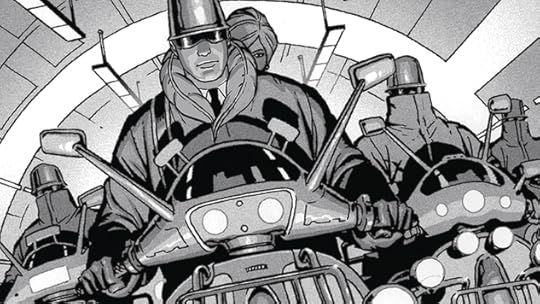
When they walk, they look cool. When they ride, they drive fast. And when they hate, they fight — brutally. One of comics' most esteemed names, Dave Gibbons (co-creator and artist of WATCHMEN and Give Me Liberty) arrives at VERTIGO to deliver an original hardcover graphic novel he's been waiting his entire life to write and draw. Lel and Bok — two best friends — want nothing more than to join the Originals, the top gang on the streets. Through them, they'll meet the high-speed world of hover scooters, all-night clubs, and, for Lel, the girl of his dreams. But with the fast life comes tough foes, and tribal loyalty will teach them the unforgettable meaning of unforgivable loss. Neither a science-fiction story nor set in a mundane reality, THE ORIGINALS takes place in a world both familiar and strange, where the young are angry, loyal and fight for what they believe in. And the only thing more important than who your friends are is who your friends hate.
Librarian note: There is more than one author in the GoodReads database with this name
Dave Gibbons is an English comic book artist, writer and sometime letterer. He is best known for his collaborations with writer Alan Moore, which include the miniseries Watchmen and the Superman story "For the Man Who Has Everything". He also was an artist for the UK anthology 2000 AD, for which he contributed a large body of work from its first issue in 1977.
Gibbons broke into British comics by working on horror and action titles for both DC Thomson and IPC. When the science-fiction anthology title 2000 AD was set up in the mid-1970s, Gibbons contributed artwork to the first issue, Prog 01 (February 1977), and went on to draw the first 24 installments of Harlem Heroes, one of the founding (and pre-Judge Dredd) strips. Mid-way through the comic's first year he began illustrating Dan Dare, a cherished project for Gibbons who had been a fan of the original series. Also working on early feature Ro-Busters, Gibbons became one of the most prolific of 2000 AD's earliest creators, contributing artwork to 108 of the first 131 Progs/issues. He returned to the pages of "the Galaxy's Greatest Comic" in the early 1980s to create Rogue Trooper with writer Gerry Finley-Day and produce an acclaimed early run on that feature, before handing it over to a succession of other artists. He also illustrated a handful of Tharg's Future Shocks shorts, primarily with author Alan Moore. Gibbons departed from 2000 AD briefly in the late 1970s/early 1980s to became the lead artist on Doctor Who Weekly/Monthly, for which magazine he drew the main comic strip from issue #1 until #69, missing only four issues during that time.
He is best known in the US for collaborating with Alan Moore on the 12-issue limited series Watchmen, now one of the best-selling graphic novels of all time, and the only one to feature on Time's "Top 100 Novels" list. From the start of the 1990s, Gibbons began to focus as much on writing and inking as on drawing, contributing to a number of different titles and issues from a variety of companies. Particular highlights included, in 1990, Gibbons writing the three-issue World's Finest miniseries for artist Steve Rude and DC, while drawing Give Me Liberty for writer Frank Miller and Dark Horse Comics. He penned the first Batman Vs. Predator crossover for artists Andy and Adam Kubert (Dec 1991 - Feb 1992), and inked Rick Veitch and Stephen R. Bissette for half of Alan Moore's 1963 Image Comics series.
Works other than comics include providing the background art for the 1994 computer game Beneath a Steel Sky and the cover to K, the 1996 debut album by psychedelic rock band Kula Shaker. In 2007, he served as a consultant on the film Watchmen, which was adapted from the book, and released in March 2009. 2009's Broken Sword: The Shadow of the Templars Director's Cut for the Nintendo DS and Wii platforms featured hand drawn art by Dave Gibbons.
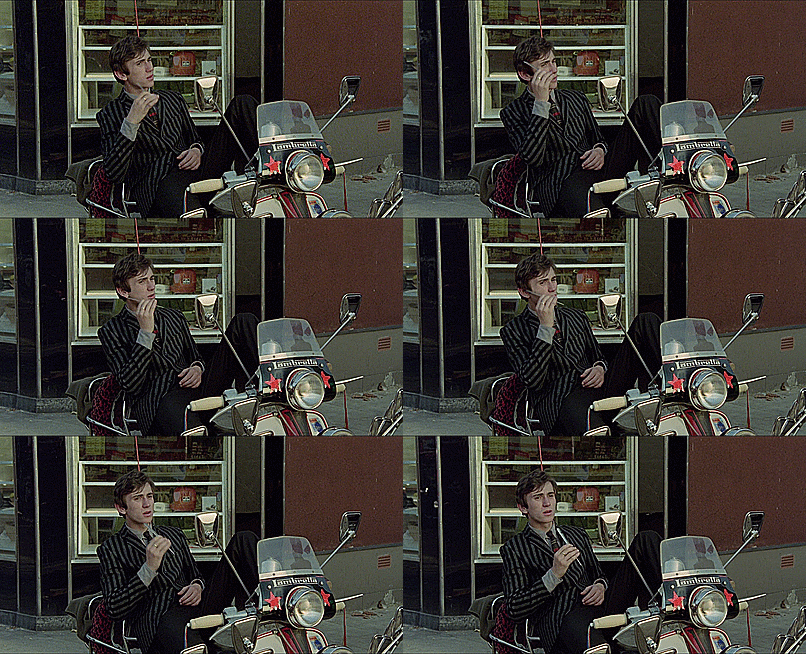
This alternative past, speculative fiction story sees the Mods versus Rockers era re-imagined with hover technology. A pretty good look at growing up, girls, friendship and gangs. Following many books set around this era it's a look at how youths' friendships are built around commonalities like the things you like, but also the people you hate! 7 out of 12. Also I will take the shallowest of reasons to share a Quodrophenia GIF :)
Nothing original about The Originals. Basically a lame story about a pointless gang rivalry between the Dirt and the Originals. There wasn't even any backstory explaining the source of the feud. That would have been interesting. Decent artwork though. Loved the black & white.
(4 of 5 for basically Gibbons' younghood memories put together into one story with fantasy glue and moved to the future) I like that '70-'80 England youngster culture stories, based on the heartbeat of that time, fun, petty crimes, the Mods and all. Before this, I read Deadenders by Ed Brubaker, which have a similar spirit and it's transferred to the future too. But the stories are different. The Originals is more personal, shorter and more direct. Dave Gibbons took all his memories from his young years in that period in England and created a thrilling story, which is work of fiction, but he put a lot of himself there. And that's maybe the reason why the story has a good swing. It was fun reading it even if it's nothing epic, nothing big, "just" a growing-up story. The art is good, sharp, neat, precise and the Gibbons' choice to do it in B&W works very well. Despite its lower rating here on Goodreads, I enjoyed reading it. I can appreciate good "life stories".
Dave's art is great as always, and he builds up a pretty immersive, grungy, low-scifi setting for gangs to fight in - but the story felt shallow, ultimately pointless with little to no likeable characters.
An interesting-enough short story that moves along without any major surprises. The setting is an alternate reality wherein people ride on hoverbikes and drinking water must be artificially created due to polluted rain. Unfortunately, this setting doesn't do much to serve the story and probably distracted more than it enhanced the narrative. This story is all hampered to some degree by some of the most explicit use of the F-word I've encountered since Pulp Fiction. On most pages, it probably appears at least four times. I'm usually not prudish about language, but this story just seemed rather excessive to the point of distracting from the story. All in all, this is a decent, although somewhat bland, gang story. It reminded me a little too much for its own good of the gang scenes in West Side Story -- minus the dancing, thankfully.
Kind of inappropriately named. This is the exact Quadrophenia-knock off Mods/Rockers thing that you're expecting when you first see it, except everyone rides floating scooters. You know right off exactly where it's going, but luckily it's short enough that it doesn't take long to get there. Even the art wasn't anything special - Gibbons is long since canonized, but he didn't go out of his way to break any new ground here, and didn't make any effort to take advantage of the black and white or the non-traditional page sizing. Didn't do much for me overall. Not really bad, but I'd be pissed if I'd paid more than $5 for it, and if I had a chance to get my $5 back, I'd probably take it.
Decent story of hard rivalry between two teen-age gangs in Britain, with a couple unexpected plot twists. Superlative artwork, as is expected from Gibbons.
I'll break my review down into categories (just to give it a spin) :
execution: Visually, the book's been very cleanly and smoothly executed. I can appreciate the believability of the characters, machines, and settings-- the effort towards realism on the artist's part is clear.
aesthetic: I've heard this described, sometimes laughingly, as "mod sci-fi," and that's strangely appropriate-- the clothes of the characters are actually a big part of the story- literally. Since the story concerns youth cultures, the clothes are a huge deal: they mark out who is a member of what gang-- acquiring and wearing the right kind of jacket is, as many of us who might recall this experience in high school, a huge deal when you're trying to fit in. The jackets which the characters wear in this story are, well, a bit hilarious in my view, but I suppose that's bound to be the perspective of someone coming from the outside. Flipping through the book, the bizarre jackets and hats tend to stand out-- as well as the shots of the "mod" clothing and furniture. I suppose fashion does tend to recycle itself, it's perfectly easy to imagine that future teenagers might base their styles on fads of the mid 1900's.
SOME SLIGHT SPOILERS HERE: Story: I read this over the course of a bus ride, it is a pretty rapid and absorbing read, and it ends very abruptly in my view. I felt that the story left me with many thoughts to muse over, thoughts about what growing up and getting "old" means when one is immersed in one's teenage years (it actually brought me back to alot of issues that concern my own high-school and young-adult years, which I hadn't thought of in a long time!) And all the trouble that can arise. I think there was this very powerful thing that happened midway through the book where the reader is brought to think "hey, he's a kid just like you! Stop hurting each other!" -- I mean that the reader is compelled to see past the violence, and wants in turn for the characters to likewise transcend, which is probably a very socially positive effect. One is a little bit reminded of the Michael Jackson "Beat It" video, where MJ comes into the middle of a gang-fight, and in a matter of seconds transforms what might have been a tragic encounter into a harmonious dance troupe. Except in this story, MJ never descends upon these unfortunate warring kids, and the tragedy ensues. The real tragedy seems to be the inability of these kids to see past the clothes, and it really seems to reflect on the stupidity of wars at large as conducted by adults-- which is, I think, probably a socially-positive thing for us all to reflect on.
If you're into Mod Culture that was big and bold in London in the 1960's (as I am), than this book is probably for you. It has some clear references to Quadrophenia (The Waterdome vs. Brighton Beach, the similar endings), which is part of the reason I liked it so much.
My only qualms with the book was a few problems to do with how the reader was to understand the setting. For example, it's never clear if this actually takes place in a future London, or if it's just an alternate universe. (I think it's easier to read the book if you imagine the whole as an alternate universe). I think if you read it in that respect, rather than assuming that it takes place in England, it is easier to understand why a culture seemingly "reverted" back to Mod culture.
All in all, I think it's an excellent book if you're into that kind of culture. And the art is amazing, too!
This is a story about one gang of teenagers who dress like their from the early 1960s. Versus a bunch of greasers who dress like their from the 1950s. All set in some future time where hover bikes are used by the teenagers. One kid and his friend try to get in with the sixties kids and have a good time. It's a quick read but boring once you get half way through it. The end comes when the main character is one week away from his eighteenth birthday but thinks he's a grown up. It's immature and slow paced but not something everyone will enjoy. Boring characters and a very typical first love story are in the background but they don't matter.
Meh. Well-enough executed, with Gibbons's trademark technically precise, cool art (in a gray wash), but this is slight, and pointlessly SF. It's the story of a couple of guys who join the Originals (like the Mods), whose rival gang is the Dirt (like the Rockers), translated into an SFnal environment (they ride hovering crafts rather than motorcycles) but otherwise very 1960s in its tone. Why it couldn't have been historical fiction is unclear. Mediocre.
Was he going for irony with the title of this book? Because it wasn't original in any sense of the word. Cliche plot, every point utterly predictable, and nothing new added. Setting it in a retro-future 50's doesn't change the fact that it felt like a 50's documentary on the dangers of gangs. The art was interesting, but beyond that it was dull.
A pretty conventional story about Mods in the 60s. The story is well told and the art is good but there’s nothing particularly notable about it. The Essential Edition offers a few uninteresting preliminary sketches, but also includes a couple of explanations from Gibbons about the real-life inspiration for the story and characters.
Bandes i pandilleros, una distòpia lleugera de pseudomods i retrorockers amb una història d'amor i mort força clàssica. El millor: la sobrietat exquisida de Gibbons. La senzillesa del plantejament. La claredat expositiva. El pitjor: que sembla desfasada, anacrònica i, fins a cert punt, naïf.
Hmm, can't decide between 1 or 2 stars. It wasn't bad, just not all that interesting to me. It felt like a script for a movie that has been made too many times already. Sorry.
An alternate-reality tale in the most superficial ways, but there was just nothing new or exciting about it. Read it in one sitting for free & wish I hadn't spent the time.
Historia de Lel and Bok y los demás "Originales". Al ser unitario que no tuvo continuaciones no creo que le haga fichas a los personajes, pero igual dejo constancia de que es un gran comic.
Remember when Dave Gibbons took over writing Rogue Trooper with a reimagining that amounted to “no talking equipment” and calling Rogue Thursday and literally sod all else? Well on the evidence of that and this, I’m beginning to think Dave Gibbons is a spectacular artist who can’t write to save his life. In the same way his Rogue Trooper was “what if the original was just really grim and boring” then this is “what if mods v rockers happened slightly in the future”. There is absolutely NOTHING to this story that justifies the bikes being hover things or the drugs having sillier names. It’s literally every mod v rocker cliche going but with a thin veneer of lazy SF draped over it. It’s so lazily written that the guy who the ostensible heroes treat as an annoying wanker turns out to be simply an annoying wanker. If he turned out to be some sort of key figure would have equally have been a cliche but at least it would have tried to have a twist of some kind. This just feels like Gibbons watched Quadrophenia one night but fancied drawing hovercraft bikes instead of lots of wheels. Incredibly bad
Lo mejor no es la historia en si, sino el estilo. Gibbons es un ilustrador genial y lo demuestra con la composición, la maquetación, la decisión de hacer la novela en blanco y negro, la estética retrofuturista. Los personajes recuerdan a La Naranja Mecánica y bien podría tomar inspiración de la misma fuente que Burgess: la fauna juvenil británica de la postguerra. Esta muy bien el guión pero no te vuela la cabeza.
Beautifully packaged and the art is excellent and evokes the proper mood. The story itself is, well, exactly what you would expect. It doesn’t really do anything that interesting or unexpected. I imagine this was a personal piece to write for the creator, but for me, it was just something to pass the time.
Pretty cool. I think it needed to be longer to be more fleshed out, but the art is what sells the book. I was afraid Gibbons had lost his touch since I felt his Kingsman and Green Lantern art was pretty mediocre, but he absolutely killed it here. The black and white coloring with a film grain really tied everything together.
Has a very Clockwork Orange vibe, but in a good youth-fighting-amongst-themselves-in-dystopian-universe way rather than an "eyeballs-forced-open-and-old-women-raped" kind of way. Good lazy afternoon read.
I can't see the art of Dave Gibbons without being four years old again and wowed by his work in Doctor Who Weekly. This story of sci-fi mods and rockers looks as good as his work always does, and if it isn't one of his all-time classic works it's still well worth reading.