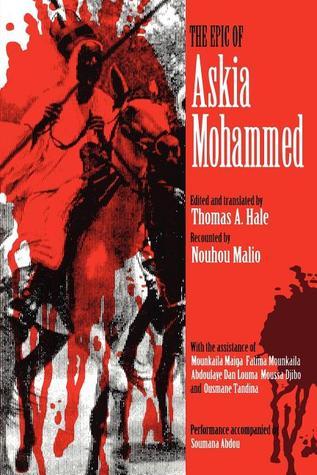
Askia Mohammed is the most famous leader in the history of the Songhay Empire, which reached its apogee during his reign in 1493-1528. Songhay, approximately halfway between the present-day cities of Timbuktu in Mali and Niamey in Niger, became a political force beginning in 1463, under the leadership of Sonni Ali Ber. By the time of his death in 1492, the foundation had been laid for the development under Askia Mohammed of a complex system of administration, a well-equipped army and navy, and a network of large government-owned farms. The present rendition of the epic was narrated by the griot (or jesere) Nouhou Malio over two evenings in Saga, a small town on the Niger River, two miles downstream from Niamey. The text is a word-for-word translation from Nouhou Malio's oral performance.
My review of THE EPIC OF ASKIA MOHAMMED, an epic poem telling one of West Africa's foundational myths, is live at Expendable Mudge Muses Aloud, better known as "my blog." It's a four-star appreciation of the hard and demanding job that is translation, especially poetry translation. Indiana University Press gets my thanks for the review copy!
As always, the click-a-phobic will get the review here in a week or so.
I would never have come across this, if it wasn't for my challenge to read Africa - this is for Mali. Askia Mohammed is the most famous leader of the Songhay empire (1493-1528), and this is the written down version of the song about his life and rule. As an oral history, and the history of a chief - it isn't strange that there are elements resembling other tales in the same or related genres. So it has the old testament-like recounting of lineage: X was the father of Y who married A (the women are rarely preserved) who gave birth to Z, and so on... I guess those lists are handy for current tribe to claim they are the descendents of X or Y. The tale of plucking onion shoots off the tomb of the Lord's Messenger, while chained end held by two strong men (to make sure he can get back out of the tomb), well it resembles Odysseus being tied to the mast to be able to listen to the Sirens song without crashing his ship. In that sense it is a recognisable genre, even if it is unusual. But interesting, and who knew there were so many horses in ancient Mali? And while Askia Mohammed is praised as a great man, he is ruling by violence - here is the repeated description of how he propagates islam across the land: "Every village that follows his orders, that accepts his wishes, he conquers them, he moves on. Every village that refuses his demand, he conquers it, he burns it, he moves on. Until the day-Mamar [Askia:] did that until, until, until, until the day he arrived at the Red Sea."
This was a little hard to follow because the translator often left things unexplained for the reader. I would have appreciated more footnotes or perhaps a glossary of terms. Nonetheless, it was a cool reading experience and I will definitely be checking out more West African epics in the future.
This is an interesting one: a piece of oral poetry, transcribed from a performance by a griot, Nouhou Malio, in Niger. To quote the introduction:
The Epic of Askia Mohammed recounts the life of the most famous ruler of the Songhay empire, a man who reigned in Gao, an old city in present-day eastern Mali, from 1493 to 1528.
Although to be strictly accurate, it recounts the life of Askia Mohammed and some of his descendants. I was interested to learn that the events were recorded in contemporary written chronicles, so we have some sense of how the stories have changed over the centuries: the genealogies have been compressed a bit, and some historical events seem to have been conflated, but the people and events are clearly identifiable.
The subject matter fits comfortably into what you might expect of epic poetry: kings, conquest, revenge, wrangling over succession. But of course it also has cultural specifics; for example, Askia Mohammed is remembered for spreading Islam in West Africa, and one of his notable achievements was a pilgrimage to Mecca. Similarly, some of the second half of the poem is the story of Amar Zoumbani, one of Askia Mohammed’s descendants, and his ambivalent social position as the son of a king and a slave woman.
It’s enjoyable as a story — if you skip over some genealogies of the Bob begat Fred begat Kevin variety — but it doesn’t seem particularly remarkable as a piece of literature. It seems to be fairly plain, direct storytelling; there’s some interesting use of repetition for emphasis, but otherwise the way the language is used seems straightforward; with the inevitable caveat that some amount has been lost in translation. Most notably, the original switched occasionally from Songhay to a version of Soninké used as an ‘occult language’ by Songhay griots, healers and sorcerers, a language which is apparently sufficiently obscure that many lines are just marked as ‘undecipherable’. There’s also some suggestion in the introduction that Malio switched between dialects of Songhay, though I may be misunderstanding; what effect any of this code-switching might have is left unclear.
I kind of feel I should be drawing comparisons with other oral/epic poetry: Greek, Haida, Norse, or Anglo-Saxon, which is the only one I’ve actually studied. But nothing insightful is coming to mind, tbh.
Anyway. The Epic of Askia Mohammed is my book from Niger for the Read The World challenge.
The number of two and three stars on this work is so disappointing. This is not meant to be a read-by-the-pool who-dun-it Oprah Bookclub Read. This book is an academic translation of a part of an important World UNESCO Heritage Cultural tradition: The Griot Tradition. Many of the low star reviews seem to be given by people who do not belong to the culture or academic field that this book targets.
This is a translation of an Iron Age tale. Up to this point, the story had ONLY been told verbally. It was related in obscure dialects of dead languages. It was recorded and translated off cassette tapes from the 1980s. In that context, it is amazing.
This is not supposed to be easily digestible or make perfect sense. It is a mythological retelling of a verbally transmitted semi-historical event. Many of the places in this book exist in the real life landscape of these tales, Niger, the current country of Mali and the historical Malwi Empire. These places are often UNESCO World Heritage Sites. The Griot (storyteller) tradition is still alive, this story is still told verbally through song, dance, and story as entertainment, history, encoded wisdom, culture, and learning. It is meant to be thought over, its symbols dug into, and its metaphors unraveled.
I find the act of giving two or three stars to an academic and cultural text of this importance really dismissive, especially as it seems many of you read this as An Around The World Challenge or Read Africa Challenge. If we slow down and start looking up how to read myth, how to read African myth, and even The Epic of Askia Mohammed specifically, there are papers, blogs, vlogs, and other books that will help you understand this tale and what it is trying to convey. It is retold in several places to a modern audience in a way that is much more digestible and understandable.
I enjoyed comparing this hero's tale to the ones I know so well: Cuchulain and Hercules. I thought the ongoing horse drama was hilarious and showed how important horses were at the time. I enjoyed looking up the Gao and learning they are real settlers from Morocco to that area. I enjoyed googling the plants and animals listed.
Askia Mohammed: Tyrant or Hero?, December 16, 2009
I came across this epic piece of orature while looking for the epic about Sundjata. Askia Mohammed is one of those giants of African history routinely referred as worthy of emulation and/or respect. However, upon concluding the read, I had the opinion that he was very hawk-like in his promotion of Islam. There is repeated mention of "Every village that follows his orders, that accepts his wishes, he conquers them, he moves on. Every village that refuses his demand, he conquers it, he burns it, he moves on. Until the day-Mamar [Askia:] did that until, until, until, until the day he arrived at the Red Sea." (298-302) I interpret the consecutive "untils" to signify that it was a repeated event that happened over time. Considering how long it took for caravans to traverse the distance from West Africa to Mecca, undoubtedly it happened not only over an extended period of time but also over an extended expanse of land. The devastation left in the wake of such excursions in arson leads me to question the respect paid to this historical figure.
The above statement notwithstanding, I did find the epic interesting in the view it provided of West Africa. It provided me with a basis for doing further research into the era and times and for that and the new perspective, it is appreciated.
The Epic of Askia Mohammed is an oral tale, and has been related widely throughout Niger and Mali for decades, if not centuries. It harks back to the Songhai empire of the 15th and 16th centuries, and particularly to rule of Muhammad ibn Abi Bakr al-Turi. Nouhou Malio was a jeseré (a traditional story teller) from the appropriately named village of Saga, in Niger. Over two evenings in December 1980 and January 1981 he recounted The Epic of Askia Mohammed to Thomas A. Hale in the Songhay language, with portions in the more archaic Soninké - a language seemingly utilized for poetic effect. Translation of the Epic proved difficult and took Hale and his team until 1994 to complete, with many lines still just given as [undecipherable] - though this may be down to the quality of the recording as much as the language - and one has to wonder whether the accompaniment of a three-stringed lute-like instrument helped matters. Critiquing the Epic is a difficult task, as it is appears here in a form different to that intended. The story would traditionally be performed as part of celebration, not presented in a dry written form and in isolation. Oral storytelling is essential in illiterate societies as a means of fostering identity and giving context to their culture as it stands now. I can not imagine that listeners were expected to take in every detail, nor to memorize the long lineages that form constant digressions to the tale, I suspect listeners would latch onto certain, catchier passages, while other sections would pass by without much notice. Much as we may sing along to the chorus of Castle on the Hill, but never really properly absorb the fact that one of Ed Sheeran's friends "works down by the coast". And so to judge The Epic of Mohammed Askia as a novel would be unfair, it is never going to entertain a modern audience in the way that modern written prose does. Also it is, frankly, confusing as all hell in parts. There are sudden jumps between characters, and it employs narrative devices peculiar to jeserés (also known as griots) of that region. The history is truncated, with events that actually took part a century of more apart being conflated. I'm sure this was partially accidental, but also I doubt empirical exactness was that much of a concern. The Epic is about giving a national identity, looking back to a time when the peoples of that area where a part of one of the largest African empires ever to have existed, in much the same way Mel Gibson's Braveheart is daubed in the warpaint of a thousand years earlier, and takes massive liberties with timelines. But the Epic is interesting if we take it as an accurate look at oral story telling, especially when it allows us to see how these traditions have influenced modern works, such as Mema, from Gabon (review can be found here). The repetition and frequent asides have a distinct quality, as does the sense that this work should be viewed as part of something larger, not as an isolated work, abstracted from outside influence.
The Epic of Askia Mohammed by Thomas Hale is a verbatim recounting of the stories passed down by generations about the Songhai Empire in the 15th-16th century West Africa. A Griot Nouhou Malio (pictured) is the primary recounter of the tale, but the editor also relies on other griots and sources to build very helpful annotations and summary section for the reader.
The epic itself is interesting and boring in parts. At times, it provides wonderful insight into the culture of the region and the currents changing it. The tale is as myths are – a healthy mixture of the real and the made-up* – and thus fairly engaging. At other times it turns into long, quite pointless unless you are a passionate historian, genealogies that goes on and on – necessary only for a completionist’s documentation. In these parts of the book become simply skim-worthy.
But as a non-fiction – the way I would classify the writing as – it is a neat effort to remember a part of history at risk of getting lost – and to save a tradition which faces a daunting challenge from the unsentimental advances of modernity. A laudable effort!
*For instance, the story of Askia’s birth curiously follows the the Hindu legend of the birth of Lord Krishna and his killing of his maternal uncle Kansa. I couldn’t find any acknowledgement of this coincidence across the web – so leaving it hear for another curious reader. I wonder how it happened!
The Epic of Askia Mohammed is a very quick read thanks to how it’s written. As it’s a transcribed song or story, the language is pretty simple and to the point. It’s the story that would be told by older generations to younger ones to inform them of their history and so uses simple language and big events are often recounted like they’re listed in bullet points.
The story itself is broad as it covers decades of history. It’s not just about Askia Mohammed, though he is the main focus, but of the Songhay Empire as a whole which lasted for almost 130 years. It covers different kings, and battles, revenges and the conflicts over succession – a lot of the usual stuff in an Empire. The Epic of Askia Mohammed did remind me a bit of Chaka as that was a fictionalised account of a real king. While the format was different, they both face similar conflicts as rulers and they both have the vibe of being almost a folktale.
The copy of The Epic of Askia Mohammed I had has a lot of historical context and is full of annotations so any names, places, or words that might’ve been unusual are explained which is always helpful and allows for a deeper meaning of the story.
This book chronicles the rule of Askia Mohammed (or Askia the Great or even Mamar Kassey) who was the first ruler of the Askia dynasty of the Songhai Empire from 1493 to 1528. The reason I have written “author” is that Nouhou Malio was a griot so this book has been orally narrated.
For anyone like me who had a vague notion of a griot being a storyteller, well yes it is, but I learnt that it is much more than that. A griot is kind of a big deal in the tribe as it was their job to preserve the oral traditions and be a kind of cultural guardian via the use of stories, poems and songs. This was not a job for just anyone! So the fact that this has been transcribed from an oral retelling is a bit special.
Having said that though, I’m not entirely convinced that it works terribly well as a transcribed book. There is a thorough introduction and several pages of footnotes explaining various aspects of the narration so quite a bit of flipping back and forth is necessary to get a complete perspective of the story. So while it is a rather interesting concept, I didn’t find it particularly captivating reading. ⭐️⭐️.5/5
Around the World Reading Challenge: NIGER === This is a directly transcribed & translated oral epic detailing the life and rule of Askia Mohammed & his descendants, the most famous leader in the history of the Songhay Empire. It was recorded over the course of two days from a performance by a griot, Nouhou Malio, in Niger. The concept was certainly interesting, and I appreciated the faithfulness to the original, though I don't really think that this oral traditional made for a successful written transcription. The notes needed to understand what was going on were numerous and made for a difficult reading experience, having to constantly pause and go back or forward to the intro & appendix for reference. The style just wasn't that interesting or captivating, though I can imagine it would feel very different when watching it performed as it was meant to be. I didn't really feel like I retained much of the information.
This is a really cool format. It is a transcription of an orally told story by a griot (kind of like a story teller). I've read so much about griots in my read the world project so it was really cool to read something by one. Of course it would be much cooler to hear it in person though I wouldn't understand. It was also interesting to read all the work that went into translating it and trying to be faithful to the story. Of course a transcription of an oral story isn't going to flow the way it would told orally but it is still really cool to have access to it.
Nouhou Malio is a Nigerien storyteller who verbally recited the Epic of Askia Mohammed and Thomas Hale, an American academic, translated and published it. It's the story of the Sanghay Empire which once controlled the area that is now modern day Niger. As far as I can tell, this is the only Nigerien book by a Nigerien author that has been translated into English (other than an academic textbook).
I don't think I can rate this one, especially as I didn't experience in the correct format (Nouhou Malio's oral retelling).
Ganske interessant og i vissen henseender endda helt fascinerende. Dog mest for dem, der måtte have en særlig antropologisk og kulturhistorisk interesse i klassisk, episk digtekunst inden for vestafrikansk, mundtlig fortælletradition.
Very short but full of character and a lot to digest from the helpful annotations, historical notes and explanation. Particularly like the explanation about the griot / scribe etc. In terms of the form, am glad to have read in that context, but would admit the plot isn’t hugely engaging or easy to follow (even with the explanation).
I read this book for Niger in my read around the world challenge. Niger is a really hard country to find anything translated into English. I don't really know how to rate a transcription of an oral performance, so I am going to refrain from giving this a rating. It's quite confusing at times to know who is speaking and who everyone is, but there are useful annotations at the end to refer to.
Unfortunately, I have to do quite a bit more research to understand what's happening here. While the conceit of a transcribed oral telling of this epic is very cool, the result is difficult for this Western reader to understand. Which is an issue I fully take responsibility for. So, I'll have to do some work & revisit later.