Contains the novella "Barnabo of the Mountains" and the following short stories: -The Bewitched Bourgeois -Personal Escort -An Interrupted Story -The Gnawing Worm -The Time Machine -The Five Brothers -The Flying Carpet -The Prohibited Word -The Plague -Confidential -Duelling Stories -A Difficult Evening -Kafka's House
Dino Buzzati Traverso (1906 – 1972) è stato uno scrittore, giornalista, pittore, drammaturgo, librettista, scenografo, costumista e poeta italiano.
Dino Buzzati Traverso was an Italian novelist, short story writer, painter and poet, as well as a journalist for Corriere della Sera. His worldwide fame is mostly due to his novel Il deserto dei Tartari, translated into English as The Tartar Steppe.
Buzzati (1906-1972) was an Italian writer famous in Italy for his novel The Tartar Steppe which was made into movie. These stories were published between 1933 and 1965. Buzzati is also known for an interesting quote: “Every writer and artist, however long he may live, says only one thing…”
The first story, Barnabo of the Mountains, is a novella making up half of the book. Twelve foresters live in a cabin high in the Italian Alps. This was considered a job with status – they have uniforms, rifles and badges. They also fight off bandits who come to steal equipment. In a run-in with bandits, Barnabo loses his job for cowardice. Years later he returns and tries to get his old job back.
In another story, a boy sees a man in the distance; perhaps he’s a Gypsy with a walking stick. This scene repeats all his life.
In a drawer, an author finds a half-completed story he wrote years ago. He can’t recall how he intended it to end, so he goes back to the village that was featured in the story, but…
One story is a classic Italian farce. A supposed old friend appears to a man and he ends up taking over his house, business and life.
A scientist finds a way to slow down the speed of life by half so you can live twice as long. We know this won’t end well.
One story is written like a fable. Five brothers have a curse put on them that they would die if they were ever again all together at the same site.
A strange county has created a prohibited word to test conformity to the cultural values of the country. A new immigrant to the country can’t get even his best friend to tell him what the word is.
There’s an auto engine “epidemic” and cars start dying.
A writer cuts deal with an unknown writer to publish his work under the name of the better-known writer. We know this won’t end well either.
Two writers play a game where they take turns developing a story a paragraph at a time. They spin a tragic tale that actually happens. Who’s responsible?
Imagine being invited to a couples’ house for dinner and the topic is that their two sons away are college are plotting to come home to kill them.
So we have a range of genres including a fables and science fiction. They vary in quality too, but all worth a read.
There’s good writing. Some passages I liked:
“The roof has gradually grown weary counting the raindrops and debating with the wind; there are gaping holes…”
A waltz has arrived in town from the city: “After a long journey the music reached the mountains, but it is weary: you can hear it dragging its feet; all its joy is gone.”
“And with bitterness he considered how his entire life had been this way: he really had all he wanted, but everything always fell short of his desire, levelled to a sort of via media that satisfied his needs but never filled him with joy.”
“And their way of running was strange: all soft, viscous movements, like a film shot in slow motion. Even the ball had less bounce for them.”
The whole collection and writing style reminds me quite a bit of the short story collection All Fires the Fire by Julio Cortazar.
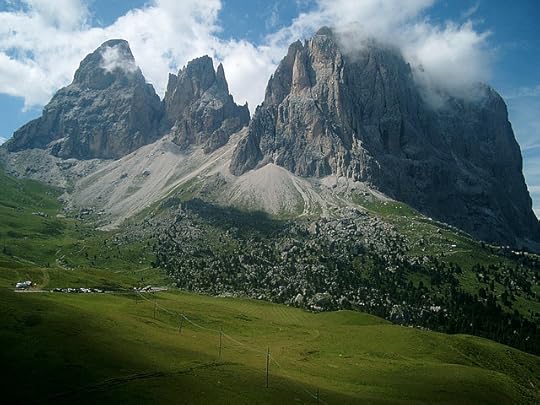
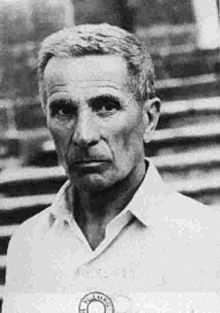
Photo of the Alps from walksinitaly.com Photo of the author from Wikipedia
Although there was nothing truly outstanding about this selection, all stories were at least good enough—a chunk of them being better than just good—to make me wonder why on earth Buzzati seemed to play second fiddle to the more popular Calvino. From a sinister game of Cowboys & Indians in The Bewitched Bourgeois, to the fictive journalism of Kafka's Houses, Buzzati mixes Mystery, fantasy, sci-fi, the real and the surreal to striking effect, that will have me going back for more with his other short story collection Restless Nights, at some point. The Siren— added to two novels, a comic book, and an illustrated children's tale, is now pushing the Milanese writer up there with my fave Italians.
If you’ve read the Tartar Steppe I’d argue you haven’t properly read Buzzati until you’ve read his short fiction. The problem is getting your hands on something. As far as I can work out, only this and Restless Nights are his only short story collections to make the translation into English. Thanks to our library I read the stunning Restless Nights several years ago. It took me a while to track down this book. I imagine many of his stories have never made it into translation this side of the Mediterranean. This collection however, isn’t quite as mesmerising as Restless Nights. It begins with the novella Barnabo of the Mountain which certainly intrigues - to me it felt like an early exploration of what was to come in the Tartar Steppe with a similarly distinctive, uneasy tone. It’s a sizeable story which leaves room for only a handful of short stories. Fortunately this is where the collection really excels. Buzzati has a playful sense of the macabre, infusing his writing with elements of science fiction, journalism, horror and magical realism. You never know quite where he will take you. The Gnawing Worm and the Time Machine are two particularly unforgettable pieces. If you can, track him down. (And if you are in publishing, please try to bring more of his work into print in English!)
A friend suggested I read this - I was not familiar with Buzzati at all, but I can see why people like him. The stories are...odd. Some of them are science-fiction, albeit with a peculiar slant. Others have just a hint of the supernatural/macabre. And at the same time, they're very literary. A curious set, good for folks who like Margaret Atwood. I will definitely look up Buzzati's other work, for science.
When you read Buzzati it's natural to think of the works of Borges and Kafka, but I think I'd pick Buzzati over either one. His short stories explore a greater range of emotions and tones than Kafka's work, and while he can write the stories about stories that rival those of Borges, he also imbues his works with a greater sense of pure enjoyment in the actual act of telling a story. Calvino still trumps him in my book, but Buzzati is certainly someone that deserves to be more widely read and appreciated than he is.
The Siren is a good collection, albeit not his best, but nevertheless there are some great stories here. The Gnawing Worm is a story that could have come from Kafka himself, but then Buzzati follows it up with The Time Machine, which is a work of science fiction, not something I've come across Buzzati having written before, done masterfully. Shortly thereafter is The Flying Carpet, a great little story that makes our mundane world a bit more magical. The Prohibited Word tackles the idea of a bizarre totalitarian society but with a twist: the ending is not one of individual powerlessness in the face of such organizations (think 1984 or Brave New World), but instead shows the protagonist successful at outsmarting the system. Kafka's House acknowledges the comparison between Kafka and Buzzati, but the ending lines show how Buzzati is a master in his own right and has his own style.
Again, though, not his best collection, and that's for two reasons: first, almost half the book is taken up by a single story, Barnabas of the Mountains, and while it has it's moments, overall it brings to mind Buzzati's longer work, The Tartar Steppe. Both feature military men guarding a remote outpost, both explore the ideas of great expectations being frustrated, and both ultimately arrive at a conclusion that's actually rather uplifting given the content of the story. They both have the ending message that a life can still have been a successful life even if it doesn't include some great triumph- it's having done one's duty that matters, not the glory that we picture in our daydreams. Overall, though, The Tartar Steppe is a better work, exploring the lack of control a person has over his fate, while Barnabas of the Mountains actually emphasizes the agency of the lead character. To me The Tartar Steppe overshadowed Barnabas of the Mountains. My second criticism is simply that this collection contains fewer stories than Buzzati's other ones, and I wanted more. Needless to say, this is not a severe criticism.
Even Buzzati's worst stories are interesting and put most other authors' to shame. If somehow you've found your way to the end of this review but haven't read any Buzzati, then I implore you to correct that deficiency as soon as you can.
Randomly spotted in a pile of incoming paperbacks at the Strand, and I recognized Dino Buzzati from his delightfully strange Poem Strip. Since I've been reading Italian authors lately, I figured I should capitalize on this (fleeting?) interest and blind-read some others.
It was pretty good. Besides the opening novella, which takes the timelessness of the mountains as a metaphor of how seemingly formative life events become unimportant with age and perspective (subtle and controlled, but somewhat unexciting, as befits the topic) this is imaginative and quick-shifting, comparable to Calvino in that they are occasional fantasists and Italian. No single story really bowls me over, but I'll certainly read more if I find it.
This one didn't measure up to The Tartar Steppe or Catastrophe for me, but was still well worth the read. Its major themes seemed in line with those works, although this collection stood out for its occasional metafictional elements.
Favorites: The Bewitched Bourgeois An Interrupted Story The Prohibited Word Confidential Kafka's Houses
simple fables in different environments, somewhat calvino esque, but maybe a bit quirkier, shades of stefan zweig, kafka
starts with a fantastic story ("barnabo of the mountains") that takes up half the collection's total length...... military men guarding an outpost from bandits among the peaks and valleys of the dolomite mountains..... a man's cowardice/pacifism leads to his exile and eventual return..... wonderful tale adapted into a 1994 movie i haven't seen
other stories involve a man playing war games with children on holiday, mortally wounded for real or not really ("bewitched bourgeois"); a man who is being watched throughout his life by another calm-faced man dressed in grey, carrying a walking stick, off in the distance ("personal escort"); an old acquaintance who ends up politely taking over every aspect of a man's life ("the gnawing worm"); a town where everyone ages at half-speed, but also everything about their lives is dulled by 50% and they can not leave or they'll blow up or something ("the time machine"); a man moves to a city where one word doesn't exist but no one can acknowledge what it is ("the prohibited word" which reminded me of a discursive version of the memory police); an admission from the writer that he takes all the credit for someone else's writing and gives them the money ("confidential"); a few others
stories are mostly about humans filled with uncertainty, indecision, manifestations of the doubts that pursue us, the arbitrary things we hold on to..... great collection
The Siren: A Selection of Short Stories [1984] - ★★★1/2
Translated by Lawrence Venuti, The Siren compiles Buzzati's lesser known short stories, presenting a novella and twelve enigmatic stories that revolve around the concept of the unusual, mixing science-fiction, fairy-tale and mysticism. In some, hidden menace and psychological “traps” give way to moments of sheer incredulity as the narrator or the characters find themes in mind-boggling situations. Barnabo of the Mountain is a novella and a definite highlight of this collection, but then, even if similar, it also does pale in comparison to Buzzati’s better known work The Tartar Steppe, which, in turn, can be described as something that Kafka would have written as a short story taking its main idea from Mann’s The Magic Mountain.
Returning to Buzzati's collection, in The Gnawing Worm, a supposed childhood friend appears in the narrator’s life seemingly out of nowhere and shyly, so very delicately, asks the narrator whether he could possibly explore his library in his house filled with antiques. One thing leads to another and soon that supposed ex-friend overstays his welcome considerably. In The Five Brothers, a fable with a twist, Prince Caramasan hears a prophecy of one wise hermit and now has to decide between a possible danger to life and his sons’ unity and friendship. In The Time Machine, a special machine was invented that slows down the aging of anyone who lives in its vicinity. The only problem is that there also emerges a possibility that this process can reverse itself spontaneously. In truth, a number of other stories are rather underwhelming, in want of better execution or development, while a couple appear to be nothing more than six or eight paragraphs of ideas-in-progress. Having said that, if you absolutely love shorter works of Kafka or Calvino, then you will find yourself in a very familiar territory and possibly enjoying these literary exercises into all things unusual and mythical.
This collection of stories, published in English translation in 1984 (I found my copy at a used book store), features stories, presented sequentially, from Buzzati's whole career. The first story pushes towards novella-length, and reveals the author's early predisposition to floaty tales of life in the mountains. It is something between a cultural study and a treatise on nature. From this point, we see the stories evolve over a three-decade period, in a way that is reminiscent of the career of Borges. Like Borges, Buzzati's more traditional stories gradually evolve into the surreal before, in the end, embracing full-fledged, self-referential postmodernism. While the early stories are well written, in a sparse and infectious style, it is the later works which are innovative, and if not on the same level of fellow countryman Calvino, then still enough so that it is unlikely the two men were not aware of each other. The most rewarding story is "The Prohibited Word," briefly depicting a city where one word out of all words is prohibited. The absurd dialogue eventually leads to a discussion of the text itself, in a clever postmodern conclusion. A few other stories stand out, and all are enjoyable in this translation (the translator, here, deserves notice). If a copy of this book can be found (or if there is a newer edition in print), then it should be picked up by anyone interested in the likes of the authors (Calvino, Borges) mentioned above.
It's an absolute bummer that Buzzati isn't more widely read and available. Some of his stories are equal to those of his regional contemporaries like Calvino and Levi. Hopefully some publishing house will see fit to rerelease his small catalogue that's available in English and maybe translate his works that are only available in Italian.